


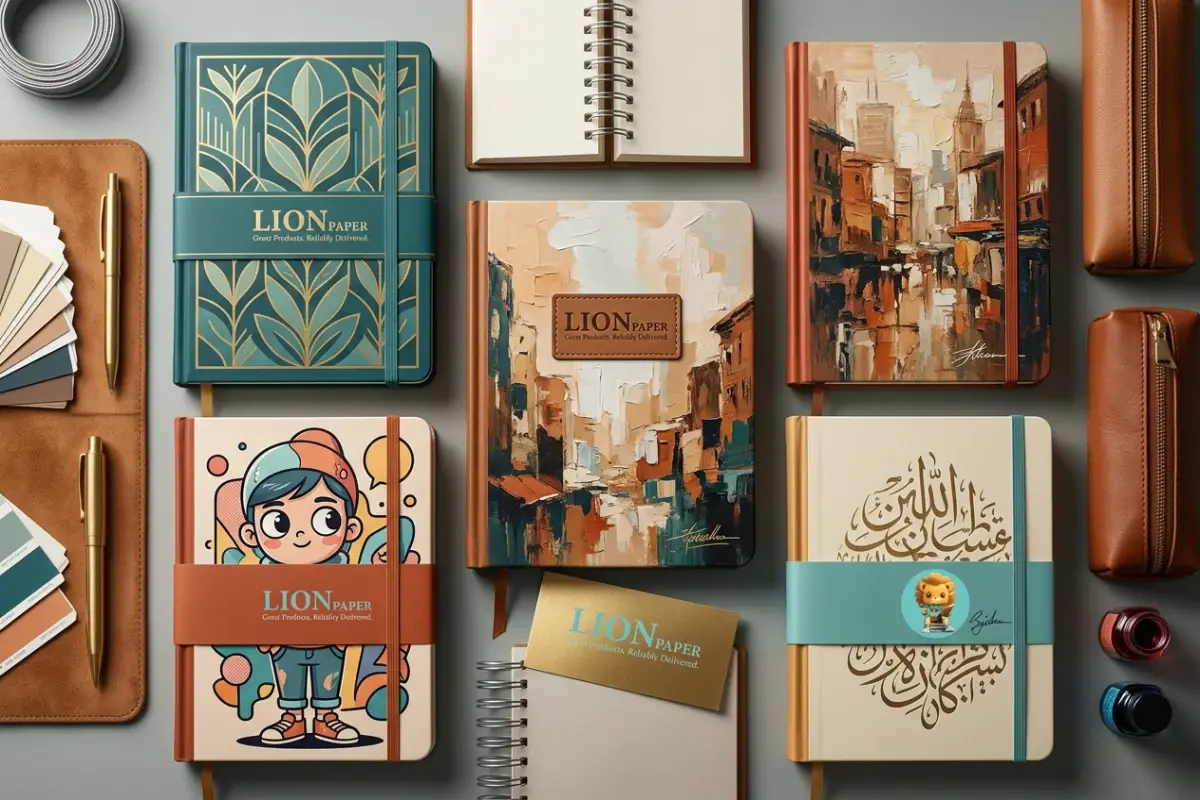
Engineering Multi-Artist Private Label Notebooks: Production, Color Fidelity, and Licensing Workflow

Manufacturing multi-artist private label notebooks requires a structured approval matrix that aligns disparate source artwork specs, calibrated color proofs, legal rights verification, and change control across diverse creative styles. Coordinating varied visual mediums into a cohesive stationery line demands standardized substrate selection, rigid prepress file conversion, and disciplined manufacturing execution to balance artistic integrity with commercial margins and retail delivery timelines.
What Are the Key Trade-Offs in Multi-Artist Private Label Notebook Sourcing?
Managing multi-artist private label notebooks introduces distinct supply chain complexities that differ significantly from single-artwork production runs. When a brand licenses artwork from multiple illustrators, painters, and graphic designers for a coordinated journal line, it must balance visual individuality against industrial standardization. Sourcing managers must evaluate four critical technical and economic trade-offs:
Standardized Formats vs. Variable Finishes: Standardizing outer trim dimensions (e.g., A5, 5.5 x 8.5 inches, or B5), binding methods, and text block papers across all artist editions allows batch production efficiencies. Conversely, customizing cover finishes (such as individual hot-stamping foils, debossing depths, or edge gilding) per artist increases visual differentiation but introduces additional tooling setups and prepress plate costs.
Color Uniformity Across Varied Media: Creative submissions range from vector graphics and digital illustrations to scanned watercolor washes and high-contrast oil paintings. Reconciling these media on a uniform coated or uncoated paper stock requires precise color management rather than relying on automated print-gang processes.
Consolidated Run Volumes vs. SKU Proliferation: High-volume single runs reduce unit costs through press speed and material yield. A multi-artist collection fragments total volume across multiple stock-keeping units (SKUs). Maintaining total-cost efficiency requires gang-printing common inner text blocks while batching cover production during sheetfed offset or hybrid digital-offset press runs.
Licensing Compliance vs. Lead Time Buffers: Unlike internal brand assets, collaborative notebook collections require tiered artist approvals at digital proof, wet proof, and pre-production sample (PPS) stages. Every validation gate adds lead-time variance that must be factored into factory production scheduling.
| Production Parameter | Single-Artist Standard Run | Multi-Artist Programmatic Run | Supply Chain Mitigation Strategy | | :--- | :--- | :--- | :--- | | | Core Text Block | Fixed paper stock, single rule/grid layout | Standardized 80–120 GSM FSC wood-free paper across all SKUs | Batch print consolidated text blocks; assemble with unique covers | | Cover Setup | Single set of CMYK printing plates and tooling | Multiple CMYK plate changes or digital offset arrays | Group artworks with shared CMYK tonal balances onto standardized press schedules | | Embellishment Tooling | Single foil/emboss die set | Unique magnesium or brass dies per artist signature/cover | Standardize die stamping positions to minimize press makeready adjustments | | Quality Sign-Off | Single internal review cycle | Multi-stakeholder review (Brand + Individual Artists) | Implement rigid prepress approval windows with defined delta-E color tolerance thresholds | | Packaging & Barcoding | Single master carton configuration and UPC | Multi-SKU carton assortments with artist-specific identifiers | Utilize variable-data inline labeling and pre-kitted retail display inner packs |

Rigid prepress color calibration and spectrophotometer measurements ensure artwork across different mediums matches physical proofs.
How Does a Multi-Artist Technical Approval and Specification Matrix Work?
A robust collaborative notebook prepress approval framework prevents costly re-runs and misaligned visual expectations. Because independent creators use varied design software, color profiles, and canvas resolutions, brand managers must establish strict intake specifications before files enter the factory engineering stage.
A standardized private label stationery licensing workflow starts with a digital intake gateway that converts diverse digital submissions into press-ready PDF/X-4 files. The following matrix governs every stage of technical submission and approval across multi-artist collections:
Resolution and Color Profile Standardization: All source raster art must meet a minimum of 300 to 450 DPI at 100% reproduction scale. Files submitted in RGB must be mapped to factory ICC profiles (such as GRACoL 2013 or ISOcoated v2) using calibrated rendering intents to preserve shadow detail and vibrant highlights.
Bleed, Wrap, and Hinge Allowances: Hardcover (casebound) notebooks require a minimum 18–20 mm wrap allowance and a 5 mm safety margin from board edges and hinge gutters. Softcover and Smyth-sewn flexi-bound books require 3 mm bleeds. Factory engineers supply dielines tailored to the exact board caliper and cover material.
Special Finish Vector Separation: Embellishments—such as hot foil stamping, blind debossing, selective spot UV, and glitter varnish—must be submitted on dedicated, vector-only spot color layers set to 100% solid overprint. Minimum line weights must not fall below 0.15 mm for foil stamping and 0.25 mm for multi-level embossing to prevent fill-in or bridge breaking during high-pressure stamping.
Spine Caliper Calculation and Layout Locking: Spine widths must never be estimated. The factory calculates spine bulk based on exact paper weight, caliper per page, page count, and binding technique (e.g., section-sewn hardcover with spine crash and headbands). Spines are dynamically generated and verified prior to dieline release to artists.
Three-Tier Approval Escalation Protocol:
Tier 1 (Brand QA): Verifies legal copyright lines, artist signature placement, UPC placement, and spine text alignment.
Tier 2 (Artist Soft Proof): Calibrated digital PDF approval for composition and layout positioning.
Tier 3 (Factory Physical Proof): Hard-copy GMG or wet proofs on actual production substrates for color, substrate tactile feedback, and embellishment accuracy.
How to Manage Prepress Proofing, Color Calibration, and Finish Verification Across Diverse Mediums?
Executing flawless multi-artwork journal printing requires an advanced color management system that eliminates subjectivity. Artistic media respond differently to commercial offset and digital presses. For example, luminous digital vector illustrations often exceed the CMYK color gamut, while delicate watercolor washes risk losing subtle tonal gradations if dot gain is not compensated during raster image processing (RIP).
Artist Source File (RGB/Vector/Media)
ICC Profile Conversion & RIP Screening (G7 Calibration) - > GMG Contract Proofing (Substrate-Matched) - > Spectrophotometer Validation (Delta-E < 2.0) - > Press Match & In-line Embellishment Execution
To achieve consistent color reproduction across diverse artworks, professional manufacturing facilities employ G7-certified calibration. Using spectrophotometers, press operators measure color targets against standardized ISO 12647-2 values. The factory establishes an acceptable color variation standard (typically Delta-E ≤ 2.0 for brand elements and Delta-E ≤ 2.5 for complex pictorial art).
Specialized techniques for specific artistic mediums include:
Scanned Watercolors and Gouache: Require stochastic (FM) screening or high-definition hybrid screening (2400 DPI engine / 200+ LPI) to eliminate rosette moiré patterns and maintain smooth transitions in light pastel washes.
High-Gamut Digital Art: Artworks containing fluorescent highlights or deep cobalt blues cannot be reproduced via standard 4-color process alone. In such cases, licensed artist notebook manufacturing may integrate expanded gamut printing (CMYK + Orange/Green/Violet) or dedicated Pantone Matching System (PMS) spot-color stations.
Textured and Dark Substrates: When applying multi-artist illustrations onto cloth, bookcloth, recycled kraft, or tinted vegan leather, an opaque white base coat (screen-printed or UV-cured) must be laid down before color application to prevent substrate bleed-through from muddying the artist's palette.
Tactile and Reflective Finishes: To protect delicate printed artworks while enhancing tactile appeal, covers receive matte anti-scratch thermal lamination, velvet soft-touch film, or scuff-resistant water-based varnishes prior to hot-stamping or spot UV application.

Automated casing-in and precision stamping maintain consistent margins and hinge alignment across diverse cover designs.
How Does China–Cambodia Dual-Site Synergy Execute Coordinated Multi-Artist Collection Launches?
Managing multi-artist notebook collections requires balancing rapid, agile product development with low-cost, high-capacity mass manufacturing. Operating a dual-base manufacturing infrastructure—combining a specialized development and prototyping center in Jiaxing, China, with a large-scale mass production hub in Cambodia—provides brand owners with maximum flexibility and risk mitigation.
In this integrated model, the Jiaxing facility serves as the engineering, sampling, and rapid-iteration hub. Covering 3,000 square meters, the Chinese center manages direct artist dieline integrations, complex color proofing, structural mockups, and accessory sourcing (such as customized ribbon bookmarks, magnetic closures, elastic bands, and custom gilded page edges). High-touch sampling and fast-turnaround pilot runs allow brand managers to review physical proofs within days, securing timely artist and licensor sign-offs.
Once pre-production samples (PPS) and digital print masters receive sign-off, volume manufacturing shifts seamlessly to the 10,000-square-meter Cambodia production facility. This dual-site synergy delivers specific commercial and operational advantages:
Total-Cost and Tariff Efficiency: Cambodia manufacturing offers competitive labor structures and favorable tariff positioning for North American and European markets, reducing landed costs on large-scale retail notebook programs.
Mass Volume Output: With automated casing-in lines, high-speed folding machines, automated Smyth-sewing arrays, and multi-station packaging equipment, the Cambodian facility produces over 5 million notebooks annually.
Standard Operating Procedures (SOPs): Both facilities operate under unified technical SOPs, ISO 9001 quality controls, and identical AQL sampling protocols. This ensures that a proof approved in Jiaxing is matched on the production floor in Cambodia.
Flexible Scaling: Emerging brands and small-batch capsule collections can utilize flexible China-based runs for market testing, transitioning smoothly to Cambodia as SKU volumes scale into hundreds of thousands of units.
| Launch Phase | Operational Location | Core Activities & Deliverables | Standard Turnaround | | :--- | :--- | :--- | :--- | | | Phase 1: Prepress & Prototyping | Jiaxing Hub (China) | File verification, ICC profiling, substrate matching, physical GMG color proofs, and blank structural mockups | 3–7 business days | | Phase 2: Licensor / Artist PPS Sign-Off | Brand HQ / Remote Artists | Review of physical finished samples with embellishments, belly bands, and packaging | 5–10 business days | | Phase 3: Material Scaling & Mass Production | Cambodia Mass Facility | FSC-certified paper sourcing, large-format offset printing, binding, casing-in, and inline quality control | 25–35 business days | | Phase 4: Retail-Ready Assembly & Export | Cambodia Mass Facility | Automated shrink-wrapping, artist bio barcode labeling, master carton packing, palletization, and global logistics dispatch | 5–7 business days |
What Is the Essential RFQ Checklist for Licensing and Brand Development Managers?
To ensure an accurate and competitive Request for Quote (RFQ) for multi-artist notebook programs, sourcing managers and brand licensing directors must provide precise technical requirements. Incomplete RFQ documentation frequently leads to miscalculated tooling costs, inaccurate yield estimates, and production delays.
RFQ Submission Checklist:
SKU Matrix (Quantities per artist, total collection volume)
Physical Dimensions (Trim size, page count, binding type)
Material Specifications (Cover substrate, board weight, text paper GSM/FSC)
Embellishment Details (Foil surface area, emboss depth, spot UV)
Packaging Requirements (Artist belly bands, shrink-wrap, display cartons)
Compliance Framework (FSC, SMETA, CPSIA, Prop 65)
Ensure your procurement documentation addresses these specific production parameters:
Collection SKU Architecture: Clearly define the total volume broken down by individual artist SKU (e.g., 20,000 total units divided across 4 artist designs at 5,000 units each). Indicate whether inner text blocks share common ruling (lined, dot grid, or blank) or require unique artist illustrations on divider pages.
Substrate & Environmental Compliance: Specify inner text paper stock (e.g., 100 GSM or 120 GSM FSC-certified wood-free paper, fountain-pen friendly, bleed-resistant) and cover materials (e.g., 157 GSM art paper over 2.0 mm / 2.5 mm greyboard, PU leather, or recycled cotton bookcloth). Identify necessary compliance certifications, such as FSC Chain of Custody, SMETA social compliance, ISO 9001, CPSIA, or FAMA.
Embellishment and Tooling Specifications: Quantify the surface area and technique for each finish across all covers. State whether hot-stamping foil uses standard metallic, holographic, or matte pigment foils, and specify whether embossing requires single-level magnesium or 3D multi-level sculpted brass dies.
Value-Added Accessories: Detail any accessory integrations, such as Pantone-dyed elastic closure bands, 15 mm ribbon markers with custom printing, expandable gusseted back pockets, or custom-printed endpapers featuring artist biographies.
Retail Packaging and Kitting: Define packaging configurations, including scannable individual UPC barcode stickers, artist biography belly bands (with specific paper weight and sealing glue points), individual protective polybags or shrink-wrapping, retail-ready countertop displays (CDUs), and export palletization standards.

Retail-ready packaging, standardized spine dimensions, and barcode kitting facilitate streamlined multi-SKU retail distribution.
If you are planning an upcoming collaborative stationery launch, submit your project details to consult with our engineering team on custom journal manufacturing. Include your artwork briefs, rights-clearance status, target retail channels, and estimated volume per SKU to receive a comprehensive technical review, dieline templates, and cost-optimized production proposals.
Frequently Asked Questions About Multi-Artist Notebook Manufacturing
How are intellectual property and unreleased artist designs protected during production?
Factories operating under professional compliance frameworks enforce strict non-disclosure agreements (NDAs) and secure digital asset protocols. Digital artwork files are stored on role-restricted internal servers accessible only by authorized prepress technicians. Physical proofs, misprints, and makeready waste sheets containing licensed creative assets are logged, shredded, and recycled under controlled supervision to prevent unauthorized distribution or leaks before market launch.
Can we combine multiple artist designs into a single production run to reduce MOQs?
Yes. Sourcing multi-artist private label notebooks allows brands to consolidate production runs by keeping inner text block specifications, physical dimensions, and binding methods identical across the collection. The factory can gang-print covers or batch sheetfed offset press runs, allowing brands to order lower minimum quantities per individual artist design (e.g., 1,000 to 2,000 units per artwork) while meeting the aggregate production threshold required for volume pricing.
How do we handle edge printing or gilded edges across multiple artworks?
Edge treatments—such as metallic foil edge gilding, solid PMS spray edges, or 3-edge digital pattern spraying—can be customized per SKU or standardized across the entire collection. When executing individual digital edge printing featuring artist patterns, high-precision alignment jigs and automated book clamp systems ensure that the sprayed motif aligns with the cover design without ink bleeding into the interior pages.
What is the typical lead time for sampling and mass-producing a multi-artist journal line?
Development and physical proofing in the rapid prototyping hub (Jiaxing) typically take 7 to 12 business days, depending on the complexity of embellishments and custom color matching. Once all artist sign-offs and master pre-production samples are completed, volume mass manufacturing at the Cambodia facility requires approximately 30 to 45 calendar days, followed by ocean logistics to North American or European destination ports.
FAQ
How are intellectual property and unreleased artist designs protected during production?
Factories operating under professional compliance frameworks enforce strict non-disclosure agreements (NDAs) and secure digital asset protocols. Digital artwork files are stored on role-restricted internal servers accessible only by authorized prepress technicians. Physical proofs, misprints, and makeready waste sheets containing licensed creative assets are logged, shredded, and recycled under controlled supervision to prevent unauthorized distribution or leaks before market launch.
Can we combine multiple artist designs into a single production run to reduce MOQs?
Yes. Sourcing multi-artist private label notebooks allows brands to consolidate production runs by keeping inner text block specifications, physical dimensions, and binding methods identical across the collection. The factory can gang-print covers or batch sheetfed offset press runs, allowing brands to order lower minimum quantities per individual artist design (e.g., 1,000 to 2,000 units per artwork) while meeting the aggregate production threshold required for volume pricing.
How do we handle edge printing or gilded edges across multiple artworks?
Edge treatments—such as metallic foil edge gilding, solid PMS spray edges, or 3-edge digital pattern spraying—can be customized per SKU or standardized across the entire collection. When executing individual digital edge printing featuring artist patterns, high-precision alignment jigs and automated book clamp systems ensure that the sprayed motif aligns with the cover design without ink bleeding into the interior pages.
What is the typical lead time for sampling and mass-producing a multi-artist journal line?
Development and physical proofing in the rapid prototyping hub (Jiaxing) typically take 7 to 12 business days, depending on the complexity of embellishments and custom color matching. Once all artist sign-offs and master pre-production samples are completed, volume mass manufacturing at the Cambodia facility requires approximately 30 to 45 calendar days, followed by ocean logistics to North American or European destination ports.


Comments