


Mixed SKU Stationery Pallets: Engineering, Packing Plans, and Logistics Optimization

Mixed SKU stationery pallets require structured tier-by-tier weight distribution, standardized outer carton modularity, and multi-panel barcode labeling to prevent carton compression, balance container payload, and eliminate warehouse receiving discrepancies. Consolidating high-density notebooks, delicate gift packaging, and varied stationery accessories onto unified shipping platforms demands calculated load plans that protect paper integrity while maximizing freight volume efficiency.
What Are the Core Challenges in Consolidating Mixed SKU Stationery Orders?
Consolidating diverse stationery products onto unified pallets introduces mechanical and inventory vulnerabilities that do not exist in single-SKU unit loads. Stationery items vary significantly in density, rigidness, and outer carton dimensions. A master carton filled with wire-bound hardcover journals can weigh upwards of 18 kg with a high volumetric density, whereas master cartons holding desktop organizers, sticky notes, or seasonal gift bags are significantly lighter and more susceptible to top-load crushing.
When cross-category stationery orders are packed haphazardly, several supply chain failure points emerge:
Crush Damage from Density Mismatches: Heavy items stacked on top of structural hollows compress lower carton fluting, causing side-panel buckling and core product distortion.
Stack Instability and Transit Shifting: Variations in carton footprints create irregular interlocking patterns, resulting in overhang, internal gaps, and load shifting during intermodal transit.
Receiving Bottlenecks: Distribution centers scanning incoming freight struggle with mixed pallets that lack clear tier-level segregation or visible outward-facing identifier labels.
Unbalanced Freight Payloads: Improper container cube optimization paper goods planning leads to either blown container weight limits or excessive underutilized volumetric space.
To mitigate these risks, brand owners and procurement teams must implement a structured multi-SKU pallet loading plan before factory palletization begins.
How Should Carton Stacking Hierarchy Be Structured to Manage Weight and Compression Limits?
Carton stacking hierarchy must follow a strict heavy-to-light, dense-to-fragile vertical profile. The foundational principle of stationery carton stacking strength depends on aligning the vertical fluting of corrugated cases directly over one another while respecting the McKee formula for Box Compression Test (BCT) thresholds.
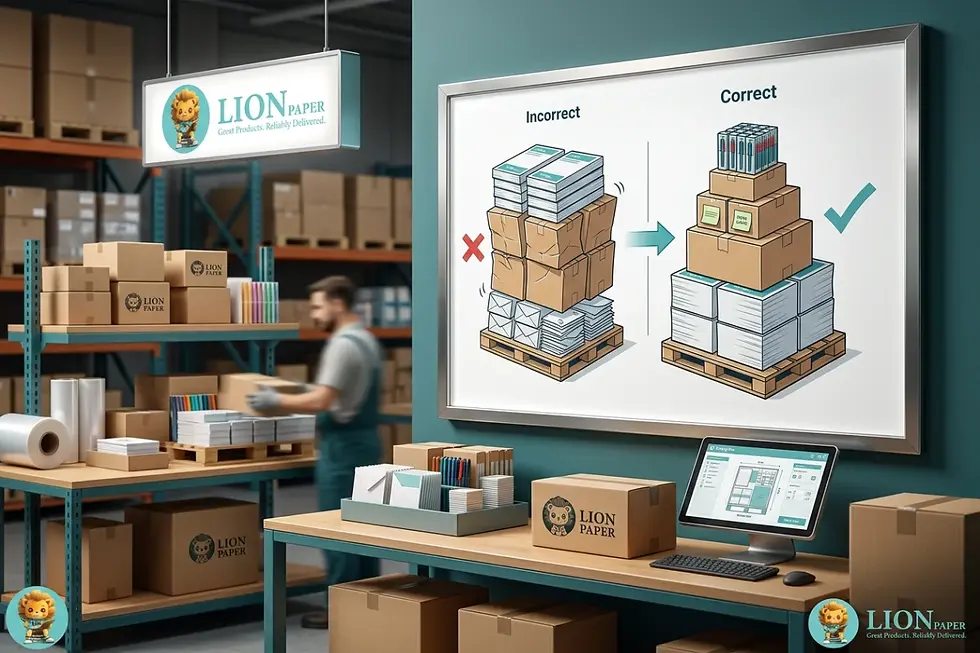
Proper carton stacking hierarchy protects structural integrity across mixed stationery SKUs.
Paper goods exhibit high static mass but low internal structural resistance once master cartons buckle. Therefore, pallet tiers must be categorized by product structural classes:
Tier Level | Product Category | Average Density | Recommended Corrugated Spec | Compression Vulnerability |
|---|---|---|---|---|
:--- | :--- | :--- | :--- | :--- |
Tier 1 (Base Layers) | Hardcover Notebooks, Daily Planners, Desk Calendars | High (>450 kg/m³) | Double-wall 5-ply (BC/EB Flute), 44+ ECT | Low (Self-supporting core) |
Tier 2 (Mid Layers) | Softcover Journals, Spiral Notebooks, Filing Folders | Medium (300-450 kg/m³) | Heavy single-wall or 5-ply, 32-40 ECT | Moderate (Spine deformation risk) |
Tier 3 (Upper-Mid) | Memo Pads, Pen Sets, Sticky Note Collections | Medium-Low (200-300 kg/m³) | Single-wall (B/C Flute), 32 ECT | Moderate |
Tier 4 (Top Layers) | Gift Boxes, Paper Bags, Pouches, Decorative Accessories | Low (<200 kg/m³) | Single-wall (E/B Flute) or Retail Rigid Boxes | Critical (Crush-prone structures) |
Master cartons placed in bottom tiers must maintain an edge crush test (ECT) rating calculated to withstand dynamic transit loads—typically 1.5 to 2.0 times the static top weight when accounting for humidity and long-haul ocean vibrations. Corrugated corner boards (minimum 3 mm to 5 mm thickness) must run full-height from the pallet deck to the top tier to transfer vertical downward force directly to the pallet stringers or blocks.
What Layer Planning and Pallet Patterns Ensure Multi-SKU Product Stability?
Achieving physical stability across mixed SKU stationery pallets requires modular footprinting. When cartons of different dimensions are loaded on a standard 48x40 inch (GMA/North America) or 1200x800 mm (Euro pallet) platform, standard column stacking cannot always be maintained. Supply chain managers must utilize interlocking brick patterns or modular carton sub-multiples.
Standard GMA Pallet Base: 48" x 40" (1200mm x 1000mm) Ideal Modular Master Carton Footprints:
Form Factor A: 16" x 12" (400mm x 300mm) -> 10 cartons/tier (Interlocked)
Form Factor B: 20" x 13.3" (500mm x 333mm) -> 6 cartons/tier (Interlocked)
Form Factor C: 24" x 16" (600mm x 400mm) -> 5 cartons/tier (Modular Grid)
When master cartons share identical footprint dimensions across different SKUs (e.g., planners and notebooks packed in standardized 400x300 mm outers), layer stability is maximized. However, when carton dimensions inevitably differ across accessory lines and paper products, tier dividers must be introduced.
To lock irregular tiers together:
Corrugated Slip Sheets: Insert a 200–250 gsm kraft slip sheet or single-wall corrugated pad every 2 to 3 vertical tiers. This creates a flat secondary base, preventing smaller cartons from falling into gaps between larger lower cartons.
Zero-Overhang Rule: Master cartons must never overhang the pallet deck edges. An overhang of just 1 inch (25 mm) can reduce carton compression strength by over 20% to 30%.
Cross-Stack Interlocking: Switch the rotational orientation of cartons between Tier N and Tier N+1 where carton dimensions permit, avoiding continuous vertical seams.
Edge Protection and Automated Stretch Wrapping: Apply rigid V-boards to all four vertical corners. Use machine-applied stretch wrap with 200–250% pre-stretch, applying a minimum of 3 bottom wraps, 2 middle spiral layers, and 3 top wraps that physically anchor the bottom tier to the wood or plastic pallet base.
What Labeling and Barcoding Protocols Prevent Warehouse Receiving Discrepancies?
Distribution centers and 3PL facilities frequently incur processing delays and inventory errors when checking in mixed-SKU pallets. Without explicit outward-facing visual and digital indicators, warehouse personnel must de-palletize entire shipments to identify inner master cartons.

Multi-panel GS1 labels and packing manifests streamline 3PL and warehouse intake.
Compliant warehouse receiving pallet labels must provide dual-layer visibility: Master Unit Load level and Carton level.
Every mixed pallet requires:
Prominent "MIXED SKU PALLET" Warning Placards: High-contrast, fluorescent or bold placards placed on all four pallet faces indicating that the load contains multiple distinct part numbers.
GS1-128 / SSCC Master Labels: Serial Shipping Container Code (SSCC) labels positioned on at least two adjacent sides (ideally front and right) at a height between 400 mm and 800 mm from the pallet base. The SSCC links directly to the Advanced Shipping Notice (ASN) electronic data interchange (EDI) feed, detailing exact SKU quantities by layer.
Pallet Manifest Slip Sheet: A clear plastic pouch affixed to the primary pallet face containing a line-by-line packing list detailing SKU descriptions, item codes, master carton counts, units per carton, total units, and gross weights.
Carton-Level Barcode Visibility: Cartons on the pallet perimeter must be arranged so their respective GS1/UPC/ITF-14 barcodes face outward through the transparent stretch film for handheld RF scanning without unpacking.
Implementing strict pallet map manifests ensures that warehouse intake scanners process mixed stationery shipments with the same dock-to-stock speed as single-SKU full pallet loads.
How Can Container Cube Optimization Be Achieved for Mixed Multi-Product Shipments?
Optimizing container payloads for custom paper goods requires balancing volumetric cube utilization against ocean container gross weight limits. Paper products—such as case-bound journals, thick memo pads, and multi-ring binders—are inherently dense. Loading full containers with solid notebook pallets often breaches maximum road and rail weight regulations long before the container's interior cubic capacity is filled.
Conversely, light accessory items like empty organizer bags, desktop organizers, and gift boxes consume volume without approaching payload weight limits.

Strategic weight and cube optimization in ocean containers for mixed stationery shipments.
By systematically pairing complementary product categories, logistics planners can achieve complete container cube optimization paper goods efficiency:
Container Cube & Weight Balance Formula: Total Shipment Mass = (Notebook/Planner Weight) + (Gift Box/Pouch Weight) <= Max Container Payload Total Shipment Cube = (Notebook/Planner Cube) + (Gift Box/Pouch Cube) -> Approaching 85-92% Container Volume
Container Type | Maximum Payload Limit | Usable Internal Volume | Heavy Stationery Strategy (Notebooks Only) | Balanced Mixed Strategy (Paper + Accessories) |
|---|---|---|---|---|
:--- | :--- | :--- | :--- | :--- |
20' Standard Dry | ~21,500 kg – 24,000 kg | ~28 – 30 CBM | Hits weight limit at ~20-22 CBM (Dead volume wasted) | Fills 28 CBM by mixing 70% paper goods with 30% light gift packaging |
40' High Cube (HC) | ~26,000 kg – 28,000 kg | ~65 – 68 CBM | Exceeds road weight limits at ~40 CBM | Fills 65 CBM by layering heavy paper bottom tiers with lightweight organizer bags on top tiers |
Integrated supply chains leveraging multi-site coordination can stage high-density notebook lines alongside lightweight gift packaging and stationery accessories, engineering mixed shipments that maximize both the container weight envelope and total usable volume.
What Quality Control and Packaging Specifications Should Brands Mandate?
To ensure flawless execution, brand procurement and supply chain managers must translate mixed pallet requirements into contractual packaging SOPs and RFQ specifications. Factory teams must follow verifiable standard operating procedures from carton packing to loading docks.
Mandatory quality control benchmarks include:
ISTA 3A / 1A Vibration and Drop Verification: Pre-shipment laboratory testing of complete mixed-tier pallet mockups to verify that lower double-wall cartons resist dynamic vibration without edge crushing or tape failure.
AQL Inspection on Outer Packaging: AQL 1.0/2.5 inspection standards applied to carton tape integrity, glue joint bonding, strapping tension, and corner board placement before wrapping.
Standardized Pallet Base Quality: Mandating Grade-A wooden GMA 4-way entry pallets (heat-treated to ISPM 15 standards) or heavy-duty recyclable plastic pallets with zero protruding nails or broken stringers.
Moisture and Climate Barrier Controls: For long-haul ocean routes, pallets must incorporate silica gel desiccant packs inside master cartons and a polyethylene top-cap sheet under the outer stretch wrap to prevent maritime humidity absorption and corrugated softening.
Lion Paper Products (Jiaxing) Co., Ltd. operates an integrated supply-chain model across its 3,000 m² Jiaxing design and prototyping center and its 10,000 m² Cambodia high-volume production facility. Manufacturing over 5 million notebooks annually alongside planners, office stationery, bags, organizers, and luxury packaging, Lion Paper integrates end-to-end design-to-manufacturing quality controls. Operating under ISO 9001, FSC, SMETA, and WCA frameworks, Lion Paper provides global brands, retailers, and online merchants with agile manufacturing, precise packaging engineering, and dependable container loading plans.
Share your carton dimensions, gross weights, SKU distribution, and warehouse receiving requirements with Lion Paper for a comprehensive pallet and container-loading review.
Frequently Asked Questions
How many different SKUs can safely be consolidated onto a single mixed pallet?
While there is no strict theoretical limit, logistics best practices recommend consolidating no more than 4 to 8 distinct SKUs per mixed pallet. Exceeding 8 SKUs increases receiving complexity, requires excessive carton sorting, and makes perimeter barcode scanning difficult for warehouse intake teams.
What is the ideal pallet height for mixed-SKU ocean freight shipments?
For standard 40-foot High Cube (HC) ocean containers, the optimal pallet height is between 44 inches (1118 mm) for double-stacked pallet configurations, or up to 86–88 inches (2184–2235 mm) for single tall pallets, leaving a minimum 4-to-6-inch clearance below the container roof to prevent transit scraping.
How do moisture and humidity affect carton stacking strength during ocean transit?
Corrugated paper absorbs airborne moisture in high-humidity maritime environments, which can reduce ECT carton stacking strength by 30% to 50%. Using water-resistant adhesives, double-wall virgin kraft liners, desiccant packs, and waterproof pallet top-sheets prevents carton fatigue and pallet collapse during transit.
FAQ
How many different SKUs can safely be consolidated onto a single mixed pallet?
While there is no strict theoretical limit, logistics best practices recommend consolidating no more than 4 to 8 distinct SKUs per mixed pallet. Exceeding 8 SKUs increases receiving complexity, requires excessive carton sorting, and makes perimeter barcode scanning difficult for warehouse intake teams.
What is the ideal pallet height for mixed-SKU ocean freight shipments?
For standard 40-foot High Cube (HC) ocean containers, the optimal pallet height is between 44 inches (1118 mm) for double-stacked pallet configurations, or up to 86–88 inches (2184–2235 mm) for single tall pallets, leaving a minimum 4-to-6-inch clearance below the container roof to prevent transit scraping.
How do moisture and humidity affect carton stacking strength during ocean transit?
Corrugated paper absorbs airborne moisture in high-humidity maritime environments, which can reduce ECT carton stacking strength by 30% to 50%. Using water-resistant adhesives, double-wall virgin kraft liners, desiccant packs, and waterproof pallet top-sheets prevents carton fatigue and pallet collapse during transit.


Comments