


Comprehensive Guide to Mechanical Pencil Lead Refill Packaging: Quality Standards, Structural Integrity, and Retail Testing

Mechanical pencil lead refill packaging requires rigorous impact resistance, secure closure retention, and retail-ready tamper evidence to prevent graphite breakage and container cracking across transit and merchandising. Reliable packaging balances rigid polymer tubes or recyclable paperboard sleeves with protective blister cards, ensuring tight dispensing tolerances, moisture resistance, and drop protection that safeguard high-fragility 0.2 mm to 0.9 mm polymer graphite leads from factory assembly to end-user retail shelves.
What Are the Critical Quality Risks in Mechanical Pencil Lead Refill Packaging?
High-polymer mechanical pencil leads present unique structural packaging challenges due to their high aspect ratio, brittle ceramic-graphite crystalline matrix, and susceptibility to shear fractures. When engineering mechanical pencil lead refill packaging, packaging engineers must resolve five distinct vulnerability zones that cause customer returns, inventory write-offs, and automated retail distribution rejections.
Dynamic Shock and Harmonic Transit Vibration: Fine graphite leads (specifically 0.2 mm, 0.3 mm, 0.5 mm, and 0.7 mm grades) fracture under sustained micro-vibrations during maritime freight, rail transit, and parcel distribution networks. If internal cavity clearance allows longitudinal rattling, lead cores strike the end-caps repeatedly, creating internal powdered debris, micro-cracks, and segmented fractures that ruin delicate advancing mechanisms inside the pencil clutch assembly.
Cap Dislodgement and Dispenser Creep: Sliding, rotating, or flip-top caps on injection-molded lead cases can experience friction loss under continuous transportation vibration or elevated warehouse storage temperatures exceeding 40°C. This relaxation causes cap pop-off and catastrophic lead spills within multi-packs, inner sleeves, or corrugated master cartons.
Brittle Case Fracture and Low-Temperature Stress Cracking: Low-cost polymer formulations using unconditioned crystal general-purpose polystyrene (GPPS) crack upon mild drop impacts or flexural loads, especially at ambient transit temperatures below 5°C. Fractured containers expose delicate graphite contents to moisture, crushing forces, and irreversible physical contamination.
Static Charge Accumulation and Graphite Dust Adhesion: Electrostatic charges on untreated clear plastic tubes attract microscopic graphite dust particles to interior transparent walls. This obscuring film diminishes lead quantity visibility, creates a soiled appearance, and significantly degrades retail shelf aesthetics and consumer perception.
Moisture Penetration and Resin Binder Degradation: Sustained high-humidity environments soften specialized water-soluble or polymer-binding matrices in economy and drafting leads. This softening leads to surface sticking, core clumping, and premature jamming inside fine metallic lead chuck mechanisms when primary dispensers lack adequate atmospheric barriers.
Failure Mode | Root Cause in Packaging Design | Physical Consequence | Corrective Packaging Measure |
|---|---|---|---|
:--- | :--- | :--- | :--- |
Internal Core Breakage | Excessive clearance in tube interior cavity | Multi-point graphite fracture under transit vibration | Internal shock-absorbing ribbing or elastomeric end-cushions |
Cap Pop-Off | Insufficient interference fit or thermal expansion mismatch | Leads discharge inside blister cavity or carton | Positive detent snap-locks and ultrasonic spot welds on tamper seals |
Blister Card Delamination | Inadequate heat-seal coating weight or dwell time | Refill tube falls out of retail hanging card | Calibrated adhesive coat weight (6–8 gsm) and matched blister varnishes |
Container Crazing | Excessive internal molded-in stress in PS/SAN resin | Micro-cracks appear under impact or drop shock | Switch to clarified Polypropylene (PP) or impact-modified SAN |
Dispensing Gate Jam | High tooling flash on injection molded dispensing orifice | Leads cannot exit smoothly one-by-one | Precision EDM gating and 100% optical sensor dimension sorting |

Structural drop testing and transit vibration simulations confirm mechanical pencil refill packaging standards.
What Are the Essential Packaging Standards and Physical Test Protocols for Refill Packs?
To ensure commercial viability across high-volume retail chains, stationery products must comply with verified mechanical pencil refill packaging standards. These international standards specify transit simulation, structural resilience, environmental conditioning, and mechanical cycling to prevent failures before freight release.
Standardized verification relies on established international ASTM and ISTA protocols, paired with specialized stationery refill blister pack testing routines designed specifically for fragile micro-components.
Transit and Environmental Simulation Protocols
ISTA 2A / 3A Distribution Testing: Master cartons containing individual blister-packed lead refills undergo pre-conditioning at 23°C and 50% relative humidity, followed by extreme atmospheric cycling (-29°C to 60°C). Cartons are subjected to random vibration spectra between 1.05 Grms across three axes and sequential drop sequences from heights between 760 mm and 1000 mm depending on gross master weight.
Free-Fall Drop Test for Primary Tubes (ISO 2248 / ASTM D5276): Standalone filled lead dispensers are dropped from a height of 1.2 meters onto polished concrete across six specific orientations: flat base, top cap, side profile, and three critical corner angles. Post-drop acceptance criteria mandate zero external cracks, zero dislodgement of the dispensing cap, and no more than one fractured lead core out of a standard 12-to-40 piece refill payload.
Cyclic Temperature and Humidity Chamber Exposure: Packaged blisters undergo 72 hours of cyclic environmental testing alternating between 45°C with 90% relative humidity and -10°C ambient dry cold. This process confirms heat-seal adhesive integrity, blister card flatness without warping, barrier blister film optical clarity, and dimensional stability of polypropylene dispensing sleeves.
Mechanical Integrity and Dispenser Performance Testing
Blister Flange Seal Peel Strength (ASTM F88): Heat-sealed transparent PVC, PET, or rPET blister covers bonded to clay-coated Solid Bleached Sulfate (SBS) paperboard backcards must demonstrate consistent peel strength between 1.8 N/cm and 3.5 N/cm. Seals must produce continuous fiber-tear across the paperboard rather than clean adhesive detachment, ensuring tamper evidence and shelf security.
Cap Torque and Push-Pull Detent Retention: Sliding dispensers, twist caps, and flip-top lids are tested across 100 continuous operational opening and closing cycles. Actuation force must remain within an ergonomic operating window of 3.5 N to 8.0 N. Retention forces below 2.0 N fail due to accidental self-opening risk during transit, while forces exceeding 10.0 N fail for consumer usability.
Hang-Tab Tensile and Tear-Out Resistance: Die-cut Euro-slots and delta hang-holes on retail blister backer cards undergo a continuous 15 N static hanging load for 48 hours at 40°C to simulate dense retail display rack environments, followed by a dynamic pull-force test to failure where a minimum tensile threshold of 35 N is required without board tear.
Test Parameter | Target Benchmark | Standard Reference | Acceptance Threshold |
|---|---|---|---|
:--- | :--- | :--- | :--- |
Seal Peel Adhesion | 1.8 to 3.5 N/cm | ASTM F88 | 100% fiber tear of paperboard backing |
Single-Unit Drop Test | 1.2 m onto concrete | ISO 2248 / ASTM D5276 | Zero cap loss; zero container breakage |
Master Pack Vibration | 1.05 Grms random 180 min | ISTA 3A / ASTM D4728 | Lead core breakage rate < 2.5% of total payload |
Dispenser Cycle Life | 100 continuous actuations | Internal Lion Standard QC | Retention force maintained within 3.5–8.0 N |
Hang Tab Tear Strength | > 35 N tensile pull | TAPPI T 839 / ASTM D828 | No tearing or delamination of card core |
How Do Defect Criteria and AQL Checkpoints Apply to Lead Refill Tubes?
High-precision pencil lead refill tube quality control depends on structured quality metrics administered via international sampling frameworks such as ISO 2859-1 (ANSI/ASQ Z1.4). Quality inspection teams evaluate physical dimensions, optical properties, operational functionality, and packaging hygiene across raw materials, inline molding, and outbound packaging.
Applying standardized lead refill container defect criteria ensures uniform sorting across automated high-speed injection lines and manual secondary pack-out operations.
Defect Classification Matrix
Critical Defects (AQL 0.0):
Presence of sharp plastic burrs, jagged parting lines, or glass-like micro-shards on container edges posing cutting risks to users.
Chemical contamination, heavy machine oil residue, or toxic mold inside lead holding chambers.
Non-compliant heavy metal, phthalate, or monomer content in raw plastic compounds violating CPSIA, RoHS, REACH, or EN 71 safety thresholds.
Major Defects (AQL 1.0):
Broken, loose, cracked, or missing dispenser caps leading to spontaneous product discharge under normal handling.
Incorrect lead grade, hardness, or diameter printed on the outer tube or card (e.g., labeled 0.5 mm HB, but loaded with 0.7 mm 2B).
Incomplete blister heat seal resulting in an unbonded edge perimeter greater than 3.0 mm.
Severe internal lead fragmentation exceeding 5.0% broken graphite rods during baseline incoming acceptance sampling.
Barcodes or 2D serialization codes failing to scan under standard ISO/IEC 15416 verification with an ANSI grade lower than 'B'.
Minor Defects (AQL 2.5 to 4.0):
Superficial scuffs, minor mold flow lines, or light gate vestige under 0.8 mm on non-functional exterior surfaces.
Printing registration shifts on the tube barrel or blister backer card between 0.5 mm and 1.0 mm.
Slight color deviation (Delta E between 2.0 and 3.5) compared against approved master Pantone swatches.
Minor cosmetic dust or static powdering on interior plastic walls that does not hinder product functionality.
Quality Control Sampling and Inline Inspection Flow
Inspection teams maintain structured checkpoints throughout the production progression to catch deviations early:
Phase 1: Raw Material & Resin Verification: Granular polymer purity checks, anti-static additive ratio confirmation, and paperboard moisture level testing (target 5.5% to 7.0%).
Phase 2: Tooling & Cavity Dimension Inspection: First Article Inspection (FAI) after mold warm-up verifying orifice tolerances within +/- 0.05 mm using optical coordinate measuring machines.
Phase 3: Automated Lead Loading & Optical Counting: Optical vision sensors count graphite leads per chamber and detect broken lead fragments prior to capping.
Phase 4: Cap Assembly & Torque Fit Check: In-Process Quality Control (IPQC) sampling at four-hour intervals to verify detent snap action, sliding resistance, and weld integrity.
Phase 5: Blister Card Heat-Seal Integrity: Peel adhesion and fiber-tear verification under calibrated heat-sealing pressure, temperature, and dwell timers.
Phase 6: Master Pack Out & Final Drop Simulation: General Inspection Level II Final Pre-Shipment Inspection (PSI) assessing master carton integrity, barcoding, and transit drop resistance.

Rigorous pencil lead refill tube quality control ensures flawless cap retention and zero injection-molding defects.
Which Materials and Formats Deliver Optimal Retail Readiness and Sustainability?
Balancing retail presentation, structural protection, and corporate ESG objectives requires matching primary refill containers with high-efficiency secondary retail packaging formats. As global packaging legislation evolves across North America, the European Union, and Australasia, stationery brands are transitioning toward lightweight plastics, post-consumer recycled resins (PCR), and plastic-free paperboard solutions.
Primary Lead Container Construction Profiles
Clarified Polypropylene (PP) Homopolymer: The industry standard for precision lead tubes. Provides exceptional living-hinge capabilities, strong chemical resistance, low density, and superior crack-resistance during drop impacts. Clarified PP delivers over 85% light transmission, displaying lead reserves clearly while maintaining impact toughness across diverse climates.
High-Impact Polystyrene (HIPS) / SAN Blends: Selected when ultra-clear transparency, scratch resistance, and rigid glass-like aesthetics are required for executive gift sets. Blends incorporate specialized impact-modifier additives (such as SBS block copolymers) to eliminate brittle shattering during cold-weather transit.
Rigid Paperboard Tubes with Biodegradable Sliding Caps: Sustainable primary dispensers manufactured from spirally wound Kraft paperboard or heavy FSC-certified unbleached virgin paperboard. Equipped with injection-molded polylactic acid (PLA) or molded cellulose fiber caps, this format eliminates single-use petroleum plastics while delivering vertical compressive crush strength exceeding 80 N.
Secondary Packaging Formats and Display Configurations
Face-Seal Thermoformed Blister Cards: Standard consumer packaging consisting of an 0.25–0.35 mm rPET blister sealed directly to an FSC-certified 350–400 gsm SBS paperboard card. Delivers 360-degree product visibility, tamper deterrence, and universal pegboard hang-tab compatibility.
Trapped Blister / Sandwich Paperboard Cards: The refill container is captured between two laminated layers of die-cut paperboard, with only the thermoformed profile protruding through the front window aperture. This format conceals the plastic sealing flange, reduces outer plastic area by up to 70%, and dramatically improves anti-theft resistance on open retail shelves.
All-Paper Self-Hanging Envelopes & Sliding Sleeves: 100% plastic-free packaging constructed from heavy 400 gsm folding boxboard (FBB) or kraft paperboard with precision die-cut internal structural tabs that lock the lead tube in place. Fully recyclable through standard municipal curbside paper waste streams.
Multi-Pack Retail Club Packs and Counter Display Units (CDUs): Value-oriented bundled configurations (such as 3-pack or 6-pack refills paired with mechanical pencils and replacement erasers) housed in micro-flute (E-flute or F-flute) corrugated counter display cartons engineered for rapid retail replenishment and high shelf density.
Packaging Format | Plastic Content (%) | Recyclability Stream | Impact Protection | Retail Shelf Impact |
|---|---|---|---|---|
:--- | :--- | :--- | :--- | :--- |
Traditional Face-Seal Blister | 35–45% | Separate plastic & card | High | Standard peg-wall presentation |
Trapped (Sandwich) Blister | 15–25% | Separate plastic & card | Very High | Premium structural appearance |
All-Paper Die-Cut Sleeve | 0% | 100% Curbside Paper | Medium-High | Modern eco-forward design |
Clarified PP Tube Bulk Multipack | 90–95% | Polypropylene (#5) | High | E-commerce / value multi-tier pack |
Paperboard Dispenser Tube | < 5% | 100% Biodegradable / Paper | High | High-tier lifestyle brand aesthetic |
How Does Lion Paper Support End-to-End Stationery Development and Packaging Supply?
Lion Paper Products (Jiaxing) Co., Ltd. serves as an integrated supply-chain partner for customized paper goods, stationery collections, and retail-ready creative products. Established in 2015 with headquarters in Jiaxing, Zhejiang, Lion Paper bridges creative product design and mass manufacturing through a flexible China–Cambodia dual-site production network.
Our integrated design-to-manufacturing infrastructure handles all phases of stationery and accessory packaging development, allowing global stationery brands, retail chains, and e-commerce platforms to source complete, cohesive product lines that integrate mechanical pencil lead refills alongside custom notebooks, daily planners, writing instruments, and desk accessories.
Dual-Site Sourcing, Prototyping, and Mass Manufacturing
Jiaxing R&D, Design, and Rapid Sampling Hub (3,000 sq m): Focuses on product conceptualization, structural packaging engineering, material selection, 3D prototyping, rapid sampling, and specialized prepress workflows. Fast sampling turnarounds enable brands to validate container ergonomics, dispenser mechanics, and blister fit prior to tooling investments.
Cambodia Production Facility (10,000 sq m): Dedicated to large-scale, cost-effective mass manufacturing, automated packaging conversion, and stable global freight delivery. The facility provides high-volume manufacturing capabilities that optimize landed costs and avoid tariff bottlenecks for international brands and major retail supermarket networks across North America, Europe, Australia, the Middle East, and Southeast Asia.
Full-Spectrum Compliance and Integrated Quality Assurance
Lion Paper applies a unified quality management system based on the Lion Standard. Every packaging run is governed by standardized Standard Operating Procedures (SOPs), optical measurement checks, and comprehensive AQL defect tracking systems.
Our manufacturing operations maintain robust social, technical, and environmental compliance frameworks, supporting client audits and international certifications across:
ISO 9001 (Quality Management Systems)
FSC Chain-of-Custody (Traceable sustainable paperboard and timber materials)
SMETA / WCA (Social and ethical labor auditing compliance)
GSV (Global Security Verification / Supply chain security)
CPSIA / RoHS / EN 71 (Physical and chemical safety verification for consumer and youth stationery products)
FAMA (Facility and Merchandise Authorization)
From primary container injection-molding oversight and custom blister card printing to bundled accessory kitting and export container palletization, Lion Paper ensures retail-ready stationery programs balance shelf impact, functional durability, and commercial scale.
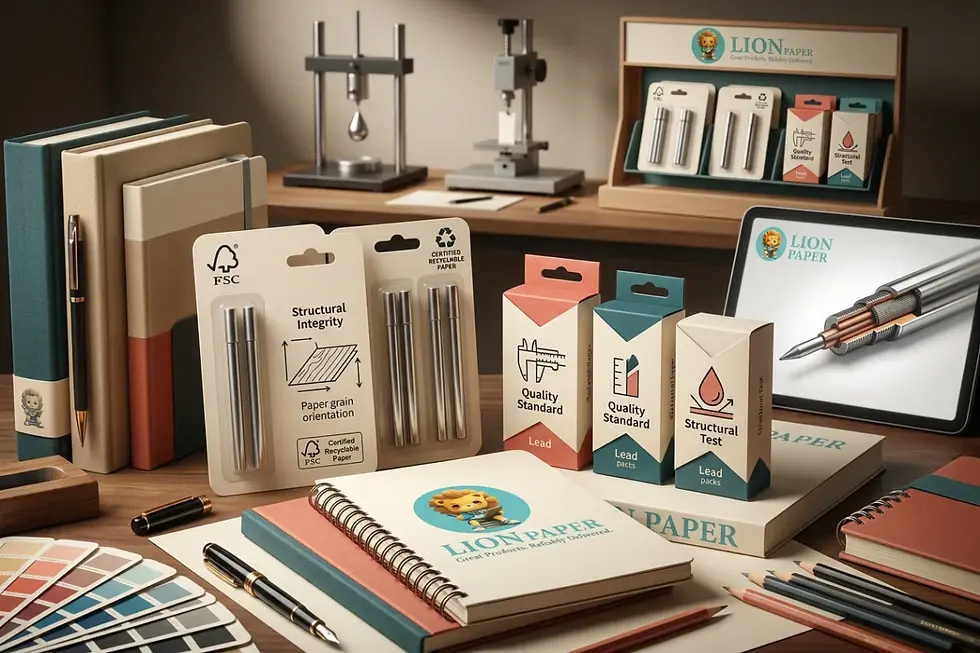
Integrated stationery packaging solutions combining sustainable paperboard blister backing with custom retail presentation.
Ready to build or upgrade your custom mechanical pencil and accessory refill product lines with market-ready packaging, compliant materials, and end-to-end supply chain reliability? Share target retail price, lead size, body material, mechanism and pack concept; request a mechanical-pencil specification and sampling plan.
FAQ
What lead diameters require specialized shock protection in packaging?
Ultra-fine lead diameters, specifically 0.2 mm, 0.3 mm, and 0.5 mm, feature high aspect ratios and low shear strength, making them extremely susceptible to micro-fracturing under transport vibration. Packaging for these diameters requires tighter internal chamber clearances, internal longitudinal dampening ribs, or soft shock-absorbing elastomer end-caps inside the tube to prevent internal core shattering.
How does packaging prevent static graphite dust buildup inside transparent tubes?
Static attraction is prevented by adding food-grade internal anti-static masterbatch additives (such as glycerol monostearate or ethoxylated alkylamines) directly into the polypropylene or SAN resin during injection molding. Alternatively, containers can receive an ionized air wash prior to automated lead insertion to neutralize surface charges.
Can mechanical pencil lead refills be packaged in 100% plastic-free packaging?
Yes. Sustainable packaging solutions include high-density FSC-certified spiral-wound paperboard tubes fitted with molded pulp or paper-slider caps, packaged inside 100% recyclable folding boxboard (FBB) hang-tag sleeves. These designs eliminate single-use plastics while meeting retail drop-test and crush-resistance benchmarks.
What is the standard AQL threshold for retail blister card heat-seal failures?
In high-volume consumer stationery manufacturing, blister card heat-seal failures—such as unsealed edges, partial delamination, or card peeling without fiber tear—are classified as Major Defects with an Acceptable Quality Level (AQL) limit of 1.0 (or 0.65 for premium retail programs), requiring immediate corrective parameter tuning on the sealing press.


Comments