


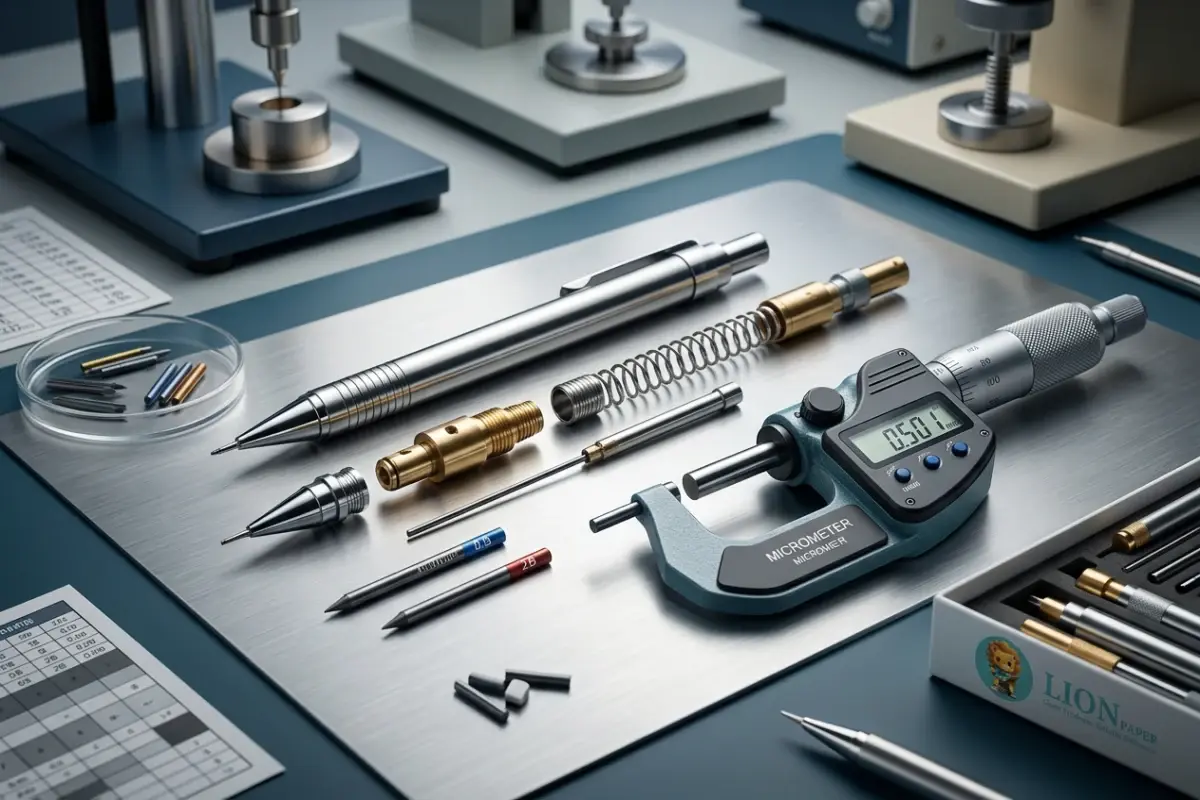
Mechanical Pencil Lead Breakage: Engineering Causes, Testing Standards, and QA Sourcing Solutions

Mechanical pencil lead breakage is primarily caused by excessive guide sleeve wobble, misaligned brass clutch chucks, inconsistent advancement click strokes, or sub-standard lead polymer flexural strength. B2B buyers and stationery brands mitigate these failures by enforcing standardized pencil lead breakage test protocols, setting a lead sleeve wobble tolerance under 0.05 mm, and implementing rigorous mechanical pencil quality control systems throughout product design, tooling, and mass manufacturing.
What Are the Primary Mechanical Causes of Mechanical Pencil Lead Breakage?
Mechanical pencil lead breakage in retail and promotional programs is rarely just the result of excessive consumer writing pressure; it is predominantly an engineering failure caused by dimensional misalignment, inferior component metallurgy, or improper polymer compounding. When writing instruments undergo continuous use, lateral and axial forces transfer directly from the paper surface through the graphite core into the internal gripping mechanism. If any sub-assembly within the pencil allows micro-movements or concentrates physical stress unevenly, structural failure occurs instantly.
Stationery product developers and procurement teams evaluate five critical root causes when diagnosing chronic lead fracture in production batches:
Guide Sleeve Radial Play and Axial Misalignment: The metal or plastic guide pipe at the pencil tip acts as the final stabilizing column for the extended lead. If the internal diameter of this pipe is bored too wide or if the assembly fitting loose inside the cone tip allows lateral shifting, the lead wobbles during writing. This radial play generates high bending moments at the exit rim of the sleeve, snapping the core under minimal downforce.
Clutch Chuck Asymmetry and Uneven Radial Clamping: The internal brass or zinc chuck consists of two or three split jaws that open and clamp to advance and secure the lead. When chuck jaws feature uneven parting lines, burrs, or off-center concentricity, they apply point-contact pressure rather than distributed cylindrical clamping. This micro-cracks the graphite-polymer matrix inside the mechanism before the lead is pushed outward.
Excessive Advancement Stroke Pitch: The internal ratchet mechanism governs the feed length per click. Standard single-click advancement should range precisely between 0.5 mm and 0.8 mm. Low-precision mechanisms that advance 1.0 mm to 1.5 mm per click expose an excessively long cantilever beam. Under normal 60-degree writing angles, the resultant shear force readily exceeds the lead core flexural limit.
Graphite-Polymer Formulation and Porosity Deficits: High-performance pencil leads utilize synthetic polymer binders, such as polyoxymethylene or thermosetting resins, blended with micro-milled graphite and carbon black. Lower-cost leads formulated with excessive natural clay binders or uneven resin curing exhibit internal voids, low tensile strength, and high brittleness.
Internal Reservoir Tube Friction and Obstructions: Refill leads stored within the internal barrel reservoir experience continuous vibration during transit. If the internal plastic extruded tube contains mold flash, rough seam lines, or excessive clearance that allows leads to rattle violently, the refills shatter internally before ever reaching the clutch mechanism.

Standardized three-point flexural testing benchmarks the minimum breaking strength of graphite and polymer lead cores.
Which Standardized Protocols Define an Effective Pencil Lead Breakage Test?
To establish reliable product baselines and prevent customer return spikes, international stationery sourcing QA standards require systematic physical and mechanical testing. Standardized lab assessments benchmark lead strength under static bending, continuous dynamic friction, and physical drop impact.
1. Three-Point Bending Flexural Strength Test (ISO 9177-2 and JIS S 6005)
The three-point flexural test is the globally accepted benchmark for measuring the absolute breaking strength of mechanical pencil lead cores. In this test protocol, a continuous lead segment is positioned horizontally across two parallel support anvils separated by a fixed span distance (typically 10 mm for 0.3 mm to 0.7 mm leads, and 20 mm for 0.9 mm to 2.0 mm leads). A motorized loading edge descends at a constant crosshead speed of 1.0 mm per minute, applying increasing force to the exact center of the span until physical fracture occurs.
Lead Nominal Diameter (mm) | Standard Hardness Grade | Minimum Breaking Force (gf) | Minimum Flexural Strength (MPa) | Primary Application Scenario |
|---|---|---|---|---|
:--- | :--- | :--- | :--- | :--- |
0.3 mm | HB / B | 120 - 140 gf | ≥ 320 MPa | Fine technical drafting & precision sketching |
0.5 mm | HB / 2B | 220 - 260 gf | ≥ 280 MPa | General writing, journaling & daily office use |
0.7 mm | HB / 2B | 380 - 450 gf | ≥ 240 MPa | Standard educational & commercial office writing |
0.9 mm | HB / 2B | 550 - 650 gf | ≥ 210 MPa | Heavy-handed writing & standardized test marking |
2.0 mm | HB / 2B / 4B | 1,200 - 1,500 gf | ≥ 160 MPa | Art sketching, carpentry & creative illustration |
Flexural strength is calculated using standard beam mechanics, factoring in the applied peak breaking load, span length, and exact cross-sectional diameter measured with an optical micrometer. Batches failing to achieve the minimum MegaPascal thresholds exhibit high failure rates under normal handwriting conditions.
2. Automated Continuous Dynamic Writing Simulation
Dynamic writing machines evaluate the entire mechanical pencil assembly under real-world operating loads. The pencil is mounted securely in an automated mechanical arm clamped at a 60-degree or 70-degree angle relative to an advancing web of standard 80 gsm wood-free paper. A calibrated downward deadweight (typically 150 gf to 300 gf) is applied while the arm executes continuous spiral, continuous wavy line, or alphanumeric patterns at a constant traverse speed of 50 mm per second.
Total Writing Distance to Breakage: The machine records the continuous linear meters completed before lead fracture occurs.
Feed Retention Under Writing Load: The test detects whether writing pressure causes the lead to slip backward into the clutch mechanism, verifying the holding power of the chuck spring.
Wear Rate and Line Density Consistency: Optical densitometers evaluate whether the line remains uniform in darkness without graphite flaking or core shattering.
3. Free-Fall Drop and Transit Shock Impact Testing
A writing instrument must survive standard drops from desks and transport handling without internal component failure. Full-capacity loaded mechanical pencils undergo free-fall drops from a height of 1.0 meter onto a dense hardwood surface. The test applies drops in three distinct orientations: tip-down vertical, cap-down vertical, and horizontal lateral. Post-drop inspection evaluates whether the lead sleeve has deformed, whether internal reservoir leads have shattered into fragments, and whether the clutch mechanism continues to feed smoothly.
What Mechanism Component Tolerances Prevent Premature Lead Fracture?
Precision engineering of internal component clearances determines the structural stability of the pencil during writing. When designing metal or hybrid mechanical pencils, engineering specifications must define exact manufacturing tolerance bands for every moving interface.
Critical Mechanism Quality Thresholds
Lead Guide Sleeve Internal Clearance: The internal diameter of the guide pipe must maintain a clearance of +0.02 mm to +0.04 mm above the nominal outer diameter of the lead core. A clearance tighter than +0.02 mm causes lead jamming due to graphite dust accumulation, while a clearance greater than +0.04 mm permits micro-bending.
Lead Sleeve Wobble Tolerance: Total lateral deflection (radial play) of the guide sleeve measured at the extreme tip must not exceed 0.05 mm under a lateral test force of 50 gf. In premium drafting or executive metal pens, this tolerance is kept below 0.03 mm.
Clutch Chuck Concentricity and Jaw Runout: Symmetrical runout across the split chuck jaws must remain within 0.02 mm. The internal gripping teeth must be precisely deburred to maintain uniform surface contact across all jaws.
Feed Advance Pitch per Depression: The internal ratchet indexing mechanism must advance the lead by 0.50 mm to 0.75 mm per full click stroke. Advancement values exceeding 0.85 mm per stroke significantly elevate cantilever failure risks.
Clutch Spring Tension and Return Force: Retraction spring force must be calibrated between 1.8 N and 2.4 N. Insufficient spring tension allows clutch slippage under downward writing pressure, while excessive spring force creates jarring vibrations upon button release that snap delicate polymer leads.
Mechanism Material Selection and Tolerance Comparison
Mechanism Component | Economical Plastic / Stamped Zinc Mechanism | Precision Machined Solid Brass Mechanism | Structural Impact on Lead Durability |
|---|---|---|---|
:--- | :--- | :--- | :--- |
Chuck Jaws | 2-jaw molded zinc or plastic; ±0.06 mm tolerance | 3-jaw CNC-machined solid brass; ±0.015 mm tolerance | Brass 3-jaw chucks distribute radial clamping evenly, preventing core micro-cracking. |
Guide Sleeve Pipe | Thin-wall rolled metal or molded ABS; ±0.05 mm fit | Seamless drawn stainless steel; ±0.01 mm press-fit | Seamless steel prevents lateral sleeve wobble and tip deformation upon impact. |
Internal Reservoir | Extruded PVC/PS with visible mold seams | Polished low-friction POM or high-density PP | Smooth low-friction polymer prevents internal lead rattling and refill abrasion. |
Return Spring | Standard carbon wire; ±15% force variance | Tempered music wire (SWP-B); ±5% force variance | Stable spring tension eliminates mechanism jamming and clutch chatter during feed cycles. |
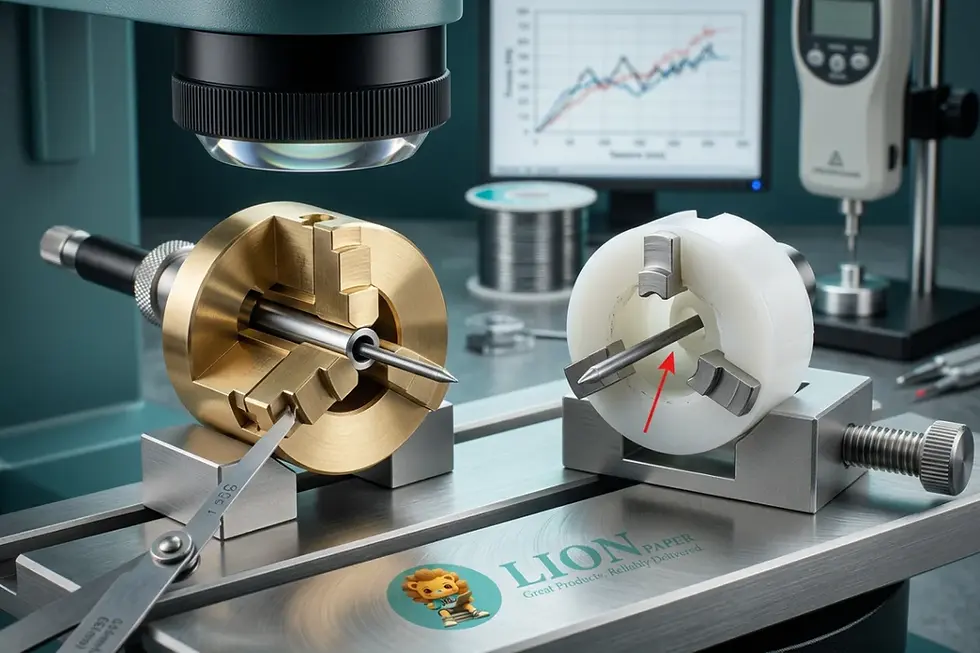
Solid brass 3-jaw chucks maintain concentric alignment, minimizing micro-cracking and lateral lead sleeve wobble.
How Should B2B Buyers Define Stationery Sourcing QA Standards for Mechanical Pencils?
Sourcing managers, brand buyers, and retail category leaders require structured inspection frameworks to verify mechanical pencil quality control before final shipment authorization. Employing ISO 2859-1 (ANSI/ASQ Z1.4) General Inspection Level II sampling with clearly defined Acceptable Quality Limit (AQL) standards ensures risk mitigation across multi-thousand-unit production runs.
Comprehensive Defect Classification Matrix
Critical Defects (AQL 0.0): Sharp external metal flash or burrs capable of causing skin laceration; toxic heavy metals exceeding CPSIA, ASTM D-4236, or EN 71-3 thresholds; total mechanism seizure preventing any lead advancement upon initial unboxing.
Major Defects (AQL 1.0): Lead sleeve wobble tolerance exceeding 0.08 mm; lead breakage rate exceeding 2.0% during a standard 10-click continuous advancement check; chuck slipping under 200 gf static vertical load; advancement pitch exceeding 1.0 mm per click; lead reservoir clearance issues preventing refill insertion; loose pocket clips detaching under 15 N pull force.
Minor Defects (AQL 2.5): Barrel silk-screen or hot-stamping alignment deviation greater than 0.3 mm; minor cosmetic hairline scratches on barrel plating or anodized coating; slight click-button tactile looseness that does not compromise feeding function; minor shade variation across multi-pack sets.
End-to-End Production Verification Checkpoints
Incoming Quality Control (IQC) on Raw Materials and Refills: Optical measurement of lead diameter consistency across every batch (verified to ±0.01 mm); standardized three-point flexural strength testing on raw lead cores; spectrophotometer color matching for plastic injection resins; tensile and elasticity verification for metal pocket clips and internal music wire springs.
In-Process Quality Control (IPQC) on Semi-Finished Mechanisms: Automated cycling of clutch-and-barrel sub-assemblies through 50 continuous depression cycles to detect internal jamming; concentricity verification of the brass chuck inside the outer tip cone; torque testing on threaded joints connecting the grip section to the main barrel.
Final Quality Control and Pre-Shipment Inspection (FQC / PSI): Full functional evaluation on finished retail units drawn randomly according to AQL sampling tables; continuous writing simulation on standard notebook paper; drop testing of fully packaged multi-packs; master export carton drop testing under ISTA protocols; barcode scan verification and retail packaging integrity checks.
What Process Safeguards Protect Mechanical Pencils in Multi-Piece Stationery Sets?
High-value stationery programs frequently combine custom mechanical pencils with hardcover notebooks, planners, pencil pouches, and accessory boxes. Ensuring that writing instruments arrive in pristine functional condition requires specific packaging engineering and handling safeguards across the supply chain.
Restricting Pre-Loaded Lead Quantities in Transit: Shipping mechanical pencils fully loaded with 4 to 6 spare leads inside the internal reservoir tube is a common cause of out-of-box lead breakage. Ocean freight container vibrations and air cargo turbulence cause multiple leads to collide violently within the tube, creating internal fractures. QA protocols should mandate that pencils ship with only 1 pre-loaded lead in the mechanism, while additional refill leads are safely packed in separate, cushioned polypropylene cases.
Precision Insert Cavity Design for Gift Packaging: When packaging pencils in corporate gift sets or retail journal kits, custom thermoformed PET blister trays or high-density die-cut EVA foam inserts must be engineered with dual-point support. The tray must firmly grip both the pencil barrel body and the metal cone section, ensuring that the fragile guide sleeve does not touch the outer box wall during rough handling.
Transit Simulation and Environmental Cycling (ISTA 3A): Packaged stationery collections must undergo ISTA 3A transit simulation testing. This protocol subjects master shipping cartons to random mechanical vibration profiles, compression loads, and rapid thermal cycling (-10°C to 50°C). Thermal cycling verifies that differential thermal expansion between metal guide sleeves and plastic barrel components does not cause mechanism binding or lead shearing.

Rigorous in-line AQL inspections and custom packaging trays protect mechanical pencils from transit shock and internal lead fracture.
How Does Lion Paper Deliver End-to-End Mechanical Pencil Quality Control?
Lion Paper Products (Jiaxing) Co., Ltd. is an integrated supply-chain partner for customized paper goods and creative products, delivering end-to-end solutions from first sketch to first shipment. By bridging precision writing accessory manufacturing with bespoke notebooks, journals, planners, and lifestyle stationery sets, Lion Paper helps global brands, retailers, and e-commerce sellers bring reliable, market-ready products to market.
China–Cambodia Dual-Site Synergy: Lion Paper combines a 3,000-square-meter design, prototyping, and engineering center in Jiaxing, Zhejiang, with a 10,000-square-meter mass-production base in Cambodia. The Jiaxing facility focuses on rapid sampling, mechanical stress analysis, and initial product validation, while the Cambodia facility provides large-scale automated manufacturing, competitive cost structures, and tariff-efficient global logistics.
Design-to-Manufacturing Integration: Our internal structural engineers, material specialists, and quality control teams work in close coordination. We ensure that writing instrument specifications, clutch tolerances, lead formulations, and customized packaging enclosures are fully aligned before tooling and mass production begin.
Robust International Compliance Management: Lion Paper operates under strict quality and social responsibility frameworks supported by ISO 9001, FSC, SMETA, WCA, GSV, FAMA, and CPSIA audits and certifications. Every mechanical pencil program is evaluated to meet North American and European chemical safety, heavy metal migration, and physical performance standards.
Total-Cost Efficiency and Scenario Fit: Through scaled raw material sourcing, automated assembly line balancing, and optimized multi-piece gift packaging, Lion Paper optimizes landed costs without compromising mechanism reliability or aesthetic refinement.
To engineer a reliable, defect-free mechanical writing program tailored to your brand positioning and retail price targets, partner with our technical development team. Share target retail price, lead size, body material, mechanism and pack concept; request a mechanical-pencil specification and sampling plan.
FAQ
What is the acceptable lead sleeve wobble tolerance in retail-grade mechanical pencils?
For standard retail-grade mechanical pencils, radial guide sleeve wobble should not exceed 0.05 mm measured at the tip under a 50 gf lateral load. High-precision drafting instruments require tighter tolerances below 0.03 mm to eliminate lateral bending stress during fast hand movements.
How does lead hardness grade (such as HB vs 2B) affect lead breakage risk?
Softer grades such as 2B, 3B, and 4B contain higher graphite ratios and lower polymer binder densities, which lowers their flexural shear strength compared to HB or H leads. Soft lead programs require high-purity synthetic polymer formulations and shorter advancement click strokes (0.5 mm) to avoid premature snapping.
Why do mechanical pencil leads snap inside the internal storage tube during shipment?
Internal lead fracture during transit is caused by excessive clearance in the internal reservoir tube, rough mold seam burrs, or overfilling the reservoir with more than 3 full-length leads. Vibrations during ocean or air transport cause multiple refill leads to collide and shatter unless factory pre-loading is restricted to 1 or 2 leads.
What international testing standards govern mechanical pencil quality control?
Key international standards include ISO 9177 (Parts 1, 2, and 3) and JIS S 6005 for mechanical pencil dimensions, lead classifications, and flexural bending strength, along with CPSIA, ASTM D-4236, and EN 71-3 for chemical non-toxicity and heavy metal restrictions.


Comments