


Comprehensive Guide to Mechanical Pencil Development: Engineering, Material Selection, and Manufacturing

Mechanical pencil development requires defining internal clutch mechanisms, barrel materials, lead diameters, and precision tolerances to balance ergonomic performance, retail compliance, and cost-effective mass production. Success depends on aligning internal mechanical engineering with barrel aesthetics, strict quality control standards, and integrated packaging solutions to ensure seamless mass-market execution.
What Are the Key Engineering Components and Mechanism Options in Mechanical Pencil Development?
Developing a high-performance mechanical pencil requires a clear understanding of its internal mechanical architecture. Unlike standard writing instruments, mechanical pencils rely on micro-engineered sub-assemblies to feed, secure, and advance graphite lead reliably.
Every functional mechanical pencil consists of several core mechanical assemblies:
The Clutch (Chuck) Mechanism: The core gripping component, typically manufactured as a two-jaw or three-jaw split collet from machined brass or molded polyoxymethylene (POM). Brass clutches provide superior durability, slip resistance, and a premium tactile weight, whereas POM offers lightweight, cost-effective performance for high-volume consumer pencils.
The Lead Reservoir Tube: The internal storage chamber that feeds leads sequentially into the clutch assembly. It must maintain smooth interior walls and precise inner diameters to prevent lead bridging or jamming.
Return and Cushion Springs: Precision-coiled steel springs that regulate the advance force and cushion heavy-handed writing pressure to mitigate lead breakage.
The Chuck Ring (Collet Collar): A metal or rigid polymer sleeve that forces the chuck jaws closed when retracted, locking the lead firmly in place during active writing.
The Guide Pipe (Sleeve): Located at the tip, this component can be fixed (preferred for technical drafting accuracy) or sliding/retractable (preferred for pocket safety and general consumer use).
During early stationery product development, engineering teams choose among primary mechanism architectures:
Rear-Push (Rachet) Actuation: The standard mechanism where pressing the rear cap advances the chuck and pushes the lead forward in discrete increments (typically 0.5 mm to 0.8 mm per click).
Side-Click Mechanism: Places the push-button on the lateral barrel wall, allowing users to advance lead without altering their grip.
Shake-Advance Mechanism: Utilizes an internal sliding weight that impacts an internal actuator when shaken vertically, offering convenience for active note-taking.
Auto-Rotating Mechanism: Employs an internal ratchet gear that rotates the lead slightly each time the pencil leaves the paper, maintaining a conical tip profile.

Precision-machined three-jaw brass clutches deliver consistent lead advance and slip resistance under writing pressure.
How Do You Select Materials for the Barrel, Clip, and Grip to Balance Weight and Ergonomics?
Material selection determines not only the exterior aesthetics and consumer price point but also the weight distribution, balance point, and long-term durability of the pencil.
Mechanical pencil specifications require balancing materials across three external zones:
1. Barrel Body Materials
Extruded and Anodized Aluminum: Delivers a modern, sleek profile with high scratch resistance and lightweight structural integrity. It is widely used for premium retail collections and executive sets.
Machined Brass: Provides substantial heft and a low center of gravity, favored for precision drafting and luxury private-label stationery.
Engineering Polymers (ABS, PC, POM): Acrylonitrile Butadiene Styrene (ABS) and Polycarbonate (PC) offer superior impact resistance, dimensional stability, and vibrant color-matching options, making them ideal for high-volume retail and educational stationery.
Eco-Conscious Materials: Recycled plastics (rPET, rABS) and composite natural fibers align with environmental, social, and governance (ESG) retail initiatives without sacrificing structural strength.
2. Grip Section Engineering
Knurled Metal: Diamond or linear knurling machined directly into brass or aluminum ensures slip-free industrial grip for technical drafting.
Co-Molded Thermoplastic Elastomer (TPE): Soft-touch rubberized sections molded directly over rigid ABS substrates reduce finger fatigue during extended writing.
Textured or Ribbed Hard Polymers: Cost-effective, cleanable grip profiles molded into the barrel geometry without secondary assembly processes.
3. Clip and Trims
Tempered Spring Steel: Offers durable tension that withstands repeated flexing without yielding or breaking.
Zinc-Alloy Die Cast: Allows for sculpted 3D geometries, custom brand emblems, and electroplated finishes (such as matte black, rose gold, or brushed chrome).
Material Type | Typical Density / Weight | Target Retail Segment | Primary Advantage | Tooling / Processing Considerations |
|---|---|---|---|---|
:--- | :--- | :--- | :--- | :--- |
ABS / PC Plastics | Lightweight (8g - 14g) | Mass Retail / Back-to-School | High impact strength, color flexibility | Multi-cavity injection molds |
Anodized Aluminum | Mid-weight (14g - 22g) | Mid-to-High Lifestyle Stationery | Premium metallic finish, corrosion proof | CNC turning, extrusion, anodizing baths |
Machined Brass | Heavy (25g - 40g) | Professional / Executive Gifting | Low center of gravity, premium tactile feel | Precision lathe turning, electroplating |
Recycled Polymers | Lightweight (8g - 14g) | Sustainable Brands / Eco Collections | Lower environmental footprint | Tight regrind quality control required |
What Lead Sizing, Dispensing Systems, and Internal Tolerances Are Required?
Precision tolerance control is essential in custom mechanical pencil manufacturing. Even slight deviations in diameter or concentricity can cause lead breakage, slippage, or catastrophic jamming.
Standard lead diameters demand specific engineering tolerances:
0.3 mm / 0.5 mm (Technical Drafting & Fine Script): Requires chuck concentricity within ±0.02 mm and internal guide sleeve tolerances within +0.03/-0.01 mm. Fine leads are susceptible to shear stress and require precise spring cushioning.
0.7 mm / 0.9 mm (Standard Writing & Everyday Note-Taking): Offers high tensile strength, ideal for school and office stationery where robust drop resistance and ease of use are paramount.
1.3 mm / 2.0 mm to 5.6 mm (Lead Holders & Sketching): Uses drop-clutch or heavy rachet jaws suited for artists, carpentry, and expressive marking.
Critical dimensions during OEM stationery pencil sourcing include:
Lead Advance Distance: The clutch must feed 0.5 mm to 0.75 mm of lead per stroke for 0.5 mm pencils. Excessive advance increases the risk of immediate fracture on contact with paper.
Clutch Retention Force: The chuck must withstand at least 3.0 N to 5.0 N of axial writing pressure without allowing the lead to push back into the reservoir.
Concentricity of Tip and Barrel: Tip runout must not exceed 0.05 mm to prevent uneven lead wear and wobbly stroke dynamics.
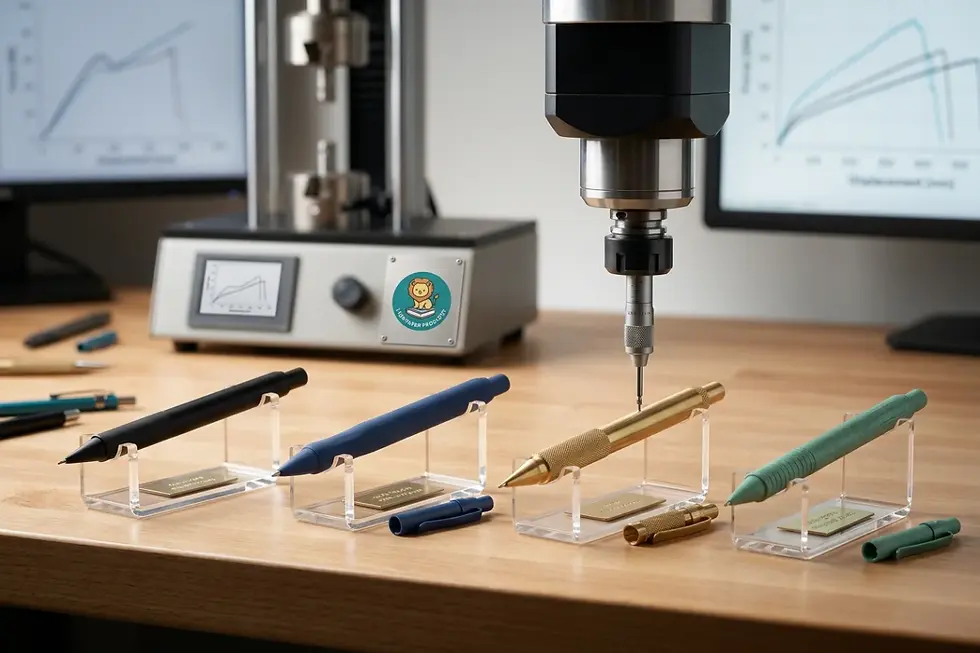
Selecting appropriate barrel materials balances weight distribution, grip ergonomics, and production economics.
What Are the Core Cost Drivers and Manufacturing Economics in Pencil Sourcing?
Managing landed product cost while preserving aesthetic quality and mechanical reliability requires an understanding of primary cost drivers.
Key factors influencing production economics include:
Tooling Cavitation and Amortization: High-precision injection molds for internal chucks, barrels, and end-caps require multi-cavity tooling. Higher initial tooling investment drastically reduces per-unit costs at scales exceeding 50,000 units.
Internal Mechanism Sourcing: Standardizing on proven, off-the-shelf internal clutch engines lowers engineering risk, shortens development lead times, and avoids unique mechanism tooling.
Secondary Surface Finishing: Processes such as multi-pass spray painting, soft-touch rubberized coatings, UV silk-screen printing, laser engraving, and electroplating add modular cycle time and labor costs.
Assembly Automation vs. Manual Labor: Automatic assembly lines insert springs, clutch jaws, and lead cartridges with high repeatability. Complex multi-material custom barrels may require manual alignment, shifting cost balances.
Dual-Site Supply Chain Strategy: Utilizing a dual-hub model—where design, prototyping, and rapid pre-production validation occur in specialized design facilities (such as Jiaxing, China), followed by mass assembly and export operations in scalable manufacturing hubs (such as Cambodia)—optimizes labor costs, trade logistics, and tariff structures for global retail distribution.
What Prototyping Protocols and Quality Assurance Standards Must Be Followed?
Systematic prototyping and testing ensure that mechanical pencil designs transition smoothly from digital CAD models to high-yield production lines.
Prototyping Phases
SLA/SLS 3D Printing (Form & Ergonomics): Validates outer barrel contours, finger rest positioning, and clip tension on physical mockups within 24 to 48 hours.
CNC Metal & Acrylic Machining (Functional Prototypes): Produces fully operational prototypes using actual production-grade brass, aluminum, or POM to test mechanism click action, weight balance, and clutch retention.
Pilot Tooling & First Article Inspection (FAI): Runs initial multi-cavity samples through dimensional checks, resin flow analysis, and mechanical stress evaluations before greenlighting mass production.
Quality Assurance and Testing Protocols
To meet international consumer safety standards, manufacturing protocols must adhere to rigorous testing frameworks:
Actuation Fatigue Testing: Automated mechanical testers actuate the push button 10,000 to 20,000 continuous cycles to ensure the spring, chuck collar, and teeth maintain consistent advance distances without fatigue failure.
Drop Impact Testing: Pencils are dropped from a height of 1.0 to 1.2 meters at multiple angles onto hard surfaces to verify that internal reservoirs do not crack, lead does not shatter internally, and guide sleeves remain aligned.
Clutch Holding Force Test: A calibrated force gauge applies axial load onto the advanced lead to measure the exact slip threshold.
Regulatory Compliance: Mechanical pencils intended for global school and office markets must comply with CPSIA (lead and phthalates content), ASTM D-4236 (toxicological risk evaluation), EN 71-3 (migration of heavy elements), and REACH standards.

Integrating mechanical pencils into coordinated stationery collections enhances retail appeal and brand consistency.
How Can Mechanical Pencils Be Integrated into Retail Packaging and Complete Stationery Collections?
Modern stationery buyers rarely evaluate writing instruments in isolation; mechanical pencils are frequently developed as part of coordinated collections that include custom notebooks, daily planners, pencil pouches, and refill accessories.
Key integration considerations include:
Color-Matching Across Substrates: Achieving exact Pantone harmony across an anodized aluminum pencil barrel, a vegan leather journal cover, a silicone pen loop, and an elastic planner band requires coordinated masterbatch formulation and color spectrophotometry.
Retail-Ready Packaging Formats: Packaging designs should balance shelf presence, tamper resistance, and environmental footprint:
FSC-Certified Blister Cards: Paperboard backing with clear, recyclable PET blisters for peg-hook supermarket merchandising.
Rigid Gifting Boxes: Custom foam or paperboard inserts holding matching mechanical pencils, refill tubes, and metal clips for executive and seasonal gift sets.
E-Commerce Multi-Packs: Compact, drop-tested paperboard tuck boxes designed to minimize dimensional shipping weight and prevent transit damage.
Co-Branded & IP Merchandise Suites: Structuring mechanical pencil production within full-category stationery programs enables brands to launch matching journals, desk calendars, and lifestyle accessories under unified quality management and supply-chain oversight.
To begin custom mechanical pencil engineering, Share target retail price, lead size, body material, mechanism and pack concept; request a mechanical-pencil specification and sampling plan.
Frequently Asked Questions
What is the standard lead time for developing a custom mechanical pencil from scratch?
Developing a fully custom mechanical pencil typically takes 8 to 12 weeks for industrial design, engineering CAD, rapid functional prototyping, and mold fabrication. Once pilot samples and First Article Inspections are approved, mass production and packaging integration usually take 35 to 50 days, depending on barrel materials and surface finishing complexity.
Which clutch material is better: brass or POM polymer?
Brass clutches offer greater durability, higher retention force against heavy writing pressure, and a premium tactile weight, making them the preferred choice for professional drafting and premium retail lines. POM (polyoxymethylene) clutches are lightweight, cost-effective, and provide reliable feeding performance for high-volume back-to-school and value-focused stationery products.
How are lead-jamming issues prevented during mass manufacturing?
Lead jams are prevented by enforcing strict concentricity tolerances (±0.02 mm) between the chuck, lead guide pipe, and reservoir tube. Additionally, internal plastic moldings must have zero interior flash or burrs, and the lead reservoir must feature internal guide ribs that keep replacement leads vertically aligned without cross-wedging.
FAQ
What is the standard lead time for developing a custom mechanical pencil from scratch?
Developing a fully custom mechanical pencil typically takes 8 to 12 weeks for industrial design, engineering CAD, rapid functional prototyping, and mold fabrication. Once pilot samples and First Article Inspections are approved, mass production and packaging integration usually take 35 to 50 days, depending on barrel materials and surface finishing complexity.
Which clutch material is better: brass or POM polymer?
Brass clutches offer greater durability, higher retention force against heavy writing pressure, and a premium tactile weight, making them the preferred choice for professional drafting and premium retail lines. POM (polyoxymethylene) clutches are lightweight, cost-effective, and provide reliable feeding performance for high-volume back-to-school and value-focused stationery products.
How are lead-jamming issues prevented during mass manufacturing?
Lead jams are prevented by enforcing strict concentricity tolerances (±0.02 mm) between the chuck, lead guide pipe, and reservoir tube. Additionally, internal plastic moldings must have zero interior flash or burrs, and the lead reservoir must feature internal guide ribs that keep replacement leads vertically aligned without cross-wedging.


Comments