


Matte vs Gloss Marble Notebook Lamination: B2B Sourcing Guide

Matte marble notebook lamination delivers a sophisticated, glare-free, and velvety texture that minimizes fingerprint marks for premium lifestyle retail, whereas gloss lamination maximizes vein depth, high-contrast vibrancy, and surface durability at a cost-effective price point. Choosing between them depends on brand positioning, retail lighting environments, secondary embellishment requirements, target retail price tiers, and intended consumer handling intensity across lifestyle or mass-market retail channels.
What Is the Difference Between Matte and Gloss Lamination for Marble Notebook Covers?
The primary technical difference between matte and gloss lamination lies in the optical refraction, surface energy, and protective film polymer applied over the printed marble artwork. Both lamination types utilize thermal or wet-applied biaxially oriented polypropylene (BOPP) or polyethylene terephthalate (PET) films bonded to printed art paper, greyboard, or cardstock under controlled heat and pressure.
Matte Lamination Film Characteristics: Matte films feature a micro-textured, light-diffusing top layer that disperses ambient light across the surface. This eliminates harsh specular glare, imparting an organic, stone-like aesthetic that mimics raw honed marble. It produces a soft, muted contrast that elevates subtle veining patterns in pastel, neutral, and minimalist notebook designs.
Gloss Lamination Film Characteristics: Gloss films possess an ultra-smooth, high-reflectance optical surface that acts like a polished crystalline glaze. By minimizing light scattering, gloss lamination increases chromatic saturation, sharpens fine line definition, and delivers high-contrast visual depth that accentuates dramatic gold, emerald, or black veining in custom notebook cover lamination projects.
Technical Parameter | Standard Matte Lamination | Soft-Touch / Velvet Matte | Standard Gloss Lamination |
|---|---|---|---|
:--- | :--- | :--- | :--- |
Film Material | BOPP / PET (18–25 µm) | Coated BOPP (28–32 µm) | BOPP / PET (15–22 µm) |
Gloss Level (60° Gardner) | 5 – 12 GU | 1 – 4 GU | 85 – 95 GU |
Optical Glare | Ultra-low (diffused) | Zero (light absorption) | High (specular reflection) |
Vein Color Saturation | Subdued / Natural | Muted / Rich tone | Hyper-vibrant / Deep black |
Fingerprint Sensitivity | Moderate | High (without anti-fingerprint treatment) | High (wipes clean easily) |
Scuff & Scratch Resistance | Moderate (scuffs appear shiny) | High (anti-scratch grade) | High (micro-scratches visible in light) |
Relative Film Cost Index | 1.00 (Baseline) | 1.45 – 1.80 | 0.85 – 0.92 |
How Do Matte and Gloss Finishes Affect Marble Print Clarity and Visual Vein Contrast?
Marble notebook cover artwork depends heavily on micro-gradients, soft blending, and crisp fissure details to emulate authentic Carrara, Calacatta, Nero Marquina, or liquid-swirl composite minerals. The choice of marble notebook cover finish alters how the human eye registers these printed ink densities.
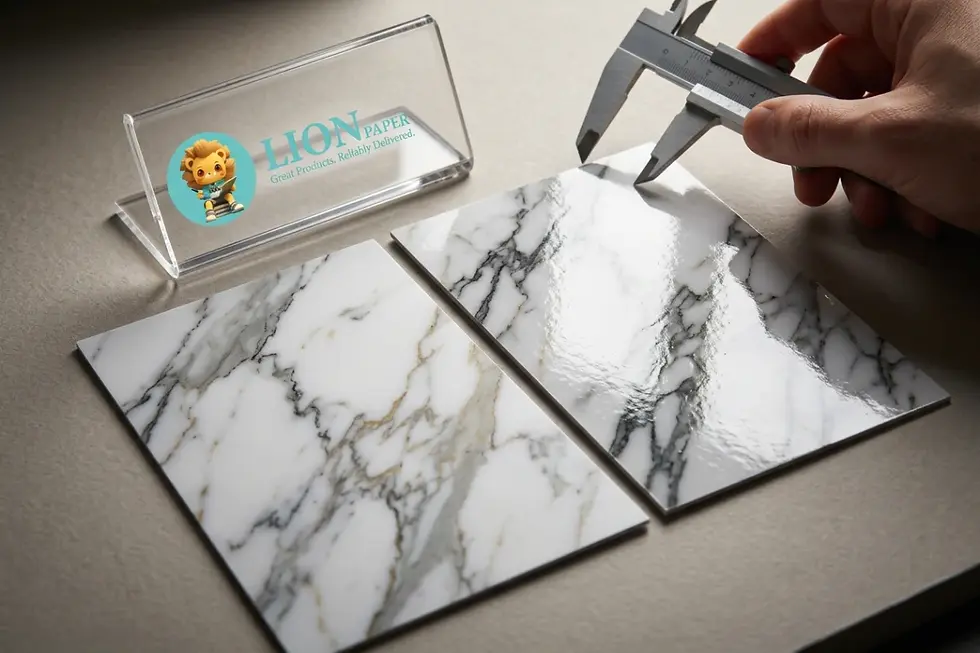
Gloss lamination maximizes chromatic saturation and vein contrast, while matte lamination diffuses glare for a natural stone look.
When applying matte lamination for journals, the diffuse light reflection softens extreme transitions between deep ink saturation and raw paper highlights. In dark marble patterns, such as charcoal and obsidian veining, standard matte film can slightly reduce black density (D-max), yielding an understated, editorial aesthetic favored by boutique stationary buyers and adult journaling enthusiasts. Soft-touch matte variants deepen tone saturation while maintaining a velvety tactile feel.
In contrast, gloss lamination notebook printing enhances internal light bounce within the underlying ink layer, a phenomenon known as optical clearing. This increases the perceived dynamic range of four-color CMYK and Pantone spot-color printing. The veins appear visually recessed beneath a glass-like finish, imitating high-polish architectural marble slabs. White marble backgrounds appear brighter and cleaner under retail spotlights, while rich jewel tones and metallic-effect process inks gain substantial pop and visual depth.
Fine Fissure Separation: Gloss lamination preserves distinct edge sharpness for fine 0.25 pt veins, whereas matte lamination blends tiny micro-details into a harmonious, soft-focus composition.
Specular Retail Glare: Under harsh fluorescent or track lighting in big-box retail environments, gloss lamination creates bright reflections that may obscure artwork details from certain angles, while matte surfaces retain complete graphic legibility from any viewing position.
Color Shift Management: Matte films typically cause a 3% to 6% perceived drop in visual color saturation upon curing, requiring prepress color curves to be boosted in midtones and shadows prior to plate output.
Which Marble Notebook Cover Finish Offers Better Durability and Scratch Resistance?
Notebook durability is dictated by film polymer toughness, surface hardness, abrasion resistance during shipping transit, and daily consumer handling. Both finishes provide baseline water resistance and moisture barrier protection for the underlying paperboard, but they fail differently under physical stress.
Abrasive Transit Scuffing: During ocean freight transit and carton friction, standard matte film surfaces can suffer from burnishing, where rubbing against adjacent covers creates shiny, polished streaks across matte areas. To eliminate this risk, procurement teams sourcing custom notebook cover lamination should specify anti-scratch matte BOPP film, which incorporates hardened top-coat additives.
Micro-Scratching in Daily Use: Gloss lamination resists burnishing effectively, but its mirror-smooth surface is susceptible to visible hairline scratches caused by keys, desk surfaces, and fingernails. However, because gloss films have high tensile flexibility, they rarely peel or delaminate along the scored spine hinges of casebound hardcovers.
Skin Oils and Fingerprint Retention: Soft-touch matte finishes readily absorb sebum from hands, leaving visible dark smudges on dark-colored marble covers unless treated with specialized oleophobic coatings. Gloss covers collect noticeable surface smudges, but they can be wiped completely clean with a dry microfiber cloth without damaging the coating.
Spine Creasing and Joint Delamination: On wire-o, spiral, and sewn flexible softcover notebooks, gloss film exhibits slightly higher tear resistance during mechanical corner folding and three-knife trimming, preventing edge-fraying over multi-year product lifespans.
How Do Secondary Cover Embellishments Perform on Matte vs Gloss Laminated Marble Boards?
High-end marble journals frequently combine printed base textures with premium post-press decorative embellishments. The surface energy (dyne level) and texture of the underlying lamination film directly influence foil stamping adhesion, screen-printed varnish wettability, and tactile relief definition.
Hot Foil Stamping (Gold, Rose Gold, Silver, Holographic): Matte lamination provides the ideal backdrop for hot foil stamping. The contrast between a non-reflective matte marble background and a mirror-like metallic foil creates a tactile, luxurious contrast. Thermal foil release properties adhere cleanly to treated matte surfaces without edge feathering or pinholing. On gloss covers, metallic foil lacks visual contrast against the shiny background, making subtle foil typography difficult to distinguish.
Spot Gloss UV and High-Build Raised 3D Varnish: Spot UV applied over a matte marble base produces maximum visual and tactile impact. Screen-printed UV gloss varnish can be mapped specifically over marble veins to create a three-dimensional living stone effect that users can feel. Applying spot gloss UV over a full-gloss laminated cover is practically invisible and provides negligible tactile distinction.
Blind Debossing and Embossing: Deep blind debossing into thick 2.0 mm to 3.0 mm binder board requires stable film elongation. Matte films yield crisp, shadow-defined depressions that catch natural light cleanly. Gloss films can reflect errant highlights within debossed grooves, occasionally reducing the visual depth of subtle monogramming.
Silk-Screen Inks and Glitter Coatings: Matte substrates offer superior ink receptivity for specialized pearlescent screen inks, neon spot colors, and metallic inks, ensuring uniform wetting tension without bubble defects or ink retraction.
What Are the Cost Dynamics, Retail Channel Positioning, and Consumer Preferences for Each Finish?
Material procurement costs, machine run speeds, and market segment expectations heavily dictate whether brands specify matte or gloss marble covers for retail stationery lines.

Secondary embellishments like spot gloss UV and hot foil stamping achieve maximum visual contrast when applied over matte substrates.
From a manufacturing standpoint, standard gloss BOPP film is the most cost-effective solution, running at higher thermal lamination speeds (up to 80–100 m/min) with low material waste rates. Standard matte film carries a minor 10% to 15% raw material premium, while specialized anti-scratch matte and soft-touch tactile films can increase lamination unit costs by 35% to 80%, depending on film micron rating and roll width optimization.
Mass-Market Retail & Back-to-School Channels: Supermarkets, discount department stores, and mass educational channels favor gloss lamination. It provides high shelf vibrancy, maximum durability against rough student handling, and lowest landed unit cost for spiral notebooks and composition books retailing at accessible price tiers.
Direct-to-Consumer (DTC) & Lifestyle Boutiques: Independent lifestyle brands, wellness planners, executive notebook ranges, and premium gifting platforms predominantly select matte or soft-touch matte lamination. The velvety hand feel aligns with modern minimalist branding and commands retail price points between $18.00 and $35.00.
E-Commerce & Amazon Packaging: Matte covers photograph cleanly under studio softbox lighting for digital product listings without generating blinding hot spots. However, products must be individually shrink-wrapped or polybagged to prevent warehouse rub-scuffs during handling and transport.
Corporate Gifting & Co-Branded IP Programs: For professional enterprise giveaways and religious merchandise, matte marble with subtle metallic foil debossing provides understated authority and high perceived gift value.
How Does Lion Paper Ensure Batch Consistency and Compliance Across China and Cambodia Facilities?
Established in 2015 in Jiaxing, Zhejiang, Lion Paper Products (Jiaxing) Co., Ltd. operates as a specialized supply-chain partner for customized paper goods, providing design-to-manufacturing integration from concept sketch to global freight delivery. With an annual notebook output exceeding 5 million units, Lion Paper provides agile manufacturing through dual-site synergy across China and Cambodia.
Our 3,000-square-meter Jiaxing facility leads product development, rapid prototyping, prepress color matching, and customer support. Our 10,000-square-meter Cambodia facility delivers high-volume automated production, tariff-optimized export logistics, and total-cost efficiency for major retailers and stationery brands across North America, Europe, Australia, the Middle East, and Southeast Asia.
Prepress Color Profiling: Calibration of CMYK ink curves to account for post-lamination Delta-E shifts between matte and gloss films.
In-Line Corona Treatment: Surface tension verification maintaining dyne levels above 38 dynes/cm to ensure flawless film-to-board adhesion.
Thermal Bonding Stabilization: Automated multi-zone temperature controls operating between 105°C and 120°C to prevent film shrinkage and surface warping.
Post-Lamination Curing Window: 24-hour controlled staging period to achieve complete adhesive crystallization and structural equilibrium.
Defect Inspection & AQL Standards: Continuous inspection protocols screening for micro-bubbles, orange peel distortion, and delamination risks under AQL 1.0/2.5 standards.
Sustainable & Compliant Palletization: Adherence to ISO 9001 and FSC chain-of-custody protocols, backed by SMETA, WCA, GSV, FAMA, and CPSIA audit readiness.
How Should Product Developers Structure an RFQ and Evaluate Physical Marble Notebook Samples?
When preparing a custom notebook cover lamination request for quotation (RFQ), clear material and finishing specifications prevent costly production misunderstandings and ensure accurate landed cost calculations.

Automated lamination and casing lines ensure consistent surface tension, adhesion, and defect-free finishes across mass production runs.
Procurement managers and product developers should use the following structured specification checklist when requesting marble notebook production:
Base Substrate Specification: Define cover core structure, such as 128 gsm C2S art paper mounted over 1,200 gsm or 1,800 gsm greyboard for casebound hardcovers, or 350 gsm C1S ivory board for softcover journals.
Lamination Film Grade: Specifically designate film type: Standard Gloss BOPP (18µm), Standard Matte BOPP (20µm), Anti-Scratch Matte BOPP (22µm), or Soft-Touch Velvet BOPP (30µm).
Marble Prepress Files: Submit high-resolution artwork (minimum 300 DPI at 100% scale) with vector layer separation for foil stamping, spot UV masks, or debossing dies.
Embellishment Coordinates: Provide exact Pantone codes for spot foils and specify gloss levels or raised height parameters, such as 50µm raised tactile 3D UV.
Binding and Packaging Protocols: Specify binding style (casebound, wire-o, exposed spine, singer sewn), edge finishing (gilded or rounded corners), and individual protective packaging (belly band, shrink wrap, polybag, or retail presentation gift box).
During pre-production sample review, evaluate sample covers under three distinct light sources: direct sunlight, fluorescent retail lighting, and warm ambient light. Test scratch resistance with standard fingernail pressure across dark marble veins, inspect spine crease flexibility for micro-cracking, and verify that foil stamping edges remain crisp without flaking.
FAQ
Can I combine both matte and gloss finishes on the same marble notebook cover?
Yes. The standard industrial method is applying an overall matte or soft-touch lamination base film across the full cover, followed by precision spot gloss UV or raised 3D high-build varnish mapped over the marble veins. This hybrid technique creates an authentic multi-textured surface where the veins shine and reflect light while the background remains smooth, velvety, and glare-free.
Does matte or gloss lamination protect better against corner wear and edge peeling?
Both standard matte and gloss BOPP films provide equal barrier protection against moisture and board delamination. However, gloss films possess slightly higher elongation flexibility, which provides marginal advantages against micro-cracking on tight 90-degree corner folds of thick paperboard. For softcover notebooks, anti-scratch matte films prevent edge scuffing during long-term backpack storage.
Which finish is recommended for dark marble designs with black or emerald veins?
If your goal is deep optical black saturation and intense contrast, gloss lamination provides the deepest visual D-max density. If your goal is an understated, premium luxury aesthetic that avoids greasy fingerprint smudges and lighting reflections, specify an anti-scratch matte or soft-touch matte film with pre-boosted ink curves in prepress.
How does lamination choice impact notebook sustainability and recyclability?
Standard plastic BOPP and PET lamination films must be separated from paperboard pulp during conventional paper recycling mills. To meet strict circular economy requirements, Lion Paper offers eco-friendly alternative solutions including FSC-certified base stocks, biodegradable cellulose-based films, water-based barrier coatings, and plastic-free varnishes that maintain recyclability compliance.


Comments