


Liquid Chalk Marker Sourcing Guide: Technical Specs, Testing, and OEM Manufacturing

Successful liquid chalk marker sourcing requires defining ink opacity, compatible non-porous surfaces, erasability requirements, nib configurations, and rigorous flow and shelf-life testing before production. Working with an experienced supply chain partner ensures balanced pigment concentration, leak-proof valve mechanisms, toxicological safety compliance, and coordinated retail packaging for global stationery and lifestyle markets.
What Are the Key Technical Specifications When Sourcing Liquid Chalk Markers?
When executing professional liquid chalk marker sourcing, product developers and procurement managers must evaluate several interrelated components rather than treating the marker as a simple commodity. A high-performance liquid chalk marker consists of five critical engineered parts: the external barrel, the airtight sealing cap, the internal valve mechanism, the ink formulation chamber, and the porous nib.
To ensure consistent writing and clean erasability across target applications, buyers must define precise parameters across the following physical and mechanical properties:
Valve Dispensing Mechanism: Liquid chalk relies on a spring-loaded or free-flow valve action. When the nib is pressed against a surface, the valve opens to release ink into the capillary structure of the tip. Spring tension must balance ease of priming with tight shutoff to prevent uncontrolled pooling or leakage during continuous writing.
Barrel Material and Sealing: High-density polypropylene (PP) is the industrial standard for marker barrels. PP provides low vapor transmission rates, preventing water-based ink carriers from evaporating prematurely over long retail and transit cycles.
Airtight Cap and Anti-Asphyxiation Design: Caps must feature positive-locking internal seals that snap over the nib housing. For retail consumer and school markets, caps should incorporate ventilated safety channels compliant with international child-safety standards such as BS 7272 and ISO 11540.
Ink Volume and Fill Ratio: Standard marker barrels accommodate between 3 grams and 8 grams of liquid chalk ink, while jumbo industrial or menu-board formats can house 15 grams to 28 grams. Specifying an exact fill weight ensures consistent write-out length, which typically ranges from 200 to 500 meters depending on nib width.
Marker Component | Standard Material | Critical Performance Parameter | Primary Risk if Under-Specified |
|---|---|---|---|
:--- | :--- | :--- | :--- |
Barrel & Cap | Virgin Polypropylene (PP) | Vapor barrier integrity & airtight seal | Premature ink dry-out during storage |
Valve Core | POM / Stainless Steel Spring | Actuation force (120–180 gf) & seal recovery | Ink flooding or tip starvation |
Nib Tip | Sintered Acrylic / Polyester | Capillary absorption & abrasion resistance | Nib fraying, clogging, or uneven line flow |
Ink Carrier | Water-based suspension | Dynamic viscosity (3.5–5.5 mPa·s) | Pigment settling or irreversible surface ghosting |

Core structural components of a professional valve-action liquid chalk marker.
How Do You Select Ink Formulations for Opacity and Surface Compatibility?
Selecting the correct chemical formulation during liquid chalk marker manufacturing directly dictates writing visibility, wiping ease, and substrate versatility. Unlike oil-based permanent markers or standard dye-based dry-erase markers, liquid chalk uses micronized solid pigments suspended in a liquid carrier system with specialized resin binders.
When evaluating formulations with a chalk marker OEM supplier, buyers must align the ink chemistry with intended consumer use scenarios:
Pigment Concentration and Dispersion: High-grade liquid chalk utilizes ultra-fine titanium dioxide ($TiO_2$) for white markers and fluorescent organic pigments for vibrant colors. Pigments must be milled below 2.5 microns to ensure smooth passage through valve filters and nib channels without clogging.
Water-Based Resin Binders: The binder holds pigment particles onto the surface once the water carrier evaporates. An optimal binder concentration ensures that dried marks resist light incidental touch while remaining completely soluble when wiped with a damp cloth or dry microfiber towel.
Dry-Wipe vs. Wet-Wipe Chemistry: Wet-wipe formulations are formulated for high adhesion on outdoor menu boards, glass windows, and non-porous chalkboards, requiring a damp cloth for removal to prevent accidental smudges. Dry-wipe liquid chalk contains release additives that allow marks to wipe clean with a standard dry felt eraser on glossy magnetic boards.
Substrate Porosity Rules: Liquid chalk is strictly designed for non-porous surfaces, such as tempered glass, porcelain whiteboards, polished ceramic, glazed metal, and non-porous vinyl blackboard film. Porous surfaces (traditional slate, unsealed wood, painted drywall) absorb pigment-carrying resins, resulting in permanent ghosting.
Which Nib Shapes and Engineering Options Best Fit Different Applications?
Nib design governs liquid chalk flow dynamics, line resolution, and overall user versatility. Sourcing teams must choose between specialized single-profile nibs and multi-functional reversible tips based on their target market.
High-density sintered acrylic fibers and compressed polyester matrices represent the industry standard for nib manufacturing. These porous materials provide the structural stiffness needed to withstand repeated priming pump actions without deforming.
Reversible Bullet and Chisel Tips (3mm – 6mm): Reversible nibs provide dual utility within a single barrel. One side features a rounded bullet tip for fine lettering and line art, while the opposite end provides an angled chisel profile for broad calligraphy and fill-in work. Users simply pull out the tip and flip it to change writing modes.
Fine Bullet Tips (1mm – 2mm): Engineered for magnetic planners, personal desk calendars, and compact memo boards, ultra-fine tips require tighter valve tolerances to ensure controlled pigment delivery without pooling on small writing areas.
Broad Chisel Tips (6mm – 8mm): Ideal for retail signage, window displays, and classroom instruction, broad tips feature higher capillary flow rates to sustain continuous, opaque, wide-angle strokes.
Jumbo Rectangular Tips (10mm – 15mm): Designed for commercial storefronts, pub menu boards, and automotive glass marking, jumbo markers incorporate heavy-duty valve springs and dual-channel ink feeds to maintain consistent pigment saturation across wide surface areas.
What Quality Control and Testing Protocols Validate Erasable Chalk Marker Performance?
Reliable quality assurance prevents common market defects such as leaky valves, hard-starting markers, pigment separation, and surface staining. Conducting rigorous erasable chalk marker testing across pre-production and mass-production batches is mandatory for professional brands.
Procurement teams should verify that their manufacturing partner implements standard operating procedures (SOPs) aligned with ISO 9001 quality management and AQL sampling standards. A comprehensive testing protocol encompasses five key validation stages:
Accelerated Shelf-Life and Thermal Aging Test: Finished marker samples undergo exposure in climate chambers at 50°C and 60% relative humidity for 30 to 90 days. This simulates 12 to 24 months of real-world retail shelf life, verifying that caps remain airtight, valve gaskets do not degrade, and ink maintains proper dispersion without hardening.
Vacuum and Differential Pressure Leak Testing: Markers undergo negative pressure chamber testing at -0.05 MPa to simulate high-altitude air freight and temperature fluctuations. Samples must show zero leakage through the barrel seam, valve seat, or cap vent.
Continuous Flow and Line Laydown Verification: Automated write-test machines depress and move markers across glass and coated test sheets. Technicians measure line consistency, write-out distance, drying time (typically 60 to 120 seconds), and color density.
Ghosting and Residue Wipe-Off Validation: Testers apply ink across diverse non-porous substrates, including tempered glass, acrylic panels, and magnetic whiteboard sheets. After leaving marks for 24 hours, 7 days, and 30 days, erasability is tested using standard dry-wipe or damp-cloth methods to ensure zero residual ghosting or chemical etching.
Drop and Structural Impact Resistance: Markers are dropped from a height of 1.2 meters at various angles onto concrete to verify that internal valve housings remain intact and caps stay securely seated without cracking.

Rigorous erasability and residue testing on various non-porous writing surfaces.
How Should Custom Packaging and Multi-Pack Sets Be Configured for Retail and E-Commerce?
Marker packaging protects product integrity during transit while maximizing shelf appeal and merchandising efficiency. Sourcing teams can leverage custom chalk marker packaging tailored to retail display, direct-to-consumer (DTC) e-commerce, or integrated gift sets.
Selecting the optimal packaging format depends on the distribution channel, brand positioning, and required level of transit protection:
PET and Blister Card Packaging: Clear, thermoformed blister trays mounted on FSC-certified paperboard cards provide maximum product visibility and hanging options for retail peg hooks. Blisters protect markers from unauthorized tampering while showcasing color assortments.
Rigid Paperboard Drawer and Flip-Top Boxes: For premium lifestyle, designer, and corporate gift collections, rigid cardboard slide boxes or magnetic-closure paper boxes deliver an elevated unboxing experience. Custom EVA foam inserts or molded paper pulp trays hold markers firmly in place.
Eco-Friendly Kraft and Tuck-End Paperboard Cartons: Compact and recyclable, printed folding cartons offer cost efficiency and minimal volumetric weight, making them ideal for high-volume Amazon FBA and e-commerce distribution.
Bundled Accessory Kits: Packaging liquid chalk markers alongside erasable magnetic planners, framed chalkboards, reusable sticky notes, or microfiber cleaning cloths creates cohesive lifestyle stationery sets that command higher retail price points.
In addition to structural design, all export packaging must comply with regional regulatory standards. Sourcing partners must ensure that packaging graphics clearly display mandatory toxicological safety certifications, such as ASTM D-4236 (LHAMA) for the North American market and EN 71-3 / CE / UKCA marks for Europe and the United Kingdom.
Why Partner with Lion Paper for Integrated Marker and Stationery Supply Chains?
Sourcing writing instruments alongside paper goods, planners, and lifestyle accessories often creates supply chain complexity when managing multiple standalone vendors. Lion Paper Products (Jiaxing) Co., Ltd. resolves this fragmentation by operating as an integrated supply chain solution provider for customized paper goods and creative lifestyle products.
Founded in 2015 with headquarters in Jiaxing, Zhejiang, Lion Paper bridges creative design and scalable manufacturing through a dual-site operational network. The 3,000-square-meter Jiaxing facility manages product engineering, design prototyping, rapid sampling, and customer development. Mass manufacturing, cost efficiency, and export assembly are powered by an expanded 10,000-square-meter facility in Cambodia, generating over 5 million units of annual output across notebooks, planners, and stationery suites.
Lion Paper applies a design-to-manufacturing approach to help international brands, retailers, and e-commerce sellers develop market-ready marker and stationery collections:
Dual-Site Supply Flexibility: Seamless China–Cambodia coordination allows buyers to optimize landed tariff costs, production lead times, and flexible minimum order quantities.
Cross-Category Merchandising: Lion Paper integrates liquid chalk markers directly with planners, calendars, desktop organizers, and reusable lifestyle paper goods, ensuring unified color matching, compliant labeling, and synchronized packaging.
Comprehensive Compliance Assurance: Operations maintain robust audit credentials across ISO 9001, FSC, SMETA, WCA, GSV, FAMA, and CPSIA standards.
Strict Intellectual Property Protection: Lion Paper enforces rigorous confidentiality policies, safeguarding proprietary brand artwork, structural packaging dies, and commercial product data.
To begin developing your custom marker line or bundled stationery collection, share your target surfaces, nib format, colors, pack size, and destination market with our engineering team to request chalk marker samples and a custom performance test plan.
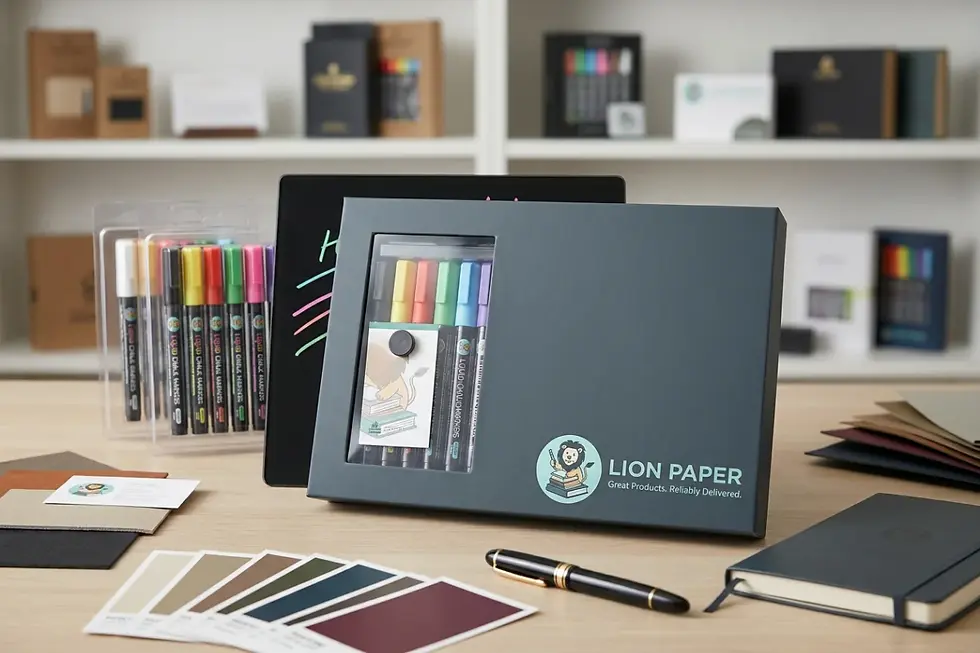
Retail-ready custom packaging formats and bundled stationery multi-packs.
Sourcing Liquid Chalk Markers: Frequently Asked Questions
What causes liquid chalk markers to leak or pool during writing?
Liquid chalk marker leakage is typically caused by improper valve spring tension, damaged nib seating, or excessive internal pressure. High-quality manufacturing incorporates calibrated POM valve cores that maintain balanced internal pressure and seal tightly when not depressed.
How can buyers prevent liquid chalk ink from drying out in storage?
To maximize shelf life (typically 24 months), markers should use high-barrier polypropylene (PP) barrels, precision inner-cap gaskets, and hermetically sealed foil outer packaging. Storing markers horizontally at moderate temperatures also prevents pigment sedimentation at the valve tip.
What certifications are required to import liquid chalk markers into North America and Europe?
In North America, markers must comply with ASTM D-4236 (LHAMA toxicological review) and CPSIA lead/phthalate limits. In the European Union and the UK, markers must pass EN 71-3 (safety of toys/heavy metal migration), REACH chemical compliance, and bear CE or UKCA markings where applicable.
FAQ
What causes liquid chalk markers to leak or pool during writing?
Liquid chalk marker leakage is typically caused by improper valve spring tension, damaged nib seating, or excessive internal pressure. High-quality manufacturing incorporates calibrated POM valve cores that maintain balanced internal pressure and seal tightly when not depressed.
How can buyers prevent liquid chalk ink from drying out in storage?
To maximize shelf life (typically 24 months), markers should use high-barrier polypropylene (PP) barrels, precision inner-cap gaskets, and hermetically sealed foil outer packaging. Storing markers horizontally at moderate temperatures also prevents pigment sedimentation at the valve tip.
What certifications are required to import liquid chalk markers into North America and Europe?
In North America, markers must comply with ASTM D-4236 (LHAMA toxicological review) and CPSIA lead/phthalate limits. In the European Union and the UK, markers must pass EN 71-3 (safety of toys/heavy metal migration), REACH chemical compliance, and bear CE or UKCA markings where applicable.


Comments