


Lined Writing Pad Tear Quality: Engineering, Specs, and Manufacturing Guide

Lined writing pad tear quality is determined by the precise balance of perforation teeth-to-tie ratios or flexible padding glue formulation, ensuring sheets detach cleanly without jagged edges, paper fiber tears, or premature pad disintegration. High-performance tear-off pads combine structural backing stability, grain direction alignment, and tightly controlled perforation depth to achieve effortless page removal while maintaining pad integrity across repeated use.
What Key Factors Define Writing Pad Tear Performance?
Lined writing pad tear quality depends on the interaction between mechanical perforation rules, binding adhesives, substrate grain direction, and paper basis weight. When evaluating clean tear legal pad manufacturing, quality is measured by edge smoothness, separation force, and structural retention of the remaining sheets.
Several core variables dictate separation mechanics:
Paper Fiber Direction (Grain Direction): Perforations executed perpendicular to the paper grain require sharper blades and shorter ties to prevent fiber elongation and tearing along the grain line instead of the perforation track.
Substrate Basis Weight (GSM) and Density: Heavier sheets (80–120 GSM) possess higher tensile strength, demanding distinct micro-perforation spacing compared to standard 56–70 GSM legal pad paper.
Perforation Tie-to-Cut Ratio: The width of the uncut paper bridge ("tie") relative to the cut slit determines how much tensile force is necessary to initiate and propagate the tear.
Binding Retention Force: The top header, whether stapled, stitched, or adhesive-bound, must exert greater clamping force than the tear resistance of the perforation line. If clamping force is insufficient, pulling a page dislodges the entire pad structure.
+----------------------------------+----------------------------------+ | Performance Metric | High-Quality Tear | Substandard Tear |
+----------------------------------+----------------------------------+ | Edge Quality | Crisp, smooth micro-fringe | Jagged, torn fibers, paper tabs | | Separation Force | Predictable, smooth linear pull | Snags, diagonal tearing across text| | Pad Integrity | Header and spine remain intact | Header lifts, adjacent pages rip | | Residue Retention | Clean detachment along line | Loose paper debris, messy stub |
+----------------------------------+----------------------------------+
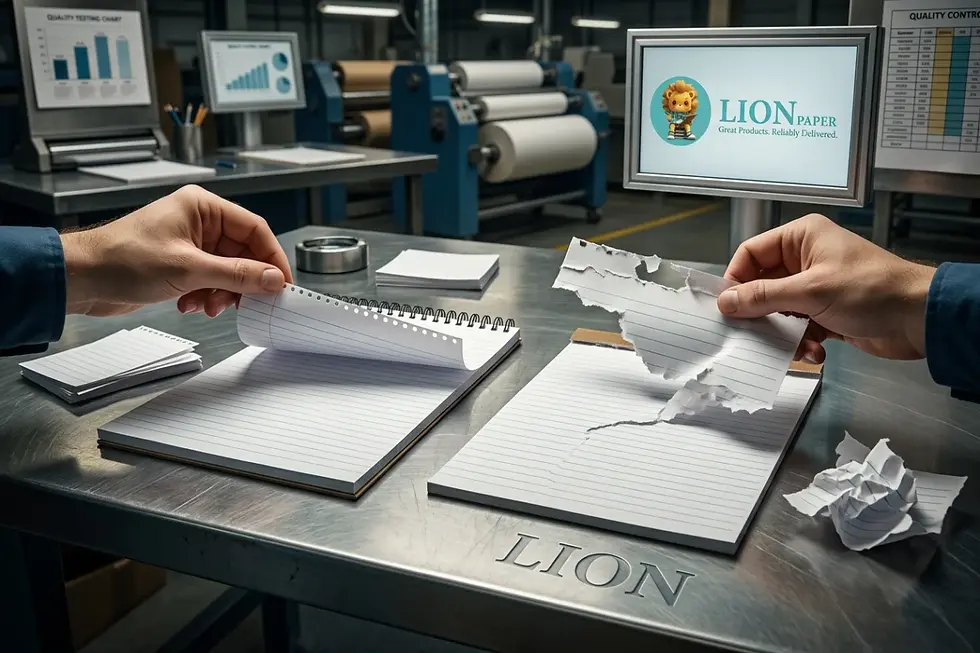
Optimized teeth-to-tie ratios eliminate jagged edges and preserve pad structure.
How Do Perforated and Glued Top Bindings Compare for Tear Resistance?
Choosing between perforated writing pad tear resistance and notepad top glue binding quality depends on the intended usage scenario, required sheet retention, and aesthetic design.
Perforated Top Construction (Legal Pads & Stitched Headers)
In perforated legal pads, sheets are secured via heavy-duty wire staples or thread stitching through a rigid paperboard header strip, with a mechanical perforation line pressed directly beneath the binding.
Mechanism: Perforations create deliberate micro-fractures along a horizontal axis. The remaining paper ties hold the sheets securely during transportation and flipping.
Strengths: Outstanding sheet retention prior to tearing; zero risk of unintended sheet loss; reliable sheet count integrity.
Considerations: Requires precise mechanical calibration of perforation blades to prevent sheets from detaching accidentally during page turns.
Top Glue Binding (Padded Memo Pads & Desk Blocks)
Top glue padding utilizes specialized synthetic water-based or hot-melt adhesive compounds applied along the cut top edge of the pad stack without mechanical perforation.
Mechanism: Sheets are held together purely by adhesive cohesion along their cross-sectional fiber edges. Tearing a sheet involves shearing the glue film away from the top edge.
Strengths: Completely flat top profile; 100% full-page yield without stub remnants; cost-effective manufacturing.
Considerations: Adhesives must balance flexibility with release strength. Glue formulations that dry too brittle cause sheets to crack off in clumps, while excessively tacky glue results in adhesive residue remaining on detached sheets.
What Are the Technical Perforation Specs for Clean-Tear Engineering?
Achieving clean tear performance requires custom writing pad perforation specs calibrated to specific paper grades, ruling densities, and sheet counts.
Perforation rules are defined by Teeth Per Inch (TPI) and the ratio of cut length to tie length:
+----------+---------------+--------------+----------------------------------+ | Spec Grade | TPI Range| Cut Length | Tie Length | Typical Paper Substrates |
+----------+---------------+--------------+----------------------------------+ | Micro-Perf | 30–50 | 0.50–0.70 mm | 0.15–0.25 mm | 80–120 GSM Woodfree / Offset | | Standard | 12–20 | 1.00–1.50 mm | 0.40–0.60 mm | 60–75 GSM Standard Writing Paper | | Coarse Perf | 6–10 | 2.50–3.50 mm | 0.80–1.20 mm | Heavy Cardstock / Multi-part NCR |
+----------+---------------+--------------+----------------------------------+
Micro-Perforation Calibration
Micro-perforations (30–50 TPI) provide a clean, virtually smooth edge when detached, making them standard for executive notebooks, corporate stationery, and high-end legal pads. Because ties are extremely small (under 0.25 mm), the pulling force separates the paper fibers instantaneously along the horizontal line without diagonal drift.
Blade Wear and Tool Maintenance
Perforation blades dull over sustained production runs. Dull blades crush paper fibers rather than cleanly slitting them, increasing the tear resistance and leading to jagged edges. Lion Paper implements standardized SOP maintenance cycles across automated production lines in our Jiaxing and Cambodia facilities, ensuring blade replacement intervals prevent fiber crushing across multi-thousand pad batches.

Precision perforation tooling maintains consistent Teeth Per Inch (TPI) across production batches.
How Do Backing Boards and Header Strips Influence Tear Stability?
Clean sheet separation requires mechanical counter-resistance provided by the structural backing and header components.
Backing Board Rigidity
When a user tears a sheet from a lined pad, downward tensile force creates flexural stress on the back of the pad. If the backing board bends excessively during the pull, the angle of tear changes dynamically, causing the tear to track away from the perforation line into the ruled writing area.
Standard Utility Pads: 400–600 GSM Chipboard / Greyboard.
Professional Desk Pads: 800–1200 GSM Heavy Solid Greyboard, ensuring full rigidity when writing and tearing without desk support.
Rigid Portfolio Backers: 1.5–2.0 mm Laminated Hardboard for zero-flex performance.
Header Strip Reinforcement and Fastening
In stitched or stapled legal pads, the header strip sandwiches the top edge of the paper block against the backing board. Key structural requirements include:
Heavyweight Header Stock: 250–350 GSM coated board or tape-wrapped cloth binding prevents staple pull-through.
Staple Clinch Consistency: Wire staples must be fully clinched with even compression across the entire pad width to distribute clamping pressure equally from left to right.
Perforation Offset: The perforation line should sit exactly 2–4 mm below the header edge to allow the paper to hinge naturally without stressing the perforation line during page turns.
How Is Writing Pad Tear Quality Tested in Manufacturing QC?
Standardized quality control testing protocols ensure consistent tear quality across high-volume production.
+-------------------------------------------------------------------+ | QC Inspection Step | Testing Procedure & Acceptance Threshold |
+-------------------------------------------------------------------+ | Initial Pull Angle | 45° and 90° manual pull tests at both edges and center. | | Fiber Retention Test | Visual inspection for fiber pullout exceeding 0.5 mm beyond line. | | Remaining Pad Test | Verification that adjacent under-sheets experience zero tearing. | | Glue Release Force | Tensile meter peel testing to measure adhesive shear threshold. | | Multi-Sheet Flip | 50-cycle back-and-forth page flip without premature detachment. |
+-------------------------------------------------------------------+
Lion Paper applies ISO 9001-aligned controls and standardized AQL sampling protocols across its 3,000-square-meter Jiaxing development facility and 10,000-square-meter Cambodia mass-production plant. Notebooks and writing pads—part of an annual production volume exceeding 5 million units—are screened against detailed defect catalogues to eliminate common tear issues such as offset cut lines, blade chatter marks, and adhesive penetration into the writing surface.

Standardized peel testing confirms adhesive flexibility and prevents page clumping.
Sourcing Checklist for Custom Writing Pad Perforation and Binding Specs
When preparing a Request for Quotation (RFQ) for custom writing pads, defining structural parameters ensures factory-calibrated tear performance.
Pad Dimensions & Sheet Count: Specify trim size (e.g., Letter, Legal, Junior Legal, A4, A5) and exact sheet count (typically 30, 50, or 100 sheets).
Substrate Specifications: Paper type (e.g., FSC-certified woodfree paper, recycled offset, smooth cream paper) and basis weight (60 GSM to 100 GSM).
Ruling Specifications: Ruling style (Narrow, Medium/College, Wide, Dot Grid, Graph) and ink specifications (soy-based or low-impact inks).
Detachment Mechanism: Micro-perforation (specify TPI or clean-tear requirement) vs. top padding compound (flexible cold glue vs. peelable hot-melt).
Header & Spine Construction: Tape-bound top, stapled header with wrap-around linen tape, or wire-stitched with perforated fold-over flap.
Backing Board Thickness: Standard chipboard (400–600 GSM) vs. extra-rigid heavy board (800–1200 GSM).
Compliance & Packaging Standards: Requirements for FSC chain-of-custody tracking, retail-ready shrink-wrapping, barcode labeling, and protective master carton palletization.
To ensure your custom pads meet exact clean-tear tolerances and retail quality standards, share your pad size, ruling, paper GSM, sheet count, backing board, cover, and packaging requirements with Lion Paper for a writing-pad sourcing review.
FAQ
What causes writing pad pages to tear diagonally instead of along the perforation?
Diagonal tearing happens when the perforation tie-to-cut ratio is too wide, the blade is dull, or the paper grain direction runs perpendicular to an inadequately perforated rule. In addition, insufficient clamping force in the top header or a flimsy backing board allows the pad to flex during the pull, diverting the tear path away from the perforation line.
What is the difference between standard perforation and micro-perforation on writing pads?
Standard perforation utilizes 10 to 20 Teeth Per Inch (TPI) with larger paper ties, resulting in visible fringe tabs after detachment. Micro-perforation features 30 to 50 TPI with microscopic ties (under 0.25 mm), producing a virtually smooth, clean edge suitable for professional legal pads and executive notebooks.
How does paper GSM affect the choice of top glue binding formulations?
Lighter papers (56–70 GSM) absorb moisture faster and require flexible adhesives with controlled viscosity to prevent bleed-through between sheets. Heavier papers (80–120 GSM) possess higher tensile strength and require stronger adhesive elasticity to hold the stack firmly while releasing individual pages smoothly without peeling off backing fibers.


Comments