


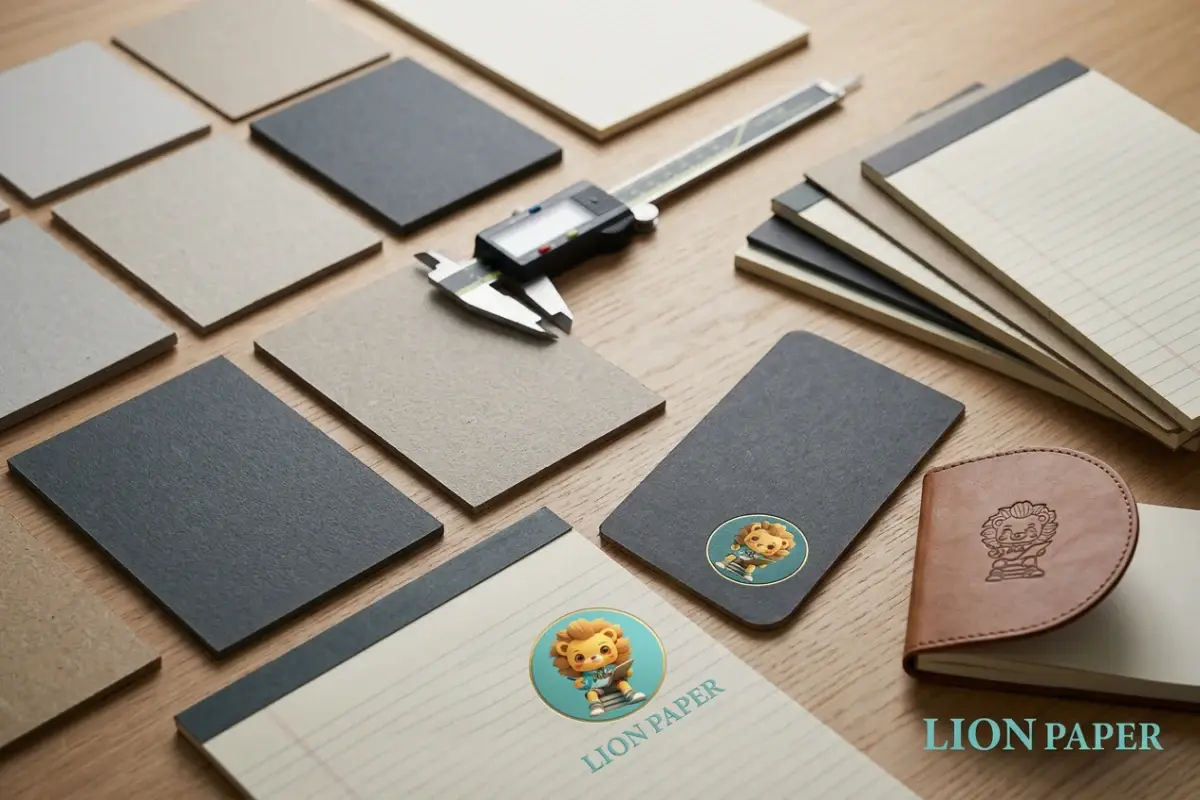
Lined Writing Pad Backing Board Guide: Materials, Thickness & Sourcing Specs
A lined writing pad backing board provides the foundational rigidity required for handheld and desktop writing, typically specified as 800 to 1800 GSM greyboard, chipboard, or duplex board depending on sheet count, retail tier, and shipping weight targets. Proper backing prevents curling, supports micro-perforated tear-off actions, and ensures structural stability from first page to last.
What is the primary role of a lined writing pad backing board?
A lined writing pad backing board serves as the structural foundation of tear-off notepads, legal pads, desk pads, and wire-bound writing pads. While standard text pages provide the medium for note-taking, the rear stiffener gives the entire stationery item its structural integrity, protecting interior leaves during transportation and retail display.
Without a calibrated backing board, notepads suffer from structural deficiencies that impair usability and brand perception:
Handheld Writing Support: Mobile professionals, inspectors, and students frequently write without a desk surface. A stiff backing board acts as a portable desktop, dispersing localized pen pressure across the pad.
Tear-off Stability: When users remove sheets along a top glue line or micro-perforated fold, the backing board resists tensile deformation, ensuring clean sheet separation without ripping the binding header.
Moisture and Curling Resistance: Changes in ambient humidity cause raw paper blocks to warp. A dense backing board acts as a planar anchor, counteracting hygroscopic dimensional shifts in the paper stack.
Retail Display and Stacking Integrity: On retail shelves, pallet displays, and e-commerce shipping cartons, pad backing prevents corner sagging, crushing, and bent spine edges.
To balance tactile rigidity and shipping weight, stationery developers evaluate backing boards across density (GSM), caliper thickness (points or millimeters), surface smoothness, and moisture content.

Material density and multi-ply composition determine the tensile tear resistance and surface finish of notepad backing boards.
How do greyboard, chipboard, and duplex board compare for pad backing?
Choosing the right board substrate determines the pad's mechanical performance, visual grade, and environmental footprint. Stationery manufacturers primarily select among recycled chipboard, high-density greyboard, kraft board, and duplex board.
Standard Chipboard: An economical, unlined recycled board made from mixed post-consumer waste. It exhibits a natural, slightly variegated brownish-grey tone with visible fiber specks. Chipboard is the standard choice for commodity legal pads and high-volume office pads due to its cost efficiency and adequate stiffness.
High-Density Greyboard (Binder's Board): A multi-ply, compressed recycled board produced under high roll pressure. It provides superior surface flatness, minimal caliper variance, and exceptional dimensional stiffness. Writing pad greyboard backing is preferred for premium corporate stationery, executive portfolios, and heavy desk pads where edge fraying and flexing must be eliminated.
Coated Duplex Board (White-Back or Kraft-Back): Formulated with a grey or kraft core layered with a bleached or clay-coated top ply. This substrate is chosen when brands require exterior branding, barcodes, or custom grid instructions directly printed on the notepad reverse.
Solid Kraft Board: Made from unbleached virgin or recycled sulfate pulp, offering high tensile tear strength and superior water resistance compared to standard recycled boards. It is widely used in rugged industrial notepads and eco-conscious lifestyle collections.
Substrate Type | Typical Density Range | Caliper (Thickness) | Key Surface Feature | Common Applications | Sourcing Advantage |
|---|---|---|---|---|---|
:--- | :--- | :--- | :--- | :--- | :--- |
Recycled Chipboard | 600–1200 GSM | 0.8 mm – 1.6 mm | Unlined, matte, natural fiber texture | Standard legal pads, student memo pads | Lowest material cost, readily accessible |
High-Density Greyboard | 900–1800 GSM | 1.2 mm – 2.5 mm | Calendered smooth, uniform grey | Executive lined pads, luxury desk jotters | Maximum stiffness, warp resistance |
White-Back Duplex | 450–900 GSM | 0.6 mm – 1.2 mm | White coated top ply, grey core | Retail branded notepads with back printing | Crisp four-color offset printability |
Solid Kraft Board | 500–1000 GSM | 0.7 mm – 1.4 mm | Smooth unbleached brown | Sustainable and outdoor utility notepads | High puncture and tear resistance |
What chipboard pad backing thickness and GSM should you specify for different sheet counts?
Selecting chipboard pad backing thickness requires balancing the page block thickness with the target rigidity profile. A backing that is too thin causes a 100-sheet legal pad to sag under its own weight, while an excessively thick stiffener on a 30-sheet memo pad adds unnecessary freight expense without improving user experience.
Board caliper is measured in points (1 pt = 0.001 inch) in North America and millimeters (mm) or GSM (grams per square meter) globally. Below is the engineering matrix for aligning sheet count, paper basis weight, and backing caliper:
Lightweight Notepads (25–30 Sheets, 70–80 GSM):
Recommended Backing: 450–650 GSM (approx. 20–28 pt / 0.5–0.7 mm chipboard).
Use Case: Promotional event giveaways, hotel bedside jotters, and tear-off shopping lists where low unit cost and low shipping volume dominate.
Standard Writing & Legal Pads (50 Sheets, 70–80 GSM):
Recommended Backing: 750–1000 GSM (approx. 32–42 pt / 0.8–1.1 mm chipboard or greyboard).
Use Case: Standard office legal pads, letter-size lined pads, and student work pads. This is the baseline legal pad stiffener board specification for high-volume retail supply chains.
Heavy-Duty and Executive Pads (80–100 Sheets, 80–100 GSM):
Recommended Backing: 1100–1500 GSM (approx. 48–60 pt / 1.2–1.6 mm high-density greyboard).
Use Case: Corporate board meeting pads, law firm docket pads, and heavy-use project planners requiring rigid lap-writing stability.
Oversized Desk Pads & Architecture Jotters (50–100 Sheets, A3 / 11x17 Inch):
Recommended Backing: 1500–2000 GSM (approx. 60–80 pt / 1.6–2.2 mm greyboard, frequently laminated with non-slip base paper).
Use Case: Broad-format workspace desk blotters that must remain perfectly flat across large surface spans without curling at corner edges.

Precise caliper and GSM control prevent structural warpage while optimizing container freight utilization.
How does backing board selection impact legal pad stiffness and logistics costs?
In high-volume stationery procurement, the backing board accounts for 15% to 35% of a finished lined writing pad's total gross weight. Optimizing board density directly influences ocean freight utilization, parcel shipping tiers, and carbon footprints.
To balance structural strength and transport economics, supply chain managers evaluate three physical metrics:
Grammage-to-Bending Stiffness Ratio: Dense, multi-calendered greyboard provides higher Taber stiffness values per millimeter than loose-formed chipboard. Specifying a slightly higher density (1000 GSM high-calender greyboard) often allows a brand to reduce thickness from 1.5 mm to 1.2 mm, saving overall cubic carton volume while maintaining required rigidity.
Container Cube Optimization: On an FCL (Full Container Load) order of 500,000 legal pads, reducing backing board thickness by just 0.3 mm compresses master carton heights, yielding an extra 8% to 12% in unit capacity per 40ft High Cube container.
Postal and E-Commerce Weight Tiers: For direct-to-consumer (DTC) stationery brands, shipping a lined pad unit under 16 oz (1 lb) or under specific carrier flat-rate thresholds is vital. Fine-tuning the backing board between 800 GSM and 1000 GSM can prevent a product from crossing into higher parcel delivery surcharges.
At Lion Paper Products, our engineering team conducts drop-test and load-bearing simulations across our Jiaxing, China design center and Cambodia mass-production facility. By evaluating dual-site manufacturing options, we help brands select backing board specifications that protect product structure while minimizing landed import costs.
What quality control standards prevent warpage and edge delamination in writing pad greyboard backing?
Backing boards made from recycled paper fibers are sensitive to environmental shifts. Quality control protocols during board manufacturing, adhesive application, and palletization prevent defects such as planar warpage, edge delamination, and paper dust.
Moisture Content Equilibrium (6%–8% Target): Recycled greyboard must be conditioned to match the relative humidity of the interior paper block (typically 45%–55% RH). If the board's moisture content exceeds 9%, water vapor migrates outward, causing inward concave bowing. Conversely, dry boards below 5% absorb ambient air humidity and buckle convexly.
Fiber Grain Direction Alignment: Paper and board expand predominantly across their cross-grain direction (CD) rather than machine direction (MD). The grain of the backing board must run parallel to the pad spine (longitudinal for top-bound pads). Misaligned grain direction causes asymmetric diagonal curling after top glue binding.
Adhesion and Spine Lamination Testing: In tape-bound and glued writing pads, the binding strip (cloth tape, coated paper, or hot-melt adhesive) joins the top header to the backing board. Quality testing measures 180-degree peel strength to confirm the adhesive penetrates board surface pores without causing ply delamination under tension.
Clean Edge Shearing and Dust Minimization: Low-grade chipboard slitting produces micro-particulates and frayed edges. Rotary carbide knives with vacuum dust extraction yield clean, burr-free borders that prevent carton contamination and automatic wrapping feeder jams.

Comprehensive RFQ specifications detail substrate thickness, corner radius options, and environmental compliance parameters.
What custom notepad backing specifications are needed for a comprehensive RFQ?
When preparing a Request for Quotation (RFQ) for custom writing pads, supplying precise structural specifications prevents sampling delays and inaccurate quotes. An engineering-ready backing board specification package includes both substrate parameters and finishing requirements.
To ensure rapid prototyping and accurate BOM (Bill of Materials) costing, supply the following parameters to your manufacturing partner:
Substrate Selection: Chipboard (standard unlined), greyboard (calendered rigid), white-back duplex, or solid unbleached kraft.
Caliper & Basis Weight: Specified in exact GSM (e.g., 1000 GSM) and target thickness in millimeters or points (e.g., 1.2 mm / 48 pt) with allowable tolerances (+/- 5%).
Corner Profiles: Square-cut corners (standard legal pads) or radius rounded corners (3 mm, 5 mm, or 8 mm for snag-free carrying in bags and portfolios).
Surface and Back Finishing: Bare unprinted board, solid flood-coat ink, matte lamination, foil-stamped logo, or four-color printed company information.
Functional Add-Ons: Magnetic backing strips, non-skid rubberized corner pads, pen loop anchor slots, or adhesive base strips.
Sustainability & Compliance Certifications: Requirement for FSC-certified (FSC Mix or FSC Recycled) material tracing, heavy-metal restrictions (CPSIA/RoHS compliance), and acid-free archival stability.
Lion Paper Products integrates design, prototyping, and raw material sourcing with scalable production across China and Cambodia. Operating under ISO 9001 and certified auditing frameworks including SMETA, WCA, and FSC, our facilities manufacture over 5 million notebooks and writing pads annually for global retail and stationery brands.
To optimize your product lineup with the right balance of material stiffness, design appeal, and freight economics, contact our team to review your lined writing pad backing board, paper ruling, and packaging specifications for your next production run.
Frequently Asked Questions
What is the difference between greyboard and chipboard for writing pad backing?
While both are made from recycled paper pulps, high-density greyboard undergoes intense mechanical calendering to produce a denser, smoother, and more uniform core with minimal caliper variance. Chipboard is less compressed, slightly lighter in density, and features a raw, unlined fiber appearance, making it a cost-effective choice for standard legal pads.
Can a lined writing pad backing board be customized with full-color printing?
Yes. To achieve high-resolution exterior printing, manufacturers use coated duplex board (clay-coated white surface over grey core) or mount a printed 128–157 GSM art paper sheet onto high-density greyboard. This allows full-color branding, product barcodes, calendar grids, or company profiles on the back of the notepad.
How does grain direction affect notepad backing board quality?
Board fibers expand and contract primarily perpendicular to the fiber grain direction. Aligning the board grain parallel to the pad spine ensures that dimensional changes occur evenly along the length of the pad, preventing spine puckering, diagonal twisting, and page detachment during environmental humidity fluctuations.
Is recycled chipboard compliant with international environmental and safety standards?
Recycled chipboard and greyboard sourced through certified supply chains comply with FSC Mix or FSC Recycled criteria. Reputable stationery manufacturers also verify that recycled boards undergo testing for heavy metals, phthalates, and formaldehyde to meet North American (CPSIA) and European (REACH/EN 71-3) consumer product safety regulations.
FAQ
What is the difference between greyboard and chipboard for writing pad backing?
While both are made from recycled paper pulps, high-density greyboard undergoes intense mechanical calendering to produce a denser, smoother, and more uniform core with minimal caliper variance. Chipboard is less compressed, slightly lighter in density, and features a raw, unlined fiber appearance, making it a cost-effective choice for standard legal pads.
Can a lined writing pad backing board be customized with full-color printing?
Yes. To achieve high-resolution exterior printing, manufacturers use coated duplex board (clay-coated white surface over grey core) or mount a printed 128–157 GSM art paper sheet onto high-density greyboard. This allows full-color branding, product barcodes, calendar grids, or company profiles on the back of the notepad.
How does grain direction affect notepad backing board quality?
Board fibers expand and contract primarily perpendicular to the fiber grain direction. Aligning the board grain parallel to the pad spine ensures that dimensional changes occur evenly along the length of the pad, preventing spine puckering, diagonal twisting, and page detachment during environmental humidity fluctuations.
Is recycled chipboard compliant with international environmental and safety standards?
Recycled chipboard and greyboard sourced through certified supply chains comply with FSC Mix or FSC Recycled criteria. Reputable stationery manufacturers also verify that recycled boards undergo testing for heavy metals, phthalates, and formaldehyde to meet North American (CPSIA) and European (REACH/EN 71-3) consumer product safety regulations.