


How to Prevent Laser Engraved Wood Cover Smoke Staining in Notebook Manufacturing

Laser engraved wood cover smoke staining is caused by re-deposited vaporized resins and combustion char during laser processing. Industrial notebook manufacturers eliminate this defect by applying low-tack protective transfer tape, calibrating high-pressure air assist and exhaust systems, selecting low-resin engineered wood veneers, and utilizing post-engraving dry sanding or protective matte clear coats before final bookbinding and assembly.
What Causes Smoke Staining and Burn Marks on Laser Engraved Wooden Notebook Covers?
Smoke staining on laser engraved wooden notebook covers occurs when a concentrated CO2 or fiber laser beam vaporizes the organic polymers—primarily lignin, cellulose, and natural resins—present within the wood matrix. As the laser heats the wood fibers past their thermal decomposition threshold (typically above 250°C), these vaporized compounds combust and atomize into a dense aerosol cloud containing microscopic carbon soot, tar, and volatile organic compounds (VOCs).
When exhaust airflow is inadequate or when air assist velocities fail to evacuate these particulates rapidly, the aerosol settles onto the cooler surrounding surface of the wood cover. The condensable tars quickly cool and adhere tenaciously to the open cellular pores of natural wood grain. This leaves a yellowish-brown to deep black haze around the engraved vector contours or rasterized lettering, commonly known in factory settings as a "smoke halo" or char ring.
Several physical and thermal factors govern the severity of wood cover engraving burn marks:
Substrate Resin and Moisture Density: Softwoods (such as pine or cedar) and high-resin hardwoods contain elevated levels of sap, which volatize into sticky, tar-heavy aerosols that stain surfaces much faster than fine-grained, low-resin species like European beech or hard maple.
Focal Length and Beam Dispersion: An improperly focused laser focal lens spreads thermal energy across a broader spot diameter, causing excessive peripheral scorching instead of clean, crisp molecular ablation.
Laser Cutting vs. Vector Engraving Heat Build-Up: Vector cut paths, which require 100% beam penetration through 2.5 mm to 5.0 mm wood panels, generate dramatically higher thermal plumes than shallow surface raster engraving, making through-cut perimeter edges the primary source of heavy smoke deposition.
Material Back-Reflection: When wood boards lie flat on metal honeycomb cutting beds, the laser beam hits the metal supports below, creating thermal back-flash and smoke condensation on the reverse side of the notebook cover.
How Does Surface Masking Prevent Wood Cover Engraving Burn Marks During Mass Production?
Industrial surface masking serves as a physical sacrificial barrier that completely isolates the finished wood surface from airborne soot, vaporized resin droplets, and thermal scorch marks during laser cut wood notebook cover manufacturing. Applying a protective film ensures that all condensable tars settle onto the masking medium rather than contaminating the wood pores.
To achieve flawless results on commercial stationery lines, manufacturing facilities utilize specialized masking media and standardized lamination protocols:
Natural Kraft Application Tape: High-grade, saturated flatback paper tape with a natural rubber-based adhesive is preferred over synthetic plastic films. Paper masking allows the laser beam to vaporize the tape cleanly without melting, shrinking, or emitting chlorinated toxic fumes.
Controlled Adhesive Tack Ratings: Adhesives must provide a low-to-medium tack rating (typically 10 to 14 oz/inch peel adhesion). High-tack adhesive leaves sticky chemical residues that attract dust and discolor raw wood grain, whereas low-tack tapes lift prematurely when subjected to high-velocity air assist jets, allowing smoke to bleed underneath the edges.
Pneumatic Roll Lamination: In high-volume production, masking is applied using automated cold-roll laminators with adjustable nip roller pressure. This eliminates air pockets, wrinkles, and micro-tunnels where soot could otherwise channel across the notebook cover.
Automated Mechanical De-Masking: Once laser processing concludes, automated sticky-roller de-masking or manual ergonomic scrapers peel the protective paper cleanly along the grain orientation at a 45-degree angle, preserving fine engraved typographic details and delicate filigree lines.

Protective paper masking tape acts as a barrier against vaporized resins and smoke halos.
What Machine Settings and Air Assist Configurations Eliminate Laser Charring?
Eliminating smoke staining requires balancing laser kinetic parameters, pneumatic air delivery, and atmospheric exhaust evacuation. When machine settings are calibrated precisely, the wood is vaporized instantly, and the resulting aerosol is evacuated before it can condense.
High-Pressure Coaxial Air Assist: Directing a continuous, concentrated stream of clean, compressed air (typically 2.0 to 4.5 bar / 30 to 65 PSI) through the laser nozzle directly onto the focal strike point accomplishes two critical objectives: it quenches combustion micro-flames immediately to prevent burning, and it expels vaporized carbon downward through the kerf before it settles across the surface.
Calibrated Exhaust Bed Flow Rates: Industrial cutting tables require downdraft vacuum exhaust systems delivering a minimum flow rate of 800 to 1,200 CFM (cubic feet per minute). This strong negative pressure draws all airborne smoke downward through the honeycomb support bed, preventing atmospheric recirculating plumes inside the machine chamber.
Frequency and Pulse Rate Balancing (PPI / Hz): Laser firing frequency dictates how many individual thermal pulses strike each linear millimeter of wood. Setting pulses per inch (PPI) between 300 and 500 PPI minimizes heat accumulation. Excessively high PPI (over 800 PPI) re-melts the wood substrate, causing extensive localized scorching, while low PPI leaves jagged, serrated cut lines.
Bi-Directional High-Speed Raster Scanning: For decorative graphic engraving, running high-speed bi-directional raster passes (600 to 1,000 mm/s) at lower peak wattages distributes thermal energy evenly, avoiding deep burn troughs that generate excessive soot.
The following table outlines standard industrial laser parameter baselines for clean processing across typical 3.0 mm notebook cover substrates:
Substrate Specification | Laser Type & Power | Cutting Speed & PPI | Engraving Speed & Power | Air Assist Pressure | Exhaust Strategy | |
|---|---|---|---|---|---|---|
:--- | :--- | :--- | :--- | :--- | :--- | :--- |
3.0 mm Natural Birch Plywood | 100W–150W CO2 Laser | 18–24 mm/s at 400 PPI | 600 mm/s at 18–22% Power | 3.5 Bar (50 PSI) | High-vacuum downdraft | |
2.5 mm American Walnut Veneer | 80W–120W CO2 Laser | 15–20 mm/s at 350 PPI | 750 mm/s at 15–18% Power | 3.0 Bar (43 PSI) | Zoned chamber extraction | |
3.0 mm Low-Formaldehyde MDF Core | 100W–150W CO2 Laser | 12–16 mm/s at 500 PPI | 500 mm/s at 20–25% Power | 4.0 Bar (58 PSI) | Honeycomb downdraft | |
2.0 mm Carbonized Bamboo Sheet | 80W–100W CO2 Laser | 14–18 mm/s at 400 PPI | 650 mm/s at 16–20% Power | 3.5 Bar (50 PSI) | Multi-port overhead + bed |
How Do Material Choices Impact Laser Cut Wood Notebook Cover Manufacturing?
Substrate composition directly dictates the chemical volume of smoke produced during laser fabrication. Natural wood is anisotropic and heterogeneous, meaning its chemical and physical density varies across growth rings, grain directions, and resin pockets. In contrast, engineered substrates offer uniform density profiles that significantly reduce burning risks when properly specified.
Engineered Wood Veneer over MDF Core: Natural micro-veneers (0.3 mm to 0.6 mm thick) laminated over a structural high-density or medium-density fiberboard (MDF) core represent the gold standard for premium notebook covers. When bonded with low-resin, non-phenolic adhesives, these boards burn predictably, generate minimal sticky sap, and resist ambient moisture warping across global retail supply chains.
Multi-Ply Laser-Grade Plywood: Standard commercial plywood contains thick exterior-grade phenolic glue lines that char into heavy, toxic black soot when intersected by a laser beam. True laser-grade plywood utilizes interior-grade urea-formaldehyde or eco-friendly soy-based resins, which cut cleanly without producing greasy carbon staining.
Solid Natural Hardwoods vs. Softwoods: Premium collections utilizing solid hardwoods (such as walnut, oak, cherry, or maple) must undergo precision kiln drying to reach a balanced moisture content (MC) of 8% to 12%. Elevated moisture causes steam-induced sap boil-over during laser cutting, leading to dark, indelible perimeter halos.
Bamboo Panels: Bamboo is a dense grass fiber bonded under extreme pressure. Natural bamboo cuts with minimal char, whereas pre-carbonized bamboo contains caramelized natural sugars that darken easily under heat, requiring higher air assist pressure during production.

High-pressure air assist directs concentrated airflow to extinguish flames and eject carbon soot instantly.
What Post-Processing Methods Clean Residual Smoke and Burn Marks on Wood Covers?
When light smoke staining or edge char occurs during high-speed production runs, post-processing secondary finishing restores the pristine aesthetic of the wooden notebook covers prior to spine binding and cover assembly.
Automated Wide-Belt Sanding and Orbital Finishing: Passing raw engraved panels through dual-head wide-belt sanding machines equipped with fine-grit abrasives (240-grit followed by 320-grit) skims 0.05 mm to 0.1 mm from the top face. This instantly removes superficial smoke shadows without distorting the depth of laser engraving lines. For covers with 3D relief or living-hinge laser flex cuts, pneumatic random orbital hand sanders clean detailed corners efficiently.
Dry Demastication and Micro-Sponge Cleaning: High-density melamine foam sponges, used dry or slightly dampened with fast-evaporating technical solvents, mechanically abrade and lift micro-soot particles out of open wood grain. This avoids saturating the wood fibers with water, preventing grain raise and surface roughness.
Non-Polar Solvent Wiping: When removing stubborn resinous oils, factory technicians wipe the covers using lint-free microfiber cloths dampened with denatured alcohol, isopropyl alcohol (IPA 99%), or mineral spirits. These non-polar solvents dissolve sticky wood tars instantly and evaporate within seconds, leaving zero moisture residue that could warp thin notebook covers.
Protective Pre-Coat Sealers: Applying a preliminary UV-curable or water-based matte polyurethane clear coat prior to laser cutting seals the wood pores completely. Any smoke deposited during the laser cycle rests entirely on top of the cured lacquer barrier and can be wiped away with a dry dry-erase pad, eliminating the need for aggressive post-engraving sanding.
What Are the Wooden Journal Cover Quality Control and AQL Inspection Standards?
Ensuring aesthetic consistency across production batches of hundreds of thousands of units requires standardized wooden journal cover quality control protocols. Quality assurance teams execute systematic sampling and defect tracking based on international AQL (Acceptable Quality Limit) standards (ISO 2859-1 / ANSI/ASQ Z1.4 General Inspection Level II).
Quality inspectors categorize wooden notebook cover defects into three rigorous inspection tiers:
Critical Defects (AQL 0.0): Flaws that compromise safety, functionality, or regulatory compliance. Examples include sharp un-deburred splintering on outer borders, fractured living hinges, loose veneer delamination, or toxic chemical residue exceeding CPSIA/REACH limits.
Major Defects (AQL 1.0 or 1.5): Flaws that impair visual marketability and brand equity. Examples include visible smoke halos or char rings extending more than 0.5 mm beyond the engraving contour, burn-through penetrating more than 40% of the cover thickness, deep localized scorching, or panel warping exceeding 1.5 mm across diagonal corners.
Minor Defects (AQL 2.5 or 4.0): Minor cosmetic imperfections acceptable within controlled thresholds, such as slight natural wood grain color variations, faint micro-soot dust easily removed during final packing, or minor interior-facing masking tape remnants.
To ensure durability under diverse global environmental conditions, finished notebook covers undergo accelerated environmental stress testing:
Hygiene and Humidity Chamber Testing: Exposing wood panels to 40°C at 90% relative humidity for 72 hours verifies that the adhesive bond lines, veneer layers, and flexible cut spines do not warp, crack, or bubble.
Hinge Fatigue Cycling: For flexible wood journals featuring laser-kerf living hinges, pneumatic cycle testers articulate the spine 180 degrees for a minimum of 2,000 continuous open-and-close cycles to confirm structural fiber integrity.
Spectrophotometer Color & Depth Consistency: Digital optical micrometers ensure engraving depth remains within ±0.1 mm tolerances, while colorimeters verify that contrasting dark engraved areas meet brand visual tone standards across multi-thousand unit runs.
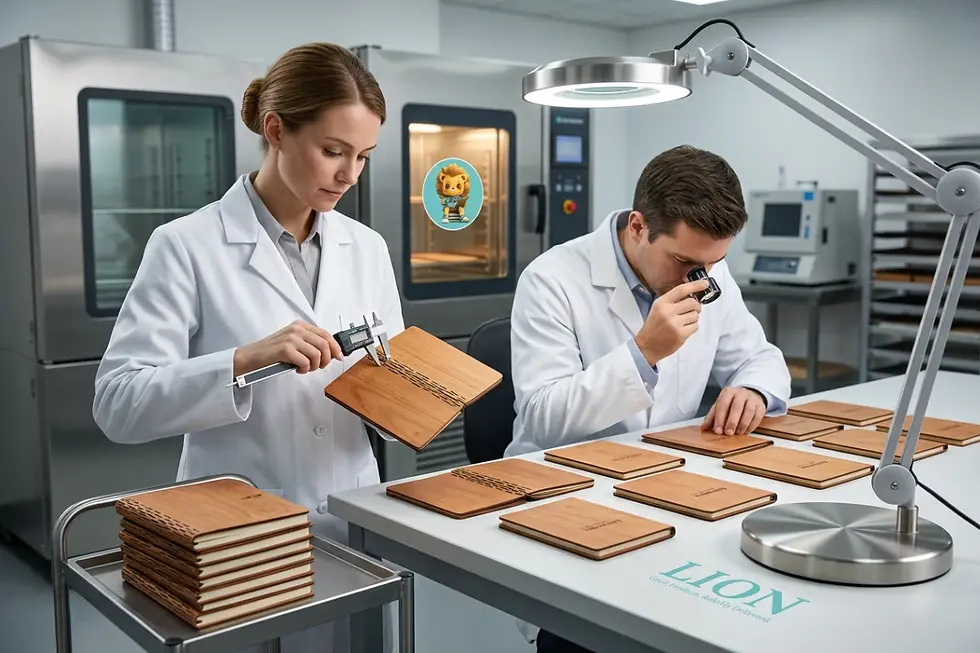
AQL inspection and quality control protocols ensure repeatable, smoke-free wood cover production.
How Does Lion Paper Optimize China–Cambodia Dual-Site Wooden Notebook Production?
Lion Paper Products (Jiaxing) Co., Ltd., founded in 2015, provides comprehensive supply-chain solutions for global stationery brands, retail chains, and creative lifestyle publishers. We bridge the gap from concept sketches to finished retail containers through our agile dual-site operating model spanning China and Cambodia.
Our 3,000-square-meter facility in Jiaxing, Zhejiang, functions as our core design, research, prototyping, and rapid sampling hub. Here, our structural packaging engineers and material specialists calibrate laser parameters, test eco-friendly masking tapes, and evaluate FSC-certified wood species and engineered veneer substrates. This rapid pre-production testing shortens product launch cycles and establishes clear, repeatable Standard Operating Procedures (SOPs) and defect boundary samples.
For cost-optimized mass manufacturing, our 10,000-square-meter facility in Cambodia delivers robust, high-volume production with an annual notebook capacity exceeding 5 million units. Operating modern automated laser cutting and engraving arrays, pneumatic laminating lines, and bookbinding machinery, the Cambodia plant ensures low landed costs, favorable trade compliance, and stable delivery timelines for volume retailers across North America, Europe, Australia, and the Middle East.
Every wood cover production run adheres to the "Lion Standard" of total quality control. Our integrated workflow incorporates FSC-traceable veneers, non-toxic waterborne adhesives, ISO 9001 quality frameworks, and social compliance audits including SMETA, WCA, GSV, FAMA, and CPSIA. Whether executing complex multi-ply living-hinge corporate gifts or high-volume private label retail journals, we guarantee pristine, smoke-free engravings, crisp bookbinding, and reliable retail-ready presentation.
Share your notebook dimensions, wood or veneer concept, laser engraving artwork, binding preference, target price point, and annual volume with our engineering team to receive a comprehensive wooden notebook manufacturing feasibility and sourcing review.
FAQ
Can smoke staining on wooden notebook covers be removed after engraving without sanding?
Yes. If the wooden cover was pre-treated with a cured matte lacquer or sealant prior to engraving, light surface smoke staining can be wiped away completely using a microfiber cloth dampened with isopropyl alcohol (IPA 99%) or denatured alcohol. Dry high-density melamine foam sponges can also lift superficial soot without scratching the surrounding wood grain.
Why does laser cutting produce more burn marks on plywood compared to MDF or solid veneer?
Commercial plywood relies on internal synthetic glue layers (such as phenolic or urea adhesives) between veneer plies. As the laser passes through these adhesive bonds, the glue vaporizes into dense, sticky chemical tars that condense heavily onto the surface. High-grade MDF-core engineered veneers or specialized laser-grade plywood utilize low-resin bonding agents that produce significantly less charring.
How does Lion Paper ensure wooden notebook covers do not warp during global ocean transit?
Lion Paper prevents warping by utilizing kiln-dried, moisture-balanced wood veneers (8% to 12% moisture content) bonded to dimensionally stable engineered cores. Finished wooden notebooks undergo 72-hour high-humidity environmental chamber testing, are shrink-wrapped in moisture-barrier film with silica desiccant packs, and are packed in heavy-duty export master cartons aligned with ISO and AQL quality packaging guidelines.


Comments