


ISO Week Numbers in Diaries: Prepress Engineering and Manufacturing Guide

ISO week numbers (ISO 8601) should be integrated into dated diaries and planners targeted at European, international corporate, and supply-chain logistics markets where Monday-start planning is standard. Incorporating these standardized numerical markers requires precise calendar calculation against 52- and 53-week year cycles, ensuring layout alignment, eliminating date-grid drift, and preventing costly prepress remakes or inventory obsolescence during custom dated planner manufacturing.
What Are ISO 8601 Week Numbers and Why Do Regional Markets Require Them?
ISO 8601 is the international standard covering the exchange of date- and time-related data. Under the ISO week date system, weeks are designated sequentially from Week 01 to Week 52 or Week 53. Understanding the foundational mathematical and structural rules of this standard is vital for global stationery brands and publishing houses.
Monday as Day One: Under ISO 8601, every calendar week strictly begins on Monday (Day 1) and ends on Sunday (Day 7). This contrasts with traditional North American civil calendars that designate Sunday as the initial day of the weekly column.
The Four-Day Majority Rule (Week 01 Definition): Week 01 of any given year is defined as the week that contains the first Thursday of the new Gregorian calendar year, or equivalently, the week that contains January 4th. If January 1st falls on a Friday, Saturday, or Sunday, those days belong to the final week (Week 52 or Week 53) of the preceding year.
The 53-Week Year Phenomenon: Most Gregorian calendar years have 52 ISO weeks (364 days). However, any year starting on a Thursday, or a leap year starting on a Wednesday, contains 53 ISO weeks (365 or 366 days). For example, 2026 and 2032 are 53-week years under ISO 8601.
Regional market demand dictates whether an ISO 8601 planner layout is mandatory or optional:
Europe (DACH, Nordics, UK, Benelux, France): Highly mandatory. Commercial operations, educational systems, production planning, and personal scheduling operate almost universally on ISO week numbers (e.g., "KW" for Kalenderwoche in Germany, "Vecka" in Sweden). A dated diary lacking week numbers faces severe commercial rejection in retail and B2B channels across these regions.
North America (USA, Canada): Highly situational. General consumer planners favor Sunday-start weekly layouts without numerical week tags. However, enterprise corporate planners, project management agendas, and academic appointment diaries frequently incorporate Monday-start grids with ISO numbers to coordinate with international operations.
Asia-Pacific & Australia: Hybrid. Corporate supply chain and B2B sectors use Monday-start ISO calendars, while retail mass-market consumer notebooks often alternate between Sunday and Monday formats depending on specific brand positioning.

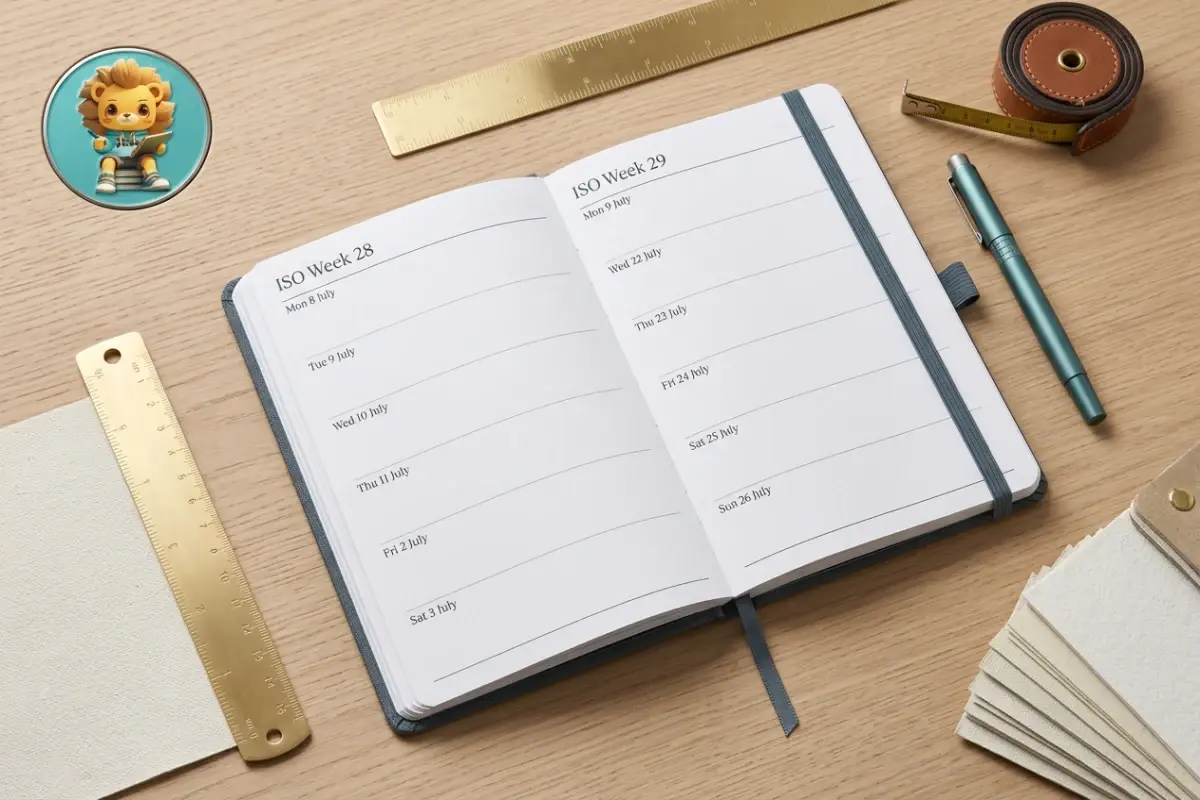
Precise typography and folio positioning ensure seamless navigation in ISO-compliant dated diaries.
When Should You Include vs. Omit Week Numbers in Custom Dated Planners?
Determining whether to include ISO week numbering depends on target demographics, channel distribution, and structural book thickness. Product development teams must evaluate several functional criteria before committing to dated diary prepress specifications.
Evaluation Metric | Include ISO Week Numbers | Omit Week Numbers / Sunday-Start |
|---|---|---|
:--- | :--- | :--- |
Target Geographic Market | Europe (UK, Germany, France, Nordics), multinational corporate channels | North America consumer retail, domestic US mass stationery |
Core Use Case | Project management, enterprise procurement, supply chain tracking, academic scheduling | Personal wellness, habit tracking, lifestyle memory keeping, decorative journaling |
Weekly Layout Structure | Week-to-view (WTV) horizontal, vertical column time-blocking, Monday-to-Sunday grids | Sunday-start block layouts, undated modular spreads, open-ended bullet dot grids |
Pagination Impact | Requires fixed 52- or 53-spread structures, affecting signature sheet folding | Flexible page budgets; allows arbitrary total page counts based on undated leaves |
Retail Channel Channel Risk | Omitting numbers results in high return rates in Northern/Central European stores | Including Monday-start/week numbers may confuse mainstream US consumer retail |
For hybrid brands selling simultaneously into North American and European channels, manufacturers like Lion Paper Products provide dual-run digital prepress strategies. By maintaining identical cover structures and binding formats while adjusting inner text plate impositions between Sunday-start non-ISO and Monday-start ISO layouts, multi-market brands can achieve scale efficiencies across their primary print runs.
What Are the Core Layout Specifications for ISO 8601 Planners?
Engineering an ISO 8601 planner layout involves precise grid balancing, typographic hierarchy, and binding structure considerations. The page real estate must accommodate numerical indicators without crowding practical writing space.
Visual Hierarchy of Week Badges: Week numbers should appear consistently in the outer top header margin (e.g., "Week 14" or "W14 / KW 14"). Placing the badge in the outer folio zone ensures that users can flip through the diary quickly to find their desired planning period.
Mini-Month Reference Grids: Most high-functioning weekly planners incorporate a mini-calendar thumbnail at the corner of each spread. In an ISO-compliant planner, these mini-months must also display Monday as the first column and feature a dedicated vertical column on the far left listing the corresponding week numbers (01–52/53).
Column Width Equality: Standard week-to-view (WTV) spreads across a 2-page layout distribute Monday through Wednesday on the left verso page and Thursday through Sunday on the right recto page. To balance writing space, Thursday, Friday, Saturday, and Sunday must be engineered carefully—either granting Saturday and Sunday equal full columns or splitting the final column horizontally while keeping workdays uniform in line count.
Signature Allocation and Pagination: Commercial bookbinding relies on 16-page or 32-page folded signatures. A 52-week planner requires 104 inner pages (52 spreads) purely for the weekly schedule, whereas a 53-week year requires 106 inner pages (53 spreads). Prepress engineers must balance front matter (yearly overviews, personal data, international holidays) and back matter (lined notes, project planners) to hit exact signature increments, avoiding blank filler leaves at the end of the book block.
Which Prepress Proofing Protocols Prevent Date Drift and Holiday Clashes?
Prepress validation is the most critical phase in custom dated planner manufacturing. Unlike undated journals, a single typographical error in a dated diary can render an entire production run unsellable. Utilizing a thorough diary calendar proofing checklist prevents systematic layout errors.

Prepress signature proofing prevents date drift and guarantees calendar alignment before mass offset printing.
The Systematic Prepress Verification Sequence
First-Week Rule Verification: Verify that Week 01 contains January 4th and starts on Monday. Ensure days in late December of the preceding year falling into Week 01 are properly labeled with their correct historical dates.
52 vs. 53-Week Annual Check: Calculate the exact number of Thursdays in the calendar year. Confirm that the final week number aligns mathematically with the calendar year transition.
Leap Year Intercalary Day Placement: Confirm that February 29th is present during leap years (such as 2024, 2028, and 2032) and strictly omitted during standard 365-day years. Ensure the date sequence across March 1st does not experience day-of-week shift.
Public Holiday Localization: Cross-reference regional public and bank holidays against target shipping destinations. Bank holidays in the UK, statutory federal holidays in the US, and regional religious holidays in Germany (Bavaria vs. North Rhine-Westphalia) require dedicated textual tags within the daily bounding box.
Day-Number / Day-Name Synchronization: Check all 365/366 day blocks mechanically using automated script verification against a verified Gregorian database, followed by two independent manual editorial read-throughs.
Prepress Mathematical Verification Matrix
Year | Year Type | Total ISO Weeks | Week 01 Start Date | Final Week End Date | Special Considerations |
|---|---|---|---|---|---|
:--- | :--- | :--- | :--- | :--- | :--- |
2025 | Standard (365 days) | 52 Weeks | Mon, Dec 30, 2024 | Sun, Dec 28, 2025 | Dec 29–31 belongs to Week 01 of 2026 |
2026 | Standard (365 days) | 53 Weeks | Mon, Dec 29, 2025 | Sun, Jan 03, 2027 | Year starts on a Thursday; 53-week structure |
2027 | Standard (365 days) | 52 Weeks | Mon, Jan 04, 2027 | Sun, Jan 02, 2028 | Jan 01–03 belongs to Week 53 of 2026 |
2028 | Leap Year (366 days) | 52 Weeks | Mon, Jan 03, 2028 | Sun, Dec 31, 2028 | Feb 29 present; Sunday year-end alignment |
How Do You Avoid Plate Rework, Production Delays, and Inventory Obsolescence?
Dated diary manufacturing operates under rigid seasonal delivery windows. Retailers and distributors require goods in regional distribution centers between August and October for the fourth-quarter retail peak. A prepress calendar error discovered during off-set press runs or binding can cause total project failure.
Digital Plotter and Blue-Line Mockup Approval: Before committing to offset CTP (Computer-to-Plate) imaging, brands should review a full-scale, trimmed, folded, and mechanically assembled digital plotter proof. This physical blue-line allows production engineers and client development managers to inspect the physical relationship of gutter margins, thumb tabs, ribbon marker placements, and weekly spreads in hands-on use.
Dual-Site Supply Chain Coordination: Utilizing a coordinated production network mitigates capacity bottlenecks. For instance, Lion Paper Products leverages its 3,000-square-meter Jiaxing facility for engineering, structural testing, and rapid digital sampling, while shifting large-scale offset mass production to its 10,000-square-meter Cambodia manufacturing hub. This China–Cambodia dual-site synergy balances upfront technical proofing with cost-effective, tariff-optimized volume output.
Managing Post-Print Quality with AQL Standards: In custom notebook and planner manufacturing, strict AQL (Acceptable Quality Limit) standards govern production runs exceeding 5 million units annually. Quality control checks evaluate print density, register alignment of micro-ruled grid lines, bleed-through resistance across 80–120 GSM FSC-certified papers, and precise indexing of edge-printed monthly tabs.

Dual-site manufacturing infrastructure supports rapid sampling and volume production under unified quality SOPs.
What Technical Parameters Belong in Your Dated Diary RFQ?
When requesting quotations and structural layouts for custom dated planner manufacturing, providing comprehensive technical specifications eliminates guesswork and accelerates sampling turnaround.
Dated Planner Engineering Specifications
Format & Binding Mechanics
Binding: Hardcover (Casebound / Smyth Sewn) / Wire-O / Flexi-bound
Finished Trim Size: A5 (148 x 210 mm) / B5 / 7 x 9 inch / Desk A4
Spine Treatment: Round vs. Square back, Ribbon markers (1 or 2)
Calendar Grid & Prepress Rules
Week Start: Monday (ISO 8601) vs. Sunday (Civil US)
Week Numbering: Outer folio KW/Week badges + Mini-month columns
Annual Week Count: 52 vs. 53-week structural layout
Holiday Sets: US, UK, DE, FR, AU, Global Multilingual
Paper Substrate & Sustainability
Text Paper: 80–120 GSM Woodfree / FSC-Certified Recycled / Ivory Offset
Ink System: Low-impact soy/vegetable inks, 1C/1C or 2C/2C PMS
Endpapers: 140–160 GSM Woodfree with printed custom end-sheet maps
Production & Compliance Parameters
Compliance Audits: ISO 9001, FSC Chain-of-Custody, SMETA, CPSIA
Packaging: Retail-ready shrink-wrapping, belly band, barcode sticker
Delivery Destination: Global door-to-door / Dual-hub ocean freight
By establishing these parameters at the project outset, stationery brands, corporate buyers, and publishing partners safeguard their production schedule, ensuring flawless date accuracy and exceptional shelf appeal for seasonal market launches.
To begin reviewing your upcoming calendar run, share your target market, diary format, week start, holiday requirements, and launch date with the team at Lion Paper for a comprehensive dated-planner proofing review.
FAQ
What happens if a dated planner miscalculates a 53-week ISO year?
Miscalculating a 53-week year causes date drift across the entire subsequent year's layout, mislabeling weekdays against numerical dates. This results in complete product obsolescence, mandatory customer returns, and heavy financial losses, emphasizing the need for automated algorithmic date proofing prior to CTP plate imaging.
Can custom planners combine both ISO week numbers and Sunday-start formats?
While technically possible, mixing Sunday-start grids with ISO week numbers creates severe visual and practical confusion because ISO 8601 mathematically defines Monday as the first day of the week. For Sunday-start planners targeting North American markets, non-ISO sequential numbering (Weeks 1–52 beginning on Sunday) is standard practice.
What paper weight is recommended to prevent ink bleed in dated corporate diaries?
For dual-sided daily or weekly planners using fountain pen, gel pen, or rollerball writing, an 80 to 120 GSM FSC-certified woodfree paper with controlled sizing is standard. This prevents show-through and feathering while maintaining an optimal spine bulk for casebound binding.


Comments