


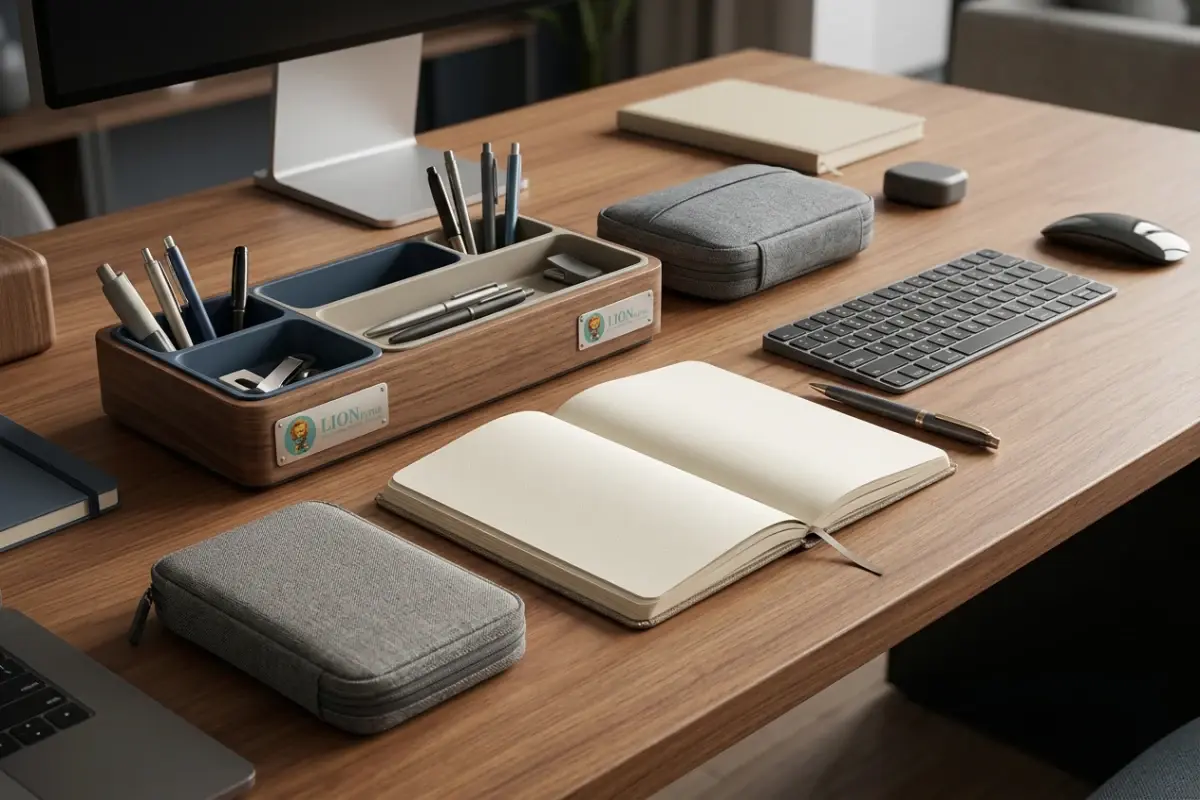
Hybrid Workspace Desk Product Trends: Supply Chain Insights and Manufacturing Strategies

The hybrid workspace trend is driving demand for portable, multifunctional, and aesthetically refined desk organization tools that bridge home and corporate work environments. Contemporary B2B buyers prioritize sustainable stationery sourcing, modular storage units, and compact desktop accessories that facilitate hot-desking, daily commuting, and cohesive interior styling without sacrificing durability, regulatory compliance, or supply-chain scalability.
How Is the Shift to Hybrid Work Transforming Desktop Product Requirements?
The transition toward flexible working models has fundamentally disrupted the traditional corporate stationery and desktop supply category. When professionals divide their working hours between centralized corporate headquarters, suburban home offices, flexible coworking hubs, and transit environments, static, heavyweight office organizers lose their utility. Modern professionals require tools that adapt seamlessly across fluid work settings.
This behavioural evolution introduces several clear functional demands:
Portability and Transit Readiness: Organizers, folios, and desk trays must withstand frequent packing into backpacks or commuter totes without structural warping or scuffing.
Compact Footprints for Smaller Spaces: Home office desks typically provide 30% to 50% less surface area than dedicated corporate cubicles, requiring space-saving vertical storage and stackable profiles.
Rapid Deployment and Clean-Up: Hot-desking policies mandate that workers unpack their essential workstation in under two minutes and clear the desk completely at the end of the shift.
Digital and Analog Convergence: Desk tools must accommodate laptops, tablets, charging cables, and stylus pens alongside notebooks, sticky notes, and planners.
Commercial buyers, brand procurement directors, and retail category managers are adapting their product development strategies to address these usage patterns. Product collections that combine rigid paperboard structures, durable textiles, and protective compartments are rapidly replacing conventional, single-purpose plastic trays.

Portable desk organizers bridge the transition between corporate offices, home workstations, and mobile environments.
What Are the Key Design and Functional Trends in Modern Hybrid Office Organization Products?
Current market data indicates that hybrid office organization products are evolving from utilitarian corporate supplies into design-led lifestyle accessories. Consumers and corporate gift buyers now expect office tools to match residential interior design palettes while maintaining commercial-grade structural resilience.
Three dominant product trends define the category:
Modular and Nesting Architecture: Desktop trays, pen cups, and filing trays engineered to nest inside one another during transit and expand into a comprehensive organizing station on any flat surface.
Dual-Environment Aesthetics: Warm, muted earth tones, soft-touch matte laminations, linen-textured bookcloth, and felt materials that look as appropriate on a living room dining table as they do in an executive boardroom.
Cable and Device Management Integration: Organizers featuring concealed channels, magnetic cable clips, and padded slots tailored to modern mobile devices.
The following table illustrates the operational and structural differences between legacy desk accessories and modern hybrid organizational products:
Feature Dimension | Traditional Office Accessories | Hybrid Workspace Desk Products |
|---|---|---|
:--- | :--- | :--- |
Primary Use Environment | Fixed single desk / cubicle | Multi-location (Home, Office, Transit) |
Structural Profile | Bulky, non-collapsible plastic or wire mesh | Lightweight, collapsible, or modular paperboard/textile |
Design Language | Utilitarian corporate (Black, Grey, Clear) | Interior lifestyle (Muted neutrals, warm pastels, textures) |
Portability Factor | Low / Static placement | High / Integrated handles, magnetic closures, fold-flat |
Material Preference | Virgin plastics, heavy sheet metal | FSC-certified paper, rPET fabric, recycled greyboard |
Device Compatibility | Paper-only or basic desktop filing | Hybrid tech-stationery slots and cable organizers |
How Does Sustainable Stationery Sourcing Influence Product Material and Packaging Choices?
Environmental accountability is no longer a peripheral marketing claim; it is a foundational procurement prerequisite for international retailers, corporate gifting programs, and lifestyle brands. Sustainable stationery sourcing requires complete transparency across raw material origins, manufacturing processes, and final packaging configurations.
To align with global ESG commitments and rigorous regional compliance standards such as the EU Deforestation Regulation (EUDR) and North American consumer safety guidelines, brands must integrate verifiable sustainable materials:
FSC-Traceable Paper and Greyboard: Utilizing virgin pulp derived exclusively from responsibly managed forestry, combined with high-density recycled greyboard cores to provide structural rigidity in desk organizers, binders, and storage boxes.
Post-Consumer Recycled (PCR) Textiles: Incorporating rPET felt and recycled cotton canvas in pencil cases, tech pouches, and desktop mat bases.
Low-Impact Printing and Finishes: Transitioning to soy-based and water-based inks, solvent-free adhesives, and micro-embossing textures that eliminate the need for non-biodegradable plastic surface films.
Plastic-Free E-Commerce Packaging: Designing custom-fit, drop-tested corrugated mailers, paper bands, and honeycomb protective wraps that eliminate single-use bubble wraps and polybags while lowering dimensional shipping weight.
By building sustainability into the product engineering phase, brand owners reduce packaging waste, satisfy environmental audits, and appeal to environmentally conscious B2B and retail consumers.

Sustainable stationery sourcing combines certified paper substrates with low-impact printing techniques.
What Structural Considerations Are Essential for Custom Desk Organizer Manufacturing?
Translating an artistic concept into a commercially viable, mass-producible desktop product requires rigorous engineering. Custom desk organizer manufacturing involves intricate material bonding, precise die-cutting, and exact fold tolerances to ensure longevity under repeated daily handling.
During structural development, engineers and product managers evaluate several critical technical parameters:
Board Caliper and Core Density: Selecting the optimal greyboard thickness (typically 1.5mm to 3.0mm) to guarantee rigidity without adding unnecessary freight weight.
Hinge Durability and Joint Flexibility: Utilizing reinforced textile backings or specialized bookbinding creasing techniques on foldable organizers to prevent joint cracking after thousands of opening cycles.
Magnetic Enclosure Calibration: Calculating the exact pull strength of embedded neodymium or ferrite magnets to secure lids during transport while allowing effortless one-handed opening at a desk.
Surface Abrasion and Scratch Resistance: Applying anti-scuff matte films or aqueous coatings to protect outer wrappings from frequent friction against desks and bag linings.
Fold-Flat Geometry: Engineering collapsible storage boxes and magazine holders that ship completely flat to minimize oceanic container volume, expanding into rigid containers via internal magnetic or snap-lock systems upon delivery.
Robust structural prototyping during early development stages identifies stress points and assembly bottlenecks before high-volume tooling and mass production commence.
How Can Brands and Retailers Optimize OEM Office Organization Solutions Across Global Channels?
Successfully scaling an organizational product line across multiple distribution channels—including direct-to-consumer (DTC) websites, Amazon storefronts, specialty boutique chains, and big-box retail—requires a customized assortment strategy.
Deploying comprehensive OEM office organization solutions enables brands to maximize revenue per customer through strategic bundling and channel-specific retail readiness:
Curated Workstation Kits: Bundling complementary SKUs, such as a matching hardcover daily planner, a collapsible desktop organizer, a magnetic cable pouch, and a desk pad into a unified gift set. This increases average order value (AOV) for online retailers and creates turnkey seasonal corporate gift solutions.
Channel-Optimized Retail Packaging: Equipping retail-bound merchandise with scannable barcodes, tamper-evident security seals, windowed presentation boxes, and clear hanging tabs that maximize shelf appeal and simplify merchandising.
E-Commerce Fulfillment Optimization: Structuring primary packaging to pass ISTA-1A or ISTA-3A drop-testing protocols, preventing crushed corners during parcel transit and minimizing customer return rates.
Coordinated Aesthetic Families: Developing unified pattern libraries, foil-stamped brand insignias, and coordinated colorways across paper stationery, organizers, and lifestyle accessories to encourage multi-item purchases.
A unified product development approach ensures brand consistency while meeting the distinct operational, packaging, and margin requirements of diverse retail and online channels.

Dual-site manufacturing infrastructure ensures high-volume precision, consistent quality, and global delivery reliability.
How Does a China-Cambodia Dual-Site Manufacturing Model Mitigate Supply Chain Risks?
Global supply chain volatility, fluctuating tariffs, freight uncertainties, and regional compliance mandates require resilient, flexible manufacturing architectures. Lion Paper addresses these challenges through a coordinated China–Cambodia dual-site operating network.
Lion Paper Products (Jiaxing) Co., Ltd., established in 2015 in Jiaxing, Zhejiang, operates as a comprehensive supply-chain solutions partner rather than a conventional print facility. The Jiaxing headquarters encompasses a 3,000-square-meter facility dedicated to product planning, structural engineering, rapid prototyping, material innovation, and customer support. This facility provides fast-turnaround sampling, small-batch pilot runs, and specialized creative execution.
Complementing the China development hub, Lion Paper operates a 10,000-square-meter mass-production facility in Cambodia. This facility is purpose-built for high-volume automated production, tariff mitigation, and cost-efficient global export to major markets including the United States, the United Kingdom, Germany, broader Europe, Australia, the Middle East, and Southeast Asia.
The strategic benefits of this dual-site model include:
Agile Prototyping Coupled with Scalable Mass Production: Rapid structural sample turnaround in Jiaxing ensures fast design iteration, followed by smooth tooling and SOP transfer to Cambodia for cost-efficient scale.
Annual Capacity Exceeding 5 Million Units: Automated binding, gluing, and assembly lines across both facilities support large retail programs, seasonal product drops, and continuous replenishment contracts.
Comprehensive Compliance and Audit Readiness: Facilities maintain certifications and audit alignments including ISO 9001, FSC chain-of-custody, SMETA, WCA, GSV, FAMA, and CPSIA consumer safety standards.
Total-Cost Efficiency: Strategic material procurement, automated manufacturing yields, and Cambodia-based export advantages optimize overall landed costs without compromising finished product quality.
Strict Intellectual Property Protection: Strict non-disclosure protocols protect proprietary designs, custom tooling specifications, and commercial client confidentiality across every production tier.
How Does Lion Paper Accelerate Product Development from First Sketch to First Shipment?
Bringing an innovative hybrid workspace collection to market requires seamless coordination across industrial design, material sourcing, quality assurance, and international logistics. Lion Paper delivers an integrated "From First Sketch to First Shipment" methodology that eliminates communication gaps between initial design concepts and commercial factory output.
Lion Paper supports clients across eight integrated product categories:
Eco Paper Products: FSC-certified notebooks, post-consumer recycled paper goods, low-carbon print materials.
Notebooks and Journals: Hardcover, softcover, wire-bound, spiral, and flexi-bound journals with specialized ribbon markers and custom pocket inserts.
Planners and Calendars: Undated productivity planners, academic agendas, wall planners, and desktop easel calendars.
Stationery and Office: File folders, expanding document wallets, sticky notes, memo blocks, and desktop pads.
Bags and Organizers: Tech pouches, felt organizers, portable laptop sleeves, and pencil cases.
Accessories: Bookmarks, paper clips, washi tapes, stickers, and custom-branded metal hardware.
Gift and Packaging: Rigid presentation boxes, collapsible gift boxes, printed mailer boxes, and luxury gift bags.
Home and Living: Desktop lifestyle organizers, magnetic planning boards, and textile-covered storage boxes.
Through this integrated category breadth, brand founders, procurement managers, and retail buyers can develop unified product collections under a single manufacturing partner. Lion Paper’s cross-functional engineering and manufacturing teams manage structural feasibility analysis, material selection, rigorous AQL inspection standards, and export packaging optimization.
Whether your objective is launching an innovative line of portable organizers for remote professionals or expanding an established stationery brand with sustainable lifestyle accessories, partner with an integrated manufacturing expert. You can contact Lion Paper for OEM/ODM stationery development and custom product solutions to transform your initial concepts into compliant, market-ready retail products.
FAQ
What are the most popular materials for hybrid workspace desk organizers?
Leading hybrid workspace desk products primarily utilize high-density recycled greyboard wrapped with FSC-certified specialty paper, linen-textured bookcloth, rPET recycled felt, and vegan leather. These materials combine lightweight portability, structural rigidity, and warm residential aesthetics.
How does Lion Paper ensure consistent product quality across its dual-site manufacturing facilities?
Lion Paper maintains identical Standard Operating Procedures (SOPs), centralized material qualification, standardized defect catalogs, and strict Acceptable Quality Limit (AQL) inspection protocols across both its Jiaxing and Cambodia facilities under an ISO 9001 quality management framework.
What is the typical minimum order quantity (MOQ) for custom OEM desk organizers and stationery sets?
MOQs vary depending on structural complexity, custom tooling requirements, and material specifications. Lion Paper supports flexible pilot batches and multi-style collections for emerging brands during initial product launches, scaling up to high-volume production runs exceeding hundreds of thousands of units.
Can packaging be engineered to meet specific e-commerce drop-test and retail-ready standards?
Yes. Lion Paper designs custom-fit primary and secondary packaging optimized for ISTA drop-test compliance for Amazon and DTC fulfillment, as well as retail-ready presentation packaging with custom barcoding, hang tabs, and counter display units.


Comments