


Standardizing Precision: How a High Quality Custom Notebooks Manufacturer Guarantees Excellence Through Strict AQL Standards and QC Lab Testing
- Leo Xia

- Jul 30
- 6 min read
Quick Answer: In the global stationery and corporate gifting market, a notebook is far more than bound paper—it is a tangible representation of a brand's identity, values, and attention to detail. For multinational corporations, retail chains, and luxury brands, sourcing paper goods in bulk comes with a significant challenge: maintaining absolute consistency across thousands of units. Even minor defects like page misalignment, cover warping, or weak binding can damage a brand's reputation.
This is where partnering with a high quality custom notebooks manufacturer like Lion Paper Products makes a decisive difference. True quality cannot be achieved by post-production sorting alone; it must be engineered into every step of the manufacturing process. By implementing rigorous bulk journal manufacturing quality control frameworks, advanced laboratory testing, and international compliance standards, premier manufacturers ensure that every shipment arrives in pristine condition.
Quick Content Reach:
Defining Quality in Custom Notebook and Journal Manufacturing
Quality in notebook manufacturing is a multi-dimensional metric. It spans raw material selection, structural integrity, print accuracy, and aesthetic finish. A premium notebook must not only look appealing on a retail shelf or at a corporate event; it must also withstand daily wear and tear without losing its structural integrity.
To achieve this, Lion Paper Products integrates quality control into the entire design-to-manufacturing workflow. From the initial paper roll inspection to the final palletization, every phase is governed by strict Standard Operating Procedures (SOPs).
By treating bulk journal manufacturing quality control as an active, preventative methodology rather than a passive inspection checklist, manufacturers can catch potential issues before they reach the assembly line. This comprehensive approach ensures that the weight of the paper, the alignment of the grid lines, the strength of the binding glue, and the texture of the cover material match the approved physical sample perfectly.
Why AQL 0.65 is the Gold Standard for Corporate Gift and Stationery Sourcing
When global procurement managers source AQL standard corporate gifts, they rely on standardized statistical methods to verify batch quality without inspecting every single item. The internationally recognized Acceptance Quality Limit (AQL) is the primary metric used to determine whether a production batch is accepted or rejected.

At Lion Paper Products, we operate under a strict dual-standard AQL framework:
Critical Defects (0% tolerance): Any defect that poses a safety hazard or completely prevents the product from being used (e.g., sharp metal edges on spiral wire, missing branding, or toxic chemicals in materials) results in immediate batch rejection.
Major Defects (AQL 0.65 limit): These are functional or significant visual defects that reduce the usability or marketability of the notebook (e.g., severe glue overflow, page tears, incorrect page counts, or misaligned hot-stamping). Our limit of 0.65 means we maintain a significantly lower tolerance for major defects than the standard industry benchmark of 1.5 or 2.5.
Minor Defects (AQL 2.5 limit): These are minor cosmetic imperfections that do not affect the notebook's functionality (e.g., tiny scuffs on the cover, minuscule ink spots, or slight packaging wrinkles).
By adhering to these rigorous metrics during our custom journal quality inspection routines, we guarantee that retail chains and corporate buyers receive a product that matches premium market expectations. Implementing an AQL 0.65 threshold for major defects ensures that high-volume corporate orders maintain the premium look and feel required to leave a lasting impression.
Inside the QC Lab: Utilizing Tension and Abrasion Testers for Defect Prevention
An effective program for notebook defect prevention relies heavily on scientific testing rather than subjective human evaluation. Our specialized Quality Control Laboratory plays a critical role in validating structural designs and testing raw materials before mass production begins.
Some of our key laboratory testing protocols include:
Page-Pull and Tension Testing: To prevent the common issue of loose pages, a calibrated pull-tester applies continuous force to individual inner sheets. This test measures the maximum tension the adhesive or stitching can withstand before a page detaches, ensuring long-term binding durability.
Cover Abrasion and Rub Resistance Testing: To verify that cover prints, hot-stamped foils, and textured laminations do not fade or peel during transit and daily use, cover samples undergo simulated rubbing tests using specialized machinery.
Environmental Chamber Cycling (Humidity & Temperature): Paper is highly sensitive to climate changes. Our environmental chamber tests how cover boards, spine adhesives, and inner pages behave under extreme humidity and temperature variations, preventing cover warping and paper curling in diverse target markets.
By simulating months of heavy usage in a matter of hours, these laboratory evaluations allow our engineering team to make necessary structural or adhesive adjustments before mass-producing a client's order.
Resolving Common Bulk Production Pitfalls: Binding Failures, Spiral Jams, and Glue Overflow
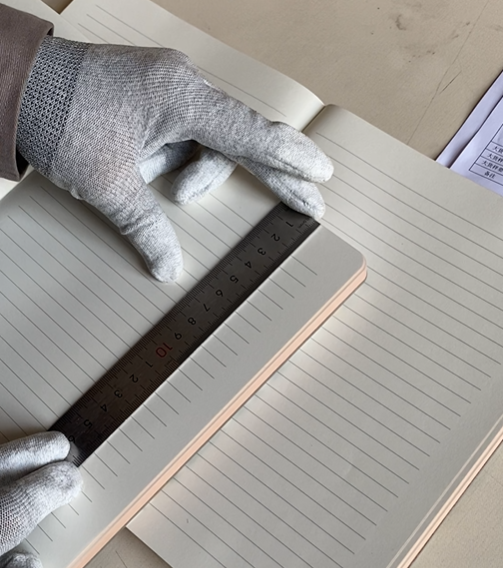
Even with high-grade materials, mass production presents specific technical challenges. Understanding and preemptively addressing these pitfalls is a cornerstone of our bulk journal manufacturing quality control system.
1. Spine Cracking and Page Shedding
In hardcover and softcover perfect-bound notebooks, spine cracking occurs when the binding adhesive is too brittle or applied at an incorrect temperature. We prevent this by utilizing high-performance polyurethane (PUR) or hot-melt adhesives under strict temperature controls, backed by standardized spine-flex testing.
2. Spiral Wire Jams and Scratches
For wire-bound and spiral notebooks, incorrect wire pitch, loop diameter, or sharp wire ends can lead to pages snagging or catching. We utilize fully automated wire-forming and binding machinery that ensures uniform loop shape and securely tucked wire ends to prevent snagging and scratches.
3. Cover Glue Overflow and Bubbling
When wrapping leatherette or printed paper over grayboard covers, uneven adhesive application can cause unsightly bubbling or glue squeeze-out along the edges. We deploy automatic gluing lines equipped with micro-adjustable doctor blades to maintain a perfectly uniform adhesive film, eliminating excess glue residue.
Through systematic notebook defect prevention training, our production line workers use customized "Defect Atlases" to quickly identify and segregate any non-conforming items directly at the workstation level.
End-to-End Quality Traceability Across Dual-Site Production Facilities
As a vertically integrated global partner, Lion Paper Products operates a strategic dual-site production network to balance agility, capacity, and cost. Our facility in Jiaxing, China, serves as our hub for high-value structural design, rapid prototyping, and complex customization. Meanwhile, our 10,000-square-meter facility in Cambodia is optimized for high-volume, cost-effective mass production.
To ensure identical product quality regardless of where a notebook is made, we implement unified quality systems across both nodes:
Synchronized SOPs: Workers in both China and Cambodia follow the exact same visual SOP cards and method sheets.
Consistent Material Sourcing: We utilize the same audited material vendors, ensuring that FSC-certified paper, eco-friendly inks, and premium cover boards maintain uniform properties.
Global Compliance Standards: Both facilities operate under comprehensive international certifications, including ISO9001, SMETA, FSC, WCA, and FAMA compliance. This dual-site synergy allows us to adapt seamlessly to our clients' regional logistics demands while guaranteeing unwavering compliance.

Partner with a Trusted Global Notebook Supply Chain Expert
Quality is never an accident; it is always the result of high intentions, sincere effort, intelligent direction, and skillful execution. When sourcing custom notebooks for retail distribution, e-commerce brands, or corporate gifting, selecting a manufacturer with a disciplined quality control system is the most reliable way to protect your brand.
At Lion Paper Products, we combine design-to-manufacturing integration, advanced laboratory testing, and global dual-site manufacturing flexibility to provide stable, compliant, and on-time business outcomes for brands worldwide.
Are you looking to elevate your next custom notebook collection?
Take a closer look at our rigorous manufacturing standards and quality assurance practices in action.
FAQ-High-quality custom notebooks manufacturer
What is the difference between AQL 0.65 and other standard inspection levels?
AQL (Acceptable Quality Limit) 0.65 is a strict quality threshold that allows a much lower percentage of major defects in a batch compared to the standard industry benchmark of 1.5 or 2.5. Adhering to AQL 0.65 ensures that major functional or aesthetic flaws—such as misaligned printing, page tears, or binding glue failure—are virtually non-existent, making it the ideal choice for premium retail channels and high-end corporate gifts.
How does Lion Paper prevent notebook covers from warping?
Cover warping is typically caused by humidity changes affecting the moisture levels in paperboard and adhesive. We prevent this by using high-density, humidity-resistant grayboard, optimizing our water-based or hot-melt adhesive ratios, and testing sample batches inside environmental chambers under extreme heat and humidity cycles to ensure they remain perfectly flat in all destination climates.
Are your manufacturing processes compliant with international sustainability and labor standards?
Yes. Lion Paper is committed to responsible manufacturing. Our production processes and facilities are fully certified to international standards including FSC (Forest Stewardship Council) for traceable sustainable forestry, SMETA and WCA for ethical working conditions, ISO9001 for quality systems, and FAMA compliance.


Comments