


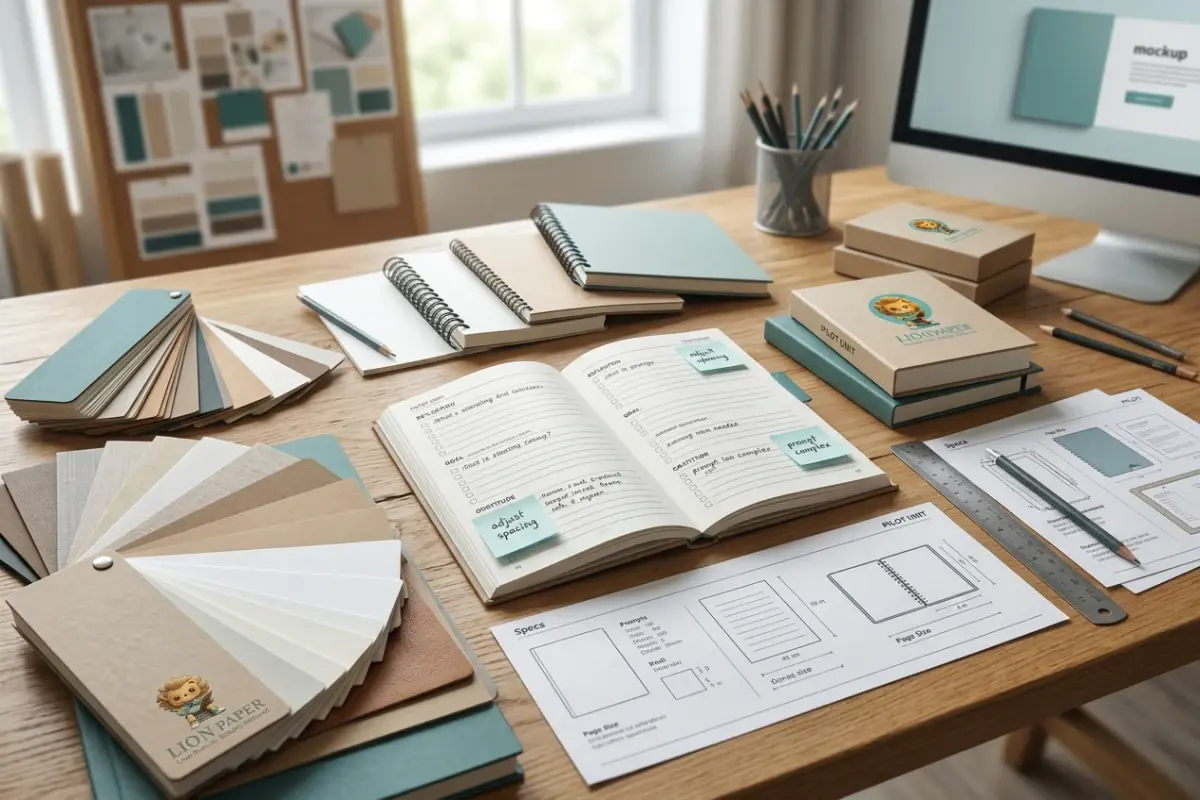
A Guide to Guided Journal Concept Pilot Testing for Stationery Brands

Guided journal concept pilot testing is a structured pre-production validation process where physical prototypes and interior layouts are evaluated by representative users to measure daily completion rates, prompt clarity, paper performance, and binding ergonomics before committing to high-volume manufacturing. This phase confirms that guided writing prompts deliver their intended behavioral outcomes while verifying structural durability and manufacturability for global retail distribution.
Why Is Guided Journal Concept Pilot Testing Essential Before High-Volume OEM Manufacturing?
Publishing and stationery brands face distinct commercial risks when launching guided journals compared to standard lined notebooks. A blank notebook relies solely on physical aesthetics and basic paper quality, whereas a guided journal acts as an interactive tool where layout architecture, prompt clarity, and psychological pacing directly dictate customer satisfaction and product reviews. Committing to a large production run without guided journal concept pilot testing often leads to high return rates, negative user reviews, and unsellable inventory caused by minor structural or editorial oversights.
Pilot testing serves as an operational bridge between initial graphic concepts and large-scale manufacturing. By placing physical mockups into the hands of real users, brand managers can evaluate how consumers interact with daily prompts, whether the writing space accommodates various handwriting sizes, and if the progression logic sustains multi-week engagement.
From a manufacturing standpoint, testing physical prototypes identifies potential production bottlenecks early. It allows engineers to detect issues such as gutter margin clipping in Smyth-sewn signatures, ink show-through caused by heavy graphic borders, or foil stamping delamination on textured cover fabrics. Validating these elements prior to commercial tooling reduces re-run costs and prevents costly supply chain disruptions.
Evaluation Area | Risk Without Pilot Testing | Benefit of Guided Journal Concept Pilot Testing |
|---|---|---|
:--- | :--- | :--- |
Interior Content | Confusing prompts leading to user drop-off | Validated prompt pacing and high user completion rates |
Page Ergonomics | Inadequate gutter space making inner margins unwriteable | Ergonomically adjusted page margins for flat, effortless writing |
Paper Compatibility | Ink bleeding and feathering across diverse pen types | Calibrated paper weight (GSM) and surface sizing for zero ghosting |
Binding Integrity | Spine cracking or page detachment during frequent daily use | Verified thread-sealing and adhesive strength across standard life cycles |
Retail Packaging | Box damage or scuffing during transit and shelf handling | Optimized retail-ready packaging and drop-tested protective boxing |
What Are the Core Phases of Guided Journal Prototyping and Layout Validation?
A comprehensive guided journal prototyping process moves systematically through four distinct stages. Each stage refines the physical product and digital interior files to ensure smooth manufacturing scale-up.
Phase 1: Digital Typesetting and Gutter Margin Engineering
Before producing a physical sample, digital page proofs must be engineered for three-dimensional mechanical binding. Guided journals frequently contain structured tables, habit trackers, and decorative border art that sit near the binding edge. Pre-press technicians calculate dynamic gutter margins that expand toward the center of folded signatures, preventing text from disappearing into the spine fold.
Phase 2: Rapid Physical Sampling and Mockup Production
The brand creates small-batch physical mockups using rapid-prototyping workflows. Digital offset printing and computerized plotting allow for the fast production of 5 to 20 functional copies featuring accurate cover textures, internal page counts, ribbon markers, and closure bands. These units allow development teams to evaluate physical balance, cover debossing depth, and tactile hand feel.
Phase 3: Field Testing and Journal Interior Validation
Prototypes are distributed to a target cohort of end users for a 14-to-30-day testing cycle. Participants complete the daily guided entries using their everyday writing instruments. This phase validates prompt comprehension, layout usability, and the physical resilience of the cover and binding under real-world daily handling.
Phase 4: Production Pre-Flight and Layout Adjustment
Data gathered during user testing is translated into technical design revisions. Writing spaces are expanded where users felt cramped, prompt language is clarified, and paper specifications are refined. Pre-press files are finalized with embedded ICC color profiles, precise bleed allowances, and automated registration marks for mass production.

Calibrated gutter margins and balanced line weights ensure comfortable writing and reliable page layouts.
How Do Brands Measure User Engagement and Journal Interior Validation During Pilot Runs?
Conducting journal interior validation requires tracking quantitative behavioral metrics alongside qualitative tactile feedback. A successful pilot run evaluates both psychological usability and physical ergonomics.
Daily Completion Velocity: Tracks how long users spend completing daily prompts versus the target session length (e.g., 5-minute morning check-ins). Extended completion times often point to overly complex prompt structures.
Prompt Abandonment Points: Identifies specific pages, exercises, or weekly reflection spreads where user engagement drops, highlighting areas that need simpler language or layout adjustments.
Writing Real Estate Utility: Measures whether users run out of space or leave excessive blank areas, guiding adjustments to line height, dot-grid intervals, or prompt positioning.
Visual Hierarchy and Legibility: Gathers user ratings on font legibility, prompt hierarchy, contrast between printed guidelines and user handwriting, and ease of navigation across sections.
Tactile and Emotional Response: Evaluates how users perceive cover materials, paper texture, opening smoothness, and overall physical craftsmanship.
What Paper, Ink, and Binding Factors Require Custom Planner Sample Testing?
Guided journals demand higher technical specifications than standard notebooks because users interact with them daily using various writing tools, including gel pens, fountain pens, highlighters, and brush markers. Conducting thorough custom planner sample testing ensures the finished product withstands rigorous daily use without material failure.
Material Validation Sequence: Paper Formulation & Sizing -> Ink Opacity & Offset Printing -> Binding Lay-Flat Analysis -> Cover Wear Testing
Paper Weight and Surface Sizing Selection
Selecting the right woodfree paper requires balancing opacity, bulk, and overall book weight. Guided journals with dense, double-sided printing typically require 100 GSM to 140 GSM uncoated woodfree paper or FSC-certified offset paper. Specialized surface sizing prevents capillary ink absorption, eliminating feathering and bleed-through when using liquid inks.
Ink Densities and Line Weights
Interior lines, dot grids, and prompt text must be visible without overpowering the user's handwriting. Custom planner sample testing evaluates neutral gray values (typically between 20% and 45% black or custom Pantone cool grays). Testing confirms that guided elements maintain consistent line density and register precisely across all sheet-fed printing passes.
Binding Durability and Lay-Flat Functionality
True 180-degree lay-flat performance is critical for guided journals, as users must write comfortably across both left- and right-hand pages. Smyth-sewn casebound binding, Swiss binding, and exposed flexi-binding represent the most reliable methods for flat opening. Pilot tests subject bound blocks to pull tests (minimum 3.5 N/cm page pull strength) and repeated flex tests to ensure the spine adhesive retains elasticity over extended use.
Specification Component | Recommended Range for Guided Journals | Key Testing Focus |
|---|---|---|
:--- | :--- | :--- |
Internal Paper Stock | 100–140 GSM FSC Uncoated Woodfree Paper | Ink feathering, ghosting, show-through, surface smoothness |
Internal Grid/Rule Lines | 0.25 pt – 0.5 pt stroke width (Pantone Cool Gray) | Visual subtlety, print register consistency, non-distracting visual tone |
Binding Structure | Thread-sewn casebound with square/round back | 180-degree lay-flat angle, spine flexibility, page pull strength |
Endsheets | 140–180 GSM Woodfree / Specialty Paper | Hinge strength, adhesive penetration, paste-down flatness |
Cover Finishing | PU Leather / Linen Fabric / 157 GSM Art Paper on Board | Debossing definition, foil adhesion, corner wrapping, abrasion resistance |
Accessories | Elastic closure, 1-2 Grosgrain ribbons, back pocket | Elastic recovery tension, ribbon fray resistance, pocket gusset strength |

Comprehensive material testing verifies that woodfree paper stocks resist ink feathering and daily handling wear.
How Does a Pre-Production Journal Pilot Run Bridge Prototyping and Mass Production?
A pre-production journal pilot run bridges individual prototype development and large-scale manufacturing. While rapid prototypes are often produced using digital presses and manual hand-binding, a pilot run utilizes actual mass-production equipment, industrial printing presses, automated folding signatures, and high-speed casing-in lines.
Executing a small-batch pre-production run of 200 to 1,000 units delivers multiple operational benefits:
Industrial Machine Calibration: Calibrates sheet-fed offset printing presses, plate curves, and automated folder-gluer settings to match finalized prototype specifications.
Material Batch Consistency Verification: Confirms that bulk paper rolls, binding boards, and covering materials sourced from suppliers meet established tensile strength and moisture-content standards.
Quality Control SOP Establishment: Creates standardized visual defect catalogs and sets Acceptable Quality Limit (AQL 2.5 / 4.0) inspection parameters for production operators.
Multi-Channel Packaging Validation: Evaluates shrink-wrapping tightness, barcode scan reliability, drop-test performance for e-commerce packaging, and retail shelf display fit.
Supply Chain Transition Workflow: Design Studio -> Jiaxing Rapid Prototyping -> Pilot Tooling Review -> Cambodia Mass Production Facility
For growing lifestyle brands and publishers, coordinating pre-production testing across dual-site networks provides both developmental agility and mass-market scalability. For instance, initial structural design, rapid prototyping, and layout adjustments can be refined at a dedicated engineering facility, while high-volume production transitions smoothly to scaled manufacturing plants equipped with automated lines.
What Manufacturing Feasibility Checklist Should Buyers Follow Before Mass Production?
Before authorizing full-scale manufacturing, stationery brands and retail buyers should verify that all layout and material parameters meet clear production feasibility criteria.
Signature Page Count Divisibility: Confirm that total interior page counts are divisible by standard 16-page or 32-page printing signatures to prevent blank overrun leaves at the back of the book.
Bleed and Trim Safety Allowances: Ensure minimum 3 mm (0.125 in) exterior bleed margins and at least 10 mm to 15 mm interior safety margins from trim and spine folds.
CMYK / Monochrome Curve Calibration: Verify that all grayscale graphics and prompt typography are converted to single-channel Black (K) or designated spot Pantone inks, preventing color-shift variations across print runs.
Endsheet Glue Trap Clearances: Confirm that front and back endsheets include proper 5 mm glue trap allowances clear of heavy varnish or foil stamping for strong hinge adhesion.
Spine Width Calculation: Calculate precise spine thickness based on validated bulk-caliper paper measurements under mechanical clamping pressure.
Accessory Anchoring Security: Ensure ribbon bookmarks and elastic bands are anchored into the spine lining with industrial hot-melt adhesives to prevent pull-out under tension.

Pilot production batches confirm automated machine tolerances and retail packaging protection prior to mass volume runs.
How Does Lion Paper Products Support Guided Journal Development and Manufacturing?
Founded in 2015 in Jiaxing, Zhejiang, Lion Paper Products (Jiaxing) Co., Ltd. operates as an integrated supply-chain solution provider specializing in customized paper goods, guided journals, planners, and creative lifestyle stationery. Operating through an integrated China-Cambodia dual-site production model, Lion Paper combines creative product engineering with large-scale, cost-effective manufacturing.
The 3,000-square-meter Jiaxing facility manages product planning, structural design, rapid prototyping, and customer support. This operation enables lifestyle brands, e-commerce sellers, and corporate publishers to produce high-precision pilot samples and validate interior layouts quickly. Once prototypes and pilot runs are approved, mass production scales seamlessly at the 10,000-square-meter Cambodia manufacturing base, which provides stable, cost-efficient delivery and an annual capacity exceeding 5 million notebook units.
Lion Paper provides end-to-end development services across eight core product categories, including eco-friendly paper products, wire-bound and casebound journals, custom planners, and retail gift packaging. All products adhere to rigorous international compliance and quality standards, supported by ISO 9001, FSC, SMETA, WCA, GSV, FAMA, and CPSIA audits. From sustainable FSC-certified paper selection and custom ribbon sourcing to drop-tested e-commerce packaging and retail-ready display boxes, Lion Paper helps brands transform creative concepts into scalable, market-ready paper goods.
To begin refining your guided journal concept, share your target user profile, interior page format, target order quantity, and intended launch timeline with Lion Paper's development team for a comprehensive product-development review.
FAQ
What is the typical sample size for a guided journal pilot test?
For qualitative user feedback and prompt validation, brands typically distribute 15 to 50 physical prototype units to target users. For technical manufacturing validation and automated assembly calibration, a pre-production pilot run of 200 to 500 units is recommended.
How long should a guided journal interior validation period last?
A standard interior validation cycle lasts between 14 and 30 days. This timeframe allows test participants to establish a daily writing rhythm, engage with recurring weekly exercises, and test the physical durability of the binding and cover through repeated use.
What is the best paper weight for a guided journal with heavy graphic borders?
Uncoated woodfree paper between 120 GSM and 140 GSM is ideal for guided journals featuring heavy border artwork or solid printed header blocks. This weight range provides high opacity, minimal ghosting, and a premium tactile feel across various writing inks.
How does Smyth-sewn binding compare to spiral binding for guided journals?
Smyth-sewn casebound binding delivers a professional, premium book aesthetic and true 180-degree lay-flat writing comfort while protecting interior pages within a durable spine. Spiral and wire-o bindings offer complete 360-degree fold-back flexibility, making them popular for desktop planners and multi-section workbooks.


Comments