


Gloss vs Matte Folder Landed Cost: Manufacturing and Finishing Economics

Standard gloss folder lamination delivers a 3% to 8% lower baseline production cost than standard matte or soft-touch finishes, but true landed cost parity depends on transit packaging protection, scratch scrap rates during distribution, score-line cracking risks, and retail handling durability. Evaluating matte vs gloss lamination folders requires analyzing post-press finishing costs, yield efficiency, freight density, and channel-specific defect tolerances rather than unit ex-factory quotes alone.
What Drives the Landed Cost Difference Between Gloss and Matte Folders?
When calculating the custom folder manufacturing landed cost, the choice between gloss and matte finishes affects raw material procurement, lamination line speeds, curing requirements, and protective secondary packaging. Presentation folder finishing cost structures are primarily driven by the chemical composition of the coating or the polymer grade of the thermal film applied during post-press processing.
Gloss finishes reflect light directly through specular reflection, which visually masks minor paperboard micro-abrasions and allows high-speed roll-fed processing with standard biaxially oriented polypropylene (BOPP) films or liquid ultraviolet (UV) varnishes. In contrast, standard matte finishes disperse light diffusely. This diffusion amplifies visual contrast against dark ink coverage and makes surface scuffs, sebum transfer from fingerprints, and transit friction more noticeable to end users and quality inspectors.
Raw Material Price Differences: Standard BOPP gloss thermal film typically costs 5% to 10% less per square meter than standard matte BOPP film due to lower polymer compounding complexity and higher manufacturing throughput globally.
Anti-Scuff Film Premiums: Premium anti-scuff matte films and tactile soft-touch films command a 25% to 45% raw material premium over standard gloss films because they incorporate specialized cross-linked hard coats or polyurethane top layers.
Machine Throughput and Line Speeds: High-speed automatic laminating lines run standard gloss BOPP film at 55 to 70 meters per minute. Standard matte films with delicate surface micro-textures require reduced line speeds of 40 to 50 meters per minute and tightly calibrated thermal nip pressure to prevent web distortion and thermal static buildup.
Scrap Allowance Budgets: Mass manufacturing yield models generally allocate a 1.5% to 2% scrap allowance for high-gloss folders, compared to 3% to 5% for standard matte folders subjected to strict cosmetic inspection criteria for hairline handling scratches.
Folder Specification Factor | Standard Gloss Finish | Standard Matte Finish | Anti-Scuff Matte Finish | Soft-Touch Matte Finish |
|---|---|---|---|---|
:--- | :--- | :--- | :--- | :--- |
Film / Coating Type | 15–18 micron BOPP Gloss | 18–20 micron BOPP Matte | 20–22 micron Hard-Coated BOPP | 28–32 micron Polyurethane BOPP |
Material Cost Index | Base (1.00x) | 1.06x – 1.10x | 1.30x – 1.45x | 1.50x – 1.70x |
Lamination Run Speed | Fast (Up to 70 m/min) | Medium (Up to 50 m/min) | Controlled (40–45 m/min) | Controlled (35–42 m/min) |
Transit Scratch Sensitivity | Low | High | Very Low | Moderate to High |
Fingerprint Visibility | High (Specular reflection) | Low to Medium | Very Low | High (Absorptive oils) |
Score-Line Durability | High flexibility | Moderate flexibility | High flexibility | High tensile resistance |
Typical Ex-Factory Impact | Benchmark | +3% to +6% | +10% to +18% | +16% to +26% |
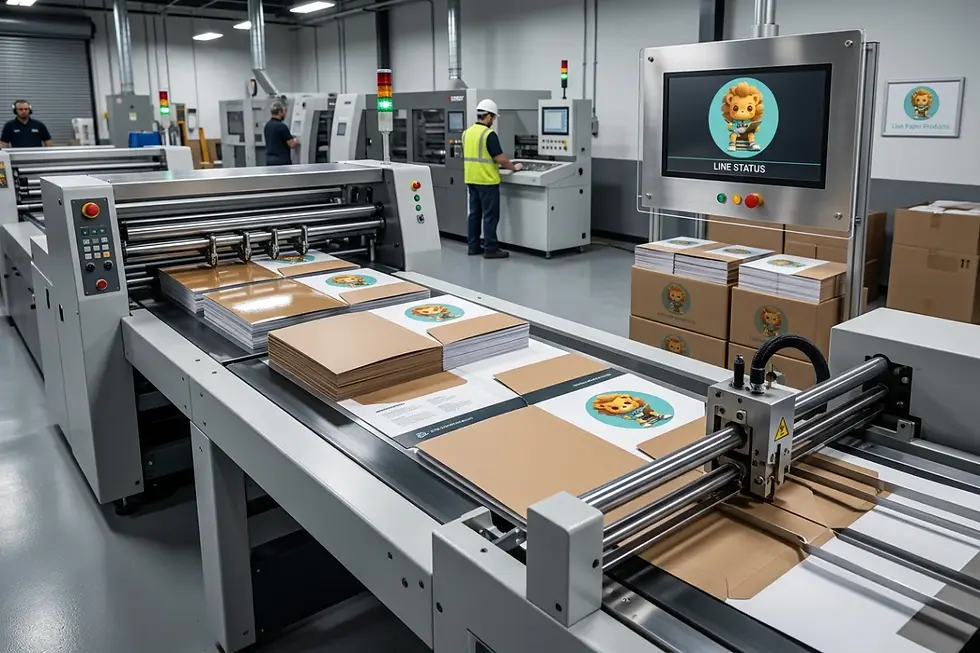
Automated lamination and precision score-line creasing maintain yield rates and structural durability on heavy paperboard.
How Do Gloss and Matte Coatings Perform on Score Lines, Pockets, and Dark Inks?
Folder manufacturing requires heavy die-cutting, pocket folding, and sharp linear creasing on paperboard stock ranging from 250 gsm to 400 gsm (12 pt to 18 pt C1S or C2S artboard). Finishing performance varies significantly along structural stress points across different surface treatments.
On solid black, navy, or rich burgundy ink coverages, standard matte lamination is vulnerable to micro-chalking—a physical phenomenon where mechanical friction compresses the matte microscopic surface structure, creating shiny burnished streaks. While standard gloss lamination resists burnishing, it reveals specular oily smudges and fingerprints from routine office handling. When folders feature dark graphic panels, brand owners often face trade-offs between visible scuffing and cosmetic oil transfer.
Along die-cut pocket folds and spine hinges, standard matte films have slightly lower elongation tensile thresholds than high-gloss polypropylene films. This variance can cause micro-fissuring, whitening, or delamination along 180-degree scores if the scoring rule width and matrix channel depth are misaligned with paperboard caliper. Applying anti scuff matte folder pricing models becomes necessary for luxury corporate presentation kits and dark-colored retail stationery lines to eliminate post-crease whitening and distribution rub marks.
Score-Line Cracking Prevention: Coated one side (C1S) artboard requires matching the paper grain direction parallel to the main spine score line, combined with double-creasing matrix rules for laminated boards exceeding 20 microns in film thickness.
Pocket Glue Flap Adhesion: Gloss lamination requires mechanical glue-tab knockouts or corona plasma surface treatment during folder-gluing to achieve permanent fiber-tear bonding with water-based PVA adhesives. Matte surfaces generally provide marginally better native surface energy (dyne levels) for cold-glue adhesion unless silicone slip additives are present.
Foil Stamping and Spot UV Compatibility: Gloss surfaces create high-contrast bases for blind debossing and matte pigment foils. Conversely, matte laminated folders provide an ideal high-contrast foundation for raised Spot UV varnish (high-build 3D polymer), spot screen gloss, and metallic hot-stamping foils by accentuating tactile and visual differences.
Which Material Combinations and Hybrid Finishes Optimize Presentation Folder Budgets?
Balancing aesthetic appeal and landed cost involves selecting the appropriate base paperboard, finish formulation, and targeted embellishment layout. Different post-press finishing routes provide distinct cost, durability, and visual performance trade-offs:
Aqueous Coating (Gloss, Satin, or Matte): Water-based aqueous coating represents the most economical surface seal. Applied inline on the offset printing press, it eliminates secondary off-line laminating processes. While aqueous coating offers basic scuff resistance and fast ink drying, it provides minimal tear resistance, lower barrier protection against humidity, and reduced structural reinforcement along folded pocket edges.
Machine Liquid UV Varnish: High-gloss liquid UV varnish delivers brilliant sheen at a lower unit cost than thermal film lamination. However, thick UV coatings can fracture along heavy pocket score lines unless formulated with specialized flexible oligomers, making UV varnish better suited for flat promotional sheets than functional multi-pocket document folders.
Thermal BOPP Film Lamination: Thermal film bonding applies a continuous polymer film backed with heat-activated ethylene vinyl acetate (EVA) adhesive. This construction delivers structural tear resistance, absolute moisture barriers, and long-term hinge durability for multi-use corporate and retail filing folders.
Hybrid Exterior and Interior Finish Strategy: A cost-effective hybrid configuration involves applying an exterior anti-scuff matte BOPP film paired with an economical interior gloss aqueous seal on inner pockets. This hybrid layout protects the outer display covers from transit friction while lowering overall film consumption and eliminating glue-tab adhesion failures on internal pockets.
Substrate Efficiency: Selecting high-bulk folding box board (FBB) or FSC-certified white-lined chipboard (WLC) balances pocket rigidity and overall carton weight, helping lower oceanic and inland freight surcharges compared to dense solid bleached sulfate (SBS) boards.
Embellishment Placement: Consolidating hot-stamping foil or raised Spot UV to the front cover while leaving inside pockets cleanly varnished minimizes secondary stamping passes and reduces setup scrap.
Pocket Geometry: Designing self-locking or continuous glued pockets that share cutting knife edges reduces sheet trim waste on automated die-cutting layouts.

Standardized rub and surface tension testing verify anti-scuff resistance and foil adhesion on matte and gloss surfaces.
How Do Manufacturing Volumes, Dual-Site Production, and Scrap Rates Shift Total Landed Cost?
Landed cost includes the ex-factory unit price, international ocean freight, customs tariffs, port handling fees, protective secondary packaging, and channel return allowances. Production footprint and batch scale significantly influence these variables.
Through Lion Paper Products' dual-site operations—integrating a 3,000-square-meter design, prototyping, and customer support center in Jiaxing, China, with a 10,000-square-meter mass manufacturing facility in Cambodia—procurement teams balance fast-turn pilot sampling with scalable production. Automated printing, die-cutting, and pocket-gluing systems across both locations ensure standardized standard operating procedures (SOPs) and yield optimization across large-scale retail runs.
Tooling and Setup Cost Amortization: Automated high-speed die-cutters and folder-gluers require makeready times of 45 to 90 minutes. At minimum order quantities (MOQs) of 3,000 to 5,000 units, setup and die costs represent 8% to 14% of total unit cost. At 50,000 to 100,000 units, tooling amortizes down to less than 1.5% of the total unit cost.
Tariff and Trade Optimization: Sourcing bulk presentation folders and stationery collections through Cambodia-based mass manufacturing provides tariff advantages in specific North American and European retail import channels, offsetting the minor raw material surcharge of anti-scuff matte finishes.
Production Yield and Defect Standard Alignment: In automated lines outputting millions of units annually, standard gloss runs achieve 98.5% first-pass yields. Standard matte runs without protective interleafing can experience a 2% to 4% increase in finishing scrap during final sorting, tipping the total landed cost balance if defect limits are strict.
How Do Packing Configurations, Moisture Controls, and Carton Yields Impact Freight Cost?
Presentation folders are dense, flat-packed paper goods where carton density, moisture control, and packaging engineering directly impact ocean container space utilization and warehouse pallet efficiency.
Interleaving and Tissue Buffering: Standard matte folders with heavy dark flood printing require tissue paper interleaving or polybag bundle wrapping (packs of 5, 10, or 25) to prevent direct contact burnishing during ocean transit. This secondary packaging adds $0.015 to $0.04 per folder and increases outer carton volume by 6% to 10%.
Anti-Scuff Packing Efficiencies: Anti-scuff matte and gloss folders eliminate the need for individual sheet interleaving. Folders can be bulk-banded and packed directly into double-wall corrugated cartons (200 lb or 32 ECT minimum), maximizing master carton packing density and lowering ocean freight per piece.
Carton Stacking and Edge Crush Protection: Pallet layout standards must incorporate corner edge protectors, bottom pallet liner sheets, and moisture-barrier stretch film wrapping to withstand dynamic shipping vibration and marine humidity fluctuations across transpacific routes.
Packing Parameter | Standard Matte (Tissue Interleaved) | Anti-Scuff Matte (Bulk Banded) | Standard Gloss (Bulk Banded) |
|---|---|---|---|
:--- | :--- | :--- | :--- |
Packs per Shipper Carton (9x12 Folder) | 100 units | 125 units | 125 units |
Carton Volume (CBM) | 0.028 CBM | 0.026 CBM | 0.026 CBM |
Pallet Utilization (Units per 40ft HQ Container) | ~180,000 units | ~220,000 units | ~220,000 units |
Ocean Freight Alloc. per Unit (Est.) | Benchmark (+18% to 22%) | Benchmark | Benchmark |
Secondary Packaging Labor & Material | +$0.025 / unit | $0.00 / unit | $0.00 / unit |

Carton density optimization and proper protective palletization reduce total landed cost and prevent transit abrasions.
What Technical Quality Parameters Should Be Specified on a Presentation Folder RFQ?
To ensure consistent quality, procurement managers, brand founders, and packaging engineers should define exact performance standards within their initial Request for Quotation (RFQ). Leaving surface lamination, varnish chemistry, or scoring parameters unspecified invites supply chain variances.
Substrate Specification: Define exact base board type (e.g., 300 gsm C1S Artboard, FSC Mix Credit, 100% Virgin Fiber or Recycled Board with specified Post-Consumer Waste percentage).
Finishing Chemistry: Explicitly list "Thermal BOPP Gloss Film (18 micron)," "Standard BOPP Matte Film (20 micron)," or "Hard-Coated Anti-Scuff BOPP Matte Film (22 micron)" rather than generic "matte/gloss varnish."
Surface Tension & Dyne Level: Specify minimum dynes/cm (typically ≥38 dynes/cm) for post-lamination embellishments like hot foil stamping or UV screen spot printing.
Pocket Assembly & Gluing: Detail double-pocket or single-pocket die-line configuration, business card slit formats (horizontal, vertical, or universal half-moon), and automated glue seam positioning.
Inspection Standards & AQL: Define incoming cosmetic defect tolerance levels following ISO 2859-1 (AQL 1.5 for Major functional defects such as score cracking or glue failure; AQL 2.5/4.0 for Minor cosmetic blemishes such as hairline scuffs).
Compliance & Factory Audits: Require production adherence to ISO 9001 quality frameworks, FSC traceability for raw paper pulp, and ethical labor certifications including SMETA, WCA, GSV, FAMA, and CPSIA compliance for educational or institutional distribution.
Lion Paper Products integrates design-to-manufacturing support, material sourcing, structural engineering, sampling, and dual-facility execution to balance aesthetics, functional durability, and delivered landed costs. Share folder size, board/paper stock, gloss/matte finish, print, pockets, labels, quantity and channel with Lion Paper for a folder sample and cost review.
FAQ
Why is anti-scuff matte lamination more cost-effective for dark-colored presentation folders?
Dark flood inks (such as rich black or deep navy) visibly show micro-scratches, scuffs, and transit burnishing under standard matte lamination. Anti-scuff matte film features a hard-coated cured polymer layer that prevents surface abrasion, eliminating the need for individual sheet tissue interleaving, reducing protective packaging volume, and cutting retail return rates.
How does dual-site production in China and Cambodia optimize custom folder landed cost?
Lion Paper leverages its Jiaxing, China facility for rapid structural prototyping, design integration, and tooling calibration, while mass production, high-volume automated die-cutting, and assembly run at the 10,000 sqm Cambodia facility. This synergy balances fast sampling timelines with scaled material sourcing, efficient labor economics, and favorable trade tariff structures.
What is the minimum recommended paper stock weight for laminated pocket folders?
The industry baseline for commercial presentation folders is 300 gsm to 350 gsm (approximately 14 pt to 16 pt) C1S or C2S artboard. Stocks below 250 gsm (12 pt) lack pocket rigidity when loaded with documents, while stocks above 400 gsm (18 pt) may require wider channel creasing dies to prevent spine score cracking.
Can presentation folders combine gloss and matte finishes on the same sheet?
Yes. A common cost-effective hybrid configuration involves applying an overall base matte thermal lamination across the outer cover, accented with high-build Spot UV gloss varnish on logos or graphic patterns. Alternatively, an exterior matte lamination can be paired with an interior economical gloss aqueous seal on internal document pockets.


Comments