


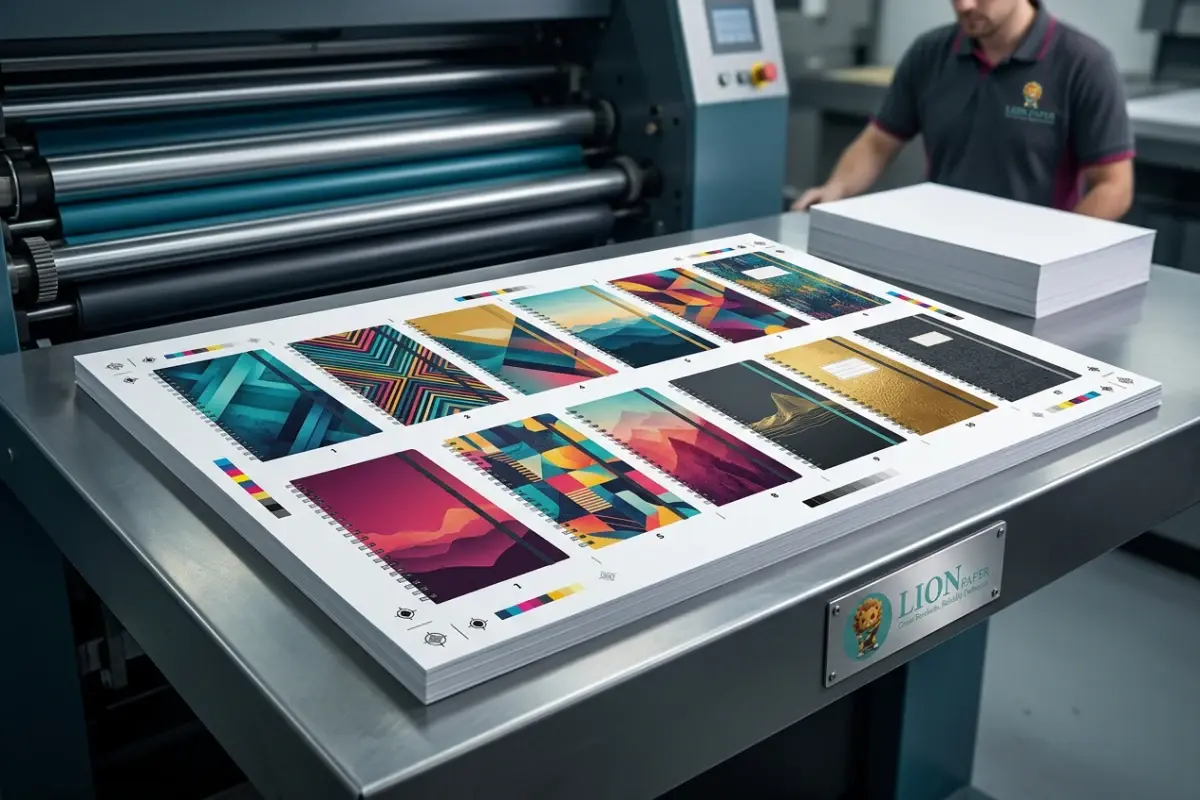
Gang Printing Multi-SKU Notebook Covers: Prepress, Imposition, and Cost Optimization Guide

Gang printing multi-SKU notebook covers combines multiple cover designs onto a single offset press sheet to distribute fixed prepress, aluminum plate, and press make-ready expenses across several product variants. This combo run method significantly reduces unit manufacturing costs and paper waste for stationery brands, provided that all grouped designs utilize identical paper substrates, compatible surface embellishments, and aligned ink-density tolerances across the press cylinder's ink zones.
When should brands choose gang printing for multi-SKU notebook cover collections?
Brands and publishers launching seasonal collections, subscription boxes, or retail assortments frequently face the challenge of balancing SKU diversity with minimum order quantities (MOQs). When evaluating production routes for stationery lines, choosing between separate dedicated offset runs, digital printing, and combined gang runs depends directly on volume per SKU, visual embellishments, and total print run size.
Individual offset runs require a dedicated set of four-color process (CMYK) aluminum printing plates—plus any specialized spot color plates—for every single design. If a brand produces six distinct notebook cover designs at 1,000 units each, individual production requires 24 separate CTP (computer-to-plate) plates and six separate press setup wash-ups and registrations. This drives up the multi variant stationery printing cost considerably.
Digital printing eliminates plate setup costs entirely, making it viable for ultrashort runs under 250 units per design. However, digital sheet-fed presses carry a substantially higher per-sheet consumable and click-charge cost, cannot cost-effectively handle metallic Pantone inks, and exhibit limitations when applying heavy finishes over oil-based digital toners without specialized primers.
Combo run notebook cover manufacturing bridges this gap by laying out multiple artworks across a single large-format offset press sheet (such as 700x1000 mm B1 or 635x965 mm split formats). By amortizing plate making, wash-up cycles, and baseline make-ready paper waste across all SKUs simultaneously, unit costs drop sharply while maintaining premium offset print sharpness and color depth.
Production Parameter | Dedicated Offset Run | Digital Sheet-Fed Run | Multi-SKU Gang Offset Run |
|---|---|---|---|
:--- | :--- | :--- | :--- |
Optimal Order Volume per SKU | 3,000 to 20,000+ units | 50 to 300 units | 500 to 2,500 units |
Plate Generation Requirements | 4 plates per SKU (24 plates for 6 SKUs) | Zero plates | 4 plates total for the combined sheet |
Make-Ready Scrap Waste | 150–300 sheets per individual SKU | 10–20 sheets per SKU | 150–300 sheets total across all SKUs |
Substrate & Caliper Flexibility | Fully customizable per SKU | Limited by machine feeder/fuser | Fully uniform across all combined SKUs |
Embellishment Compatibility | Individual foil/deboss dies per run | Digital varnish/foil (light duty) | Shared surface coats; modular post-press dies |
Unit Economics at Medium Runs | High upfront cost, low variable | High fixed per-unit click rate | Balanced setup and low variable cost |

Prepress imposition layout aligning grain direction, bleed margins, and spine allowances for multi-variant journal covers.
What prepress imposition and sheet optimization rules govern multi-variant journals?
Executing successful prepress imposition for custom journals demands rigorous geometric planning. Prepress operators must map cover dimensions, mechanical spine thicknesses, turn-in margins for hardcovers, and hinge scores for softcovers onto standardized raw sheet sizes while observing grain direction constraints.
1. Spine Width Variations Across Cover SKUs
Even when notebook covers share identical trim heights and widths, variation in interior page counts or paper stock densities alters the spine caliper. In hardcover case-bound journals, the imposition template must account for the board thickness (typically 1.5 mm to 3.0 mm greyboard), the hinge gap (usually 8 mm to 10 mm), and the wrap-around turn-in margin (15 mm to 20 mm on all outer edges). Grouping designs with identical spine calculations on the same gang form prevents mechanical misalignment during subsequent die-cutting and casing-in steps.
2. Paper Grain Direction Alignment
Paper grain direction is a foundational structural parameter in book manufacturing. The grain of the cover stock must run parallel to the notebook spine. Folding against the paper grain creates micro-cracking along the spine edge and induces moisture-related cover warping over time. Therefore, when rotating individual artwork cells during offset sheet optimization for notebooks, prepress engineers cannot freely turn individual covers 90 degrees to squeeze extra yield from the sheet if doing so forces the grain into a perpendicular orientation relative to the spine fold.
3. Gutter Spacing, Bleed, and Trim Margins
Because gang sheets undergo high-speed guillotine cutting or automatic slitting to separate individual SKU panels, precise gutter spacing is mandatory:
Exterior Bleed: Minimum 3.0 mm (0.125 in) for softcover journals; minimum 18.0 mm to 20.0 mm for hardcover turn-in wraps.
Inter-SKU Gaps: Minimum 6.0 mm double-trim gutter between adjacent designs sharing distinct color boundaries to prevent color bleed during blade deflection.
Edge Gripper & Side Guides: Maintain 12.0 mm to 15.0 mm of unprinted margin along the press sheet gripper edge for mechanical press grippers, registration targets, color bars, and plate alignment marks.
Standard Sheet Imposition Yield Matrix (Sample: B1 Sheet 720 x 1020 mm)
| Gripper Margin: Color Control Bar & Side Registration Targets |
+------------------------------------+ | SKU-A: A5 Journal Wrap (Portrait) | SKU-B: A5 Journal Wrap (Portrait) | | Grain Direction: Vertical | Grain Direction: Vertical |
+------------------------------------+ | SKU-C: A5 Journal Wrap (Portrait) | SKU-D: A5 Journal Wrap (Portrait) | | Grain Direction: Vertical | Grain Direction: Vertical |
+------------------------------------+ | Double-cut Gutter: 6mm | Tail Margin: Waste Scrap Pull |
How do press operators manage color balance and ink key conflicts across diverse cover artworks?
Modern commercial offset lithography presses regulate ink transfer through segmented ink fountain keys positioned across the width of the press cylinder. Each ink key corresponds to a vertical channel (typically 30 mm to 35 mm wide) along the direction of sheet travel. When gang printing multi SKU notebook covers, designs positioned within the same ink fountain column share identical mechanical ink volume delivery across that zone.
Resolving Ink Density Conflicts Across Columns
If a dark, heavy-coverage cover (such as an 80% Black + 60% Cyan deep navy illustration) is imposed in the exact same ink key column as a minimalist pastel or white cover featuring delicate typography, the press operator cannot adjust ink supply independently for those two items. Increasing the fountain key flow to achieve optical density on the saturated artwork inevitably floods the adjacent pastel design, causing dot gain, muddy tones, and potential ink set-off on the delivery pile.
To prevent ink zone conflicts, prepress teams must implement structural grouping rules:
Color-Family Grouping: Cluster designs with similar Total Area Coverage (TAC) and compatible dominant color profiles (e.g., cool hues with cool hues, warm earth tones with warm earth tones) along the same vertical ink channels.
TAC Equalization: Restrict artwork Total Area Coverage to a maximum of 280%–300% for coated art paper or 240%–260% for uncoated wood-free sheets through Gray Component Replacement (GCR) or Under Color Removal (UCR) prepress curves.
Dynamic Take-off Bars: Place ghosting/take-off tint strips in the sheet's trim waste areas outside the live artwork to consume excess ink from keys that run across both low-coverage artwork and high-coverage zones.

Ink key zoning management balances color density across diverse artwork designs on combo offset runs.
Spot Colors vs. Extended Gamut CMYK
Adding a dedicated Pantone spot color to a combo run applies that specific ink across the entire sheet. Unless all grouped SKUs utilize that identical spot formulation (such as a shared corporate metallic accent or specific brand identity shade), adding custom spot ink units negates the cost advantage of the gang run. Press operations achieve the best balance by standardizing on ISO 12647-2 or G7-calibrated four-color process printing, or by adopting 7-color Extended Color Gamut (ECG) printing (CMYK + Orange + Green + Violet) when handling vibrant multi-brand collections.
How does post-press finishing and converting handle multi-variant gang-printed sheets?
Surface finishes, structural cutting, and final assembly represent a critical juncture where gang run efficiency can either be preserved or compromised. Finishing steps must be structured based on whether embellishments apply sheet-wide or require selective downstream processing.
1. Sheet-Wide Surface Treatments
Protective and tactile coatings applied before individual panel slitting provide the greatest production efficiency. These treatments run through inline or offline coater units over the uncut press sheet:
Thermal Film Lamination: Matte, gloss, anti-scratch, or soft-touch BOPP films applied across the entire sheet surface before die-cutting.
Aqueous or UV Varnishes: Flood-applied dispersion or overall UV gloss barriers that seal the ink film and prevent scuffing during downstream binding steps.
2. Selective Embellishments and Step-and-Repeat Tooling
When individual SKUs require custom hot foil stamping, debossing, or spot UV varnishing, finishing engineers must choose between combined gang tooling or segmented individual post-press passes:
Combo-Die Foil Stamping: Mounting all individual foil stamping artwork elements onto a single large honeycomb chase matching the master sheet imposition layout. This enables a single machine pass on a large-format platen press (such as a Bobst or Brausse unit), stamping all SKU covers simultaneously.
Modular Offline Tooling: For collections where only two of four SKUs feature foil, the master sheet can either be slit into individual SKU stacks prior to stamping on smaller automatic platen machines, or the combo die can leave unfoiled sections open on the master sheet.
Multi-Variant Finishing Flow Diagram Offset Gang Printing Sheet (B1/B2 Format) │ ▼ Full-Sheet Surface Lamination (Matte / Soft-Touch) │ ▼ Master-Sheet Step-and-Repeat Hot Foil Stamping (Shared Pass) │ ▼ ┌───────────┴───────────┐ ▼ ▼ Hardcover Route Softcover Route • Precision Slitting • High-Speed Slitting & Trimming • Greyboard Casing-In • Inline Spine Scoring & Gluing • Turn-In Corner Wrap • Perfect / Wire-O Binding Assembly
3. Slitting, Sorting, and Defect Scrap Balancing
In gang run production, a printing defect (such as an ink hickey, scratch, or misregistration mark) occurring on one quadrant of the parent sheet scraps that specific sheet, which reduces the output of every other SKU sharing that sheet. To guarantee balanced final inventory across all SKUs, production facilities calculate a 3% to 5% scrap buffer per finishing step and run high-accuracy optical inspection systems during the slitting and packing stages.
What RFQ specifications and quality control protocols guarantee successful production?
Procurement managers, stationery brand directors, and supply chain leads must define comprehensive Request for Quotation (RFQ) packages and strict quality control criteria to ensure gang run notebook projects execute smoothly across international manufacturing nodes.
1. Standardizing Technical RFQ Parameters
When compiling RFQs for multi-SKU notebook lines, supply chain teams must explicitly outline shared material baselines to allow manufacturing engineering teams to evaluate gang run feasibility accurately:
Substrate Consistency: Specify uniform base paper across all variants (e.g., 157 gsm C2S art paper mounted over 2.0 mm greyboard for hardcovers, or 350 gsm C1S ivory board for softcover journals).
Target Run Ratios: Indicate if SKU ratios are 1:1:1:1 or asymmetrical (e.g., 2,000 units of SKU A and 1,000 units each of SKUs B and C, which requires allocating twice as many sheet positions to SKU A on the master imposition).
Surface Standard: Standardize on uniform film lamination bases across the set before applying variable spot enhancements.

High-precision converting and slitting isolate individual cover SKUs following shared surface finishing passes.
2. Proofing and Color Approval Protocols
Pre-production verification requires two distinct tiers of proofing. Digital scatter proofs or contract GMG color proofs confirm individual artwork color separations and typography. However, because ink key interaction cannot be fully modeled on standalone digital proofs, contract color targets must adhere to standardized ISO/G7 target density curves.
3. Dual-Site Agile Manufacturing Workflow
For global stationery brands, leveraging structured multi-site manufacturing provides both product development flexibility and mass-volume price efficiency. At Lion Paper Products (Jiaxing) Co., Ltd., founded in 2015 in Jiaxing, Zhejiang, supply chain operations operate across a dual-base infrastructure:
Jiaxing Facility (approx. 3,000 sq. m): Dedicated to initial concept development, engineering structural design, prepress gang imposition planning, and rapid sampling.
Cambodia Facility (approx. 10,000 sq. m): Equipped with automated production lines, standardized SOPs, and scaled capacity delivering an annual notebook output exceeding 5 million units for North American, European, Middle Eastern, and Southeast Asian retail channels.
Quality assurance across both facilities follows rigorous AQL (Acceptable Quality Level) sampling, defined defect classification catalogs, and unified operating procedures. These controls maintain strict registration tolerances and color consistency across product batches, supported by certified management frameworks including ISO 9001, FSC, SMETA, WCA, GSV, FAMA, and CPSIA compliance standards.
To evaluate production routes for your upcoming stationery line, contact Lion Paper with your artwork files, paper stock preferences, SKU run ratios, color targets, and finishing specifications to receive an engineered manufacturing plan.
Frequently Asked Questions
Can I mix softcover and hardcover notebook covers on the same gang sheet?
No. Hardcover wraps and softcover covers use completely different substrates and calipers. Hardcover wraps typically use 128 gsm or 157 gsm coated art paper engineered to wrap around dense greyboard, requiring 15 mm to 20 mm turn-in margins. Softcover notebooks require 300 gsm to 400 gsm cardstock (such as C1S ivory board or heavy art card) with integrated spine hinge scores. These different paper weights cannot run simultaneously on the same sheet.
What happens if one SKU requires a higher order quantity than the others?
Uneven order ratios are handled by adjusting sheet position allocation on the prepress imposition layout. For example, if SKU 1 requires 4,000 units while SKU 2 and SKU 3 require 2,000 units each, the prepress team creates a 4-up master template allocating two positions to SKU 1, one position to SKU 2, and one position to SKU 3. A single print run of 2,000 parent sheets yields the exact required product ratio without overproducing the smaller SKUs.
How are spot UV and foil stamping dies charged in a multi-SKU combo run?
Finishing tooling can be calculated as a single large step-and-repeat combo die covering all sheet positions, or as individual small dies used after slitting the master sheet into separate SKU piles. Creating a combined master die minimizes press setup and pass time on automatic platen machines, making it the most cost-effective route for runs above 1,000 sheets when all variants share the same embellishment type.
FAQ
Can I mix softcover and hardcover notebook covers on the same gang sheet?
No. Hardcover wraps and softcover covers use completely different substrates and calipers. Hardcover wraps typically use 128 gsm or 157 gsm coated art paper engineered to wrap around dense greyboard, requiring 15 mm to 20 mm turn-in margins. Softcover notebooks require 300 gsm to 400 gsm cardstock (such as C1S ivory board or heavy art card) with integrated spine hinge scores. These different paper weights cannot run simultaneously on the same sheet.
What happens if one SKU requires a higher order quantity than the others?
Uneven order ratios are handled by adjusting sheet position allocation on the prepress imposition layout. For example, if SKU 1 requires 4,000 units while SKU 2 and SKU 3 require 2,000 units each, the prepress team creates a 4-up master template allocating two positions to SKU 1, one position to SKU 2, and one position to SKU 3. A single print run of 2,000 parent sheets yields the exact required product ratio without overproducing the smaller SKUs.
How are spot UV and foil stamping dies charged in a multi-SKU combo run?
Finishing tooling can be calculated as a single large step-and-repeat combo die covering all sheet positions, or as individual small dies used after slitting the master sheet into separate SKU piles. Creating a combined master die minimizes press setup and pass time on automatic platen machines, making it the most cost-effective route for runs above 1,000 sheets when all variants share the same embellishment type.


Comments