


Fountain Pen Nib Sizes: Engineering Specifications, Paper Compatibility, and Sourcing Guide

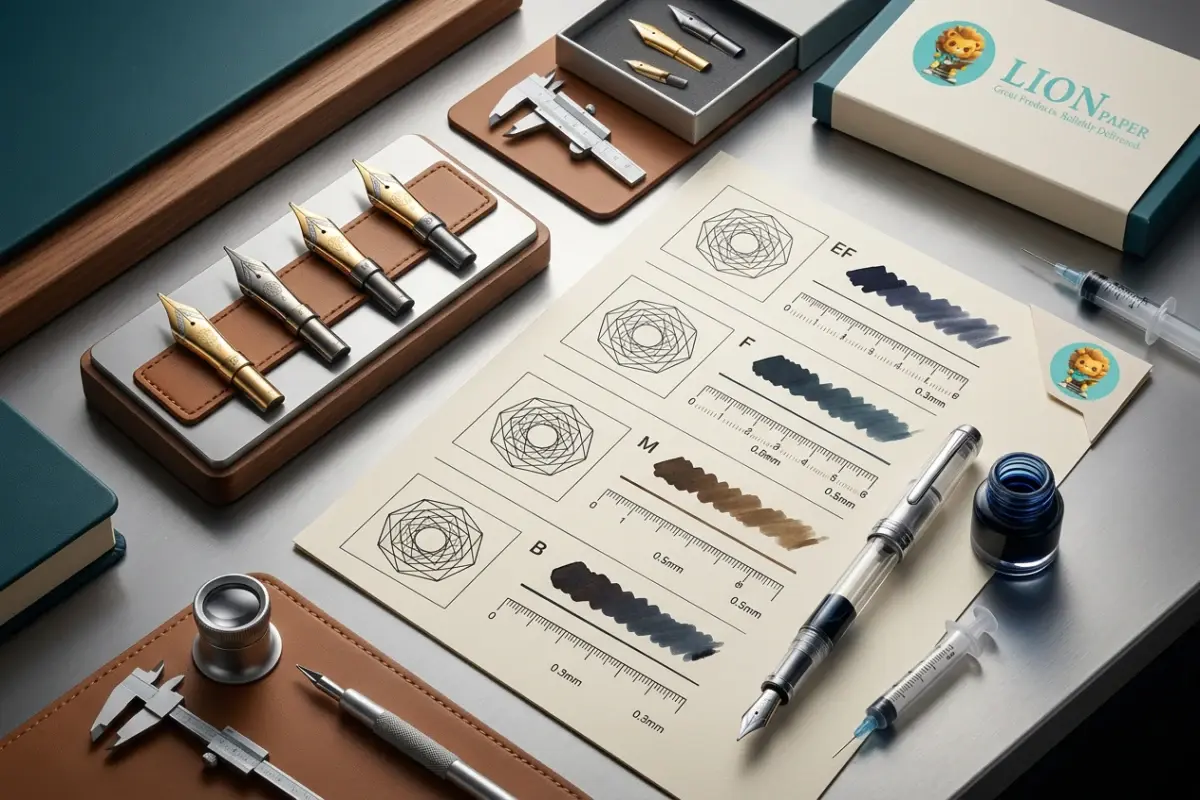
Fountain pen nib sizes—primarily Extra Fine (EF), Fine (F), Medium (M), and Broad (B)—determine line width, ink delivery volume, and writing friction. Tip dimensions generally range from 0.3 mm for ultra-fine grades up to 1.0 mm or more for broad profiles. Nib selection dictates ink wetness, paper absorption dynamics, and user ergonomics, making exact technical specification essential when engineering standalone writing instruments or paired notebook gift sets.
What Are the Standard Fountain Pen Nib Sizes and Their Tip Widths?
Standard fountain pen nib sizes are categorized by the physical width of the tipping material welded to the metal nib structure. Tipping material is typically a hard osmium, ruthenium, or tungsten alloy ground and polished to a precise spherical or elliptical geometry. While global standardization across all brands does not exist under a single ISO rubric, industrial manufacturing follows established width conventions categorized into Western and Japanese sizing systems.
Japanese nib sizing runs approximately one full grade finer than Western sizing due to the structural density and intricate stroke complexity of East Asian scripts, which require narrow, high-definition ink channels. Conversely, Western nib profiles favor broader tipping dimensions that accommodate continuous cursive writing and wet ink formulations.
Nib Designation | Western Tip Width (mm) | Japanese Tip Width (mm) | Typical Line Width on 80 gsm Bond | Primary Writing Application |
|---|---|---|---|---|
:--- | :--- | :--- | :--- | :--- |
Extra Fine (EF / XF) | 0.35 – 0.45 mm | 0.25 – 0.35 mm | 0.25 – 0.35 mm | Accounting, marginalia, compact grid journals (3.5 mm – 5 mm) |
Fine (F) | 0.50 – 0.60 mm | 0.35 – 0.45 mm | 0.40 – 0.50 mm | General daily note-taking, standard business correspondence, ruled planners |
Medium (M) | 0.70 – 0.80 mm | 0.50 – 0.65 mm | 0.60 – 0.75 mm | Signature lines, expressive journaling, showcase ink shading properties |
Broad (B) | 0.90 – 1.10 mm | 0.75 – 0.90 mm | 0.85 – 1.05 mm | Executive signatures, display lettering, heavy dye and pigment inks |
Double Broad (BB) | 1.10 – 1.30 mm | 1.00 – 1.20 mm | 1.10 – 1.35 mm | Calligraphic headlines, legal endorsements, bold creative mark-making |
Stub / Italic | 0.90 – 1.90 mm (Flat) | 0.80 – 1.50 mm (Flat) | Variable Line Variation | Formal calligraphy, invitation addressing, custom lettering |
When evaluating a fountain pen nib size chart for commercial production, procurement engineers must account for the mechanical tolerance range (typically ±0.03 mm to ±0.05 mm) established during the final tipping grinding and slitting processes. Variations in slit width, tine tension, and ink viscosity will subtly expand or contract the deposited line relative to the dry tip measurement.

Polished tipping alloy and capillary slit geometry dictate line consistency and ink flow rate.
How Does Nib Geometry Impact Ink Flow, Feathering, and Paper Performance?
Nib geometry governs capillary action, hydrodynamics, and the mechanical shear applied to paper fibers. The writing system operates as a balance between ink surface tension, capillary draw through the feed's micro-channels, slit geometry, and the sizing chemistry of the paper substrate.
A narrow nib profile, such as Extra Fine or Fine, deposits a lower ink volume per linear millimeter (approximately 0.8 to 1.4 microliters per meter of line). The smaller contact area concentrates downward pressure across fewer paper surface fibers, increasing the mechanical abrasion on lightweight or uncoated paper. However, because low ink volume evaporates quickly and does not deeply penetrate the sheet, fine nibs rarely induce bleed-through or show-through, even on standard 70 gsm to 80 gsm woodfree paper.
Conversely, Medium and Broad nibs feature broader contact patches and wider capillary slits, depositing between 2.2 and 4.0 microliters of ink per linear meter. This higher volume introduces specific hydro-mechanical challenges:
Feathering Risk: When excessive wet ink hits porous, unsized cellulosic fibers, lateral capillary absorption pulls the liquid outward, causing jagged edge blur along written strokes.
Bleed-Through: High-volume ink pools can bypass internal paper sizing, penetrating through the cross-section of the sheet to create spots or full strike-through on the reverse side.
Extended Dry Times: Broad liquid deposits require longer ambient evaporation times (often 15 to 45 seconds on clay-coated or dense paper grades), heightening smudging risks for left-handed users or high-speed note takers.
Surface Sheen and Shading: Broader nibs allow complex dye inks to pool naturally at the end of downward strokes, highlighting multi-tonal shading and reflective surface sheen on smooth, non-absorbent paper stocks.
Achieving optimal fountain pen and paper compatibility requires matching the nib's wetness profile with internal surface sizing agents (such as alkyl ketene dimer or alkenyl succinic anhydride) and smooth surface calenders on paper stocks weighing 100 gsm to 160 gsm.
How Do You Choose Fountain Pen Nib Width for Target Demographics and Price Points?
Choosing fountain pen nib width during product design depends on the end-user's writing habits, regional typographic requirements, retail price architecture, and intended stationery use cases.
Target Demographic & Use Case Mapping:
Daily Planners & Compact Notebooks --> EF / F Nibs (Controlled ink flow, crisp definitions)
Executive Gifts & Signatures --> M / B Nibs (Smooth glide, authoritative stroke width)
Calligraphy & Creative Journals --> Stub / Flex Nibs (Line variation, dynamic pooling)
Mass-Market Retail / Entry-Level --> Standardized F / M Nibs (Universal reliability)
1. Daily Organization and Functional Productivity
Users working within compact daily planners, pocket diaries, or dot-grid notebooks (such as 3.5 mm, 4 mm, or 5 mm grids) require Extra Fine (EF) or Fine (F) nibs. These sizes keep character ascenders and descenders legible within confined line heights without merging adjoining strokes. Mass-market productivity stationery is therefore best paired with 0.4 mm to 0.5 mm line widths.
2. Executive Gifting and Corporate Bundles
Corporate gift sets, executive signature pens, and premium leather-bound journal collections perform best with Medium (M) or soft Fine (F) nibs. A Medium nib offers immediate tactile smoothness by maintaining a hydro-dynamic ink buffer between the tipping sphere and paper surface, minimizing toothy feedback for casual or novice fountain pen users.
3. Creative Journaling and Calligraphy Enthusiasts
Artisan lifestyle brands, bullet journal communities, and lettering artists seek expressive line variation. For these segments, offering specialized options such as 1.1 mm Stub nibs, Architect grinds, or semi-flexible tines provides dynamic stroke differentiation, appealing directly to pen collectors and enthusiast audiences.
4. Commercial Price Point Tiers
Nib materials and finishing complexities align closely with retail pricing brackets:
Entry-Level Tier ($5 – $25 MSRP): Stamped stainless steel nibs (such as #5 or #6 friction-fit units), single-color chrome or black PVD plating, standardized F or M tipping points.
Mid-Range Tier ($25 – $85 MSRP): Precision-ground stamped steel or bi-color gold-plated steel nibs, laser-etched custom branding, paired with dedicated threaded converter housings.
Luxury / Collector Tier ($85 – $300+ MSRP): Solid 14K or 18K gold nib assemblies, custom hand-tuned tipping profiles, micro-polished feed housings, and coordinated luxury packaging.

Matching nib width with paper sizing and grammage prevents feathering and ink bleed-through.
What Are the Critical Fountain Pen Nib Manufacturing Specifications?
Engineering commercial-grade fountain pens requires strict adherence to fountain pen nib manufacturing specifications to guarantee leak resistance, immediate capillary startup, and dimensional stability during continuous writing.
Core Nib Assembly Specifications:
Nib Component: Stainless Steel (304/316) or 14K/18K Gold Sheet (0.35–0.50 mm thickness)
Tipping Sphere: Osmium/Ruthenium Hard Alloy Pellet (Micro-resistance welded & ground)
Capillary Slit: Precision wire-cut or diamond-disc slit (0.02–0.04 mm width taper)
Breather Hole: Circular, heart, or custom punched geometry (Stress relief & airflow)
Ink Feed: Injection-molded ABS or machined Ebonite with micro-finned capillary fins
Nib Unit Housing: Threaded collar assembly (#5 / #6 industry footprint standards)
Mechanical Dimensions and Tolerances
Production drawings must specify precise structural variables across the nib and feed interface:
Nib Sizing Standards: Standard industrial fountain pen assemblies generally use #5 (feed diameter ~5.0 mm) or #6 (feed diameter ~6.0 mm) formats. The nib curvature radius must match the feed profile within a radial tolerance of ±0.02 mm.
Slit Width and Taper: The capillary slit cut from the breather hole to the tip should taper from approximately 0.04 mm at the breather hole down to 0.015–0.025 mm at the inner tipping point, establishing a steady capillary pressure gradient.
Tine Alignment and Symmetry: Both tines must align within a vertical height variance under 0.01 mm at the tip. Uneven tines cause scratchiness and irregular ink distribution during directional strokes.
Feed Air-Return Mechanics: The ink feed must balance outward ink capillary flow with inward air displacement. Micro-channel widths of 0.08 mm to 0.12 mm prevent hydraulic vacuum formation inside the reservoir cartridge or converter.
Cap Air-Tightness: The inner cap seal (spring-loaded plastic sleeve or elastomer gasket) must maintain a hermetic seal when capped, preventing nib dry-out over a minimum 30-day uninked static storage cycle.
Specification Parameter | Standard Industrial Target | Tight Engineering Tolerance | Testing & Inspection Method |
|---|---|---|---|
:--- | :--- | :--- | :--- |
Feed Diameter Fit | 5.00 mm / 6.00 mm | +0.02 mm / -0.01 mm | Go/No-Go plug gauge |
Tipping Hardness | > 250 HV (Vickers) | > 300 HV (Vickers) | Micro-indentation hardness tester |
Tine Gap at Rest | 0.020 mm | ±0.005 mm | Optical comparator / 50x microscope |
Slit Concentricity | Centered on Breather | Max offset < 0.03 mm | Digital vision inspection system |
Writing Angle Range | 40° to 60° from paper | Functional 35° to 65° | Automated mechanized stroke tester |
How Do Brands Test Fountain Pen and Paper Compatibility for Notebook Gift Sets?
When developing bundled stationery collections containing custom notebooks and fountain pens, cross-compatibility testing prevents common consumer complaints regarding ink bleed, feathering, or slow dry times.
Protocol for Fountain Pen and Paper Compatibility Validation: Step 1: Raw Material Sizing Verification (Cobb 60 Water Absorption Test) Step 2: Automated Stroke Deposition (Line width & capillary bleed measurement) Step 3: Multi-Viscosity Ink Stress Testing (Standard dye, iron gall, pigment formulations) Step 4: Optical Density & Strike-Through Assessment (Spectrophotometer measurement) Step 5: Environmental Aging & Climate Chamber Cycling (Temperature & RH stress)
1. Water Absorption and Surface Sizing Testing
Paper stock undergoes Cobb 60 testing (ISO 535) to measure water absorption rates. Premium fountain-pen-friendly notebook papers typically exhibit a Cobb value of 20 to 30 g/m², ensuring that aqueous dye solutions stay anchored near the surface rather than saturating the internal cellulosic web.
2. Optical Strike-Through and Show-Through Evaluation
Using a spectrophotometer, optical density is measured on the reverse side of 100 gsm, 120 gsm, or 160 gsm paper following heavy Broad (B) and Stub nib line passes. Target delta opacity must remain above 90% to allow dual-sided notebook writing without visual distraction.
3. Lateral Line Expansion Analysis
High-resolution optical micrometers measure the physical line deposited on the target paper versus the dry tip dimension. Acceptable lateral line bleed expansion must not exceed 15% over the dry mechanical width under standard writing pressure (0.5 to 1.5 N).
4. Smear and Dry Time Profiling
Using standard dye-based black and blue inks at 23°C and 50% Relative Humidity, stroke dry times are benchmarked at 5-second intervals. A balanced writing system achieves dry times between 8 and 18 seconds on sized notebook paper.

Rigorous AQL quality control protocols ensure reliable capillary start-up and leak prevention.
What Quality Control and AQL Standards Apply to Bulk Nib and Writing Instrument Production?
High-volume fountain pen manufacturing requires multi-tier quality assurance protocols aligned with ISO 2859-1 (ANSI/ASQ Z1.4) sampling standards to prevent dry starts, ink leaks, and surface finish flaws.
Standard Quality Acceptance Sampling (AQL):
Critical Defects (AQL 0.0 / 0.1): Barrel leakage, loose nib assembly, ink reservoir failure
Major Defects (AQL 1.0 / 1.5): Hard starting, severe scratchiness, tine misalignment, cap loose
Minor Defects (AQL 2.5 / 4.0): Plating micro-scratches, subtle logo misprints, minor clip play
In-Line Inspection Checks
During assembly, automated optical inspection (AOI) units verify the tipping sphere placement, slit symmetry, and tine gap on 100% of manufactured nib units. Feeds undergo ultrasonic cleaning to clear mold release residues or plastic flash from capillary channels prior to collar insertion.
Functional Pen Testing Matrix
Cap Air-Tightness Pressure Decay Test: Assembled caps undergo low-pressure air decay testing to confirm hermetic seal integrity, preventing solvent evaporation from the nib.
Continuous Writing Machine Run: Random production samples are mounted on robotic writing testers to verify continuous ink delivery across 100 meters of continuous spiral stroke lines without railroading or skipping.
Drop and Leak Resistance Testing: Inked pens undergo negative pressure altitude simulation (-0.5 bar for 15 minutes) and 1.0-meter drop tests onto hardwood surfaces to verify structural reservoir stability.
How Does Lion Paper Support Integrated Pen and Stationery Sourcing?
Lion Paper Products (Jiaxing) Co., Ltd., founded in 2015 in Jiaxing, Zhejiang, operates as an integrated supply-chain partner for customized paper goods and creative stationery collections. Combining a 3,000-square-meter design, prototyping, and customer support center in Jiaxing with a 10,000-square-meter mass-production facility in Cambodia, Lion Paper delivers cohesive, retail-ready writing and paper solutions.
Producing over 5 million notebooks annually alongside integrated lifestyle and office stationery collections, Lion Paper pairs notebook development with writing instrument sourcing, guaranteeing cross-compatibility across all product categories:
Design-to-Manufacturing Integration: In-house engineering teams match paper caliper, internal sizing formulations, and binding structures with custom pen nib sizes, finishes, and filling mechanisms from the initial concept sketch.
China–Cambodia Dual-Site Synergy: China operations provide rapid sampling, creative structural design, and prototype iteration, while Cambodia facilities manage large-scale manufacturing, tariff optimization, and global logistics.
FSC-Certified and Sustainable Materials: Lion Paper provides fully traceable FSC-certified papers, recycled fiber boards, low-impact soy-based inks, and plastic-free retail gift packaging.
Compliance and Social Audits: Manufacturing operations maintain comprehensive compliance systems supported by ISO 9001, FSC, SMETA, WCA, GSV, FAMA, and CPSIA certifications.
Turnkey Retail Packaging: From protective presentation gift boxes to custom blister cards, PDQ retail display units, and e-commerce-ready fulfillment packs, all elements are engineered for physical durability and unified branding.
Whether developing private-label stationery sets for boutique gift brands, high-volume retail chains, or direct-to-consumer creators, Lion Paper manages the complete supply chain from first sketch to final container delivery.
For custom manufacturing programs, share your target nib size, ink filling mechanism, barrel material, price tier, and packaging requirements to request a fountain pen sample and comprehensive QC plan.
FAQ
What is the difference between Japanese and Western fountain pen nib sizes?
Japanese nib sizes are ground approximately one grade finer than Western nibs. A Japanese Medium (M) produces a line width roughly equivalent to a Western Fine (F), around 0.50 mm to 0.60 mm, designed to render complex Asian character strokes crisply.
Which fountain pen nib size is best for beginners and everyday note-taking?
A Fine (F) or Medium (M) nib in standard Western sizing (0.5 mm to 0.7 mm) is recommended for general daily writing. It provides a smooth balance of ink flow, forgiving writing angles, and broad compatibility with standard 80 gsm to 100 gsm paper stocks.
How does paper weight and surface sizing affect fountain pen performance?
Internal and surface paper sizing controls liquid absorption rate, preventing feathering and bleed-through. Densely sized paper weighing between 100 gsm and 160 gsm keeps ink on the surface, preserving crisp line edges and rich ink shading.
Can stainless steel fountain pen nibs perform as smoothly as 14K gold nibs?
Yes. Writing smoothness is primarily determined by the quality, geometry, and polish of the welded tipping alloy pellet, rather than the base metal of the nib body. Gold nibs offer slightly more elastic tine spring, but high-precision steel nibs deliver comparable glide.


Comments