


Expanding File Carton Packing: Standards, Gusset Protection, and Shipping Density Optimization

Expanding file carton packing balances engineered inner supports and carton compression thresholds to prevent gusset deformation while maximizing container loading density. Proper packing requires selecting heavy-duty double-wall master cartons (ECT 44 or higher), alternating unit orientations to distribute spine-to-gusset taper, calibrating polybag ventilation, and restricting inner stack pressure so that polypropylene and paperboard gussets retain their structural elasticity throughout international ocean transit.
What Are the Key Structural Challenges in Expanding File Carton Packing?
Accordion-style document organizers present unique structural packaging challenges because of their non-uniform geometry and expandable pleats. Unlike standard bound notebooks or flat paper folders, an expanding file is naturally wedge-shaped: the bound or clasped spine is rigid and thin, whereas the multi-pocket gusset top is flexible and thick. When multiple units are stacked uniformly in a shipping container, this structural asymmetry creates uneven pressure zones that lead to carton tilting, collapsed outer walls, and crushed file edges.
Several physical vulnerabilities require targeted carton engineering:
Gusset Crease Crushing: Extended vertical pressure inside export cartons causes accordion pleats to fold along unintended axes, leading to permanent plastic deformation in polypropylene (PP) files or irreversible creasing in paperboard and pressboard models.
Hardware and Closure Indentations: Fasteners such as elastic loop buttons, turn locks, push-button plastic latches, and metal grommets concentrate downward pressure into localized points. In densely packed cartons, these metal or rigid plastic components press into the face of adjacent files, causing surface gouges, scuffs, and puncturing.
Flap and Edge Buckling: The perimeter flaps and indexing tab dividers inside expanding files often protrude slightly above the main folder body. Without dedicated internal clearance, top-load compressive force bends index tabs and distorts perimeter bindings.
Corner Abrasion During Transit Vibration: Ocean freight and inland transit subject pallets to prolonged harmonic vibration. When expanding files shift within an oversized carton, friction scuffs protective clear coats, matte laminations, and foil-stamped branding.
Solving these issues requires matching inner packaging configurations with verified accordion file packaging standards to isolate fragile edges and balance internal compressive loads.

Proper inner carton clearances prevent permanent gusset deformation and tab crushing during transit.
How Do Pocket Count, Gusset Materials, and Closure Types Impact Carton Design?
Carton design parameters must be engineered around the specific mechanical properties of the expanding file, specifically pocket count, substrate composition, and closure hardware. A 24-pocket heavy-duty desk file requires an entirely different protective strategy than a 6-pocket slim poly document pouch.
File Type & Capacity | Gusset Material & Thickness | Closure Hardware | Primary Packaging Vulnerability | Recommended Master Carton Configuration |
|---|---|---|---|---|
:--- | :--- | :--- | :--- | :--- |
6–8 Pocket Slim Organizer | 0.15–0.20 mm Polypropylene (PP) | Elastic cord with corner anchor | Edge curling, side-to-side friction scuffing | 48 units/carton; 5-ply Double Wall (BC-flute); alternating head-to-tail nested pairs |
12–13 Pocket Monthly Organizer | 0.18–0.25 mm PP or 250 gsm Kraft | Center push-button latch or buckle | Buckle point-pressure puncture; tab header bending | 24 units/carton; individual polybags with micro-perforations; corrugated center divider beam |
24–31 Pocket Heavy Desk File | Reinforced cloth/Tyvek gusset; 1200 gsm greyboard cover | Full flap with dual elastic loops or twist lock | Side gusset sag; bottom spine collapse under top load | 12 units/carton; reinforced inner cartons (6 units/inner); vertical spine-down orientation |
Open-Top Tiered Desktop File | Heavyweight Paperboard with Mylar-reinforced tabs | Open top / No flap | Top tab crushing; corner splitting along base score lines | 12–16 units/carton; perimeter EPE foam edge caps; individual shrink-wrap wrapping |
Material behavior under prolonged load dictates the maximum stack height within each carton. Polypropylene retains shape memory when flexed within normal elasticity limits, but high ambient temperatures in shipping containers (often exceeding 50°C in ship holds) increase polymer ductility, making warm PP prone to cold-flow deformation under sustained load. In contrast, paperboard gussets are sensitive to relative humidity; excessive moisture absorption softens paper fibers, reducing edge crush resistance by up to 40% if export cartons lack appropriate vapor barriers and desiccant placement.
What Are the Core Accordion File Packaging Standards for Export Transit?
To ensure damage-free global delivery across B2B, retail, and e-commerce distribution networks, export packaging must comply with rigorous corrugated carton specifications. Standard single-wall cartons are insufficient for high-volume expanding file shipments due to dynamic load shifting.
Export-ready bulk document organizer carton specs require the following engineering baselines:
Carton Board Construction: Master cartons must utilize minimum 5-ply double-wall corrugated board (typically BC-Flute, 6.5 mm to 7.0 mm thickness) with a minimum Edge Crush Test (ECT) rating of 44 lbs/in (equivalent to a Mullen Bursting Test of 275 psi). For master cartons exceeding 15 kg gross weight, export lines should upgrade to ECT 48.
Moisture Barrier and Polybag Enclosures: Each expanding file should be enclosed in a clear polybag (minimum 0.04 mm / 40-micron thickness) sealed with a suffocation warning label. Polybags must feature punched vent holes to allow air expulsion during packing compression while preventing trapped moisture condensation during oceanic dew-point shifts.
Internal Corrugated Dividers and Pads: Master cartons packing more than 24 units must incorporate corrugated divider pads (B-flute or C-flute) between vertical tiers. These pads distribute stacking weight evenly across the rigid folder spines rather than concentrating it onto the flexible accordion gussets.
Top and Bottom Buffer Pads: Inserting a 3-ply corrugated pad at both the top and bottom of the master carton prevents box-cutter blade penetration during unpacking and adds supplemental puncture resistance against pallet strapping.
Carton Weight and Dimensional Limits: Master carton gross weight should be maintained between 10.0 kg and 14.5 kg. Exceeding 15.0 kg increases manual handling drops and causes bottom-layer accordion files to exceed their maximum compressive threshold.

Accordion file packaging standards require high-ECT double-wall corrugated board and protective layer pads.
How Does Gusset Elasticity Recovery Logic Prevent Permanent Deformation in Transit?
Preventing gusset deformation in transit requires an understanding of structural elasticity recovery. When an expanding file is packed, its pleats are pressed into a closed state. If the clamping pressure exceeds the structural memory of the fold, the accordion hinges develop micro-fractures or permanent creep, preventing the folder from opening smoothly or standing upright on an office desk.
To preserve gusset spring-back performance across extended supply chain timelines, packaging engineers follow three structural rules:
Avoid Over-Compression in Inner Sleeves: Unit bundling (such as shrink wrapping sets of 3 or 6) must not compress the gusset beyond its resting flat dimension. Applying high-tension shrink film forces the accordion edges outward, crushing the valley folds against the outer perimeter.
Calibrate Head-to-Tail Nesting Tolerances: To eliminate the natural wedge taper of expanding files, units must be paired in alternating orientations (Folder A spine top / Folder B spine bottom). The carton interior dimensions (length, width, depth) must match this paired footprint with a tight tolerance of +3 mm to +5 mm. Excessive space allows units to slide and wedge into one another, while undersized cartons subject side gussets to constant lateral pinch.
Preserve Gusset Scored Crease Radii: In production, paperboard and PP gussets must be creased with calibrated scoring wheels that define fold geometry without tearing fiber strands or thinning polymer walls. Proper creasing ensures that when transit clamping pressure is relieved at the destination warehouse, the gusset naturally expands to its designated capacity.
How Do You Optimize Expanding File Shipping Density for Freight Efficiency?
Ocean and air freight costs correlate directly with volumetric efficiency. Because expanding files inherently contain empty air pockets between dividers, optimizing expanding file shipping density without crushing the product is essential for total-cost optimization.
Maximizing freight density involves combining precision carton sizing, pallet footprint matching, and container load optimization:
Eliminating Carton Headspace: Unused vertical space inside a master carton is the primary cause of carton collapse. Under top-load pallet weight, empty headspace forces carton side walls to bear 100% of the load without internal support from the product. Sizing the carton depth precisely to the nested height of the file stack ensures that product spines share compressive loads safely.
Pallet Utilization Modeling: Master carton external dimensions should be engineered around standard export pallet footprints: 1200 mm × 1000 mm (standard standard UK/Europe/Global) or 48" × 40" (1219 mm × 1016 mm GMA pallets for North America). Optimizing carton footprints to achieve 95% to 98% pallet surface coverage eliminates overhang (which reduces carton strength by up to 32%) and prevents underhang (which causes transit shifting).
Container Cube Utilization: Standard 40-foot High Cube (40HQ) containers offer 76.2 cubic meters of volume and an internal height of 2.69 meters. Pallet stack heights should be calculated to utilize 2.38 to 2.45 meters of vertical height (typically two stacked pallets of 1.15 to 1.20 meters each), accounting for forklift clearance while avoiding excess headspace.
Container Type | Target Master Cartons (24-pk standard) | Estimated Unit Capacity | Pallet Pattern Configuration | Volume Utilization Rate |
|---|---|---|---|---|
:--- | :--- | :--- | :--- | :--- |
20-Foot Standard (20GP) | 800–900 Cartons | 19,200–21,600 Units | 10 Pallets (Floor-loaded optional for +12%) | 84%–88% |
40-Foot Standard (40GP) | 1,700–1,850 Cartons | 40,800–44,400 Units | 20–21 Pallets (Single tier or stacked) | 88%–91% |
40-Foot High Cube (40HQ) | 2,050–2,250 Cartons | 49,200–54,000 Units | 20–21 Pallets (Double stacked, 1.2m each) | 92%–95% |
By synchronizing nested head-to-tail interior packing with tight external carton dimensions, brands reduce freight cost per unit by 15% to 22% while reinforcing overall carton structural integrity.
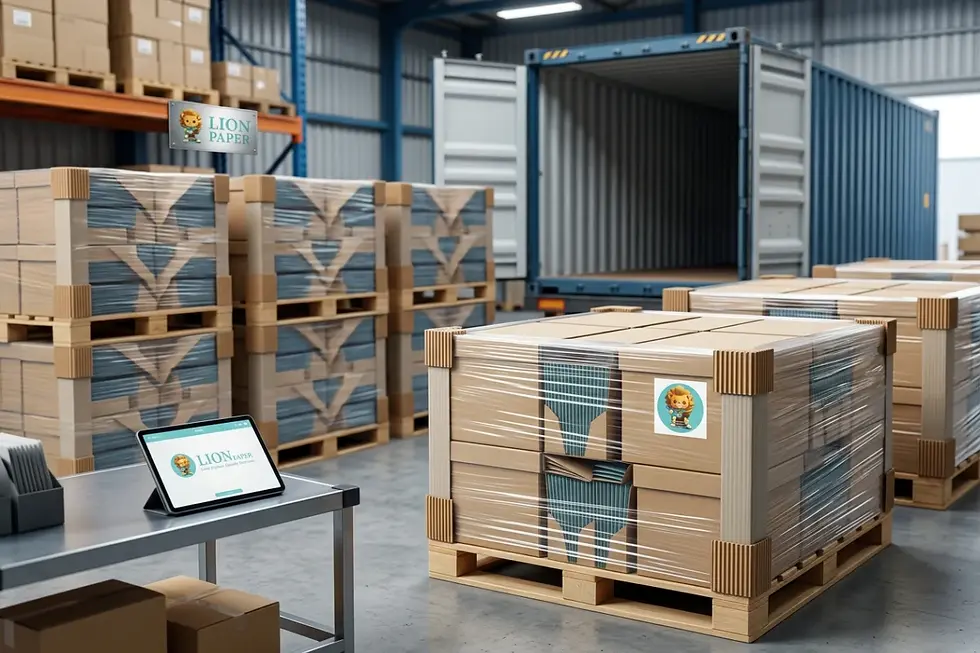
Optimized palletization and container loading patterns maximize expanding file shipping density without risking carton crush.
What Quality Assurance Tests Validate Expanding File Carton Packing Integrity?
Before authorizing mass production and container loading, master carton designs and internal packing configurations must undergo rigorous transit simulation testing. Lion Paper applies standard operating procedures (SOPs) and AQL sampling standards aligned with international packaging testing protocols.
Key transit validation tests include:
ISTA 1A / 2A Drop Testing: A fully packed master carton undergoes a standardized 10-drop sequence from heights between 76 cm and 100 cm (based on gross carton weight). The sequence tests structural resilience across the carton's most vulnerable points: one corner drop, three edge drops, and six flat face drops. A passing result requires zero burst seams, zero gusset pleat crinkling, and uncompromised closure operation.
Dynamic Vibration Testing: Simulates 2,000 to 5,000 nautical miles of ocean vessel engine hum and road transit vibration. The test verifies that internal polybag surfaces prevent abrasive scuffing on printed folder covers and that nested files do not interlock and crush index tabs.
Box Compression Testing (BCT) and Static Stacking: Evaluates the carton's vertical crush strength under environmental conditioning. Cartons are subjected to static loads simulating pallet stacking up to 2.5 meters for 72 hours under high humidity (85% RH at 38°C) to verify that bottom-tier cartons do not buckle under oceanic shipping conditions.
Closure Fatigue and Tab Alignment Check: Post-drop inspection checks that indexing dividers remain aligned within ±1.0 mm of specification and that plastic push-buttons or elastic cords open and close smoothly without micro-cracking.
Lion Paper executes these packaging and transit validations across its integrated manufacturing footprint. With creative product planning, structural engineering, and rapid prototyping managed at our Jiaxing facility (3,000 sqm), and high-volume manufacturing, automated folding, and container logistics executed at our Cambodia production base (10,000 sqm), we ensure that every production run meets consistent quality and international transit standards.
What Specifications Are Required to Develop a Custom Expanding File Packaging Plan?
Developing an optimized packaging plan requires aligning file physical dimensions, material selections, and distribution channel requirements early in the product development cycle. Providing comprehensive specifications ensures accurate dieline generation, carton footprint calculations, and cost-effective freight modeling.
To generate an engineered packing specification, provide the following parameters:
Document and Pocket Format: Specify sheet dimensions (e.g., US Letter, A4, Legal, Cheque size), internal pocket count (e.g., 6, 12, 13, 24, 31 pockets), and maximum expansion width (e.g., 250 mm to 600 mm fully open).
Cover and Gusset Substrates: Indicate cover material (e.g., polypropylene thickness in microns, greyboard wrapped in coated art paper, natural kraft) and gusset material (e.g., virgin PP, recycled PP, reinforced cloth, Mylar-taped paperboard).
Hardware and Fastener Details: Define closure mechanisms (elastic band with corner hooks, center latch, zipper closure, plastic twist buckle, or magnetic snap).
Retail Packaging Requirements: Specify inner packaging format (individual polybag with barcode, retail header card, full-color presentation gift box, belly band, or multi-pack master shrink wrapping).
Logistics and Channel Constraints: Identify delivery destination requirements, pallet height limitations (e.g., Amazon FBA 1.8 m height restrictions or standard retail distribution center 1.2 m pallet limits), and gross weight caps per master carton.
Our cross-facility engineering team converts these parameters into optimized dielines, load-tested master carton specs, and container stuffing plans that safeguard product presentation while minimizing landed logistics costs. To evaluate structural options for your next production run, request an expanding-file prototype and load-test plan tailored to your exact document format and target shipping volumes.
FAQ
Why do expanding files deform when packed in standard single-wall cartons?
Standard single-wall corrugated cartons lack sufficient Edge Crush Test (ECT) strength to support vertical stacking loads over long transit cycles. Expanding files have an uneven, wedge-like profile that concentrates pressure onto flexible accordion gussets rather than distributing weight across flat surfaces. Under shipping vibration and warehouse stacking, single-wall box walls bow, transferring crushing forces directly onto the file pleats and causing permanent crease deformation.
What is head-to-tail nesting in accordion file packaging?
Head-to-tail nesting is a packaging technique where adjacent expanding files are packed in alternating orientations (one unit with the spine facing upward, the adjacent unit with the spine facing downward). Because expanding files are thinner at the base spine and thicker at the top gusset, pairing them in alternating directions creates a balanced rectangular block. This eliminates empty wedge voids, prevents carton tilting, and equalizes compressive load distribution across the master carton.
How does relative humidity affect paperboard versus polypropylene expanding files during ocean transit?
High ocean transit humidity (often reaching 85-90% RH) softens paperboard fibers and water-based adhesives, reducing carton and paperboard folder crush strength by up to 40% unless sealed with moisture-resistant polybags and desiccants. Conversely, polypropylene (PP) files resist moisture absorption but are susceptible to high container temperatures (up to 50°C-60°C), which increase polymer ductility and make PP gussets prone to heat-induced cold-flow deformation under sustained compression.
What master carton weight is recommended for bulk expanding document files?
The optimal gross weight for expanding file master cartons is between 10.0 kg and 14.5 kg (22 to 32 lbs). Keeping carton gross weight under 15 kg prevents excessive manual handling drop impacts, reduces worker fatigue, meets standard retailer warehouse compliance standards, and ensures bottom-layer units inside the box do not experience compressive failure.


Comments