


Event Notepads vs Notebooks: Comprehensive B2B Comparison for Event Planners and Corporate Procurement

Event notepads provide lightweight, budget-friendly stationery for single-session use and fast note-taking, while custom notebooks offer long-term desk retention, elevated perceived value, and superior brand longevity for multi-day summits, executive seminars, and corporate gifts. Selecting between promotional conference notepads and custom corporate notebooks depends primarily on attendee tier, event duration, freight logistics, and overall procurement budget.
What are the key functional differences between event notepads and branded notebooks?
Choosing between event notepads and branded notebooks requires understanding how physical stationery drives attendee engagement and post-event brand exposure. While both belong to the broader category of branded event stationery, their structural design, page layout, and usage lifecycles target distinctly different event touchpoints.
Event notepads are engineered for immediate, tactical use. They typically feature top-edge glue or wire binding, tear-away sheets, lightweight chipboard backing, and compact page counts (often 25 to 50 sheets). Attendees use them during rapid keynote presentations, single-day workshops, or quick networking sessions where notes are transactional and frequently discarded or scanned after the event.
In contrast, custom corporate notebooks are durable stationery assets designed for sustained utility. Built with casebound hardcovers, flexible softcovers, or double-loop wire-o binding, notebooks contain 80 to 192 lined or dotted pages made from heavier text stock. They often incorporate premium finishing details such as elastic closure bands, ribbon page markers, expandable inner back pockets, and perimeter stitching. Consequently, attendees treat corporate notebooks as permanent work tools, carrying them back to their home offices for months or years after the conference concludes.
Primary Purpose: Notepads serve disposable, fast-reference data capture; notebooks serve long-form strategic planning and sustained reference.
Structural Durability: Notepads utilize unprotected top edges and exposed cardboard backs; notebooks feature wrapped spine structures that protect page signatures.
Brand Perception: Notepads convey functional utility at scale; notebooks convey high-value corporate investment and professional esteem.
Sheet Lifecourse: Notepad sheets are designed for individual removal and brief retention; notebook pages remain permanently bound in an archival structure.

Structural binding differences between casebound corporate journals and tear-away promotional notepads.
How do notepads and notebooks compare across cost, perceived value, and retention?
Procurement managers must balance unit costs against brand equity returns. Evaluating promotional conference notepads alongside custom corporate notebooks across clear performance metrics demonstrates how different formats influence attendee behavior and budget efficiency.
Evaluation Metric | Promotional Conference Notepads | Custom Corporate Notebooks |
|---|---|---|
:--- | :--- | :--- |
Average Unit Cost Target | Low to moderate ($0.50 – $2.50) | Mid to premium ($3.00 – $12.00+) |
Standard Page Count | 25 to 50 sheets (50 to 100 pages) | 80 to 96 sheets (160 to 192 pages) |
Paper Stock Weight | 70 – 80 gsm woodfree or recycled | 80 – 120 gsm premium offset / FSC paper |
Cover Material Options | Self-cover paper, kraft, or open top | PU leather, book cloth, hardcover board, softcover art card |
Average Desk Retention | 1 to 14 days post-event | 6 to 18 months post-event |
Primary Distribution Channel | General session seat drops, tote bags | VIP registration kits, executive swag, speaker gifts |
Branding Placement Area | Header block, bottom margin, watermark | Debossed cover, foil stamp, custom tip-in pages, belly bands |
Freight Volume Impact | High density, compact pallet cube | Moderate density, higher cubic volume per unit |
From a total-cost-of-ownership perspective, event notepads deliver broad brand reach for large crowds at minimal per-attendee expense. However, their short lifespan yields lower long-term impressions. Custom corporate notebooks require higher initial capital allocation but generate ongoing brand visibility on executive desks, driving a substantially lower cost-per-impression over a 12-month period.
What are the logistics, freight, and palletization considerations for bulk event stationery?
Managing bulk event journal procurement involves physical transportation constraints that are frequently overlooked during early event planning. Event stationery is heavy and dense; miscalculating unit weights or carton dimensions can lead to steep international air freight charges or on-site venue storage surcharges.
A standard production run of 5,000 custom hardbound A5 notebooks (96 sheets of 100 gsm paper with 2.0 mm greyboard covers) weighs approximately 1,600 kg to 1,800 kg (3,500 to 3,900 lbs) and occupies 3 to 4 standard shipping pallets. By comparison, an identical quantity of 50-sheet A5 glued notepads (70 gsm text stock with 1.0 mm greyboard backing) weighs approximately 650 kg to 750 kg, cutting overall shipping weight and dimensional pallet footprint by more than half.
Air Freight vs. Ocean Freight: If project lead times are tight, shipping 10,000 corporate notebooks via air cargo can cost as much as the manufacturing run itself. Planning production cycles 8 to 12 weeks in advance enables ocean transport to regional warehouses, maintaining total-cost efficiency.
Pallet Density and Stacking: Notepads pack flat and resist corner crushing due to their lower spine profile. Hardcover notebooks require rigid carton packaging with internal corner protectors and shrink-wrapped bundles to prevent spine damage or edge bruising during intermodal transit.
Venue Drayage and Handling: Convention centers often charge handling and drayage fees based on weight per hundredweight (cwt). Lighter notepads reduce venue loading dock surcharges for large-scale public trade shows.
Drop-Shipping and Kit Assembly: For events shipping direct-to-attendee or coordinating multi-city roadshows, lighter softcover notebooks or bound memo pads reduce individual postal mailing costs without sacrificing cover aesthetics.
What material specifications, page counts, and binding methods work best for each format?
Achieving the right balance of performance, brand presentation, and usability requires careful selection of raw materials and binding engineering.

Material engineering options including FSC-certified inner pages, durable cover boards, and binding methods.
Binding Methods and Mechanical Function
Padded Glue Top (Notepads): The most cost-efficient binding style. Uses flexible hot-melt compound along the top edge, enabling clean page tear-off without leaving paper residue.
Spiral and Wire-O (Notepads & Notebooks): Twin-loop wire binding allows stationery to lay completely flat or fold back 360 degrees, making it ideal for narrow conference seating and lecture halls.
Section-Sewn Casebound (Hardcover Notebooks): Thread-sewn book blocks glued into rigid wrapped boards provide maximum durability, full lay-flat writing comfort, and an upscale, professional aesthetic.
Smyth Sewn or Singer Stitched (Softcover Notebooks): Lightweight thread stitching along the spine creates a modern, flexible profile that slips easily into travel briefcases and laptop sleeves.
Paper Substrates and Performance Engineering
Paper weight directly impacts writing performance and ink bleed-through. Standard ballpoint pens perform adequately on 70 to 80 gsm uncoated woodfree paper, which serves as the industry standard for high-volume promotional conference notepads. For custom corporate notebooks, specifying 80 to 100 gsm FSC-certified paper prevents ghosting and feathering from rollerball pens, gel pens, and fountain pens. Premium corporate editions may specify 120 gsm text stock with ivory or cream tinting to reduce glare under fluorescent conference hall lighting.
Cover Enhancements and Sustainability Options
Cover materials establish the initial tactile connection with attendees. For notepads, 300 to 400 gsm art card covers with matte soft-touch lamination or natural kraft stocks provide structure at an accessible price point. For executive notebooks, choices range from thermo-reactive PU leather (which darkens during blind debossing) and natural linen book cloths to recycled PET fabrics and post-consumer waste (PCW) recycled paperboards. Utilizing soy-based inks and FSC-traceable chain-of-custody materials aligns branded event stationery with corporate ESG procurement guidelines.
How should event planners choose stationery formats across different event tiers?
To optimize budget allocation and attendee satisfaction, event managers should align stationery formats with specific conference tiers, ticket pricing, and attendee profiles.
Large Trade Shows (1,000+ Guests) --> Compact Tear-Away Notepads (Cost Efficiency) Multi-Day Industry Summits (300-1,000) --> Softcover Wire-O or Flexi-Notebooks (Balanced Utility) Executive Roundtables & VIPs (20-100) --> Casebound Hardcover Journals (High Retention)
Tier 1: Large-Scale Exhibitions and Public Trade Shows
Audience Profile: High-traffic trade show visitors, casual floor attendees, student delegates.
Optimal Format: Slim pocket notepads (A6 or 4x6 inch) or standard A5 glued notepads with 25 to 30 sheets.
Strategic Objective: Maximize brand impressions per dollar while keeping weight manageable for attendees walking exhibition floors all day.
Tier 2: Multi-Day Industry Conferences and Paid Seminars
Audience Profile: Mid-level professionals, department managers, delegates attending multiple breakout sessions.
Optimal Format: Flexible softcover notebooks or double-wire notebooks (A5 or B5 size) with 60 to 80 lined sheets.
Strategic Objective: Provide sufficient writing surface for 2 to 3 days of intensive presentations, ensuring the book remains useful for project follow-ups back at the office.
Tier 3: Executive Summits, Board Meetings, and VIP Retreats
Audience Profile: C-suite executives, keynote speakers, board members, high-value corporate partners.
Optimal Format: Hardcover faux-leather or textured cloth journals featuring debossed logos, custom branded tip-in presentation pages, ribbon markers, and luxury matching pen sets.
Strategic Objective: Create a memorable, premium gift that reinforces organizational prestige and earns a permanent place on executive desks.
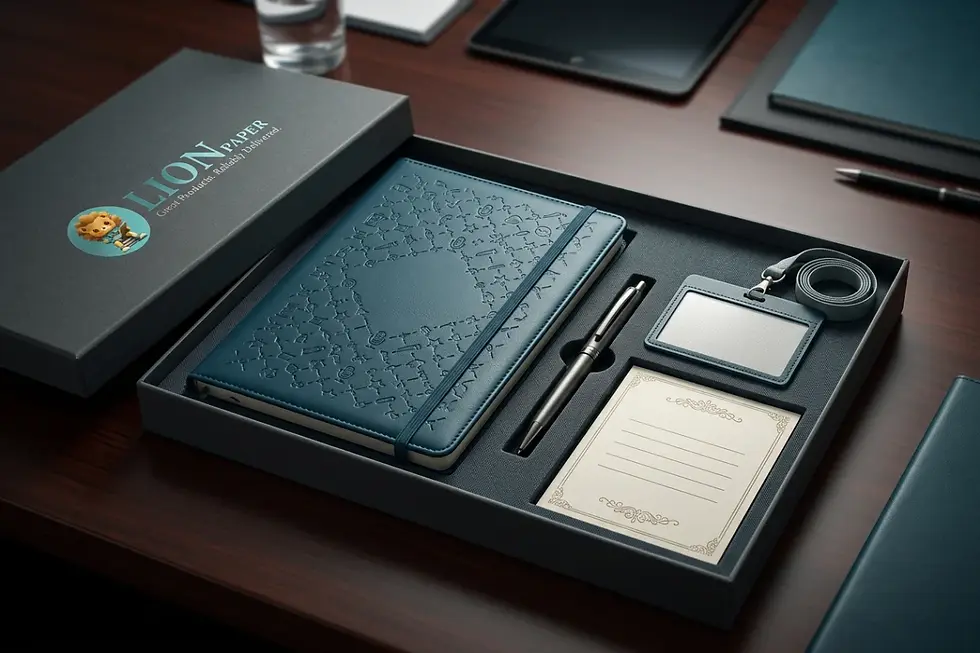
Custom corporate notebooks integrated into premium registration kits for VIP and executive events.
How does Lion Paper streamline custom event stationery manufacturing and procurement?
Sourcing custom corporate stationery at scale demands supply-chain reliability, technical engineering, and rigorous compliance. Founded in 2015 in Jiaxing, Zhejiang, Lion Paper Products (Jiaxing) Co., Ltd. operates as a specialized supply-chain partner for customized paper goods and creative stationery programs.
Lion Paper combines design, material research, and rapid prototyping at its 3,000-square-meter facility in Jiaxing with large-scale automated manufacturing at its 10,000-square-meter production site in Cambodia. With an annual notebook output exceeding 5 million units, Lion Paper leverages this dual-site synergy to offer brand owners, enterprise event organizers, and retail buyers flexible production scheduling, tariff-optimized trade routes, and reliable delivery across North America, Europe, Australia, the Middle East, and Southeast Asia.
Design-to-Manufacturing Integration: In-house industrial and graphic design teams translate raw brand assets and event briefs into production-ready structural dielines, optimizing sheet yields, cover wrapping structures, and branded packaging.
Comprehensive Material Audits & Sustainability: Complete support for FSC-traceable papers, post-consumer recycled substrates, low-impact soy printing, and plastic-free packaging, verified by ISO 9001, FSC, SMETA, WCA, GSV, FAMA, and CPSIA compliance frameworks.
Strict Quality Control (Lion Standard): Standardized SOPs, unified defect spectrums, and stringent AQL sampling inspections ensure consistent foil registration, precise debossing depth, clean spine gluing, and durable palletized protective packaging.
End-to-End Category Breadth: Beyond standalone notebooks and notepads, Lion Paper produces matching presentation gift boxes, branded tote bags, pens, and organizer accessories, delivering cohesive event stationery sets from a single manufacturing source.
To ensure timely delivery and compliant production for your upcoming conference, contact our global stationery team to review your event dates, artwork specifications, required order quantities, and packaging requirements.
FAQ
What is the standard production lead time for bulk event stationery?
Custom event notepads generally require 10 to 18 business days for mass production after sample approval. Custom casebound hardcover notebooks typically require 20 to 30 business days due to book block stitching, case-making, and drying cycles. Ocean freight shipping adds 3 to 5 weeks depending on destination port.
Can we print custom attendee information or agendas inside conference notebooks?
Yes. Custom corporate notebooks frequently incorporate full-color tip-in pages bound into the front or back of the book block. These pages can display event schedules, floor plans, speaker bios, sponsor acknowledgments, or QR codes linking to digital conference hubs.
What minimum order quantities (MOQ) apply to custom event stationery?
Standard production runs for custom-printed promotional notepads typically start at 1,000 units. For fully customized corporate notebooks featuring bespoke cover materials, custom debossing, ribbon markers, and dyed edge printing, standard manufacturing runs usually start between 1,000 and 3,000 units per design.


Comments