


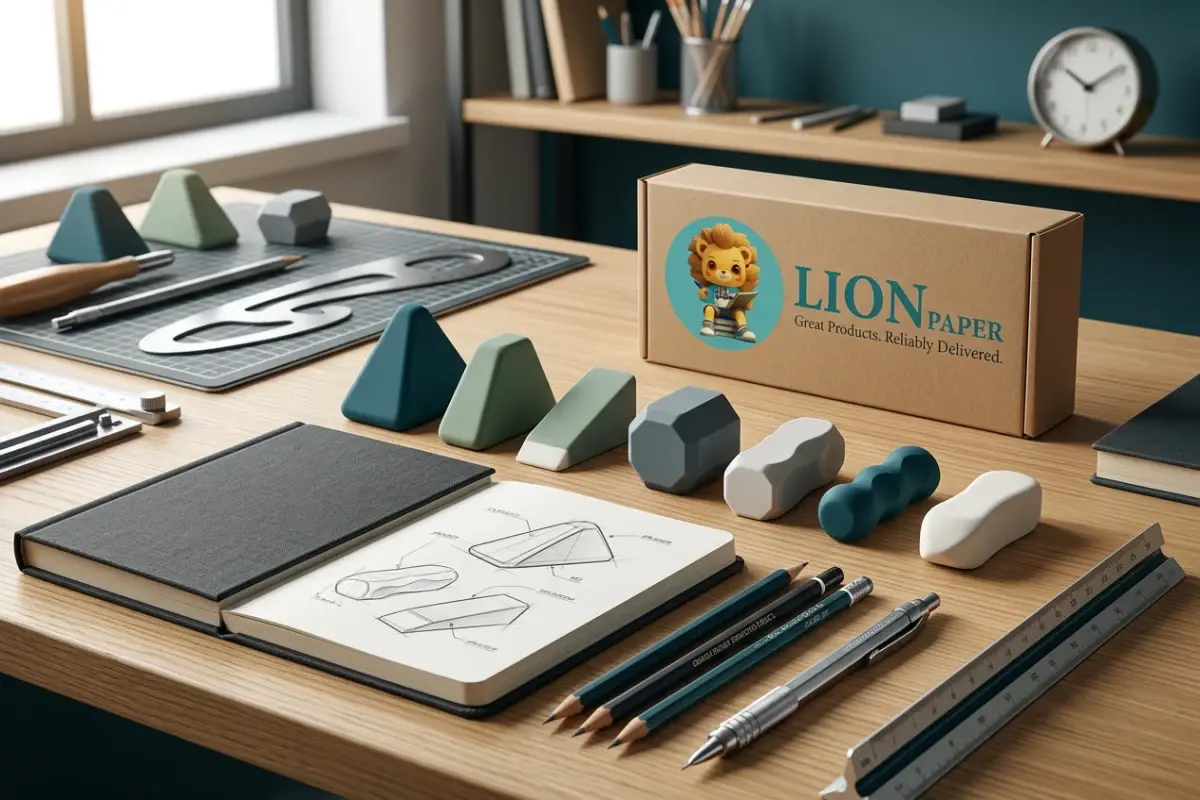
Eraser Shape Ergonomics: Design Principles, OEM Specifications, and Sourcing Guide

Eraser shape ergonomics balances grip biomechanics, surface contact precision, and material durometer to reduce hand fatigue while delivering targeted graphite removal across diverse stationery applications. By engineering multi-angle facets, contoured thumb channels, and balanced aspect ratios, ergonomic eraser design improves user control, minimizes repetitive strain, and optimizes correcting efficiency across technical, artistic, and everyday writing environments.
What Biomechanical Principles Define Ergonomic Eraser Design?
Ergonomic eraser design focuses on the physical mechanics of the human hand during repetitive friction-based tasks. Traditional rectangular block erasers require a tight, continuous pinch grip between the distal phalanx of the thumb and the index finger. This static muscular load creates localized pressure points, reduces blood circulation, and accelerates hand fatigue during extended drafting or study sessions. When users maintain this static pinching posture over sustained intervals, the intrinsic muscles of the hand—specifically the thenar eminence and first dorsal interosseous—experience rapid fatigue and micro-cramping.
To resolve these physiological strains, modern ergonomic designs integrate biomechanical principles that redistribute contact pressure and stabilize the grip angle throughout various motion vectors:
Contact Pressure Redistribution: Flared profiles, parabolic tapers, and concave thumb rests widen the effective contact surface area, lowering peak pressure on the index finger pulp and spreading the reaction force over a broader surface.
Dynamic Grip Adaptation: Non-symmetrical geometries provide intuitive placement for both three-jaw chuck grips (used for fine detail work) and lateral power pinch grips (used for heavy surface clearing across broad paper planes).
Vector Force Alignment: Designing the center of gravity closer to the paper line ensures downward force translates directly into friction without requiring excessive lateral grip tension or downward wrist pressure.
Friction Stability: Micro-textured surfaces, longitudinal ribbing, or overmolded thermoplastic elastomer (TPE) shells eliminate micro-slipping, enabling continuous control with 25% to 40% less grasping effort.
Palmar Support Integration: Curved base arches align with the natural palmar curve, allowing larger correction blocks to nestle comfortably against the palm during broad sweeping motions.
Understanding these physical dynamics allows stationery developers to shift correction accessories from commodity blocks into precision instruments that complement high-grade writing and drafting systems.

Triangular and contoured profiles redistribute grip pressure, reducing hand fatigue during continuous drafting.
How Do Geometric Eraser Shapes Balance Precision vs. Broad-Area Correction?
Eraser geometry directly dictates functional utility. While broad strokes require wide surface contact to clean large areas quickly, technical drafting and fine art demand sharp edges that isolate single lines without disturbing surrounding work. Modern correction development uses specialized cross-sections to reconcile these competing needs without adding unnecessary bulk.
Geometric Profile | Primary Grip Style | Edge Retention | Ergonomic Feature | Best-Fit Application |
|---|---|---|---|---|
:--- | :--- | :--- | :--- | :--- |
Triangular Prism | 3-finger tripod grip | Moderate to High | Natural facet alignment with fingers; prevents rolling on slanted desks | K-12 education, standard pencil companion sets |
Chisel / Wedge Block | Lateral pinch grip | High (at tip) | Thin knife-edge leading into wide rear base for multi-stroke versatility | Technical drafting, accounting, fine ledger work |
Pen-Style Barrel / Retractable | Dynamic tripod grip | High (fixed cylindrical core) | Extended barrel mimics writing instrument posture, reducing muscular retraining | Detailed sketching, portable notebook accessories |
Polygon Multi-Corner Block | Dynamic finger-shift | Very High (20+ micro-vertices) | Self-renewing corners as outer edges wear down, maintaining sharpness | Precision art eraser development, architecture |
Contoured Pebble / Elliptical | Full-palm / cupped grip | Low to Moderate | Smooth rounded curvature matching natural hand arch for broad sweeping strokes | Executive desk accessories, broad-area charcoal work |
Hexagonal Fluted Column | Index-thumb rotational grip | Moderate | Tactile ridges offer anti-slip grip and multiple narrow linear contact ribs | Universal office work, corporate stationery sets |
Triangular cross-sections naturally correspond to standard tripod writing posture, making them ideal for children developing fine motor skills and professionals writing for long hours. In contrast, polygon multi-corner geometries incorporate dozens of discrete vertices. As the user wears down one edge, an adjacent geometric facet becomes available, eliminating the need to cut or shave worn corners manually. Pen-style mechanical erasers provide continuous narrow-diameter erasing cores encased within an ergonomic barrel, allowing artists to switch between writing and erasing with identical hand mechanics.
What Material Formulations and Shore Durometer Ratings Optimize Ergonomic Performance?
Shape and material compound work together to determine ergonomic performance. If an eraser compound is too soft, it will buckle and deform under moderate pressure, forcing the user to squeeze harder to maintain directional stability. Conversely, if the compound is too hard, the user must apply excessive downward force, risking paper surface abrasion and wrist fatigue.
Stationery erasers generally span a specific Shore A hardness spectrum based on functional application:
Extra Soft Formulations (30A to 42A): Characteristic of kneaded natural and synthetic art erasers, designed for gentle lifting without friction pressure.
Balanced Ergonomic Formulations (45A to 58A): Standard for high-efficiency TPE and modified synthetic polymers, offering optimal structural balance and low user strain.
Firm Technical Formulations (60A to 75A): Characteristic of rigid vinyl, PVC plastisols, and technical drafting blocks engineered for high-pressure line erasure.
Polyvinyl Chloride (PVC) Plastisols
Durometer Range: 55 to 68 Shore A.
Characteristics: Delivers smooth erasing with micro-dust clumping that gathers into roll-up strands. However, traditional formulations require strict phthalate regulation and plasticizer management to satisfy global non-toxicity standards.
Thermoplastic Elastomers (TPE) and Synthetic Rubber
Durometer Range: 45 to 58 Shore A.
Characteristics: Phthalate-free, latex-free, and recyclable. TPE allows co-injection molding with rigid polypropylene (PP) or acrylonitrile butadiene styrene (ABS) cores, enabling hybrid shapes with firm ergonomic grips and soft erasing compounds.
Kneaded Natural and Synthetic Rubbers
Durometer Range: Variable malleable plastic state.
Characteristics: Absorbs graphite particles via lifting rather than abrasive friction. Highly ergonomic because users can mold the compound to fit their exact finger profile or narrow tip requirements, though it lacks structural rigidity for rapid stroke wiping.
Paper Fiber Interaction and Substrate Pairing
Selecting the correct material durometer also depends on the target paper stock. For standard 70 to 80 gsm woodfree notebook paper, a medium-soft 50 Shore A TPE compound prevents surface fiber tearing and sheet wrinkling. For heavy 120 to 160 gsm sketchbook cartridge paper, a 60 Shore A compound provides the firm structural resistance necessary to lift dark B-grade graphite without smudging or leaving oily residues on toothy surfaces.

Matching polymer durometer to paper fiber weight ensures optimal graphite pickup without tearing sheet surfaces.
What Are Key OEM Eraser Manufacturing Specifications and Tooling Constraints?
Translating an ergonomic concept into mass production requires balancing geometric complexity against industrial processing parameters. Custom OEM eraser manufacturing specifications depend on whether the product is formed through continuous extrusion or multi-cavity injection molding.
Continuous Profile Extrusion
Extrusion works best for uniform linear geometries such as triangular, hexagonal, or ribbed profiles. The compound is plasticized, forced through a custom precision die plate, cooled in a temperature-controlled water bath, and sliced to length by synchronized high-speed rotary cutters.
Tooling Investment: Moderate die-tooling cost, making it cost-effective for medium to large production volumes and multi-color co-extrusion runs.
Dimensional Tolerance: ±0.3 mm to ±0.5 mm variance depending on cooling bath thermal control and compound haul-off speed.
Design Limitations: Cross-sections must remain uniform along the entire extrusion axis; cannot incorporate isolated thumb indentations, variable-depth tapering, or enclosed blind holes.
High-Precision Multi-Cavity Injection Molding
Complex 3D organic contours, pebble shapes, internal core lock-ins, and multi-component overmolding require high-pressure injection molds.
Tooling Investment: Higher initial capital expenditure for hardened steel molds with 8 to 32 cavities, balanced by rapid per-unit cycle times.
Dimensional Tolerance: High precision within ±0.1 mm, critical for retractable cartridges, push-button mechanisms, and snap-fit modular casings.
Draft Angles: Minimum 1.0° to 1.5° draft angles required on all side walls to ensure clean ejection of soft elastomeric compounds without surface tearing or drag marks.
Shrinkage Compensation: TPE formulations experience 1.2% to 2.5% volumetric shrinkage during cooling, requiring precise mold cavity scaling and conformal cooling channels.
What Cost Drivers and Compliance Audits Govern Stationery Correction Accessory Sourcing?
When managing stationery correction accessory sourcing, procurement teams must balance unit costs against international safety and compliance benchmarks. Understanding the primary cost drivers helps commercial buyers optimize unit economics without sacrificing ergonomic functionality.
In a typical custom eraser manufacturing program, production costs are distributed across several core categories:
Raw Polymer Compounds (40% to 50%): Includes base TPE, synthetic elastomer resins, non-phthalate plasticizers, and custom pantone color masterbatches.
Tooling Amortization and Machine Cycle Time (15% to 20%): Covers initial mold or extrusion die investment, multi-cavity depreciation, and injection cycle efficiency.
Packaging, Sleeve Printing, and Assembly (20% to 25%): Comprises FSC-certified paperboard sliding sleeves, blister packs, barcoding, and master carton packaging.
Compliance Testing, QA Audits, and Shipping (10% to 15%): Encompasses third-party lab assays, factory social audits, inline AQL inspections, and outbound logistics.
Primary Cost Variables
Material Chemistry: Virgin medical-grade or food-contact-grade TPE commands a premium over standard synthetic rubber compounds but eliminates chemical compliance risks.
Overmolding vs. Single-Shot: Dual-shot molding (rigid grip chassis + soft erasing element) increases cycle times and machine setup costs compared to single-compound profiles paired with printed paper sleeves.
Protective Packaging: Sliding FSC-certified paperboard sleeves protect the ergonomic shape from skin oils and dirt while reinforcing brand identity. Custom thermoformed blisters or color-coordinated tins add protective durability for retail display.
Global Safety and Compliance Standards
Because correction accessories are widely used in school, office, and home environments, OEM programs must comply with strict regional safety frameworks:
United States: CPSIA (Consumer Product Safety Improvement Act) compliance for total lead content (<100 ppm in substrates) and regulated phthalate limits (<0.1%), alongside ASTM D-4236 toxicological risk assessments for art materials.
European Union: EN 71-3 (Safety of Toys - Migration of Certain Elements) and REACH Regulation (EC No 1907/2006) governing SVHC (Substances of Very High Concern).
Environmental Tracing: FSC (Forest Stewardship Council) chain-of-custody verification for all paperboard sliding jackets, blister backer cards, and counter display units.

Integrated stationery sourcing combines ergonomic correction tools with custom notebooks, pencil pouches, and retail packaging.
How Does Quality Control and AQL Inspection Ensure Consistent Eraser Performance?
Maintaining consistent hardness, surface friction, and erasing efficiency across mass production batches requires structured quality assurance protocols. Manufacturers follow ISO 2859-1 (ANSI/ASQ Z1.4) sampling procedures, applying an Acceptance Quality Limit (AQL) of Major 1.5 and Minor 4.0 for commercial stationery lines.
Standard Laboratory and In-Line Test Protocols
Graphite Removal Efficiency (Spectrophotometric Delta-E): Standardized mechanical stroke testers apply a 500g vertical load across 2B pencil swatches on 80 gsm woodfree paper. Pre- and post-erasing optical density is measured using a spectrophotometer to verify a minimum 92% graphite clearance rate without excessive ghosting.
Torsional Resilience and Snap Resistance: The eraser body is flexed to a 45° angle under continuous automated cycles to ensure the ergonomic shape does not fracture or exhibit micro-tearing along thin grip edges or functional fins.
Paper Abrasion Index: Surface inspection of tested paper sheets under magnification to ensure zero fiber tearing, surface gouging, or coating breakdown on standard writing papers.
Thermal Aging and Blooming Test: Samples are placed in conditioning chambers at 50°C and 80% relative humidity for 96 hours to ensure plasticizers do not migrate to the surface, creating sticky residue or staining adjacent notebook pages.
Color Fastness and Light Stability: Accelerated xenon-arc testing ensures custom pantone colors do not fade or leach into surrounding paper substrates during shelf life.
How Does Lion Paper Integrate Custom Ergonomic Erasers into Complete Stationery Sets?
Founded in 2015 and headquartered in Jiaxing, Zhejiang, Lion Paper Products (Jiaxing) Co., Ltd. is a customized paper goods and creative product supply-chain solution provider. Rather than operating merely as a conventional product maker, Lion Paper manages the complete supply chain from first sketch to first shipment. We balance structural design, material safety, cost management, and global fulfillment across multi-item stationery collections.
Dual-Site Production Synergy (China and Cambodia)
Lion Paper coordinates an agile dual-site supply chain tailored to the volume, timing, and tariff requirements of international brands and retail chains:
Jiaxing Facility (China - 3,000 m²): Serves as the central innovation hub, handling product planning, precision 3D industrial design, ergonomic rapid prototyping, material testing, and customer development support.
Cambodia Facility (10,000 m²): Provides large-scale production, automated assembly, and cost-effective export manufacturing for high-volume stationery programs, supported by an annual notebook output exceeding 5 million units.
Turnkey Category Integration
Lion Paper integrates correction tools into complete lifestyle and office assortments across its eight core product categories:
Eco Paper Products: FSC-certified paper packaging, recycled pulp casings, and low-impact printed sleeves.
Notebooks & Journals: Hardcover, softcover, wire-bound, and spiral formats matched to specific paper weights and eraser durometers.
Planners & Calendars: Professional organizational tools paired with high-precision correction tools and fine-line layout accessories.
Stationery & Office: Memo sets, desktop organizers, filing systems, and complementary correction accessories.
Bags & Organizers: Pencil cases and pouches designed with custom interior slots for ergonomic erasers and writing tools.
Accessories: Coordinated binder clips, sticky tabs, bookmarks, and bespoke correction implements.
Gift & Packaging: Custom gift boxes, retail cartons, and seasonal holiday collections with custom molded inserts.
Home & Living: Functional desktop organizers, magnetic planning tools, and lifestyle paper collections.
Supported by ISO 9001, FSC, SMETA, WCA, GSV, FAMA, and CPSIA compliance frameworks, Lion Paper ensures every custom eraser program meets strict chemical safety, ergonomic usability, and batch consistency benchmarks. Whether engineering a multi-faceted precision art eraser or an integrated office gift collection, our end-to-end design-to-manufacturing approach minimizes supply-chain risk and accelerates time-to-market.
Ready to elevate your correction and writing line with custom tooling and compliant manufacturing? Share end use, graphite/paper types, compliance market and packaging format; request an eraser performance-test and sourcing brief.
FAQ
What is the optimal Shore A durometer for an ergonomic everyday pencil eraser?
A Shore A durometer between 48 and 56 provides the optimal balance for general writing. This range offers sufficient structural rigidity to prevent the eraser body from bending under pressure while remaining soft enough to pick up standard HB and 2B graphite without abrading 70 to 90 gsm paper.
How do PVC-free TPE erasers compare to traditional PVC vinyl erasers?
Thermoplastic Elastomer (TPE) erasers are free from phthalates, chlorine, and heavy metals, making them safer for global regulatory compliance (CPSIA, EN 71-3, REACH). While PVC formulations generate slightly stickier dust strands, modern high-grade TPE compounds achieve comparable 90%+ erasing efficiency while offering superior recyclable properties and lower environmental impact.
What is the typical minimum order quantity (MOQ) for custom-molded ergonomic erasers?
For custom extruded shapes with bespoke cross-section dies, MOQs typically range from 10,000 to 20,000 units. For fully custom 3D injection-molded designs requiring dedicated multi-cavity tooling, MOQs generally start at 20,000 to 30,000 units to amortize mold engineering costs effectively.
Can custom ergonomic erasers be co-packaged directly into notebook and stationery gift sets?
Yes. Through integrated supply chain providers like Lion Paper, custom erasers can be manufactured, quality-checked, and packaged alongside notebooks, journals, writing instruments, and pencil pouches into complete retail-ready or gift packaging configurations via coordinated China and Cambodia production lines.


Comments