


Dotted Composition Page Borders: Sourcing, Layout Margins, and Production Guide

Dotted composition page borders define the structural margin space and visual frame surrounding a dot grid matrix on inner notebook leaves. They balance writing ergonomics, visual alignment, and automated sheet-trimming allowances during high-volume binding. Incorporating precise outer margins prevents dots from clipping during guillotine trimming, reduces visual crowding at the spine, and ensures consistent quality across mass retail stationery programs.
What Are Dotted Composition Page Borders and How Do Framed Layouts Differ from Edge-to-Edge Grids?
Dotted composition page borders are deliberately unprinted or border-demarcated boundary zones surrounding a dot grid pattern on notebook pages. Unlike traditional college-ruled composition books that feature a single solid vertical margin line and horizontal rules running off the sheet edge, dot grid composition books utilize a matrix of precision dots—typically spaced 5.0 mm apart—to offer subtle guides for writing, wireframing, bullet journaling, and technical sketching.
When specifying dot grid interiors for mass manufacturing, stationery brands and retail buyers choose between two primary geometric architectures: framed grid layouts and edge-to-edge (full-bleed) grids.
Framed Grid Layouts with Margins: In a framed page border, the matrix of dots terminates cleanly inside a predetermined margin perimeter. The border area remains unprinted white or off-white paper space, creating a natural frame around the functional writing canvas. This layout mirrors traditional composition books, keeps the visual layout organized, eliminates edge-clipping variance during high-speed production cutting, and prevents thumb smudging when holding the open book.
Edge-to-Edge (Full-Bleed) Grid Layouts: Full-bleed layouts extend the dot matrix all the way to the trimmed perimeter of the page. While popular among creative bullet journal users seeking maximum surface utility, full-bleed dot grids introduce tighter print-to-cut registration demands during finishing. If trimming shifts by even 0.5 mm to 1.0 mm, outer dots can become partial hemispheres or get cut unevenly across book signatures.
Hybrid Framed Layouts with Accent Header Borders: Some educational and lifestyle programs incorporate a distinct header box or solid perimeter frame line encasing the dotted matrix. This structure gives the book a structured, collegiate look while maintaining the versatile utility of a dot grid notebook.
Understanding these layout distinctions helps product managers select the optimal format based on production stability, binding type, and retail customer expectations.
What Are the Standard Dotted Notebook Margin Specifications Across Trim Sizes?
Setting accurate dotted notebook margin specifications requires balancing physical hand clearance, optical symmetry, and binding clearance. Standard composition book trim sizes vary by region, with North America favoring the classic 7.5 x 9.75 inch format, while international markets utilize standard ISO sizes like A5, B5, or standard 8.5 x 11 inch sheets.
Below are standard technical margin specifications for mass-market dotted composition books:
Trim Size Format | Page Dimensions (Width x Height) | Top Margin | Bottom Margin | Outer / Fore-Edge Margin | Gutter / Spine Margin | Recommended Dot Pitch | Standard Dot Diameter |
|---|---|---|---|---|---|---|---|
:--- | :--- | :--- | :--- | :--- | :--- | :--- | :--- |
US Standard Composition | 7.50" x 9.75" (190 x 248 mm) | 12.0 mm - 15.0 mm | 12.0 mm - 15.0 mm | 10.0 mm - 12.5 mm | 12.5 mm - 15.0 mm | 5.00 mm (0.197") | 0.35 mm - 0.50 mm |
US Letter Format | 8.50" x 11.00" (216 x 279 mm) | 15.0 mm - 18.0 mm | 15.0 mm - 18.0 mm | 12.5 mm - 15.0 mm | 15.0 mm - 18.0 mm | 5.00 mm (0.197") | 0.40 mm - 0.50 mm |
Metric Medium (B5) | 7.00" x 9.84" (176 x 250 mm) | 10.0 mm - 12.0 mm | 10.0 mm - 12.0 mm | 10.0 mm - 12.0 mm | 12.0 mm - 14.0 mm | 5.00 mm / 7.00 mm | 0.35 mm - 0.45 mm |
Metric Standard (A5) | 5.83" x 8.27" (148 x 210 mm) | 8.0 mm - 10.0 mm | 8.0 mm - 10.0 mm | 8.0 mm - 10.0 mm | 10.0 mm - 12.0 mm | 5.00 mm (0.197") | 0.30 mm - 0.40 mm |
Compact Pocket | 3.50" x 5.50" (89 x 140 mm) | 6.0 mm - 8.0 mm | 6.0 mm - 8.0 mm | 6.0 mm - 7.5 mm | 8.0 mm - 10.0 mm | 3.50 mm / 4.00 mm | 0.25 mm - 0.35 mm |
Maintaining a slightly wider gutter margin (12.5 mm to 15.0 mm) is critical for standard composition notebooks bound with center-sewn thread and cloth spine tape. Because tape-bound books do not lie entirely flat at the innermost fold without hand pressure, wider spine borders prevent the innermost dots from sinking into the gutter curve.
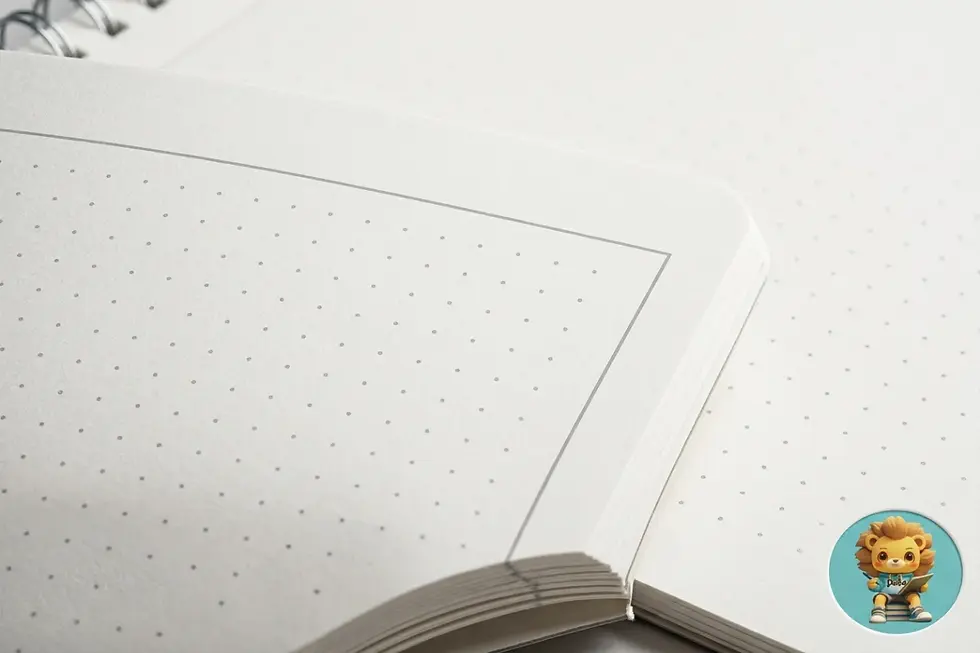
Framed dot grid page borders establish safe cutting margins and prevent dot clipping during automated trimming.
How Do Custom Composition Notebook Printing Tolerances Impact Dot Grid Page Border Manufacturing?
Achieving uniform dotted composition page borders across millions of notebooks requires strict control over custom composition notebook printing tolerances. In high-speed commercial printing and binding lines, minor mechanical variances occur across web feeding, sheet cutting, folding, and final three-knife trimming.
Key manufacturing tolerances that dictate border design include:
Cut-to-Print Registration Tolerance: Commercial guillotine and three-knife trimmers operate within an industry tolerance of ±1.0 mm to ±1.5 mm. When inner pages have framed margins of at least 10 mm, minor trimming variances remain imperceptible to the consumer. In contrast, margins under 5 mm make even a 0.75 mm cutting shift visually obvious, causing uneven border widths across adjacent pages.
Spine Creep and Page Bulk Compensation: When multiple paper sheets are gathered into a single center-sewn signature (standard for 80-sheet / 160-page composition books), the innermost sheets are pushed outward relative to the outermost sheets. When the combined book block undergoes face trimming, the outer margin of inner sheets becomes slightly narrower than outer sheets. Pre-press files must apply automated creep compensation to balance the outer border width across the entire book.
Dot Grid Linearity and Sheet Skew: On rotary flexographic ruling machines and high-speed web offset presses, paper tension must remain precisely balanced. An angular sheet skew of more than 0.5 degrees can cause horizontal dot rows to tilt relative to the top and bottom trimmed borders, degrading visual symmetry.
Grid Ink Density and Dot Tone Value: Dots must be printed in a restrained, neutral gray tone (typically 10% to 15% Black / 100% Pantones like Cool Gray 3C or Warm Gray 2C). If the ink transfer density fluctuates during long production runs, dots can expand (dot gain) from an intended 0.4 mm diameter to over 0.6 mm, overpowering the user's handwriting and visual margin borders.
Standardizing pre-press guidelines ensures that dot grid page border manufacturing yields consistent, aligned margins across every production run.
How Does Composition Book Grid Layout Sourcing Influence Paper GSM, Show-Through, and Substrate Selection?
During composition book grid layout sourcing, selecting the appropriate paper basis weight (GSM) and surface sizing is directly linked to the user experience of dotted page borders. Because dot grids are widely used for mixed-media writing, bullet journaling, and fountain pens, paper opacity and ink resistance are critical sourcing considerations.
Below is a technical comparison of paper grades used for dotted composition notebook manufacturing:
55 GSM to 60 GSM Standard Woodfree / Offset Paper: Commonly specified for mass retail, entry-tier back-to-school composition books. This substrate offers an economical price point but features lower opacity (85–88%). When using a framed dot border, double-sided printing requires delicate gray inks to avoid dot show-through (ghosting) on the reverse page margins.
70 GSM to 80 GSM Premium Uncoated Woodfree Paper: The commercial standard for mid-tier branded notebooks, corporate stationery, and private label journals. With opacity ratings between 90% and 94%, 70–80 GSM offset paper supports smooth ballpoint, gel pen, and light felt-tip writing while preserving clean margin separation on both sides of the sheet.
100 GSM to 120 GSM Heavyweight Smooth Offset / Woodfree: Ideal for premium lifestyle stationery, designer planners, and art-adjacent journaling. High opacity (95–98%) prevents bleed-through from wetter fountain pen inks and highlighters, allowing crisp border demarcation and double-sided grid alignment.
FSC-Certified and Recycled Offset Papers (70–90 GSM): Sourced from sustainably managed forests or post-consumer waste. Recycled sheets feature slightly warmer undertones and natural micro-fibers. Dot grid borders on recycled papers should utilize slightly darker gray ink formulations (Cool Gray 4C) to maintain legible margin contrast against the natural paper shade.
Evaluating the interplay between substrate opacity, surface smoothness (Sheffield / Gurley porosity), and ink formulation ensures that the finished dotted margins perform reliably across all standard writing instruments.

Strict pre-press alignment and cutting tolerances ensure consistent margin symmetry across large production batches.
What Are the Cost, MOQ, and Retail Merchandising Trade-Offs for Dot Grid Page Border Manufacturing?
When developing a custom dotted composition notebook line, procurement managers and brand buyers must evaluate how interior ruling configurations, plate changes, and margin designs influence production costs and Minimum Order Quantities (MOQs).
Key commercial and manufacturing trade-offs include:
Rotary Flexographic Web Ruling vs. Sheet-Fed Offset Printing: High-volume composition books (50,000+ units) typically run on dedicated web ruling machines. These automated lines print continuous rolls of paper on both sides, cut them into signatures, stitch the spine, and apply tape binding in a continuous process. Setting up custom dotted page borders with custom margin boundaries on rotary cylinders requires dedicated engraving or photopolymer plate tooling, driving MOQs to roughly 10,000 to 20,000 units per interior SKU. For smaller brand runs (1,000 to 5,000 units), sheet-fed offset presses offer lower initial setup fees and higher registration control, though at a slightly higher unit cost.
Standard Margins vs. Complex Header / Numbering Systems: Standard symmetric framed dot borders use identical plate layouts on every leaf, keeping plate costs minimal. If a brand introduces alternating left/right page numbering, dedicated date headers, or variable margin tabs, plate costs increase because multiple unique signatures must be configured, folded, and gathered sequentially.
Cover Material Matching and Shelf Presentation: Dotted composition books often command higher retail price points ($3.99 to $9.99) compared to commodity wide-ruled books ($1.00 to $2.50). Upgrading to heavy 350 GSM duplex paperboard, textured Kraft covers, soft-touch matte lamination, foil-stamped labels, or rounded cloth spine tape enhances the perceived value of the dotted grid interior, supporting higher retail margins.
Balancing these tooling investments against expected sales velocity enables retail buyers to optimize landing costs while delivering on-trend stationery products.
What Pre-Press and Quality Control Standards Ensure Defect-Free Dotted Page Margins?
To prevent misregistration, dot clipping, and color variance, notebook manufacturers implement rigorous pre-press digital proofs and in-line quality assurance procedures throughout dot grid page border manufacturing.
Essential quality control checkpoints include:
Digital Pre-Press Die-Line Overlays: Before plate exposure, pre-press engineers overlay digital CAD die-lines across the inner page artwork. This step verifies that margin clear zones (minimum 10 mm from the trim line) accommodate maximum mechanical cutting tolerances without touching the dot matrix.
First-Off Signature Inspection: During the initial press run, technicians measure sheet squareness, margin width consistency across all 4 quadrants, and dot pitch accuracy using optical micrometer loupes. Ink density is verified using spectrophotometers to guarantee standard gray values (Delta E < 1.5 across the run).
AQL Standard Sampling and Defect Catalogs: Finished batches undergo Acceptance Quality Limit (AQL) 2.5 / 4.0 inspection protocols. Quality control inspectors check for common ruling defects such as:
Grid Clipping: Dots sliced in half by shifting trim knives.
Hickey Defects / Ink Spotting: Extraneous ink droplets in unprinted page border margins.
Gutter Sinking: Dots buried inside center spine stitching.
Ghosting and Show-Through: Reverse-side dot matrices showing through unprinted margin frames.
Palletization and Transit Protection: Bulk cartons are stacked on standardized pallets with corner protectors, stretch-wrapping, and moisture-barrier liners to prevent moisture-induced sheet warping or edge waviness during ocean freight.
Adhering to these standardized testing procedures protects batch-to-batch consistency and safeguards retail brand equity.

Dual-site manufacturing synergy across China and Cambodia supports high-speed, cost-efficient notebook production.
How Does Lion Paper Support End-to-End Composition Book Grid Layout Sourcing and Manufacturing?
Lion Paper Products (Jiaxing) Co., Ltd. is an integrated supply-chain partner for customized paper goods and creative stationery products, supporting global stationery brands, supermarket retail chains, e-commerce sellers, and IP creators from initial sketch to final shipment.
Lion Paper provides distinct manufacturing and supply-chain capabilities for custom dotted composition notebook programs:
China–Cambodia Dual-Site Synergy: Lion Paper operates a 3,000-square-meter facility in Jiaxing, China, dedicated to product planning, structural engineering, design development, rapid prototyping, and client support. For mass-scale production, Lion Paper's 10,000-square-meter Cambodia manufacturing facility delivers cost-optimized, tariff-resilient volume output with an annual notebook capacity exceeding 5 million units.
Design-to-Manufacturing Integration: Our in-house pre-press and engineering teams convert customer branding and aesthetic concepts into production-ready CAD die-lines, dot grid margin layouts, and binding specifications tailored for automated high-yield production lines.
Comprehensive Compliance and Sustainability: Lion Paper maintains full compliance systems supported by ISO 9001, FSC traceability, SMETA, WCA, GSV, FAMA, and CPSIA audits. We provide FSC-certified paper, recycled content, soy-based low-impact inks, and plastic-free retail packaging.
Full Category Breadth: Beyond composition notebooks, Lion Paper integrates full product collections across notebooks and journals, planners and calendars, eco-friendly stationery, office filing products, organizer bags, and retail gift packaging.
Whether launching an agile test batch or scaling a nationwide retail private label line, Lion Paper delivers stable, compliant, and cost-efficient stationery supply solutions.
Ready to develop your next custom notebook program? Share target size, dot/ruling spec, paper GSM, page count, quantity and target retail price with Lion Paper for a production-ready composition notebook brief.
Frequently Asked Questions
What is the ideal margin distance for a 5 mm dotted composition notebook?
For a standard 7.5 x 9.75 inch composition notebook, the optimal margin distance is 12 mm to 15 mm along the top, bottom, and spine gutter, and 10 mm to 12.5 mm along the outer fore-edge. This framed boundary ensures that 5 mm spaced dots do not get cut off during three-knife trimming, while keeping writing comfortably clear of spine tape curvature.
Can custom dotted page borders include printed margin lines or headers?
Yes. Pre-press layouts can easily incorporate a vertical margin line (similar to traditional wide-ruled composition books), top title boxes, date prompts, or solid boundary frames surrounding the dot matrix. These hybrid layouts combine the structured aesthetic of a traditional school notebook with the creative flexibility of a bullet journal.
What paper weight is recommended to prevent dot grid ghosting?
An 80 GSM woodfree offset paper is recommended as the baseline standard for double-sided dotted composition books. For premium journaling lines or fountain-pen-friendly stationery programs, upgrading to 100 GSM or 120 GSM uncoated offset paper ensures near-total opacity and eliminates show-through across unprinted margin borders.
How does Lion Paper maintain consistent dot ruling alignment across multi-thousand unit runs?
Lion Paper utilizes automated web ruling and high-precision sheet-fed presses paired with strict pre-press bleed and creep compensation. During mass production in our Cambodia and China facilities, automated tension controls and standardized SOP inspection cards monitor dot pitch, margin widths, and ink density (Delta E < 1.5) to guarantee cross-batch consistency under ISO 9001 and AQL 2.5 standards.
FAQ
What is the ideal margin distance for a 5 mm dotted composition notebook?
For a standard 7.5 x 9.75 inch composition notebook, the optimal margin distance is 12 mm to 15 mm along the top, bottom, and spine gutter, and 10 mm to 12.5 mm along the outer fore-edge. This framed boundary ensures that 5 mm spaced dots do not get cut off during three-knife trimming, while keeping writing comfortably clear of spine tape curvature.
Can custom dotted page borders include printed margin lines or headers?
Yes. Pre-press layouts can easily incorporate a vertical margin line (similar to traditional wide-ruled composition books), top title boxes, date prompts, or solid boundary frames surrounding the dot matrix. These hybrid layouts combine the structured aesthetic of a traditional school notebook with the creative flexibility of a bullet journal.
What paper weight is recommended to prevent dot grid ghosting?
An 80 GSM woodfree offset paper is recommended as the baseline standard for double-sided dotted composition books. For premium journaling lines or fountain-pen-friendly stationery programs, upgrading to 100 GSM or 120 GSM uncoated offset paper ensures near-total opacity and eliminates show-through across unprinted margin borders.
How does Lion Paper maintain consistent dot ruling alignment across multi-thousand unit runs?
Lion Paper utilizes automated web ruling and high-precision sheet-fed presses paired with strict pre-press bleed and creep compensation. During mass production in our Cambodia and China facilities, automated tension controls and standardized SOP inspection cards monitor dot pitch, margin widths, and ink density (Delta E < 1.5) to guarantee cross-batch consistency under ISO 9001 and AQL 2.5 standards.


Comments