


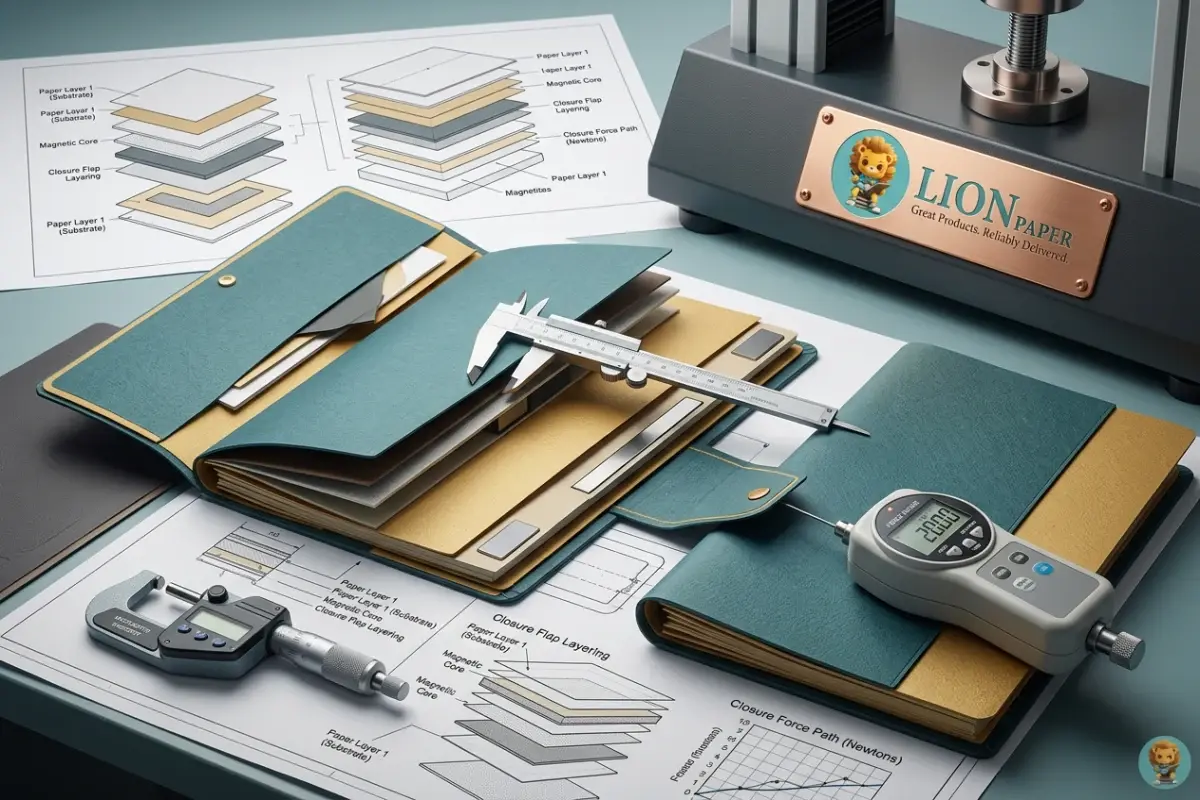
Document Folio Closure Force Engineering: Standards, Ergonomics, and Manufacturing Tolerances

Optimal document folio closure force balances reliable document retention during handling with smooth, single-handed opening ergonomics, typically calibrated between 3.0 to 8.0 Newtons for magnetic closures and 5.0 to 12.0 Newtons for elastic band systems depending on payload capacity, spine geometry, and core board rigidity.
What Is the Ideal Document Folio Closure Force for Professional Organizers?
Calibrating document folio closure force requires balancing two competing mechanical demands: securing interior contents against accidental discharge during transport and delivering an effortless, premium tactile experience during opening. When a user lifts, shakes, or packs a document organizer, gravitational force and dynamic kinetic energy exert outward pressure against the interior pockets and closure flap. If the closure resistance is too weak, stored loose sheets, tablets, or stationery accessories slip out. Conversely, excessive closure resistance risks tearing cover materials, delaminating rigid greyboard cores, straining closure hinges, or frustrating the end user.
In professional stationery closure mechanism engineering, retention force is measured in Newtons (N) or grams-force (gf), where 1 Newton equals approximately 101.97 grams-force. Standard industry calibrations follow specific functional thresholds across primary closure types:
Concealed Magnetic Flaps (Standard Capacity, 1–50 sheets): 3.0 N to 5.5 N (300–560 gf). This range allows smooth single-handed peeling while preventing unintended opening when held vertically.
Concealed Magnetic Flaps (High-Capacity Gusseted Folios, 50–150 sheets): 5.5 N to 8.5 N (560–865 gf). Higher magnetic attraction counteracts the outward expansion pressure exerted by thick document bundles.
Woven Elastic Bands (Horizontal or Vertical Corner Straps): 5.0 N to 12.0 N (510–1220 gf) of working tension at nominal stretch (typically 20% to 40% elongation), providing flexible containment across varying page fills.
Mechanical Snap Buttons and Press Studs: 8.0 N to 15.0 N (815–1530 gf) of disengagement pull force, prioritized for heavy-duty corporate, archival, or technical document holders.
Tuck Flaps and Friction Tabs: 2.0 N to 4.5 N (200–460 gf) of frictional resistance, engineered via precision die-cut tolerances and paperboard caliper interactions.
Maintaining these engineering tolerances ensures that folios remain securely shut inside bags or briefcases without compromising the tactile opening feel expected in premium lifestyle, designer, and corporate stationery collections.

Embedded neodymium disc magnets require calibrated steel flux cups to direct magnetic force through laminated cover substrates.
How Do Magnetic, Elastic, and Mechanical Closure Mechanisms Compare in Stationery Engineering?
Selecting the right custom document organizer hardware involves evaluating mechanical behavior, cycle life, visual integration, and manufacturing complexity. Each closure architecture interacts differently with cover substrates and interior structures.
Closure Mechanism | Nominal Force Range (N) | Primary Hardware Components | Fatigue Life (Cycles to Failure/Loss) | Key Aesthetic & Structural Advantages |
|---|---|---|---|---|
:--- | :--- | :--- | :--- | :--- |
Concealed Disc Magnets (NdFeB) | 3.0 N – 8.0 N | Neodymium N35–N52 rare-earth magnets, steel flux-directing cups | >20,000 cycles (near-zero magnetic decay) | Fully invisible integration beneath paper/cloth wrap; smooth, silent closure action. |
Exposed Magnetic Clasps | 4.0 N – 9.0 N | Zinc alloy housing, electroplated magnetic snap pairs | >15,000 cycles (limited by mechanical finish wear) | Distinctive visual hardware accent; high initial alignment pull; tactile feedback. |
Flat Elastic Band Systems | 5.0 N – 12.0 N | Braided polyester/nylon sheath, natural latex or spandex core | 3,000 – 5,000 cycles (gradual modulus reduction) | Self-adjusting volume accommodation; budget-friendly; wide range of custom colors. |
Metal Snap Buttons / Rivets | 8.0 N – 15.0 N | Brass or stainless steel pronged snap assemblies | 5,000 – 10,000 cycles (receptacle spring wear) | Maximum physical retention security; positive tactile "click"; ideal for rugged use. |
Mechanical Tuck-In Tabs | 2.0 N – 4.5 N | Laminated paperboard, PU leather, or metal end-clips | 1,000 – 3,000 cycles (hinge creasing fatigue) | Minimalist hardware requirements; eco-friendly mono-material potential. |
Folio Magnetic Closure Strength Dynamics
Concealed folio magnetic closure strength depends on magnetic flux density, magnet geometry, and substrate barrier thickness. Most premium paper and bookcloth organizers employ sintered Neodymium-Iron-Boron (NdFeB) disc magnets ranging from Grade N35 to N52. A standard specification utilizes disc magnets measuring 10 mm to 15 mm in diameter with a thickness of 1.0 mm to 2.0 mm.
Magnetic pull force drops exponentially as the separation distance (air gap) increases, following an inverse-square law:
$$F \propto \frac{1}{d^2}$$
When magnets are embedded beneath 157 gsm art paper laminated to 2.0 mm greyboard, the intervening paper wraps, adhesive films, and bookcloth layers introduce a separation barrier of 0.2 mm to 0.6 mm between opposing poles. If an unshielded N35 magnet provides 12.0 N of direct contact pull force, an intervening 0.4 mm liner stack reduces effective surface pull force down to approximately 4.5 N. To prevent field dissipation and focus magnetic flux toward the contact surface, engineers incorporate steel flux-retaining cups behind the rear pole, boosting forward magnetic pull by 20% to 35% without increasing magnet thickness.
Elastic Band Tension for Folios
Elastic band tension for folios relies on the modulus of elasticity of internal elastomer cores. In high-grade stationery, woven bands utilize multi-strand natural rubber or synthetic elastane cores wrapped in high-density polyester or nylon threads. Key parameters include:
Relaxed Width and Thickness: Common stationery specifications range from 7 mm to 15 mm in width and 1.0 mm to 1.5 mm in thickness.
Elongation Modulus: Standard folio elastics are engineered for a 100% to 120% maximum elongation, operating comfortably at 25% to 40% stretch when strapped around a loaded organizer.
Hysteresis and Creep: Cheaper elastic braids experience permanent elongation (creep) after prolonged tension over a loaded folio. Premium braids retain over 85% of baseline tension after 3,000 extension cycles.
How Do Substrate Rigidity, Pocket Depth, and Fill Volume Interdepend on Closure Engineering?
The structural performance of any closure mechanism is closely linked with the cover substrate's stiffness, spine hinge design, and anticipated paper load capacity. A closure system designed in isolation from the organizer's structural skeleton frequently suffers from cover bowing, edge gaping, or premature hinge failure.
Cover Flap Assembly --> Concealed Magnet / Elastic | | Lever Arm Moment (L) Resistive Retaining Force (F) | | Internal Document Payload -> Outward Springback Force | Greyboard Core Rigidity (1.5mm - 3.0mm)
Substrate Caliper and Bending Stiffness
Document folios typically utilize high-density greyboard cores ranging from 1.5 mm to 3.0 mm in thickness (approximate basis weight of 1000 to 2000 gsm). Board selection dictates the mechanical lever arm acting on the closure:
Thin Boards (1.5 mm to 1.8 mm): Susceptible to bending when subjected to localized high-force magnetic pulls or tight elastic bands, causing visible cover warpage or concave surface bowing.
Thick Boards (2.0 mm to 3.0 mm): Provide high planar rigidity, evenly distributing closure tension across the entire spine and hinge line. They prevent localized stress concentrations around hardware anchor points.
When a magnetic flap is placed at the outer perimeter of a wide folio cover, the cover acts as a physical lever. If the greyboard exhibits insufficient flexural modulus, the user lifting one corner will peel the magnet open at an angle rather than via direct perpendicular separation, reducing effective detachment force by up to 50%.
Spine Expansion and Internal Payload Backpressure
As document folios fill with paper sheets, folders, business cards, and writing instruments, the interior payload acts as a mechanical spring, exerting continuous outward pressure against the closed flap. Engineering the folio spine requires matching the hinge geometry to the target fill volume:
Fixed Single-Crease Spines (Flat Folios): Intended for 1 to 20 sheets. As fill approaches 30 sheets, the covers splay outward, introducing an angular offset at the closure flap that degrades magnetic alignment.
Double-Crease Box Spines (Bookbound Folios): Features a defined 5 mm to 15 mm spine wall. Parallel cover alignment is preserved up to design capacity, maintaining flush magnetic contact.
Accordion Gusseted Pockets (Expanding Files): Multi-pocket organizers generate variable backpressure depending on pocket distribution. Closures on expanding folios require either extended wrap-around magnetic flaps with multi-stage catch plates or wide elastic bands capable of dynamic elongation.

Standardized perpendicular tensile testing verifies that folio magnetic closure strength adheres to strict Newton pull force tolerances.
What Quality Assurance Testing Protocols Verify Closure Durability and Retention?
To ensure consistent batch-to-batch quality across high-volume production, professional manufacturing facilities employ standardized mechanical testing procedures. Testing protocols validate initial pull force, fatigue resistance over extended lifecycles, and performance under extreme climate conditions.
Pull-Force Measurement Testing
Closure retention force is verified using calibrated digital force gauges mounted to motorized tensile test stands:
Perpendicular Pull Test (0° Normal Separation): Measures the direct holding strength of magnetic or snap closures. The folio body is secured to a rigid base plate while the closure flap is clamped to a load cell moving vertically at a constant speed of 100 mm/min. Peak force (N) is recorded at separation.
Peel Resistance Test (90° and 180° Angular Separation): Simulates natural consumer opening behavior, where the flap is pulled from an edge. Peak and average peel forces are logged to verify ergonomic smoothness.
Elastic Extension Force Test: Measures the force required to stretch an elastic band from its resting state to the nominal strapped dimension, as well as the residual retention force exerted against the cover perimeter.
Fatigue and Mechanical Cycle Verification
Stationery products must withstand months or years of repeated access without mechanical failure. Automated pneumatic test rigs cycle closures through repeated open-and-close sequences to assess durability thresholds:
Magnetic Enclosures: Subjected to 5,000 to 10,000 continuous open-close cycles. Post-test inspections check for magnet delamination, cracking of adhesive bonds, internal shifting within greyboard pockets, and cover surface abrasion.
Elastic Bands: Cycled 3,000 to 5,000 times to nominal stretch. Acceptable quality standards require that permanent elastic elongation (loss of resting recovery) remains below 5% of initial length, and tension drop does not exceed 15%.
Mechanical Snaps and Rivets: Evaluated over 3,000 cycles for retention force degradation, socket spring loosening, and rivet head pull-out from the backing board.
Environmental and Adhesive Stress Testing
Because folios are distributed globally across diverse climatic zones, closure assemblies undergo environmental chamber conditioning to verify adhesive and material stability:
High Temperature and Humidity Cycling (40°C ± 2°C at 90%–95% RH for 72 hours): Verifies that hot-melt or water-based laminating glues securing internal magnets do not soften, bubble, or allow hardware displacement.
Low Temperature Flexibility (-10°C for 24 hours): Confirms that elastic cores and plastic snap components do not become brittle or fracture under dynamic tension.
Salt Spray Corrosion Resistance: Metal hardware (exposed clasps, decorative studs, snap rivets) is tested according to ASTM B117 standards (typically 24 to 48 hours) to verify electroplating integrity against oxidation and rust.
How Should B2B Buyers Specify Closure Parameters in an RFQ?
Procurement managers, stationery brand directors, and product development teams can prevent prototyping delays and production defects by providing structured mechanical specifications in their initial Request for Quotation (RFQ). Clear technical definitions ensure engineering teams match raw materials, tooling, and assembly processes precisely to product requirements.
When preparing an RFQ for custom document folios, specify the following closure engineering criteria:
Closure Architecture: Specify exact mechanism type (e.g., fully concealed dual NdFeB magnetic flap, 10 mm woven elastic band with metal eyelets, custom zinc alloy clasp with magnetic lock).
Target Document Capacity: State maximum payload in paper sheet counts (e.g., 50 sheets of 80 gsm woodfree paper), booklet thicknesses (e.g., up to 12 mm spine), or specific devices (e.g., 11-inch tablet with protective sleeve).
Target Retention Force: State acceptable force range in Newtons or functional criteria (e.g., "Target perpendicular pull force: 4.5 N ± 0.8 N; must hold closed under vertical gravity shake test with 100-page payload").
Cover and Substrate Composition: Detail outer material (PU leather, bookcloth, coated art paper, FSC-certified kraft paper), core board caliper (e.g., 2.0 mm / 1400 gsm premium greyboard), and interior lining specifications.
Hardware Finish and Compliance: Define electroplating colors (matte black, brushed brass, nickel-free silver), anti-corrosion requirements, and compliance standards (CPSIA, REACH, Prop 65, RoHS).
Packaging and Retail Presentation: Outline retail display orientation (hanging tab, shrink-wrapped with band, rigid gift box) to ensure closures do not deform under secondary packing pressure.

Selecting appropriate closure hardware depends on target sheet capacity, retail channel requirements, and substrate rigidity.
Integrating Prototyping with Dual-Site Manufacturing
Translating precise closure engineering into cost-effective mass production requires seamless collaboration between design development and factory assembly lines. Working with an integrated supply-chain partner ensures structural concepts are tested via rapid physical mockups before tooling and volume cutting begin.
At Lion Paper Products (Jiaxing) Co., Ltd., founded in 2015, product development leverages a dual-site operational model. Our 3,000-square-meter facility in Jiaxing, Zhejiang, functions as an advanced design, engineering, and rapid prototyping hub, calibrating closure force, hinge kinematics, and material lamination. Once validated, scalable mass production is executed through our 10,000-square-meter Cambodia facility, which combines automated production lines, standardized SOPs, and robust quality control systems to produce over 5 million units annually.
This integrated China–Cambodia supply network provides global stationery brands, corporate gift buyers, and retail chains with balanced capacity options, optimized landed costs, and comprehensive compliance backing (ISO 9001, FSC, SMETA, WCA, GSV, FAMA, and CPSIA).
To optimize your upcoming stationery collection, send your document size, target capacity, material preferences, pocket layout, closure mechanism, and retail channel requirements to Lion Paper for a comprehensive folio structure and manufacturability review. Request a folio engineering evaluation today to align tactile quality, functional retention, and cost-efficient mass manufacturing.
FAQ
What is the standard tolerance for magnetic closure pull force in mass production?
In automated and semi-automated stationery assembly, magnetic closure pull force is typically held to a tolerance of ±10% to ±15% of the target Newton rating. Variations are managed by using standardized grade magnets (such as Grade N35 or N42 NdFeB) and maintaining strict caliper control over laminating paper wraps and adhesive spread thickness.
How does paper wrap thickness affect concealed magnetic closure performance?
Paper wrap and bookcloth act as non-magnetic separation barriers. Because magnetic field strength drops exponentially with distance, an increase in cover wrap thickness from 120 gsm (approx. 0.12 mm) to 250 gsm (approx. 0.30 mm) can reduce surface pull force by 25% to 40%. Engineers compensate by selecting higher magnetic grades or incorporating steel backing cups to focus flux lines.
Why do elastic band closures lose tension over time, and how can this be prevented?
Elastic tension loss occurs due to elastomer hysteresis and polymer creep under continuous strain. To prevent premature fatigue, folios should use multi-strand woven elastic bands made with high-grade synthetic elastane or vulcanized natural rubber cores wrapped in abrasion-resistant nylon sheaths, engineered to operate well below their 100% elongation ceiling.
Can custom folios incorporate multi-position closures for adjustable document capacity?
Yes. Expanding folios often feature multi-stage closure mechanisms, such as extended wrap-around flaps with dual hidden magnet catch strips or multi-position mechanical stud receivers. This allows the user to secure the organizer firmly whether it contains 20 sheets or 150 sheets without warping the cover structure.


Comments