


Comprehensive Guide to Disc-Bound Planner Quality Control and Testing Protocols

Disc-bound planner quality control relies on quantifying mushroom punch retention pull force, verifying page repositioning endurance cycles, and evaluating disc rim abrasion to prevent accidental sheet detachment. Rigorous inspection protocols ensure paper fiber integrity, uniform punch stem tolerances, disc lip smoothness, and dimensional alignment across custom covers, tabs, and refill inserts to deliver consistent structural performance throughout extended commercial usage.
What Are the Primary Quality Control Challenges in Disc-Bound Planner Systems?
Disc-bound stationery relies on friction, paper tensile strength, and precise mechanical clearance rather than closed-loop wire, spiral, or adhesive binding. Because users frequently peel sheets away from the binding and snap them back into place, the entire system faces unique mechanical stresses that standard notebook manufacturing does not encounter.
Executing successful discbound notebook quality control requires managing four interconnected mechanical factors:
Punch Stem Deformation: If the narrow neck of the mushroom cut is punched too wide, sheets pop out with minimal lateral force; if punched too narrow, turning pages becomes stiff, tearing the delicate paper tabs around the disc rim.
Paper Fiber Fatigue: Lower-grade paper or incorrect paper grain orientation causes premature fiber breakdown along the punched margins after only three to five removal cycles.
Disc Edge Roughness: Injection-molded plastic discs with parting line flash or stamped aluminum discs with microscopic burrs act like cutting blades against the paper stems during normal page-turning.
Stack Dimensional Mismatch: Combining varying caliper materials—such as 100 GSM uncoated wood-free paper with 250 GSM polypropylene (PP) dividers and 1.5 mm laminated chipboard covers—causes binding bind-up if the punch slot pitch deviates by even 0.15 mm across the spine.
To balance these variables, factory production inspection protocols must establish tight acceptable quality limit (AQL) standards and objective physical testing procedures rather than relying on subjective manual inspections.
Failure Mode | Root Cause in Production | Immediate Functional Impact | Detection & QC Prevention Method |
|---|---|---|---|
:--- | :--- | :--- | :--- |
Loose Sheet Fallout | Die-blade wear resulting in oversized punch notch | Pages fall out under their own weight during handling | Mushroom punch pull force test using digital force gauge |
Stem Tearing during Turns | Incorrect disc rim thickness or sharp mold flash | Page edges catch, bend, and rip along the inner spine | Optical comparator disc profiling and tactile edge audit |
Page Binding / Jamming | Punch spacing drift on high-speed automated lines | Notebook resists opening flat; uneven page turning | Precision steel rule gauge and automated optical inspection |
Premature Punch Fatigue | Incorrect paper fiber grain orientation | Punch lips split after fewer than 10 repositioning cycles | Grain direction audit during sheeting; paper tensile verification |

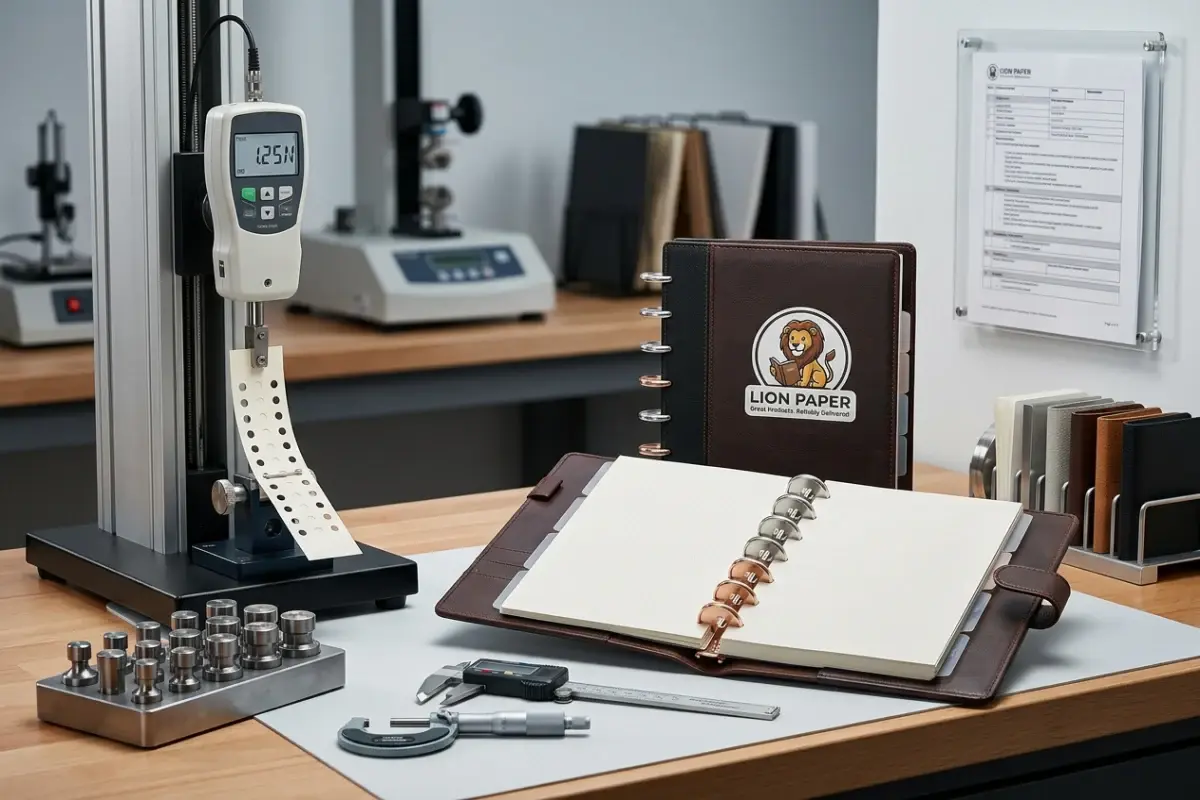
Automated pull force measurement quantifies mushroom punch retention strength to prevent page fallout.
How Do You Execute a Standard Mushroom Punch Pull Force Test?
To prevent spontaneous sheet detachment while maintaining user-friendly page removal, production laboratories execute the standardized mushroom punch pull force test. This quantitative test measures the peak mechanical force (in Newtons) required to extract a single sheet horizontally from a fully assembled disc-bound spine.
Required Equipment and Calibration Setup
A motorized digital force test stand (rate of travel: 300 mm/min).
Precision pneumatic sheet clamp with rubberized jaw faces to prevent slippage.
Fixed spine fixture to anchor the disc assembly perpendicular to the pulling axis.
Calibrated digital force gauge with peak-hold recording capability (resolution: 0.01 N).
Step-by-Step Test Procedure
Sample Conditioning: Condition test sheets and assembled disc spines at 23°C (±2°C) and 50% relative humidity (±5% RH) for at least 24 hours prior to testing to stabilize paper moisture content.
Fixture Alignment: Clamp the disc-bound notebook spine securely into the base fixture so that the test page aligns exactly parallel with the pulling vector.
Page Clamping: Secure the outer edge of the target test sheet into the pneumatic clamp, ensuring uniform clamping pressure across the top, middle, and bottom sections of the page.
Pull Execution: Initiate the tensile pull at a steady speed of 300 mm per minute until all mushroom slots fully disengage from the discs.
Peak Force Data Capture: Record the maximum peak tensile force and examine the punch stems under 10x magnification to confirm whether failure occurred via elastic disengagement or destructive paper tearing.
Disc Spine Fixture === (Mushroom Notch Connection) === Sheet Clamp ---> Digital Force Gauge (300 mm/min)
Pull Force Acceptance Criteria
For standard letter, half-letter, A4, and A5 planner formats using 8 to 11 discs, baseline performance benchmarks dictate the following parameters:
Single Sheet Retention Force (100–120 GSM Wood-Free Paper): Target range of 3.5 N to 6.0 N total retention force across the entire page edge (approximately 0.40 N to 0.65 N per individual disc punch).
Failure Mode Classification: 100% of tested sheets must release without structural fiber tear across the neck or wings of the mushroom punch slot.
Batch Uniformity: The variance across top, center, and bottom punches on a single sheet must remain within ±15% to avoid diagonal page peel-off during standard page turning.
What Standards Govern the Discbound Repositioning Cycle Test and Tear Resistance?
Unlike traditional binding where pages remain stationary, a disc-bound planner's primary feature is infinite repositioning. The discbound repositioning cycle test measures how well the punched paper notches maintain structural integrity after repeated insertion and removal cycles.
The Repositioning Test Protocol
During pre-production qualification and inline lot validation, dedicated QC technicians subject randomized sample sheets to automated or standardized manual cycle testing:
Removal Phase: A sheet is pulled from the disc spine at a 45-degree peeling angle, replicating natural human hand movement.
Re-insertion Phase: The sheet is positioned over the discs, and uniform downward finger pressure is applied across the spine margin until every mushroom notch snaps completely over the disc rim.
Cycle Repetition: The sequence is repeated for 10, 20, 30, and 50 continuous cycles.
Retention Retest: Every 10 cycles, the sheet is re-evaluated using the discbound page retention test to chart the degradation curve of holding strength.
Cycle Interval | Minimum Allowable Retention (% of Initial Value) | Allowable Visual Wear Parameters |
|---|---|---|
:--- | :--- | :--- |
Cycle 1 (Baseline) | 100% (Nominal 3.5 N – 6.0 N) | Crisp, uncreased punch lips; zero micro-tearing |
Cycle 10 | ≥ 85% of baseline value | Minor burnishing along paper neck; no fiber separation |
Cycle 25 | ≥ 70% of baseline value | Light fiber softening allowed; zero structural tearing |
Cycle 50 | ≥ 55% of baseline value | Visible fiber spread; sheet must still support its own weight without falling |
Mitigating Paper Tear Resistance Issues
Paper selection directly determines cycle durability. To pass high-cycle requirements without adding laminated reinforcement tape to the spine margins, specific paper parameters must be controlled:
Paper Grammage (GSM): Paper below 80 GSM generally fails repositioning cycle testing due to low tear resistance. Premium custom planners specify 100 GSM, 120 GSM, or 140 GSM uncoated offset paper.
Fiber Grain Direction: Paper must always be sheeted with the grain running parallel to the spine (Long Grain for portrait planners). Cross-grain punch margins experience rapid fiber snapping when bent over the disc rim.
Elmendorf Tear Strength: High long-fiber chemical wood pulp formulations (providing Elmendorf tear values ≥ 550 mN in the cross direction) resist notch elongation during high-frequency repositioning.

Micro-tolerance die punch cuts and smooth disc rims ensure high repositioning cycle endurance.
How Are Disc Material Durability, Rim Wear, and Drop Resistance Evaluated?
Discs serve as the structural backbone of the planner. Whether manufactured from injection-molded polymers (ABS, Polycarbonate, Polyoxymethylene/POM) or CNC-machined/anodized aluminum alloy, discs must maintain smooth, dimensionally stable contact surfaces.
Dimensional and Surface Quality Standards
The disc's outer rim (lip) holds the paper punch tab, while the recessed inner drum allows the page to glide during turning. Production engineers audit discs against three dimensional criteria:
Lip Thickness and Profile: The outer rim must maintain a continuous radius without sharp transitions. The target lip thickness is typically 1.20 mm (±0.05 mm).
Core Drum Diameter: The inner drum width determines how freely the paper tab moves. Diameters commonly range from 18 mm (0.75 in) for slim notebooks up to 38 mm (1.5 in) for high-capacity planners, with a strict tolerance of ±0.08 mm.
Parting Line & Gate Vestige: Injection-molded plastic discs must have gate vestiges trimmed flush to ≤ 0.03 mm. Any parting-line flash exceeding 0.02 mm causes page catching and paper abrasion.
<- Outer Lip (Holds punch notch wings in place: 1.20 mm +/- 0.05 mm)
| | | (Core)| | <- Recessed Inner Drum (Allows free glide of page neck)
|
<- Smooth radius edge (Zero flash/burrs to prevent paper shaving)
Wear and Environmental Testing
High-Speed Page-Turn Friction Test: A mechanized arm flips a 100-sheet planner block through 2,000 continuous full-open cycles. The paper tabs and disc rims are inspected for white powder residue (polymeric wear dust or paper shaving), which indicates excessive friction.
Free-Fall Impact Drop Test: Fully assembled, loaded planners (weighing 400 g to 800 g) are subjected to six drop orientations (flat front, flat back, spine edge, and three corners) from a height of 1.0 meter onto a smooth concrete surface at 20°C and after cold conditioning at -10°C. Zero discs may crack, shatter, or release more than 5% of their page block.
Anodization & Coating Adhesion Test: For metallic discs, surface coatings undergo ASTM D3359 cross-hatch tape adhesion tests and 48-hour neutral salt spray tests (ASTM B117) to ensure skin oils, sweat, and humidity do not cause tarnishing or flaking.
What Ensures Dimensional Compatibility Across Covers, Dividers, and Refills?
A comprehensive disc bound planner qc system must verify that heavyweight covers, tabbed dividers, transparent poly pockets, and paper refills function seamlessly as a unified system. Variances in punch slot depth or edge margin across different substrates will lock up the spine.
Punch Slot Margin Synchronization
The punch margin—defined as the precise distance from the physical edge of the substrate to the deepest inner radius of the mushroom stem—must match across all components:
Text Refill Sheets (100–120 GSM): Punch depth margin of 4.2 mm (±0.10 mm).
Tabbed PP Dividers (0.25–0.40 mm Polypropylene): Punch depth margin of 4.2 mm (±0.08 mm). The plastic punch notches require radius-blunted die blades to eliminate notch-corner stress risers that propagate sheet splits.
Hardcover & Heavy Poly Covers (0.8–1.5 mm): Punch depth margin of 4.5 mm (±0.10 mm). A 0.3 mm deeper clearance is engineered into covers to accommodate the larger swing radius of rigid materials rotating around the disc perimeter.
Cover Overhang and Tab Protection
Covers must shield internal text sheets and indexing tabs from edge impact during storage and transit. Quality assurance inspectors measure the assembled stack using precision optical measuring calipers:
Top/Bottom/Fore-edge Cover Square Extension: Finished covers must overhang the text block by 3.5 mm to 5.0 mm.
Index Tab Clearance: Indexing tabs must sit at least 1.5 mm inside the outer perimeter of the closed cover to prevent edge curling and impact damage when packed in cartons or retail displays.

Precision dimensional audits confirm seamless alignment across covers, tabbed dividers, and paper refills.
How Does Lion Paper Implement Dual-Site Quality Control for Disc-Bound Notebooks?
Lion Paper Products (Jiaxing) Co., Ltd., founded in 2015, operates an integrated supply-chain model engineered specifically for custom paper products and creative lifestyle stationery. With annual notebook and planner output exceeding 5 million units, Lion Paper combines design, prototyping, high-volume production, and rigorous quality management across its multi-node China and Cambodia facilities.
Design, Prototyping, and Pre-Flight Validation in Jiaxing
Lion Paper’s 3,000-square-meter facility in Jiaxing, Zhejiang serves as the advanced product development, material engineering, and rapid prototyping hub. When engineering custom disc-bound planners for North American, European, Australian, and international retail brands, the Jiaxing engineering team executes pre-production validation:
Custom Punch Die Engineering: In-house toolmakers fabricate and calibrate micro-tolerance progressive mushroom punch dies tailored to specific customer paper grammages and disc diameters.
Material Compatibility Testing: Pre-production validation includes computerized tensile pull force tests, Elmendorf paper tear evaluations, and 50-cycle repositioning endurance trials.
Accessory & Cover Integration: Engineering teams evaluate structural fit across diverse cover constructions, including flexible PP, wrapped hardcovers, vegan leather slipcovers, elastic band closures, and molded metal or polymer discs.
Scaled Production and Standardized SOP Execution in Cambodia
For high-volume retail rollouts and ongoing supply chain replenishment, Lion Paper leverages its 10,000-square-meter manufacturing facility in Cambodia. The facility deploys automated high-capacity punching lines, precision automated collating systems, and strict inline standard operating procedures (SOPs):
Automated Progressive Punching: High-speed automated punching machinery eliminates punch-pitch drift, holding dimensional hole spacing to within ±0.05 mm across multi-thousand-sheet runs.
Unified AQL Inspection Standards: Production runs strictly follow ISO 9001 quality management protocols and ANSI/ASQ Z1.4 (ISO 2859-1) Level II sampling plans with Critical: 0, Major: 1.0, and Minor: 2.5 acceptance criteria.
Die Blade Wear Tracking: Punch dies are governed by preventive maintenance schedules, undergoing microscopic inspection and re-sharpening every 100,000 cycles to eliminate burrs or mushroom stem pinching.
Compliance-Ready Ecosystem: Operations are certified and audited under international standards, including ISO 9001, FSC traceability, SMETA, WCA, GSV, FAMA, and CPSIA compliance, ensuring full transparency and sustainability across global supply chains.
By leveraging the rapid prototyping strengths of our Jiaxing engineering center alongside the cost-efficient mass-production capacity of our Cambodia site, Lion Paper provides global brands with agile manufacturing, market-ready compliance, and dependable batch consistency from initial concept to final container shipment.
To develop your custom disc-bound planner collection, share your target page size, paper grammage, sheet count, disc material, and refill specifications with our engineering team, and request a customized disc-bound prototype and structural retention test today.
Frequently Asked Questions
Why do pages fall out of disc-bound planners during regular use?
Pages detach unexpectedly when the mushroom punch notch dimensions do not match the disc rim profile, when the paper grammage is too low (under 80 GSM), or when blunt punch tooling leaves jagged edges that reduce retention friction. Improper long-grain paper orientation also causes the paper stem wings to soften and bend outward, preventing them from gripping the disc drum securely.
What paper weight is recommended for durable disc-bound planner manufacturing?
For standard consumer planners, 100 GSM to 120 GSM uncoated wood-free paper provides the ideal balance between stack thickness and repositioning durability. For high-frequency commercial or executive planners where pages are moved frequently, 120 GSM to 140 GSM paper or synthetic-reinforced spine margins are recommended to achieve over 50 repositioning cycles without structural fiber failure.
How does aluminum disc performance compare to injection-molded plastic discs?
Anodized aluminum discs offer superior rigidity, zero mold parting-line flash, and a premium tactile feel, delivering smoother page turning and higher drop-impact resistance. However, aluminum discs require precise CNC machining or deburring to eliminate microscopic edge roughness. High-grade plastic discs (such as ABS or Polycarbonate) provide a lightweight, cost-effective alternative, provided that injection gate marks and parting line flash are kept under 0.02 mm.
Can plastic and laminated hardcovers be bound with standard disc sizes?
Yes, but the cover's mushroom punch depth margin must be engineered approximately 0.3 mm to 0.5 mm deeper than the interior paper block. Because rigid plastic (0.8–1.0 mm PP) and wrapped chipboard covers (1.2–1.8 mm) do not flex like paper during rotation, this additional clearance prevents the cover from binding against adjacent refill sheets when the planner is opened flat.
FAQ
Why do pages fall out of disc-bound planners during regular use?
Pages detach unexpectedly when the mushroom punch notch dimensions do not match the disc rim profile, when the paper grammage is too low (under 80 GSM), or when blunt punch tooling leaves jagged edges that reduce retention friction. Improper long-grain paper orientation also causes the paper stem wings to soften and bend outward, preventing them from gripping the disc drum securely.
What paper weight is recommended for durable disc-bound planner manufacturing?
For standard consumer planners, 100 GSM to 120 GSM uncoated wood-free paper provides the ideal balance between stack thickness and repositioning durability. For high-frequency commercial or executive planners where pages are moved frequently, 120 GSM to 140 GSM paper or synthetic-reinforced spine margins are recommended to achieve over 50 repositioning cycles without structural fiber failure.
How does aluminum disc performance compare to injection-molded plastic discs?
Anodized aluminum discs offer superior rigidity, zero mold parting-line flash, and a premium tactile feel, delivering smoother page turning and higher drop-impact resistance. However, aluminum discs require precise CNC machining or deburring to eliminate microscopic edge roughness. High-grade plastic discs (such as ABS or Polycarbonate) provide a lightweight, cost-effective alternative, provided that injection gate marks and parting line flash are kept under 0.02 mm.
Can plastic and laminated hardcovers be bound with standard disc sizes?
Yes, but the cover's mushroom punch depth margin must be engineered approximately 0.3 mm to 0.5 mm deeper than the interior paper block. Because rigid plastic (0.8–1.0 mm PP) and wrapped chipboard covers (1.2–1.8 mm) do not flex like paper during rotation, this additional clearance prevents the cover from binding against adjacent refill sheets when the planner is opened flat.


Comments