


Comprehensive Guide to Die Cut Nicking: Specifications, Tooling, and Packaging Tolerances

Die cut nicking involves introducing microscopic, precisely calculated interruptions along steel cutting blades to keep individual blanks connected to the surrounding paperboard matrix during high-speed converting. These micro-joints prevent premature detachment, sheet collapse, and machine jams while ensuring clean separation during mechanical stripping. Proper nick configuration balances web integrity on flatbed or rotary presses with pristine, burr-free edges on finished packaging and stationery components.
What Is Die Cut Nicking and Why Is It Essential in Paper Converting?
Die cut nicking is a mechanical converting process where steel cutting rules are intentionally notched with microscopic gaps. In high-speed flatbed and rotary die cutting, solid cutting rules would completely sever individual blanks from the parent paperboard sheet. Without die cutting nicks, loose blanks would shift, flip, or jam the press during sheet transfer from the cutting station to the stripping and blanking sections.
Nicks act as temporary structural bridges. They preserve sufficient tensile strength across the sheet matrix so delivery grippers and vacuum belts can pull the entire layout through the converting line at speeds exceeding 7,000 to 10,000 sheets per hour. Once the sheet arrives at the stripping station, dynamic stripping pins or rotary stripping fingers exert localized vertical pressure, fracturing the paperboard stripping nicks cleanly and pushing waste into collection chutes while keeping carton blanks intact or dropping them neatly onto pallet stacking units.
In modern packaging and stationery manufacturing, achieving zero defects requires balancing structural rigidity during converting against minimal aesthetic trace on the finished unit. If nicks are omitted or improperly sized, operations face severe downtime, inconsistent blank stacking, die damage, and high scrap rates. Conversely, properly engineered steel rule die nicking ensures uninterrupted throughput, precise registration, and smooth edge finishes that meet strict retail presentation standards.

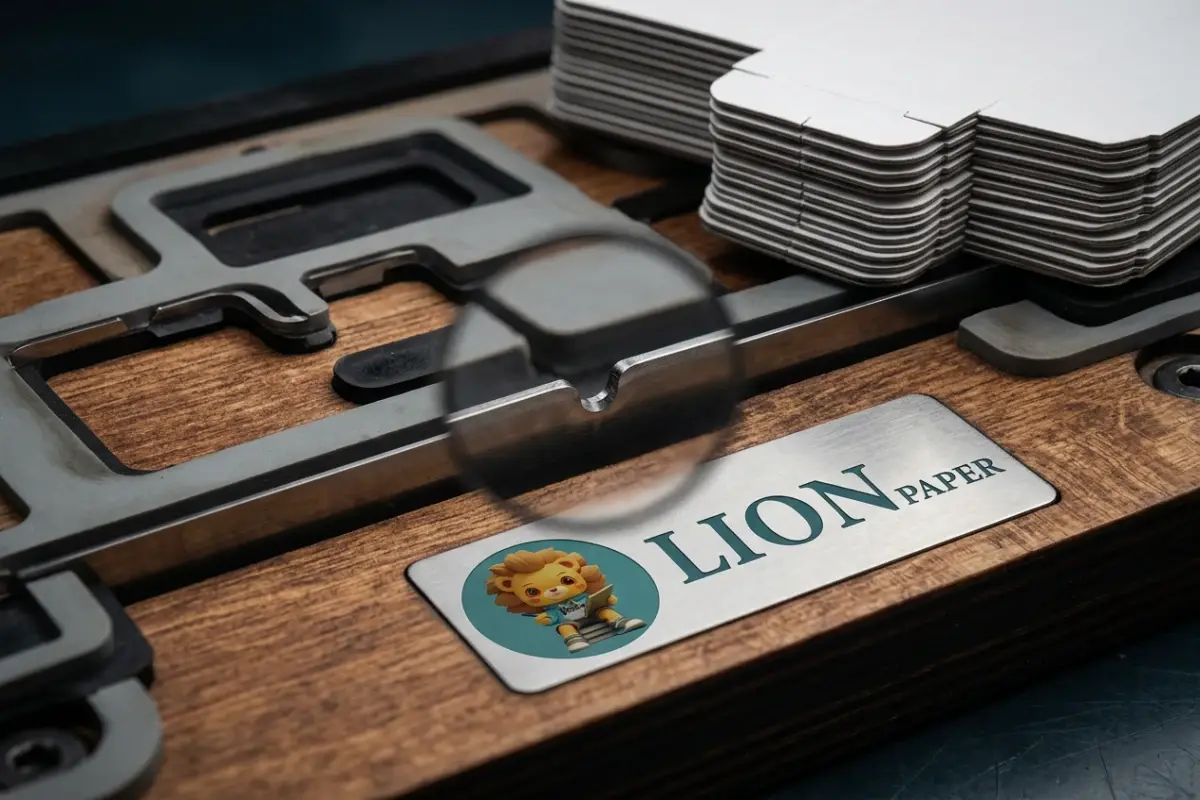
Paperboard sheets maintain structural integrity across converting platens via engineered micro-nicks.
Technical Specifications: How Are Nick Width, Depth, and Placement Calculated?
Engineering die cutting nicks requires matching blade notches to the caliper, fiber composition, grain direction, and surface coatings of the paperboard substrate. Nicks are ground into the cutting rule using specialized pneumatic or manual grinders equipped with high-precision diamond or carborundum wheels ranging from 0.20 mm to 1.50 mm in thickness.
The geometry of a nick depends directly on substrate thickness and flute profile. Below are baseline engineering specifications across common paper and board grades:
Substrate Type | Typical Caliper / Basis Weight | Recommended Nick Width (mm) | Recommended Nick Depth (mm) | Primary Placement Strategy |
|---|---|---|---|---|
:--- | :--- | :--- | :--- | :--- |
Premium Folding Boxboard (FBB/SBS) | 250 – 400 gsm (0.30 – 0.55 mm) | 0.25 – 0.40 mm | 0.35 – 0.60 mm | 15–25 mm from corners; along straight edges |
Heavy White Lined Chipboard (WLC) | 400 – 600 gsm (0.55 – 0.85 mm) | 0.40 – 0.60 mm | 0.60 – 0.90 mm | Centered on long panels; near lead edge |
Microflute Corrugated (F-Flute, N-Flute) | 0.80 – 1.20 mm caliper | 0.50 – 0.75 mm | Full blade depth notch | Across flute crests; offset from structural scores |
Rigid Setup Box Wraps & Art Paper | 128 – 157 gsm (0.12 – 0.18 mm) | 0.15 – 0.25 mm | 0.20 – 0.35 mm | Minimal micro-nicks at waste trim margins only |
Multi-Ply Kraft & Uncoated Board | 300 – 500 gsm (0.40 – 0.70 mm) | 0.35 – 0.50 mm | 0.50 – 0.75 mm | Parallel to paper grain to avoid fiber tear |
Calculating nick locations requires strict adherence to converting dynamics:
Lead-Edge Retention: The leading edge of the sheet entering the die cutter experiences the highest aerodynamic drag and mechanical pull. Nicks on the leading edge are typically 0.05 mm to 0.10 mm wider than trailing-edge nicks to prevent premature release.
Paper Grain Direction: Tearing across the paper grain requires higher mechanical force than tearing parallel to the grain. Nicks cut parallel to the fiber direction must be narrower (e.g., 0.30 mm) compared to cross-grain nicks (e.g., 0.40 mm) to maintain uniform stripping force.
Corner Exclusion: Nicks should never be positioned directly on blank corners or score intersections. Placing nicks at least 15 mm away from corners prevents carton corner bursting, flap misalignment, and interference with downstream folder-gluer hooks.
Ejection Rubber Coordination: Dense ejection rubber (such as 60°–70° Shore A profile rubber) must be positioned adjacent to nicked rules. The rubber stabilizes the sheet before and after blade penetration, preventing the nick from tearing prematurely under cutting pressure.
Stripping Efficiency vs. Edge Quality: What Are the Engineering Trade-Offs?
Die cut engineering involves managing a direct compromise between stripping efficiency on the factory floor and visual edge cleanliness on the retail shelf. Packaging die cutting tolerances demand that the residual fiber nib—the visible bump remaining after the nick fractures—does not exceed specified cosmetic thresholds or interfere with automated packaging assembly.
When die cutting nicks are too small or under-specified:
Matrix Breakage and Web Jamming: The sheet breaks apart inside the cutting platen or before reaching the stripping station, leading to catastrophic machine stops, damaged dies, and wasted substrate.
Blank Dropping: Individual blanks dislodge prematurely and fall into waste hoppers, lowering production yield and skewing piece counts.
Rotary Stripping Failure: High-speed stripping cylinders fail to carry waste sections cleanly, causing waste paperboard to wrap around delivery shafts.
When die cutting nicks are oversized or over-applied:
Visible Edge Burrs (Nibs): Large fiber tears remain on exposed folding carton edges, creating rough contact points that degrade premium cosmetics on luxury stationery, cosmetics cartons, and gift packaging.
Linting and Dusting: Severe tearing of oversized nicks generates loose cellulose fibers and dust, which clog automated gluing nozzles and contaminate clean-room packaging lines.
Folder-Gluer Jams: Pronounced burrs catch on guide rails, feed belts, or transfer hooks during high-speed folding and gluing, leading to skewed cartons and line stoppages.
Unboxing Friction: For two-piece setup boxes, notebook slipcases, and interior product trays, protruding nicks increase tactile friction, preventing smooth lid opening and degrading the consumer unboxing experience.
To resolve this trade-off, converting facilities deploy quick-break micro-nicks ground with specialized pyramid-profile wheels. These wheels create an inverted V-notch that concentrates mechanical stress at the center of the nick, allowing the bridge to snap cleanly under stripping impact without tearing deep into the blank panel.

Properly sized micro-nicks eliminate fiber tearing and unsightly burrs on visible retail packaging edges.
How Do Die Cutting Nicks Affect Retail Packaging, Stationery Components, and Automated Assembly?
Different product formats impose unique structural and visual constraints on steel rule die nicking strategies. Consumer packaging, office stationery, and e-commerce packaging each interact differently with die cut edges.
Folding Cartons and Retail Packaging
Retail cartons for cosmetics, health goods, and lifestyle products require immaculate perimeter lines. In these applications, packaging die cutting tolerances typically restrict maximum residual nib protrusion to under 0.15 mm. Nicks are intentionally shifted to glue flaps, bottom tucks, or interior dust flaps that remain hidden once the package is erected. This maintains continuous, pristine contours on the primary display panels.
Notebook Covers, Planners, and Stationery Accessories
For wire-bound notebooks, journals, tabbed dividers, filing folders, and calendar desk stands, die cut edges are exposed to frequent handling. Uncoated specialty boards, textured art papers, and soft-touch laminated stocks are vulnerable to visible edge whitening if nicks tear unevenly. In stationery converting, micro-nicks (0.20 mm or smaller) are placed exclusively along the binding edge or bottom base, ensuring the user-facing top and outer edges remain perfectly smooth.
Automated Packaging Lines and Case Packing
High-speed cartoning machines utilize suction cups and mechanical forming arms to pick, erect, fill, and close folding cartons at speeds reaching hundreds of units per minute. If paperboard stripping nicks leave excessive burrs along closure tabs or friction locks, cartons may fail to seat correctly inside forming mandrels. Clean nick fracturing ensures automated erecting lines run smoothly without misfeeds, sensory rejection, or carton deformation.
How Does Lion Paper Engineer Precision Die Tooling Across Dual Production Facilities?
Lion Paper Products (Jiaxing) Co., Ltd. applies an integrated engineering approach to die cutting tooling, balancing rapid product development with cost-efficient mass production. Utilizing a collaborative dual-site production model, Lion Paper connects design prototyping in Jiaxing, China, with large-scale converting at its manufacturing hub in Cambodia.
The 3,000-square-meter Jiaxing facility leads structural planning, sample prototyping, and precision die optimization. Engineering teams analyze paperboard tensile strengths, grain directions, and lamination coatings to produce optimized CAD dielines. Tooling parameters—including rule heights, bevel types, ejection rubber durometers, and exact nick coordinates—are verified during rapid sampling and pilot runs to establish baseline packaging die cutting tolerances.
For mass production, the 10,000-square-meter Cambodia manufacturing facility executes high-volume converting under standardized operating procedures (SOPs). With an annual notebook output exceeding 5 million units alongside extensive folding carton and packaging lines, Cambodia operations utilize laser-cut high-density plywood die boards, CNC-ground steel rules, and dynamic blanking stations. Automated flatbed die cutters operate with controlled nick depths adjusted for local ambient humidity and substrate elasticity, ensuring consistent stripping efficiency and uniform edge quality.
Operating under comprehensive ISO 9001 quality management, FSC certified chain-of-custody, and rigorous social and security compliance standards (including SMETA, WCA, GSV, FAMA, and CPSIA), Lion Paper applies uniform defect classification catalogs and AQL inspection protocols across both manufacturing plants. This China–Cambodia synergy allows global lifestyle brands, stationery publishers, and retail chains across North America, Europe, Australia, and Southeast Asia to achieve structural consistency, competitive landed costs, and stable commercial delivery.

Rigorous quality inspection ensures residual nick dimensions conform to strict packaging die cutting tolerances.
Quality Control and RFQ Checklist: How to Specify Die Cut Nicking Tolerances
When submitting a Request for Quotation (RFQ) or approving final packaging dielines, specifying precise nicking requirements eliminates costly tooling rework, prevents line stoppages, and protects brand aesthetics. Use the following technical checklist during structural design and tooling sign-off:
Substrate Specification: Fully define the caliper (pt or mm), basis weight (gsm), fiber furnish (virgin bleached kraft, recycled chipboard, unbleached kraft), and surface treatments (gloss/matte lamination, UV coating, soft-touch film).
Grain Direction Mapping: Ensure the dieline layout aligns primary structural scores and critical visible cuts favorably with the sheet grain direction, noting where cross-grain nicks require reduced widths.
Automated vs. Manual Stripping Clarity: Specify whether downstream converting relies on automated inline blanking, dynamic pin stripping, or manual hammer stripping. Automated blanking requires smaller, more precise micro-nicks compared to manual separation.
Critical Aesthetic Surfaces (No-Nick Zones): Mark high-visibility display edges, header cards, and thumb notches as restricted zones where no cutting nicks are permitted.
Nib Height Limits: Standardize the maximum allowable residual nib height (e.g., maximum 0.15 mm on retail edges; maximum 0.30 mm on hidden glue flaps) within your quality control defect catalog.
Tooling Approval Process: Require physical pilot cut-outs and sample assembly checks to evaluate edge burrs, opening force, and tab insertion before authorizing full production die fabrication.
AQL Inspection Levels: Establish incoming quality limits for edge roughness, delamination, and burr protrusion under ANSI/ASQ Z1.4 (ISO 2859-1) standards during mass production sign-off.
FAQ
What is the difference between a nick and a perforation in die cutting?
A nick is a singular microscopic gap (typically 0.20 mm to 0.60 mm wide) ground into a continuous cutting rule to hold a blank to the waste skeleton during machine transfer. A perforation consists of a repeating, alternating pattern of cuts and ties (such as 3 mm cut / 3 mm tie) designed to allow end-users to easily tear away a paper component, such as a coupon, notebook page, or tear-strip opening.
How does paperboard grain direction influence die cutting nicks?
Paperboard has significantly higher tensile strength along the grain than across it. Nicks placed parallel to the grain tear easily and cleanly during stripping, meaning they can be ground slightly narrower. Nicks placed perpendicular (cross-grain) encounter higher fiber resistance, requiring precise micro-notch profiles to prevent excessive fiber tearing and ragged edge burrs during mechanical stripping.
Can film lamination or coating cause issues with die cut nicking?
Yes. Plastic film laminations (such as OPP, PET, or soft-touch films) increase the surface tensile strength and elasticity of the substrate. If a nick is too wide on laminated board, the plastic film will stretch rather than snap during stripping, causing delamination, film peeling, or carton hang-ups. Dies cutting laminated stocks require specialized razor-sharp micro-notches and high-durometer ejection rubber to ensure clean fracture.
How are residual nicks kept invisible on luxury packaging?
Packaging structural designers position nicks exclusively along non-visible structural zones, such as internal glue tabs, dust flaps, or bottom interlocks. Additionally, high-end converting utilizes dynamic female blanking units and laser-dressed micro-nicks (0.15 mm to 0.20 mm) that leave near-zero residual fiber protrusion on primary visible edges.


Comments