


Customized Reading Journals for Independent Bookshops: Sourcing, Design, and Margin Guide

Independent bookshops driving private-label revenue must balance versatile, evergreen reading log templates against niche, curated literary prompts to optimize inventory turns, licensing compliance, and repeat reorder velocity. Developing customized reading journals for independent bookshops creates high-margin retail merchandise that builds brand affinity, captures recurring customer visits, and expands retail gift assortments beyond traditional trade book margins.
Buyer Trade-Off: Evergreen Reading Templates vs. Curated Niche Prompts
When retail buyers and independent bookstore owners develop proprietary stationery lines, the initial strategic choice centers on interior page architecture. Independent bookstore stationery merchandise must appeal to both omnivorous readers who devour multiple genres and specialized book club patrons seeking guided analysis. Selecting between open-ended structural templates and prompt-dense literary trackers dictates both immediate inventory turnover and long-term reorder cycles.
Evergreen reading log templates utilize structured yet unconstrained formats: numbered book logs, open grid review spaces, star-rating rubrics, and blank index trackers. This architectural neutrality ensures universal appeal across diverse customer demographics, from casual fiction buyers to academic researchers. Because evergreen layouts do not tie themselves to specific literary challenges or temporal reading goals, they resist seasonal obsolescence and maintain steady year-round sales velocity.
In contrast, curated niche prompts introduce thematic guiding questions, genre trackers, reading bingo cards, and book club reflection prompts. While prompt-rich journals demonstrate high impulse-purchase appeal during holiday gifting seasons and new-year planning cycles, they require precise demographic targeting. If prompts are overly complex, they increase consumer friction, reducing the likelihood of repeat volume purchases.
To balance this trade-off, successful independent retailers frequently adopt a modular, core-and-capsule merchandising strategy:
Core Evergreen Line: Standardized dot-grid and numbered log pages occupying 60% of total journal inventory, securing predictable sell-through across all four quarters.
Thematic Capsule Editions: Genre-specific or seasonal prompt sections occupying 40% of inventory, refreshed annually to incentivize gift purchases and collector behavior.
Hybrid Layout Integration: Incorporating functional reference features—such as tear-out lending logs, ribbon page markers, and back-cover storage pockets—to provide functional utility regardless of interior prompt density.

Balanced interior layouts combine functional rating rubrics with unconstrained note-taking space for diverse reader demographics.
Side-by-Side Decision Matrix: Layout Versatility, Margins, and Reorder Potential
Evaluating interior journal layouts requires analyzing unit production economics, retail markup thresholds, and audience retention metrics. Bookshop branded reading planners and private label reading logs must meet minimum gross margin benchmarks to justify shelf space allocation over third-party distributed gift lines.
Structural Layout Type | Primary Interior Features | Retail Target Demographic | Target Gross Margin | Reorder Cycle & Seasonality |
|---|---|---|---|---|
:--- | :--- | :--- | :--- | :--- |
Minimalist Log & Index | Numbered indices, date finished, star ratings, blank lined notes, quote banners | Universal fiction/non-fiction readers, bullet journalers | 65% – 72% | Evergreen; consistent 8–12 month consumer replenishment |
Guided Literary Planner | Monthly reading targets, TBR (To-Be-Read) trackers, pacing charts, habit logs | Dedicated book club members, reading challenge participants | 60% – 68% | Highly cyclical; peak Q4 holiday gifting and Q1 new-year purchases |
Genre-Specific Chronicle | Specialized tropes, character arcs, worldbuilding trackers, trigger warning logs | Romance, Fantasy (Romantasy), Sci-Fi, and YA enthusiasts | 62% – 70% | Mid-frequency reorders; tied to major author release cycles |
Collector's Literary Journal | Thread-sewn lay-flat binding, gilded edges, debossed cloth cover, ribbon sets | Gift buyers, rare book collectors, premium stationery shoppers | 70% – 78% | High Q4 volume; exceptional retail gift basket performance |
Selecting the appropriate layout directly influences manufacturing setup costs. Minimalist, uniform grid layouts require fewer plate changes and simplified prepress setups during custom literary journal printing, allowing bookshops to test multiple cover variants without incurring compounding interior print costs.
Material Engineering and Finishes for Retail-Ready Bookstore Stationery
Independent bookstore patrons possess heightened tactile expectations regarding paper quality, binding durability, and exterior cover treatments. Engineering customized reading journals for independent bookshops requires balancing premium tactile aesthetics with production economics and durability.
Paper stock selection represents the foundational quality indicator for discerning consumers. Fountain pens, rollerball pens, highlighters, and archival ink markers are standard tools among journal keepers. Selecting paper with substandard opacity or inadequate sizing results in feathering and bleed-through, damaging brand reputation.
100 gsm to 120 gsm Wood-Free Uncoated Paper: The industry standard for balanced thickness, smooth hand-feel, and excellent opacity, preventing ink ghosting while keeping journal spine thickness manageable for everyday carry.
100 gsm FSC-Certified Recycled Acid-Free Paper: An eco-conscious alternative that aligns with the environmental values of independent bookshop customers, offering high ink stability and archival longevity without yellowing.
140 gsm Bamboo or Heavyweight Wood-Free Stock: Optimized for mixed-media journaling, watercolor margin annotations, and dense highlighter usage, ideal for collector-tier stationery formats.
Binding integrity determines long-term utility. Reading journals undergo extensive handling, remaining open on flat surfaces while users read concurrently. Smyth-sewn case binding (hardcover) and sewn lay-flat flexi-binding (softcover) represent the premier structural standards. Thread-sewn signatures allow the journal to open a complete 180 degrees without cracking the spine or dropping leaves.
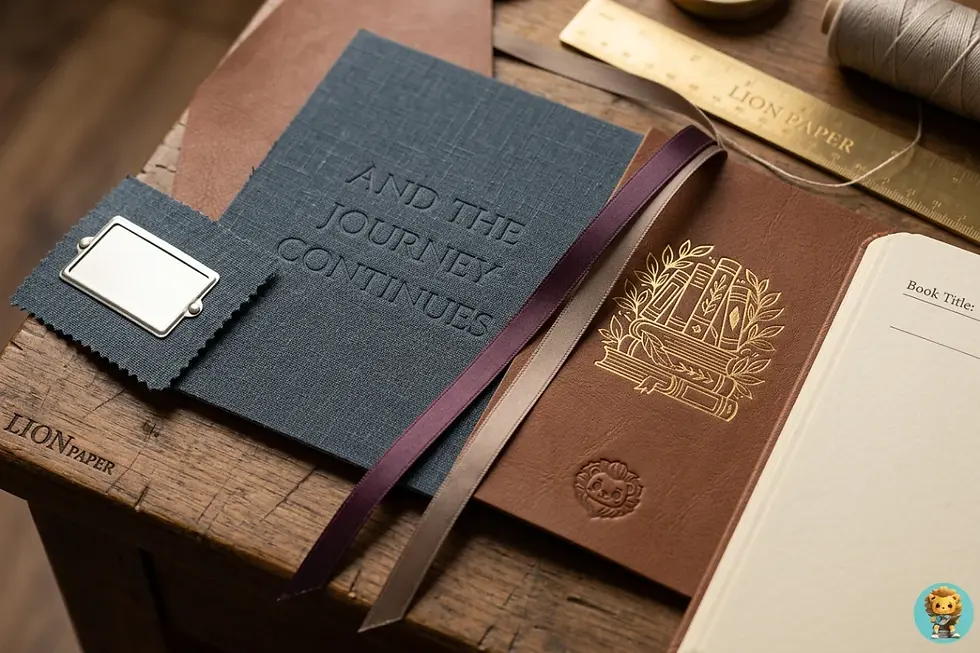
Tactile cover materials like woven book cloth and precise foil stamping enhance perceived gift value in retail settings.
Cover embellishments elevate retail shelf presence. Combining tactile materials with understated finishing techniques increases perceived gift value:
Linen and Buckram Book Cloths: Provide timeless tactile appeal; highly compatible with hot foil stamping (metallic gold, matte copper, or blind debossing) for bookstore logos and bespoke typography.
Soft-Touch Matte Laminated Hardcovers: Provide scuff resistance, water droplet protection, and vibrant full-color custom illustration reproduction for bespoke store art.
Vegan PU Leather (Faux Leather): Delivers supple flexibility, durable edge stitching, and crisp, deep heat-burnished debossing for classic literary motifs.
Functional Hardware: Elastic closure bands, dual satin ribbon bookmarks in complementary pantones, and expandable accordion back pockets engineered from 250 gsm reinforced cardstock for holding bookmarks and receipts.
Navigating Literary Licensing, Rights Approvals, and Cover Artwork Verification
Developing custom literary journal printing collections often involves celebrating literary history. However, independent retailers must navigate copyright clearance, trademark law, and licensing compliance before moving designs into commercial mass production.
Understanding the distinction between public domain literature and protected intellectual property is essential when developing literary merchandise:
Public Domain Clearance: In most jurisdictions (such as the United States), literary works published before 1928 have entered the public domain. Quotations, character names, and original text passages from authors like Jane Austen, Arthur Conan Doyle, or Mary Shelley can be utilized freely on covers, chapter headers, and interior prompt pages without licensing fees.
Protected Modern Translations and Editions: While underlying 19th-century texts may be public domain, modern translations, specialized scholarly annotations, modern typography arrangements, and specific contemporary cover illustrations remain protected by copyright. Retailers must commission original typographic layouts and proprietary vector illustrations.
Visual Artist Royalties and Commercial Licensing: When collaborating with local artists or illustrators for bookstore cover art, procure explicit, written commercial merchandise rights. A standard editorial license does not cover retail product manufacturing. Establish whether the agreement is a flat-fee complete copyright assignment or a royalty-bearing product license with defined territory and unit volume limits.
Trademark Compliance: Avoid utilizing trademarked brand phrases, distinct contemporary franchise insignia, or protected book cover trade dress without formal sub-licensing agreements from publishing houses or literary estates.
Professional manufacturing partners maintain rigorous artwork verification processes, requiring pre-flight checks of print-ready vector files (CMYK color mode, minimum 300 DPI resolution, 3mm bleed margins, and outlined fonts) alongside documented copyright clearance before initiating plate production.
Sourcing Blueprint: Transitioning from Small Pilot Batches to Scale Reorders
Independent bookstores, regional multi-store collectives, and boutique bookshop alliances require agile supply chain pathways that mitigate inventory holding risk while maintaining competitive cost-of-goods-sold (COGS).
Navigating production scaling requires understanding how supply chains manage sampling, pilot runs, and high-volume mass production. Leveraging coordinated dual-site manufacturing operations provides distinct strategic advantages for growing bookstore brands:
Phase 1: Concept & Prototyping (Jiaxing R&D Facility)
Material Selection & Dummy Sampling (Paper, Cloth, Ribbons)
Digital Prepress Proofing & Color Calibration
Structural Engineering Verification (Lay-flat Test, Pocket Durability)
Phase 2: Pilot Batch Production (Small-Run Agile Lines)
Low MOQ Trial Run (500 – 1,000 units)
Multi-Cover Variant Testing Across Retail Shelves
In-Store Sell-Through & POS Data Assessment
Phase 3: Scale Manufacturing (Cambodia Production Facility)
Automated Volume Output (5,000+ units)
Standardized SOP Quality Control & AQL 2.5/4.0 Inspections
Landed Cost Optimization & Container Freight Consolidation
Utilizing rapid prototyping and design verification at specialized development centers—such as Lion Paper's 3,000-square-meter Jiaxing facility—enables boutique retailers to execute rapid physical sampling within 7 working days. Physical dummy samples allow store managers to verify paper opacity, binding flexibility, and foil stamp precision prior to capital commitment.
Once in-store pilot batches establish customer demand metrics, production can transition smoothly into large-scale automated facilities—such as Lion Paper's 10,000-square-meter Cambodia manufacturing plant. This dual-site synergy optimizes total landed cost through automated line efficiencies and raw material scale sourcing, while providing diversified trade route logistics and international compliance (FSC, ISO 9001, SMETA, and CPSIA audits).

Dual-site manufacturing synergy provides rapid sampling in Jiaxing and high-volume cost efficiency in Cambodia.
Key RFQ Questions and Specifications for Custom Bookstore Journals
To secure accurate, binding quotations from stationery manufacturing partners, procurement buyers should structure their Request for Quotation (RFQ) with precise physical specifications and commercial logistics criteria.
When compiling an RFQ for bookshop branded reading planners or private label reading logs, specify the following parameters:
Trim Size: Standardize on recognized, shelf-friendly dimensions such as A5 (148 x 210 mm), Executive / B6 (128 x 182 mm), or Classic Medium (5.5 x 8.5 inches).
Page Count and Page Extent: Specify total pages in multiples of 16 (standard print signatures), typically 160, 192, or 224 pages.
Interior Paper Engineering: Specify paper weight (e.g., 100 gsm or 120 gsm), base color (ivory/cream for reduced eye strain vs. high-white), surface sizing, and sustainability certifications (FSC Mix or FSC 100% Recycled).
Interior Print Specifications: State whether interior grids use 1C/1C (single-color subtle charcoal/pantone grey lines) or 4C/4C (full-color illustrated backgrounds and prompts).
Binding Method: Specify smyth-sewn casebound with square or rounded spine, flexible sewn softcover, or exposed thread binding with true 180-degree lay-flat functionality.
Cover Materials and Embellishments: Outline core board thickness (e.g., 2.0mm to 2.5mm greyboard), wrapped material (natural linen, bookcloth, premium PU, or 157 gsm coated art paper with anti-scratch matte lamination), and exact embellishment dimensions (foil stamping area, blind deboss depth, screen-printed motifs).
Retail Packaging and Barcoding: Request custom belly bands (printed on 200 gsm kraft or art paper), individual biodegradable shrink-wrap or OPP polybags with compliant suffocation warnings, and pre-applied scannable retail UPC/EAN barcode stickers.
Logistics Terms and Delivery Nodes: Define shipping terms (FOB port of origin, CIF destination port, or DDP direct to central bookstore warehouse or multiple retail branch locations).
To begin tailoring your proprietary merchandise collection, request a custom journal development review by providing your artwork specifications, intellectual property clearance documentation, intended retail distribution channels, and projected production volumes.
FAQ
What is the typical minimum order quantity (MOQ) for custom bookstore reading journals?
Pilot production runs for custom-designed reading journals typically start at 500 to 1,000 units for fully bespoke hardcover or softcover formats with custom interior printing. Higher-volume production runs (3,000 to 5,000+ units) unlock optimized unit manufacturing costs through high-speed automated binding lines and bulk raw material sourcing.
Which paper weight is recommended to prevent ink bleed-through from fountain pens and markers?
A 100 gsm to 120 gsm wood-free uncoated acid-free paper stock is the ideal standard for literary journals. It provides superior opacity and sizing that prevents ink feathering and ghosting from standard fountain pens, gel pens, and highlighters while keeping the book's total weight and spine thickness comfortable for daily use.
Can independent bookstores print multiple cover designs within a single production run?
Yes. If the interior page extent, paper stock, trim dimensions, and binding construction remain identical across the batch, manufacturers can split an order across multiple cover artwork variations or cloth colorways. This allows bookstores to offer seasonal or genre-themed cover options while maintaining high-volume interior printing efficiencies.
What certifications should bookstores verify when sourcing eco-friendly reading planners?
Retailers should verify that the manufacturer maintains FSC Chain of Custody certification (FSC-STD-40-004) for paper traceability, utilizes soy-based or low-VOC vegetable printing inks, and complies with international social and environmental standards through SMETA, ISO 9001, or WCA factory audits.


Comments