


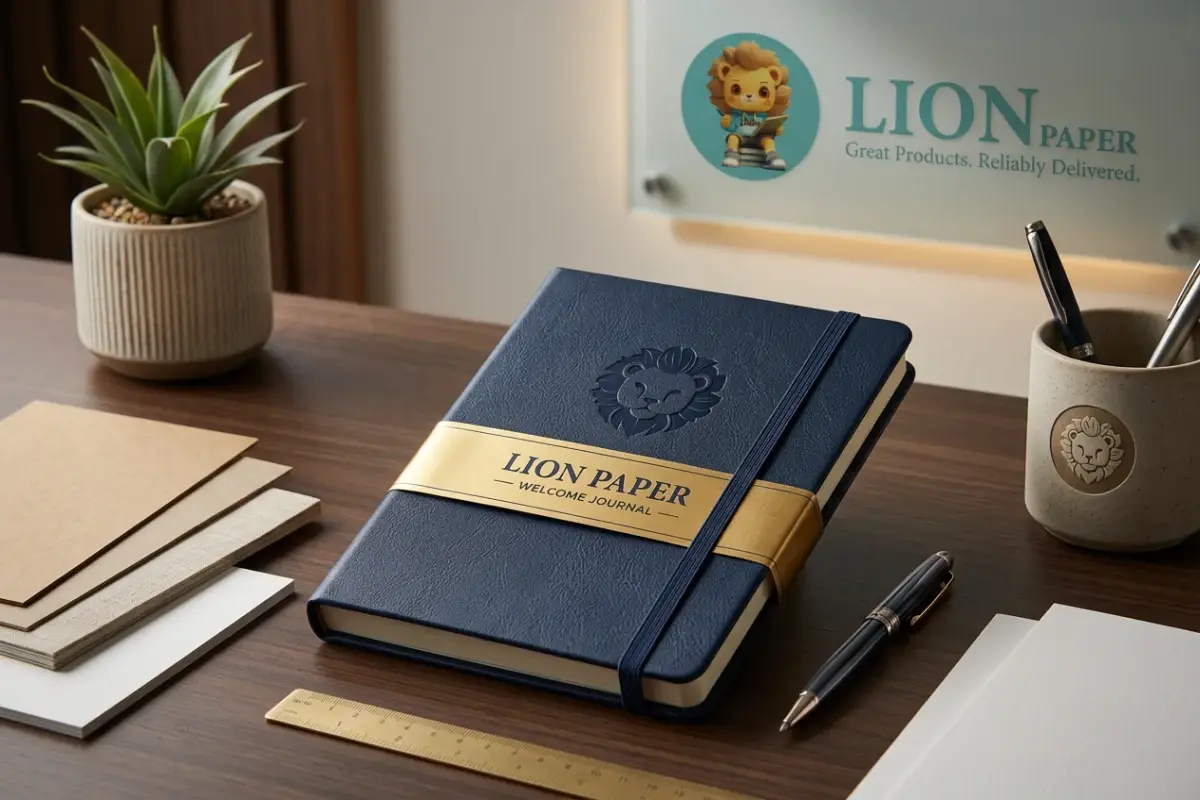
Customer Welcome Journals: Design, Materials, and Supply Chain Guide
Customer welcome journals are custom branded notebooks designed for onboarding new clients, balancing concise company orientation inserts with functional, high-grade writing pages to maximize daily utility and brand recall. These tailored stationery assets bridge the gap between digital communications and physical relationship building, providing long-term brand exposure across executive meetings, project planning, and day-to-day administrative workflows.
Why Are Customer Welcome Journals Essential for B2B Client Onboarding?
Client onboarding sets the tone for long-term commercial relationships. While digital welcome emails and SaaS portal walkthroughs handle functional access, they often lack tactile engagement. Customer welcome journals introduce a physical anchor to the relationship, communicating appreciation and professionalism from the initial kickoff meeting.
Integrating branded onboarding notebooks into customer success workflows offers distinct commercial benefits:
Enhanced Brand Perception: High-finish stationery communicates stability, attention to detail, and a commitment to quality before service delivery begins.
Continuous Brand Recall: Unlike promotional items that are quickly discarded, a high-quality journal remains on an executive desk or in a meeting bag for 6 to 12 months, delivering daily visual impressions.
Higher Information Retention: Printed orientation pages—such as dedicated service contacts, escalation paths, and shared mission frameworks—remain permanently accessible without navigating digital dashboards.
Tangible Relationship Investment: Presenting physical client welcome gift stationery signals a partnership orientation rather than a purely transactional engagement.
Corporate accounts that receive premium onboarding tools exhibit higher early-stage engagement metrics during implementation phases, as tangible touchpoints encourage stakeholders to actively document milestones and project scopes.
How Do You Balance Informational Onboarding Inserts with Functional Note-Taking Pages?
The structural design of custom corporate journals requires an intentional ratio between brand introduction content and open writing space. If a notebook contains too much corporate literature, it becomes a marketing brochure that recipients hesitate to use for private notes. Conversely, if it contains no orientation material, it loses its onboarding utility.
An optimal page layout follows an 85/15 architectural rule:
Orientation Section (First 4 to 12 Pages): Tip-in pages or front-matter spreads printed on distinct paper stock (such as 120 gsm matte art paper) featuring executive welcome letters, onboarding roadmaps, team contacts, core values, and QR codes directing to resource hubs.
Functional Note Space (Next 160 to 192 Pages): Neutral, unobtrusive dot grid, lined, or bullet-journal layouts printed with subtle gray inks (Pantone Cool Gray 4C or 5C) to prioritize the user's daily writing.
Reference and Utility Section (Final 2 to 4 Pages): Project milestone trackers, conversion charts, key dates, and expandable rear document pockets for storing business cards, loose documents, and receipts.
Page Section | Page Count Range | Primary Paper Stock | Primary Function |
|---|---|---|---|
:--- | :--- | :--- | :--- |
Welcome & Orientation | 4–12 pages | 120–140 gsm Coated or Woodfree | Introduces leadership, team structure, and onboarding timelines |
Main Writing Body | 160–192 pages | 80–100 gsm FSC Uncoated Woodfree | Everyday meeting notes, action items, and project planning |
Utility & Reference | 2–6 pages | 100–120 gsm Uncoated Woodfree | Project schedules, index logs, and reference frameworks |
Expandable Pocket | 1 back gusset | 250–350 gsm Kraft or Greyboard | Holding service agreements, business cards, and project briefs |

An intentional page architecture balances brand orientation inserts with functional note-taking layouts.
What Are the Key Material and Binding Specifications for Custom Corporate Journals?
Material specifications dictate the durability, tactile feel, and cost structure of promotional notebook manufacturing. Selecting the right combination of cover material, binding technique, and inner paper weight ensures that client welcome gift stationery withstands frequent business travel while remaining comfortable to write in.
Cover Substrates and Textures
Thermo PU (Polyurethane / Vegan Leather): The standard for executive journals. Thermo PU reacts to heat debossing, producing a dark, recessed impression that highlights corporate logos without requiring foil.
Linen and Bookcloth Fabrics: Natural woven textiles mounted over heavy board provide a tactile, modern aesthetic suitable for design-focused, architectural, or sustainability-led brands.
Recycled Hardcover Board (Kraft / Greyboard): Uncoated, dense boards made from post-consumer waste deliver an authentic eco-friendly statement, especially when paired with blind debossing or soy ink screen printing.
Softcover Flexible Cardstock: Lightweight 300–400 gsm textured cardstock offers portability for onboarding kits that require minimal shipping weight.
Binding Formats and Functional Utility
Thread-Sewn Casebound (Hardcover): Signatures are sewn together with cotton thread before being cased into rigid covers. This structure allows the journal to lay completely flat at 180 degrees, which is critical for comfortable, two-page writing spreads.
Wire-O / Double Spiral Binding: Twin-loop metal binding allows 360-degree rotation, ideal for workshops, field operations, and desk environments with limited space.
Flexi-Bound (Softcover Casebound): Combines sewn signatures with a supple, flexible cover, balancing lay-flat performance with reduced overall weight.
Paper Characteristics and Performance
Inner paper selection must prevent ink feathering and ghosting across various writing instruments, including rollerball pens, fountain pens, and gel highlighters.
80 gsm FSC-Certified Cream Woodfree: Standard weight for mass onboarding programs; smooth texture, glare-reducing warm tint, and cost-efficient.
100 gsm Premium Uncoated Offset: Balanced choice for executive kits; zero show-through with standard ballpoint and gel pens.
120 gsm Heavyweight Mixed-Media Paper: High-end specification suited for fountain pens and marker use without bleed-through.
What Packaging and Presentation Options Elevate Client Welcome Gift Stationery?
The unboxing experience directly influences the initial perceived value of branded onboarding notebooks. Presenting a loose notebook diminishes the gift impact, whereas structured, retail-ready packaging creates anticipation and reinforces brand equity.
Primary Packaging Formats
Custom Paper Belly Bands (Wrappers): Printed 157 gsm art paper bands wrapping the exterior of the journal, displaying campaign themes, recipient names, or program titles with foil stamping or soft-touch lamination.
Two-Piece Rigid Presentation Boxes: Telescoping lid-and-base boxes lined with custom EVA foam or fluted cardboard trays that hold the journal alongside complementary executive accessories.
Drawer-Style Sliding Gift Boxes: Outer rigid sleeves with pull-ribbon interior trays that create an interactive reveal mechanism.
Recyclable Kraft Envelopes with String Closures: A sustainable packaging option featuring custom wax seals or printed branded stickers.
Integrated Corporate Onboarding Bundles
To increase the practical utility of customer welcome journals, enterprise programs frequently bundle the core notebook with matching desktop tools within a unified presentation package:
Weighted metal twist pens matching the notebook's accent stitching or ribbon color.
Self-adhesive tab dividers and repositionable sticky note flags.
Custom-printed branded bookmark cards containing direct QR access to client portals.
Matching canvas or felt tech pouches designed to house the notebook and office cables.

Structured unboxing packaging and bundled stationery accessories elevate perceived value for enterprise client gifting.
How Does Dual-Site Promotional Notebook Manufacturing Streamline Custom Corporate Journal Orders?
Scaling promotional notebook manufacturing across diverse enterprise branches requires an agile supply chain that balances rapid prototyping, strict compliance, and landed-cost optimization. Utilizing a dual-site manufacturing model addresses these production demands effectively.
Dual-Site Production Dynamics
A dual-site network coordinates pre-production development with high-volume manufacturing output:
Design, Prototyping, and Pilot Batches (China Facility): Engineering teams translate initial sketches into physical samples within 3 to 7 working days. The facility manages complex pre-press finishing, custom tooling, material sourcing, and specialized pilot runs for urgent onboarding launches.
Scale Manufacturing and Cost Efficiency (Cambodia Facility): Once specifications and quality benchmarks are approved, automated high-capacity binding and assembly lines handle large-scale volume production (5,000 to 100,000+ units), optimizing tariff structures, labor costs, and raw material yields.
Standardized Quality and Compliance Frameworks
Consistent quality across multi-thousand unit runs requires standardized standard operating procedures (SOPs) and international compliance accreditations:
ISO 9001 Quality Management: Incoming material inspections, in-line signature alignment checks, glue temperature monitoring, and final AQL (Acceptable Quality Limit) 2.5/4.0 defect screening.
FSC Chain of Custody: Traceable forestry supply chains ensuring paper stocks derive from responsibly managed forests.
Social and Safety Audits: Verification under SMETA, WCA, GSV, FAMA, and CPSIA frameworks to meet the supplier governance standards of multinational enterprises and major retail systems.
Manufacturing Phase | China Facility (Jiaxing) | Cambodia Facility |
|---|---|---|
:--- | :--- | :--- |
Facility Footprint | ~3,000 sq. meters | ~10,000 sq. meters |
Core Function | R&D, rapid prototyping, pilot runs | Large-scale automated manufacturing |
Typical Lead Times | 10–18 business days | 30–45 business days |
Capacity Profile | Agile, multi-SKU, small-to-medium runs | High-volume scale, export container shipments |
Quality Governance | Defect mapping, material testing, SOPs | Standardized SOP replication, AQL audit controls |

Standardized automated manufacturing and stringent AQL quality controls ensure batch-to-batch consistency for volume corporate orders.
What Information Is Required to Initiate a Custom Welcome Journal Production Review?
To ensure an efficient production review, accurate cost modeling, and rapid sample turnaround, corporate procurement teams and brand managers should prepare specific project parameters before initiating an RFQ.
Production Specification Checklist
Target Program Date and Delivery Locations: Critical delivery deadlines, split-shipment requirements across regional offices, and desired shipping methods (ocean freight vs. air priority).
Order Volumes and Style Variations: Total quantity, number of cover colorways, and multi-tier variations (e.g., standard employee versions vs. executive client tiers).
Cover & Spine Configuration: Dimensions (A5, B5, Executive 7x9"), cover substrate (thermo PU, fabric, hard kraft), corner rounding radius, and binding type (casebound, wire-o, flexi).
Branding Finishes: Vector artwork files (.AI, .EPS, .PDF) with specifications for blind debossing, foil stamping (gold, silver, matte black), screen printing, or full-color digital UV.
Page Architecture: Total page count, inner paper grammage (80, 100, or 120 gsm), grid style (dot, lined, blank), and number of full-color custom insert pages.
Functional Accessories: Elastic closure bands, ribbon page markers, pen loops, expandable back pockets, and integrated edge gilding.
Packaging Requirements: Individual shrink-wrapping, printed belly bands, rigid two-piece gift boxes, or bulk master carton pack-outs.
Providing these project parameters ensures an accurate, transparent manufacturing roadmap with minimized revision cycles.
Share your event or program date, artwork, required quantity, and packing needs for a branded stationery review with our engineering and production specialists today.
FAQ
What is the typical minimum order quantity (MOQ) for custom customer welcome journals?
Standard MOQs typically start at 500 to 1,000 units for fully customized cover materials, custom-printed tip-in pages, and bespoke accessories. Pilot runs or smaller batch tests starting from 300 units can be supported depending on the level of cover customization and stock material availability.
How long does the sampling and mass production cycle take?
Physical custom prototyping usually takes 5 to 7 working days following vector artwork approval. Once the pre-production sample is confirmed, mass production ranges from 15 to 25 business days for agile regional runs, and 30 to 45 business days for large-scale container-volume manufacturing.
Can custom welcome journals include personalized individual recipient names?
Yes. Individual variable-data laser engraving, metallic foil personalization, or custom-printed name bands can be incorporated into production runs, allowing enterprise clients to create bespoke executive gift tiers within a unified master batch.
Are eco-friendly and FSC-certified materials available for onboarding journals?
Yes. Notebooks can be manufactured using 100% FSC-certified inner paper stocks, post-consumer recycled greyboard covers, organic cotton or linen bookcloths, water-based glues, and non-toxic soy-based printing inks to satisfy corporate sustainability and ESG procurement mandates.