


Customer Service Desk Notepads Bulk Procurement & Manufacturing Guide

Procuring customer service desk notepads in bulk requires choosing between preprinted structured intake forms for fast, standardized data capture and general memo pads for flexible notes, balanced with optimized paper weight, secure tear-off glue binding, and dual-site manufacturing efficiency.
Why do organizations deploy structured customer service writing pads wholesale rather than generic blank paper?
Organizations implementing structured customer service writing pads wholesale establish standard operational discipline across frontline counters, call centers, medical intake stations, and hospitality reception desks. Generic blank paper invites incomplete data recording, unstructured notes, and inconsistent communication between shift handovers. In contrast, custom printed service desk memo pads guide frontline staff through mandatory data capture protocols, accelerating customer triage and issue resolution.
Standardizing front-desk paperwork with purpose-built pads yields measurable operational benefits:
Error Reduction: Preprinted check boxes, timestamp entries, and department routing fields ensure staff gather complete caller information before escalating tickets.
Shift Continuity: Standardized intake sections enable incoming team members to review customer requests, ticket numbers, and pending actions without deciphering arbitrary shorthand.
Brand Presentation: Desk pads facing clients project a coherent corporate identity, reinforcing professionalism across branch networks, retail store counters, and hotel check-in desks.
Compliance and Record Archiving: Consistent paper fields simplify physical filing, scanning into electronic health records (EHR) or customer relationship management (CRM) systems, and auditing physical transactions.
| Operational Feature | Generic Blank Memo Pads | Structured Frontline Intake Notepads | | :--- | :--- | :--- |n| Data Completeness | Low (relies entirely on agent memory) | High (enforced via mandatory prompt fields) | | Intake Speed | Moderate to slow (manual labeling required) | Fast (tick boxes, pre-formatted tables) | | Handover Clarity | Poor (variable layouts across staff) | High (uniform visual hierarchy) | | Filing & Digitization | Difficult to index systematically | Optimized with dedicated ID & barcode zones | | Brand Consistency | Neutral / Unbranded | Professional private label integration |

Preprinted intake layouts ensure standardized data capture and clear shift handover documentation.
What layout designs and dimensional formats optimize frontline intake notepad manufacturing?
Selecting the correct dimensional format and layout structure during frontline intake notepad manufacturing directly influences desk ergonomics and data throughput. Service desks typically operate under restricted counter space, necessitating pads that balance writable area with a compact desk footprint.
Standard Commercial Dimensions
4.25 x 5.5 inches (Quarter-Letter / A6 equivalent): Best suited for compact point-of-sale (POS) counters, drive-thru order stations, and quick telephone message pads.
5.5 x 8.5 inches (Half-Letter / A5 equivalent): The industry standard for hotel front desks, retail return desks, and IT support desks requiring balanced room for customer profiles, problem descriptions, and routing details.
8.5 x 11 inches (Letter / A4 equivalent): Ideal for comprehensive medical reception intake, automotive repair drop-offs, and multi-part client onboarding pads.
3.5 x 8.5 inches (Slender Docket / Receipt format): Configured for serialized merchandise pickup, security passes, and luggage tagging registers.
Functional Preprinted Layout Modules
A high-performing customer intake notepad integrates structured visual blocks organized by conversational sequence:
Header Block: Company brand mark, site ID, terminal identifier, date, time stamp, and customer account/case number.
Customer Profile Block: Caller/guest name, callback number, verified email, and preferred contact channel.
Categorization Matrix: Grid or tick boxes for query classification (e.g., Billing, Technical Support, Returns, Escalation, VIP Service).
Core Narrative Grid: Ruled or dot-grid area with 7 mm line spacing for legible problem summaries and diagnostic findings.
Resolution & Routing Block: Assigned agent initials, target resolution department, promised callback deadline, and status indicators (Open, In Progress, Closed).
What material and structural specifications ensure clean tear-off counter notepads bulk order performance?
Tear-off counter notepads bulk order projects require rigorous raw material selection to withstand high-volume, rapid handling without structural failure. The core assembly consists of the text stock, the binding glue formulation, and the stabilizing backing board.
Paper Stock and Weight Selection
70–80 gsm Uncoated Woodfree Paper: The standard commercial grade for high-speed ballpoint and rollerball pen writing. Provides adequate opacity for single-sided forms while maintaining competitive unit pricing in massive print runs.
100–120 gsm Premium Offset / FSC-Certified Paper: Preferred for executive reception areas and luxury hospitality, preventing ink feathering and show-through from gel pens, fountain pens, or desk highlighter markers.
2-Part or 3-Part Carbonless (NCR) Paper: Essential for workflows requiring an instant customer copy alongside an internal record copy without using carbon sheets.
Binding and Backing Architecture
Padding Compound (Top Glued): Flexible polyvinyl acetate (PVA) cold adhesive applied to the top or side edge. A calibrated adhesive formulation ensures individual sheets peel away cleanly without tearing the header or leaving fibrous adhesive residue on the sheet edge.
Gummed Header Binding with Micro-Perforation: For multi-part carbonless sets or pads requiring a staple-reinforced spine wrapped in bookbinding tape, micro-perforations allow clean separation while holding remaining sheets intact.
Heavyweight Chipboard Backing: Backing boards ranging from 600 gsm to 1200 gsm (approx. 22 pt to 48 pt thickness) provide rigid support for hand-held writing across counters or mobile floor assistance scenarios.
Sheet Count Formats: Standard configurations range between 25 sheets (compact forms), 50 sheets (standard front-desk turnover), and 100 sheets (high-volume telemarketing stations).

Automated padding compound application guarantees clean sheet release without fiber tearing.
How does dual-site manufacturing balance cost and agility for custom printed service desk memo pads?
Managing enterprise-scale custom printed service desk memo pads procurement across national retail chains, franchise systems, or multinational hospitality brands requires balancing fast iteration with volume cost containment. Lion Paper Products operates a China–Cambodia dual-site manufacturing network that addresses these distinct project phases.
Jiaxing Facility: R&D, Prototyping, and Pilot Batches
The 3,000-square-meter facility in Jiaxing, China, functions as the agile design and engineering hub. It supports:
Fast turn-around digital and offset physical proofing within 3 to 5 business days.
Structural layout optimization and pre-press prep for multi-brand franchises.
Pilot manufacturing runs and seasonal test campaigns with low minimum order quantities (MOQs).
Cambodia Facility: High-Volume Mass Production and Landed-Cost Optimization
The 10,000-square-meter manufacturing plant in Cambodia is engineered for automated high-volume processing and predictable delivery schedules. With an annual capacity exceeding 5 million notebook and stationery units across automated gluing, cutting, and collating lines, this facility enables clients to achieve substantial landed-cost savings on full container load (FCL) shipments.
| Manufacturing Dimension | China Hub (Jiaxing) | Cambodia Hub (Phnom Penh) | | :--- | :--- | :--- |n| Primary Function | Prototyping, rapid sampling, design engineering | Automated mass production, volume scaling | | Facility Scale | Approx. 3,000 m² | Approx. 10,000 m² | | Optimal Order Volume | Pilot runs, multi-SKU regional rollouts | Mass volume orders, annual contract replenishment | | Tooling & Sampling | Fast turnaround (3–5 working days) | Matched to standardized master tooling | | Tariff & Logistics | High agility for air/sea split shipments | Duty-optimized container shipments to US/EU |
Which quality control standards and AQL checkpoints govern high-frequency front-desk pads?
High-frequency desk environments demand that every sheet tears smoothly, feeds into standard digital scanners, and displays consistent line contrast. Quality assurance protocols at Lion Paper adhere to strict ISO 9001 and AQL (Acceptable Quality Limit) 2.5/4.0 sampling standards throughout every stage of fabrication.
Critical Quality Inspection Stages
Pre-Press Color & Registration Auditing: Monitoring CMYK / Pantone line work registration to prevent blurred form lines or skewed text boxes that could interfere with automated Optical Mark Recognition (OMR) or digital OCR indexing.
Tear-Tension & Adhesive Bond Verification: Tensile peel tests check that sheets release cleanly with minimal force without separating the remaining pad block from the backing chipboard.
Dimensional & Squareness Trimming Checks: Rotary knife alignment ensures pads maintain strict 90-degree corners and flush edges to prevent paper jams in desk drawers or branded acrylic desktop holders.
Moisture Content & Paper Flatness: Raw paper stock is stored and processed under controlled relative humidity (45%–55%) to prevent sheet curl or edge waviness when exposed to front-desk HVAC environments.
Carton Drop and Bulk Packaging Integrity: Multi-pack shrink wrapping with desiccants protects pads from edge denting, scuffing, and atmospheric moisture during international maritime transit.
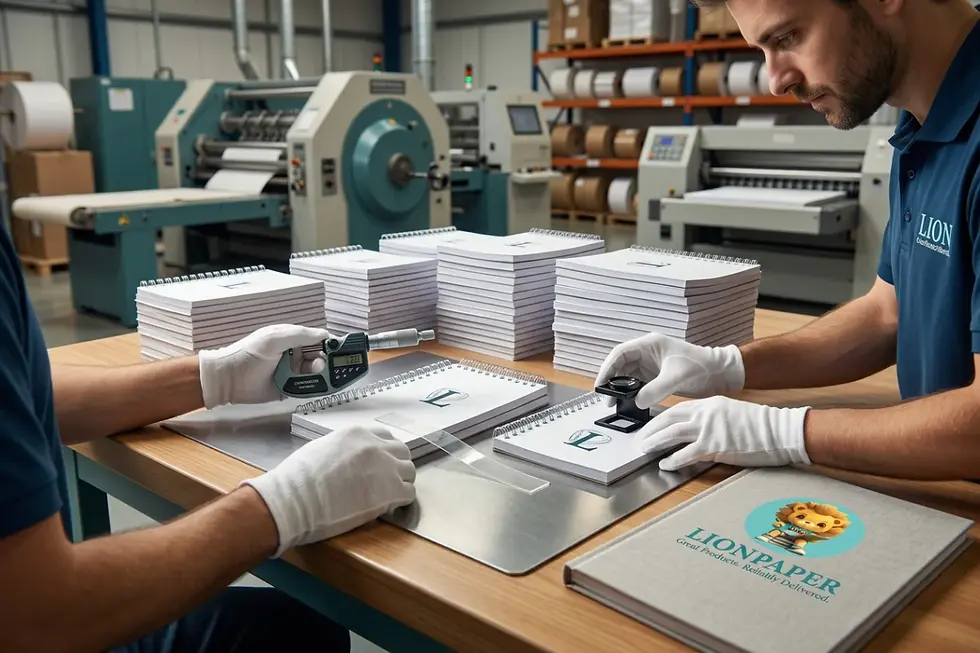
Comprehensive AQL inspection verifies form registration, trim squareness, and tear-off performance.
What essential specifications should be included in an RFQ for customer service desk notepads bulk orders?
To ensure rapid quote generation and accurate engineering feedback when sourcing customer service desk notepads bulk, procurement teams should structure their Request for Quotation (RFQ) with precise commercial and material parameters.
Procurement Specification Checklist
Pad Dimensions: Width x Height in millimeters or inches (e.g., 5.5 x 8.5 in / 140 x 216 mm).
Sheet Count: Number of writable leaves per pad (commonly 25, 50, or 100 sheets).
Text Paper Specification: Grammage (e.g., 80 gsm uncoated woodfree), paper grade (standard offset vs. FSC-certified sustainable stock), and color (white, cream, canary yellow).
Printing Configuration: Number of printed sides (single-sided vs. double-sided), color mode (1C monochrome black/slate, 2C spot color, or 4C full-color process).
Binding Method: Padding compound edge (top or left side), glued with micro-perforated header, or staple-and-tape bound.
Backing Board Grade: Greyboard or kraft chipboard caliper (e.g., 800 gsm / 1.2 mm thickness).
Special Finishing: Serialization numbering, carbonless duplicate transfer, magnetic backing strips, or branded top cover wrap.
Packaging Requirements: Individual or grouped poly-bagging, custom inner carton master pack quantities, retail-ready barcodes, and palletization standards (standard US/Euro pallets).
Send the intended workflow, pad size, sheet count, artwork and order quantity to discuss OEM notepad layout, sample checks and bulk pricing with the manufacturing engineering team through Lion Paper Products Inquiry.
FAQ
What is the typical minimum order quantity (MOQ) for custom printed service desk memo pads?
For custom printed pads with bespoke layouts and branding, standard MOQs start at 1,000 to 2,500 pads depending on sheet count and dimensional format. Larger volume runs of 10,000+ units leverage automated mass production lines in Cambodia for maximum cost efficiency.
Can service desk memo pads incorporate duplicate carbonless (NCR) sheets?
Yes. Frontline intake notepads can be engineered with 2-part (white/canary) or 3-part (white/canary/pink) carbonless paper sets, bonded with specialized fan-apart padding glue or staple-perforated binding to provide immediate physical copies for customers and internal filing.
What sustainability certifications are available for bulk notepad manufacturing?
Notepad production supports full Chain of Custody FSC-certified papers, post-consumer recycled (PCW) stocks, soy-based vegetable printing inks, and plastic-free unbleached kraft backing boards to align with corporate ESG and sustainable procurement policies.


Comments