


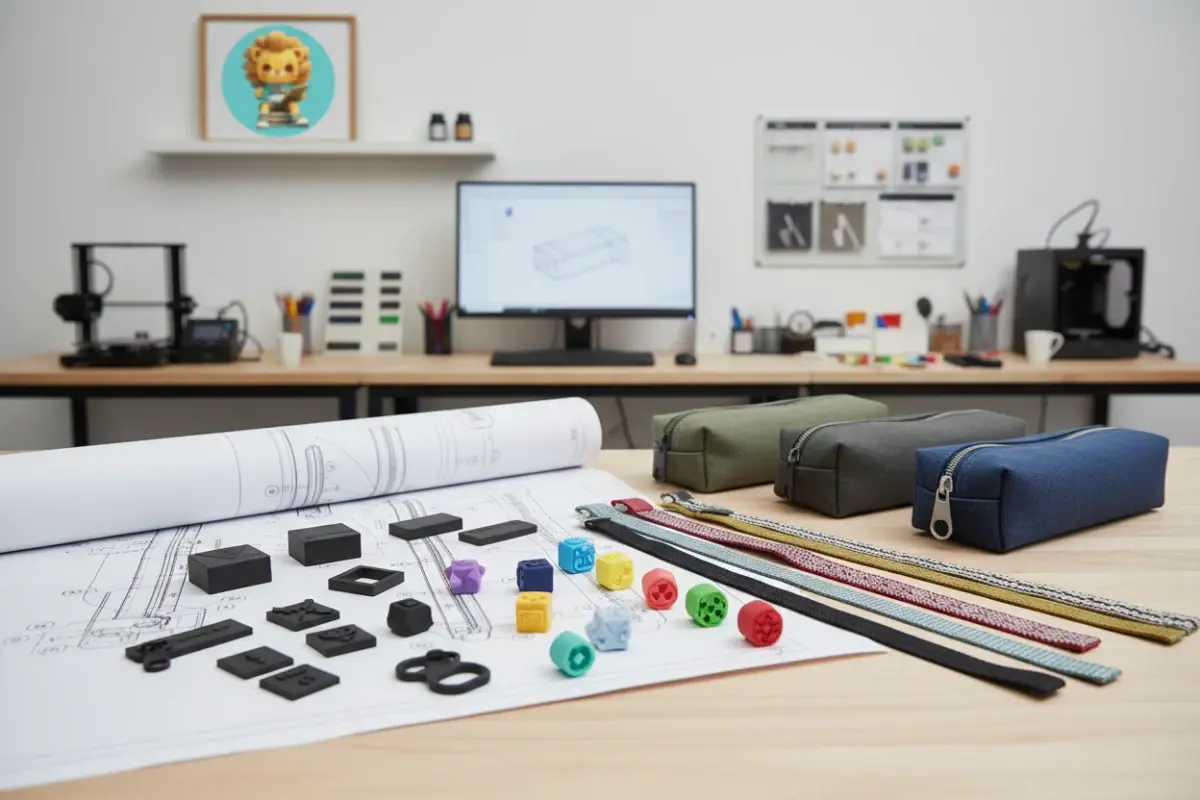
Engineering Guide to Custom Zipper Pullers for Pencil Cases and Stationery Pouches

Selecting the right custom zipper pullers for pencil cases and organizer bags requires evaluating metal, rubber, paracord, and woven fabric based on unit economics, tactile ergonomics, brand identity, and structural durability. Tailoring custom stationery hardware to specific pouch fabrics—such as canvas, rPET, or vegan leather—ensures smooth slider glide, regulatory compliance, and a distinctive retail-ready unboxing experience across school, office, and lifestyle stationery collections.
Which Materials Perform Best for Custom Zipper Pullers on Stationery Pouches?
Choosing the right substrate for pencil case zipper pulls dictates the aesthetic perceived value, tactile feedback, mechanical pull-strength, and overall tooling investment. The four primary material categories across retail and corporate stationery manufacturing include zinc alloy, molded silicone, high-density woven tape, and utility cord.
1. Zinc Alloy (Bespoke Metal Zip Pullers)
Key Characteristics: Zinc alloy (#3 or #5 grade) offers high tensile strength, crisp edge definition, and substantial heft. It supports intricate 3D relief, debossed brand logos, enamel color filling, and electroplated metallic finishes.
Surface Finishes: Matte black, brushed brass, antique bronze, rose gold, polished chrome, and pearl nickel.
Best For: Premium notebooks with attached pen pouches, professional desk organizers, executive canvas pouches, and luxury stationery gift sets.
2. Molded Silicone and Soft PVC (Silicone Zipper Tags)
Key Characteristics: Flexible, soft-touch, lightweight, and impact-resistant. Molded silicone zipper tags enable multi-color micro-injection molding, vibrant Pantone color-matching, and rounded, child-safe structural geometries.
Best For: Back-to-school pencil cases, youth creative organizers, waterproof travel pouches, and silicone desktop accessories.
3. Woven Jacquard and Embroidered Ribbon Pullers
Key Characteristics: Made from woven polyester, rPET (recycled polyethylene terephthalate), or organic cotton webbing. They provide a streetwear, casual lifestyle texture with flat or tubular construction.
Best For: Large-capacity multi-compartment pencil cases, artist brush bags, and eco-forward paper-and-textile collections.
4. Paracord, Utility Cord, and Rubber Toggles
Key Characteristics: Braided nylon or polyester climbing cord tied with heat-shrink aglets or clamped into textured plastic/rubber end-toggles.
Best For: Tactical desk pouches, outdoor stationery organizers, tech accessory cases, and minimalist urban stationery.
Material Category | Tooling / Mold Cost (USD) | Unit Cost Impact (USD) | Durability Rating | Best Matched Pouch Fabrics |
|---|---|---|---|---|
:--- | :--- | :--- | :--- | :--- |
Zinc Alloy Metal | $120 – $300 | $0.18 – $0.55 | Extreme (Tensile > 150N) | Structured Canvas, PU Leather, Heavy Twill |
Molded Silicone | $80 – $180 | $0.12 – $0.35 | High (Elastic, Non-snapping) | Neoprene, Nylon Ripstop, Clear TPU |
Woven / Jacquard Tape | $30 – $80 | $0.08 – $0.22 | High (Abrasion-resistant) | Recycled Canvas, Cordura, Cotton Denim |
Paracord with End-Clip | $0 – $60 (Stock toggle) | $0.06 – $0.18 | High (Flexible, Washable) | Tyvek, Lightweight Poly, Grid Mesh |

Comparison of structural materials for custom stationery hardware across different price points.
How Do Custom Pencil Case Zipper Pulls Impact Ergonomics and Tactile User Experience?
Pencil case zipper pulls serve as the primary tactile interface between the consumer and the organizer bag. Ergonomic considerations impact how effortlessly users open multi-layer compartments during fast-paced note-taking, sketching, or travel packing.
Grip Geometry and Contact Surface
A standard adult index finger and thumb grip requires a minimum puller contact surface of 25 mm in length by 9 mm in width. For back-to-school pencil cases intended for younger students, designers widen the puller body to 14–18 mm and introduce micro-ribbed silicone ridges or raised 3D typography. These textures prevent slip when pulled quickly or at off-angles.
Puller Mass, Weight Distribution, and Noise Profile
Bespoke metal zip pullers convey structural quality through physical density (typically 4.5 to 9.0 grams per unit). However, in multi-zipper pencil cases containing 3 to 5 distinct compartments, heavy metal pullers can cause pouch sagging or metallic clinking during transit. To balance quiet utility and premium aesthetics, stationery developers often pair a metal main zipper pull with soft silicone or woven secondary pocket pulls.
Ergonomic Hierarchy for Pouch Zipper Hardware:
Primary Opening (High Frequency)  --> High-grip 35mm Puller with Contoured Concave Center
Internal Mesh Pockets (Low Clearance) --> Flat 15mm Micro-Puller or Low-Profile Ribbon
External Quick-Access Slot           --> High-Contrast Paracord Loop with Textured End-Aglet
What Are the Cost Tiering and Landed Price Impacts Across Production Volumes?
Tooling amortization, raw material consumption, manual assembly labor, and dimensional shipping weight all influence the total landed manufacturing cost of custom zipper pullers.
1. Tooling and Mold Amortization
Metal Die-Cast Molds: Steel injection tooling for zinc alloy bespoke metal zip pullers requires precision CNC engraving and electrical discharge machining (EDM). A single-cavity mold costs approximately $150 to $280. When amortized over an order of 10,000 pencil cases, mold cost adds less than $0.025 per unit.
Silicone Micro-Injection Molds: Aluminum or brass molds for silicone zipper tags are faster to tool, typically costing $90 to $160, making them economical for lower initial production runs.
2. Unit Economic Breakdown by Order Volume
Tier 1 (MOQ 1,000 – 2,500 units): Unit hardware cost accounts for 8% to 14% of the complete cut-and-sew pencil case cost. Higher setup overhead per batch dominates the cost curve.
Tier 2 (Volume 5,000 – 15,000 units): Production stabilizes across automated multi-head die-casting or multi-cavity silicone injection. Unit costs drop by 25% to 40% compared to Tier 1.
Tier 3 (Enterprise 20,000+ units): Custom hardware cost drops below 4% to 6% of total product Bill of Materials (BOM). Dual-site supply chains (such as prototyping in Jiaxing and mass production in Cambodia) maximize yield, bulk metal purchasing power, and automated sewing assembly lines.

Rigorous mechanical tensile testing ensures custom zipper hardware meets international retail durability standards.
What Compliance, Chemical Safety, and Eco-Standards Apply to Custom Stationery Hardware?
Because pencil cases, organizer pouches, and stationery sets bridge the divide between adult office tools, teenage lifestyle goods, and children's school supplies, custom stationery hardware must strictly comply with international consumer product safety regulations.
1. Lead and Heavy Metal Limits (CPSIA & California Prop 65)
Under the US Consumer Product Safety Improvement Act (CPSIA), accessible substrate materials intended for children aged 12 and under must contain less than 100 ppm total lead content. Electroplated finishes on metal pullers and paints must not exceed 90 ppm lead.
2. Phthalate Restrictions in Polymers
Flexible plastic and PVC components can leach harmful plasticizers. Global standards mandate using non-phthalate PVC or switching entirely to food-grade silicone tags, thermoplastic polyurethane (TPU), or recycled polyester (rPET) cords.
3. REACH Compliance and Nickel Release
For goods distributed across the European Union (EU), custom metal zipper pulls must conform to REACH Annex XVII standards regarding nickel release (less than 0.5 µg/cm²/week for items in prolonged contact with skin), ensuring users with sensitive skin or allergies avoid contact dermatitis.
4. Sustainable Material Formulations (GRS & FSC Coordinated)
Recycled Zinc Alloy: Sourced from reclaimed industrial hardware, lowering carbon footprints during smelting.
Post-Consumer rPET Cords: Produced from recycled clear beverage bottles, complete with Global Recycled Standard (GRS) transaction certificates.
OEKO-TEX Standard 100: Certified non-toxic dyed polyester ribbons and cotton pulls, coordinating cleanly with FSC-certified paper packaging and notebook cover materials.
Compliance Matrix for Stationery Hardware:
├── North America: CPSIA (Lead < 100ppm, Phthalates < 1000ppm) | CA Prop 65 (Cadmium/Lead Testing)
├── European Union: REACH SVHC List | EN 71-3 (Toy Safety Heavy Element Migration) | Nickel Release Standard
└── Sustainable Auditing: GRS Certification (Recycled Metals/Plastics) | SMETA / ISO 9001 Factory Auditing
How Do You Engineer Compatibility Between Custom Zipper Pullers, Slider Types, and Pouch Fabrics?
Hardware failures on pencil cases and organizer bags rarely stem from fabric tears; they most commonly occur when mismatched puller loops crack slider crowns, or when undersized sliders bind against heavy textiles.
Slider Body Types and Mechanical Clearance
Non-Lock Sliders: Standard for pencil cases, desk organizers, and cosmetic pouches. Allows smooth, rapid glide without requiring constant tension on the puller body.
Auto-Lock Sliders: Contains an internal locking pin that freezes the slider if the puller is released. Ideal for vertical pouches, backpack laptop sleeves, or cases with dynamic interior expansion.
Slider Crown Attachment Geometry: The internal aperture (bridge eyelet) of standard #3 and #5 nylon coil sliders measures between 1.8 mm and 2.6 mm in diameter. Custom zipper pullers must feature connection loops with an outer wire thickness no greater than 1.6 mm to 2.2 mm to guarantee 180-degree free swivel without mechanical binding.
Matching Zipper Gauges to Pouch Construction
#3 Nylon Coil Zipper (3.9 – 4.5 mm chain width): Best paired with compact pen sleeves, internal zipper dividers, and slim minimalist stationery pouches. Matches ultra-lightweight pullers (under 4.0 grams) to prevent zipper wave distortion.
#5 Nylon Coil or Vislon Plastic Zipper (5.5 – 6.2 mm chain width): The standard workhorse for high-capacity expandable pencil cases, 3-ring binder pouches, and travel artist cases. Supports heavier zinc alloy bespoke metal zip pullers and 3D silicone tags.
#8 or #10 Chunky Resin / Metal Zippers (7.2 – 8.8 mm chain width): Reserved for heavy-duty artist workbenches, studio portfolio bags, and statement street-style organizers requiring oversized statement pullers.

Integrated design-to-manufacturing execution delivers seamless zipper glide and robust brand presentation.
What Is the Step-by-Step Design-to-Manufacturing Checklist for Retail-Ready Pencil Cases?
To bridge the path from initial sketch to full retail delivery without unexpected tool modifications or compliance rejections, follow this structured engineering checklist:
PHASE 1: 2D/3D CAD Modeling & Engineering Analysis
├── Define puller dimensions (L x W x T) and connection loop clearance.
├── Verify draft angles (minimum 1.5°) for clean mold release on molded metal/silicone.
└── Simulate stress distribution at the pull-loop neck using FEA (Finite Element Analysis).

PHASE 2: Prototyping & Functional Sampling
├── Output 3D resin SLA rapid prototypes within 24–48 hours for physical scale validation.
├── Machine preliminary single-cavity sample tooling for physical material test.
└── Assemble working sample onto targeted pouch material (Canvas, PU, rPET, Kraft Paper Fabric).

PHASE 3: Physical & Chemical Laboratory Testing
├── Cross-directional tensile pull-strength testing (Minimum standard: 120N for 10 seconds).
├── Torque and twist resistance testing (Minimum: 0.34 N·m).
├── Salt spray corrosion resistance testing (24–48 hours neutral salt spray for metal finishes).
└── Chemical spectrometer screening (CPSIA Lead/Phthalate & REACH heavy metal compliance).

PHASE 4: Mass Tooling & Dual-Site Production Scaling
├── Cut multi-cavity production tooling (4 to 8 cavities) for high yield throughput.
├── Conduct standardized in-line AQL 2.5 / 4.0 inspection on hardware before sewing attachment.
└── Synchronize hardware supply with automated assembly lines for on-time global fulfillment.
Executing this structured methodology prevents costly delays, ensures flawless glide across millions of duty cycles, and creates an exceptional tactile brand touchpoint for stationery consumers.
Whether developing a multi-tiered back-to-school line, an executive office organizer collection, or a specialized artist tool case, precision hardware development balances form, safety, and unit cost. Send target retail price, capacity and material idea; request a pencil-case construction and sample plan.
FAQ
What is the typical minimum order quantity (MOQ) for custom zipper pullers?
For bespoke metal zip pullers and molded silicone zipper tags, custom production tooling typically requires an MOQ between 1,000 and 3,000 pieces per design. For woven jacquard tapes or stock-color paracord assemblies, MOQs can be flexible down to 500 to 1,000 units depending on the pouch production volume.
How long does the sampling and tooling process take for custom stationery hardware?
Rapid 3D digital SLA prototyping takes approximately 24 to 48 hours. Physical mold opening and sample production for zinc alloy or silicone hardware typically take 7 to 10 business days. Full cut-and-sew sample pencil cases incorporating the custom hardware are generally completed in 10 to 14 days.
Can custom zipper pullers pass child safety and bite-force tests for school products?
Yes. When engineered for school and youth markets, pullers are designed with rounded geometries, non-toxic materials, and robust loop cross-sections to pass EN 71, ASTM F963, and CPSIA small parts and torque/tension safety requirements without detaching or fragmenting.


Comments