


Custom Pencil Cases: Sourcing & Manufacturing Guide

Sourcing custom pencil cases for global retail assortments requires balancing functional hardware selection, material durability, and cohesive SKU architecture to align with seasonal stationery programs and retail compliance standards. Partnering with an end-to-end stationery pouch manufacturer guarantees that your private label or retail products successfully transition from the first sketch to the first shipment with consistent batch quality.
How Do Brands Select the Best Materials for Custom Pencil Cases?
To develop high-performing custom pencil cases, brand managers must evaluate structural shell fabrics, lining materials, and inner padding. The selection directly dictates the product's retail price point, target demographic, and functional longevity.
Canvas: An absolute classic for the stationery market. Utilizing heavy-duty cotton canvas (ranging from 10oz to 16oz) results in highly durable, tactile, and natural-feeling custom canvas pencil bags. Canvas is highly receptive to silk-screen printing, rotary printing, and elaborate embroidery.
PU Leather (Polyurethane): Ideal for lifestyle, professional, and corporate gifting sectors. PU leather can be embossed with intricate patterns, saffiano textures, or smooth pebble grains. It is water-resistant, easy to clean, and provides a premium, retail-ready aesthetic.
Polyester & Nylon: The go-to choices for school-age demographics and heavy-duty daily use. Standard denier counts like 300D, 600D, or 900D polyester offer incredible tear resistance, colorfastness, and low water absorption.
Sustainable & Eco-Friendly Options: Modern consumers demand ecological responsibility. Brands can opt for recycled polyester (rPET) derived from post-consumer plastic bottles, organic cotton canvas, or FSC-certified washable kraft paper.
Here is a detailed comparison table to assist sourcing teams:
Material Type | Common Weights / Specs | Best Market Segment | Durability | Eco-Friendly Options | Cost Index |
|---|---|---|---|---|---|
:--- | :--- | :--- | :--- | :--- | :--- |
Cotton Canvas | 10oz, 12oz, 16oz | Creative, Academic, Eco-conscious | High | Organic Cotton, Recycled Canvas | Moderate |
PU Leather | 0.8mm - 1.2mm thickness | Corporate, Adult Journaling, Executive | Moderate to High | Water-based PU, Bio-based PU | High |
Polyester (rPET) | 300D, 600D, 900D | Student, Mass Retail, Promotional | Very High | Recycled PET (rPET) | Low to Moderate |
Washable Kraft Paper | 350gsm - 400gsm | Minimalist, Vegan, Designer Brands | Moderate | FSC-Certified, Recyclable | Moderate to High |
What Are the Critical Construction Checkpoints for Bulk Pencil Pouches?
When manufacturing bulk pencil pouches, structural integrity is defined by minor hardware details and stitching techniques. A visually appealing design will quickly fail in the consumer's hands if the zipper splits or the interior seams fray under pressure. Sourcing teams must prioritize quality checkpoints to protect brand reputation:
Zipper and Slider Specification: The zipper is the most frequently operated component. For everyday pencil pouches, #3 and #5 nylon coil zippers are standard due to their smooth glide and flexibility. For rugged or industrial-style designs, plastic molded or brass metal zippers are preferred. Ensure that the manufacturer uses auto-lock sliders to prevent the pouch from self-opening.
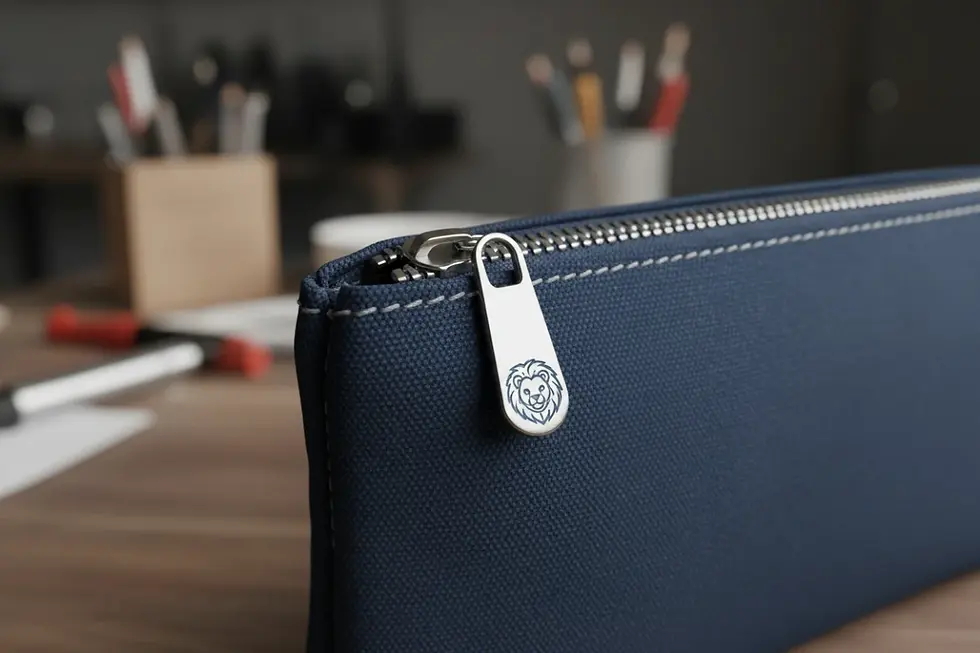
Pullers and Hardware Finishing: Sourcing teams should pay careful attention to the puller itself. Standard sliders can be upgraded with custom metal pullers debossed with your brand logo, colorful woven paracord loops for an outdoorsy aesthetic, or soft silicone tabs for a modern feel. The metal plating on the slider must also pass 24-hour salt-spray tests to ensure it does not tarnish or rust in high-humidity shipping containers.
Reinforced Seam Binding: Raw fabric edges inside the pouch must never be left exposed. Sourcing managers should mandate interior binding tape (typically nylon or polyester webbing) stitched over all raw seams. This "bound seam" technique prevents unraveling and adds structural rigidity.
Internal Lining and Padding: A raw single-layer pouch feels cheap and lacks protective structure. Adding a 190T or 210D polyester inner lining significantly elevates the tactile feel. Inserting a thin layer of EPE foam or non-woven interfacing between the outer fabric and the lining provides structural support, allowing the case to hold its shape even when empty.
Double-Stitched Stress Points: Pull tabs, zipper ends, and carrying loops undergo intense tension. These areas must be reinforced with box-stitching or double-needle bar tacks to distribute load-bearing strain.
How Can Retailers Coordinate Custom Pencil Cases with Notebook and Planner Collections?
For lifestyle brands and major retailers, products are rarely sold in isolation. Custom pencil cases are highly effective as complementary accessories within a broader, unified stationery ecosystem. Designing cross-category assortments increases average transaction values and strengthens brand identity through cohesive retail programs.
To achieve this "Scenario Fit," manufacturers and designers must collaborate across several visual and functional vectors:
Color Palette Alignment: Ensure that the fabric dye lots of your custom pencil cases match the Pantone codes of your hardcover notebooks, wire-bound journals, and planners.
Coordinated Hardware and Accents: If your flagship planner features gold foil stamping and gold twin-wire binding, the matching stationery pouch should utilize a gold-plated metal zipper, puller, or snap buttons.
Shared Material Accents: Incorporate consistent trim details. For example, a debossed leather patch on a canvas pencil bag can feature the exact same vegan leather used for the cover of a matching academic planner.
Packaging Harmony: Gift sets and seasonal bundles benefit from coordinated packaging. Design custom retail-ready boxes that elegantly house both the notebook and the matching pencil case in customized cardboard inserts.
Cross-Category Merchandising: Retailers can optimize floor space by utilizing pre-packaged counter display units (CDUs) or shipper displays that showcase notebooks and matching custom pencil cases side-by-side. This visual merchandising strategy reinforces the product's thematic cohesion and encourages spontaneous add-on purchases.
What Certifications and Quality Control Measures Are Required for Wholesale Pencil Cases?
Distributing wholesale pencil cases globally means navigating a complex landscape of safety, environmental, and social compliance standards. Retail buyers must partner with a stationery pouch manufacturer that possesses robust, certified supply chains.
The primary regulatory and quality standards include:
CPSIA & REACH Compliance: Since pencil pouches are frequently utilized by children and students, they must comply with strict limits on lead, heavy metals, and phthalates. Materials, dyes, and metal hardware must undergo third-party testing to obtain Children's Product Certificates (CPC) for the US market, or meet REACH chemical limits for European distribution.
FSC (Forest Stewardship Council) Certification: For eco-focused stationery collections that blend paper components (like notebooks) with organizers, sourcing materials through FSC-certified chains ensures that any cellulose-based materials or packaging are sourced from responsibly managed forests.
Social Compliance and Audits: Major retail chains and supermarket groups will not list products without verified factory working conditions. Partnering with facilities that regularly undergo and pass SMETA (Sedex Members Ethical Trade Audit), WCA (Workplace Conditions Assessment), and FAMA (Facility and Merchandise Authorization) audits is non-negotiable for smooth market entry.
AQL Inspection Framework: Before any shipment leaves the factory floor, a standardized Acceptable Quality Limit (AQL) inspection must be conducted. Typically, an AQL of 1.5 for critical defects, 2.5 for major defects, and 4.0 for minor defects is used to evaluate zipper function, seam strength, cleanliness, and dimensional accuracy.

Why is a China-Cambodia Dual-Site Synergy Model Beneficial for Sourcing Stationery Organizers?
The global stationery supply chain is undergoing a structural shift. Relying on a single manufacturing origin introduces risks related to trade tariffs, labor shortages, and capacity bottlenecks. A dual-site manufacturing network offers an elegant solution to these challenges.
Lion Paper Products operates a sophisticated dual-site model that perfectly balances development agility with mass-production cost-efficiency:
The Jiaxing Base (China): Spanning 3,000 square meters, this facility serves as the nervous system for product development, structural engineering, rapid prototyping, and customer support. Our design-to-manufacturing integration allows us to transform a client's initial creative concepts into physical, production-ready samples in a matter of days.
The Cambodia Facility: Spanning 10,000 square meters, our Cambodia plant is optimized for high-volume, continuous mass production. This facility features automated assembly lines and standardized SOPs, delivering exceptional capacity and cost advantages.
Tariff and Duty Mitigation: Sourcing custom pencil cases from Cambodia allows international buyers, particularly those in North America and Europe, to benefit from favorable tariff treatments (such as Generalized System of Preferences status or duty-free access for specific product classifications), significantly lowering the total landed cost of wholesale pencil cases.
Risk Diversification: Having dual bases ensures production continuity. If regional disruptions affect one facility, capacity can be dynamically reallocated to ensure that key retail programs and seasonal launches are delivered strictly on schedule.
How Should You Structure Your RFQ Spec Checklist for Custom Canvas Pencil Bags?
To receive an accurate and rapid quotation from a stationery pouch manufacturer, your Request for Quote (RFQ) must contain precise technical parameters. Vague specifications lead to endless communication, prolonging your product launch cycle.
When preparing an RFQ for custom canvas pencil bags or other fabric organizers, utilize this comprehensive specifications checklist:
Dimensions: Specify length, width, and depth (gusset size) in millimeters or inches.
Shell Fabric: State the exact material type and weight (e.g., 12oz natural cotton canvas, 600D recycled polyester with PU coating).
Lining Fabric: Define the internal fabric (e.g., 210D polyester lining with customized brand pattern print).
Interfacing/Padding: Note if you require structural foam (e.g., 2mm EPE foam) or light non-woven backing to help the pouch retain its shape.
Zipper Specification: Define the zipper size (#3 or #5), tape material (nylon, polyester), tooth material (nylon coil, molded plastic, metal), and puller style (standard metal puller, woven cord, custom molded rubber puller with debossed logo).
Logo & Decoration Methods: Detail how your brand mark should be applied. Options include silk-screen printing (cost-effective for solid colors), heat-transfer printing (ideal for multi-color, photographic graphics), embroidery (gives a classic, high-end texture), debossed leather or PU patch (excellent for heritage branding), or woven label (ideal for clean, minimalist branding sewn into the side seam).
Packaging Configuration: Specify if you require retail-ready packaging, such as individual polybags with warning prints, FSC-certified hangtags, or custom paper bellybands for retail display shelves.
Target Quantity: Provide broken-down quantities per SKU (e.g., 3,000 units per style across 3 colorways, totaling 9,000 units).

What Are the Key Design Trends Shaping the Modern Custom Pencil Cases Market?
To capture the interest of modern consumers, brands must stay ahead of design trends that blend utility with lifestyle aesthetics. Currently, three major trends dominate the market:
Multifunctional and Expandable Layouts: Consumers love pouches that can expand to accommodate heavy-duty supply storage and collapse for easy transport. Multi-tiered structures with fold-out flaps, mesh pockets, and built-in pen slots are highly popular for organizing markers, charging cables, and small tech accessories.
The Pastel and Earthy Color Revolution: Vibrant, oversaturated primary colors are being replaced by muted pastel tones (like lavender, sage green, and dusty pink) and warm earthy neutrals (such as terracotta, olive, and oatmeal). These colors appeal to adult journal enthusiasts, university students, and creative professionals alike.
Tech-Pouch Convergence: With digital devices becoming central to education and work, custom pencil cases are evolving to double as tech organizers. Incorporating elastic bands to secure USB drives, small pockets for charging bricks, and padded compartments for stylus pens allows the product to fit seamlessly into modern work-from-anywhere lifestyles.
Sourcing high-quality, retail-ready pencil organizers requires meticulous planning, deep technical understanding, and an agile manufacturing partner capable of scaling with your brand. By utilizing our dual-site network in China and Cambodia, Lion Paper Products manages your entire product journey—ensuring cost efficiency, strict compliance, and impeccable design fidelity. If you are ready to develop your next stationery collection, Send your target product, material, decoration and quantity; Lion Paper can propose a retail-ready construction and sampling route.
FAQ
What is the standard MOQ for bulk pencil pouches and custom canvas pencil bags?
The minimum order quantity (MOQ) depends primarily on the material choice and whether custom fabric dyeing is required. For standard stock-colored canvas or polyester fabrics, the typical MOQ is 3,000 units per style. For custom-dyed fabrics matching specific Pantone colors or custom-patterned all-over prints, the MOQ may range from 5,000 to 10,000 units per run. At Lion Paper, we leverage our dual-site procurement power to offer flexible low-volume test runs for qualified brand partners to support pilot launches before expanding into larger mass production programs.
How does manufacturing in Cambodia benefit buyers regarding import duties and customs?
Sourcing from our Cambodia production base provides significant tariff relief and trade advantages for buyers in North America, the United Kingdom, and the European Union. Under various trade agreements and Generalized System of Preferences (GSP) schemes, many stationery items and textile organizers manufactured in Cambodia are eligible for duty-free or reduced-tariff entry. This directly translates to lower landed costs, making your retail pricing more competitive while diversifying your supply chain away from concentrated single-country reliance.
Can your facilities produce coordinated stationery sets that package notebooks with matching custom pencil cases?
Yes, cross-category coordination is one of our primary strengths. As an integrated creative product supply-chain solution provider, Lion Paper specializes in design-to-manufacturing integration. We seamlessly coordinate the manufacturing of paper-based products—such as notebooks, planners, and journals—with fabric-based accessories like custom pencil cases and organizers. We can source identical material accents, match brand colorways exactly, and supply custom retail-ready packaging (like presentation boxes with custom tray inserts) to deliver a cohesive, market-ready gift set directly to your distribution center.


Comments