


Custom Notebook Tooling Investment: Costs, ROI, and Engineering Guide

Custom notebook tooling investment is financially justified when unique cover structures, proprietary hardware, bespoke edge treatments, or high-precision debossing dies generate measurable brand differentiation that can be amortized across scalable production runs or recurring seasonal collections. For mid-to-high volume orders, upfront tooling reduces per-unit costs, stabilizes dimensional consistency, and prevents counterfeit duplication across retail and e-commerce channels.
What Are the Primary Tooling Types and Mold Dies Used in Custom Notebook Manufacturing?
Tooling in notebook production represents the physical instruments—metal dies, steel-rule blades, injection molds, and alignment fixtures—engineered to cut, shape, emboss, or assemble customized paper stationery components. In high-standard stationery manufacturing, tooling guarantees tight tolerances and repeatable visual quality across tens of thousands of units.
Custom notebook tooling generally falls into five distinct engineering categories:
Custom Debossing and Foil Stamping Dies: Metal blocks engraved with brand artwork, typography, or textures. Used under controlled heat and hydraulic pressure to imprint vegan leather, PU, bookcloth, or heavy paperboards.
Steel-Rule and Rotary Cutting Dies: Steel blades bent into custom contours and embedded in high-density plywood or steel cylinders. Used to die-cut interior tab dividers, irregular pockets, shaped edges, index tabs, or custom cover windows.
Plastic and Metal Injection Molds: Custom-machined steel or aluminum cavity molds used to produce proprietary elastic strap closures, magnetic clasps, custom-branded metal badges, bespoke pen holder clips, or specialized spiral coil bindings.
Thermal Edge-Gilding and Foil Transfer Fixtures: Specialized clamping and edge-profiling tooling that holds trimmed paper blocks under strict tension during metallic gilding, foil transfer, or spray edge printing.
Case-Making and Structural Lining Fixtures: Custom mechanical positioning guides calibrated for non-standard notebook dimensions, double-spine mechanics, or integrated presentation slipcases.
Tooling Category | Typical Tool Material | Standard Production Lifespan | Primary Application Area |
|---|---|---|---|
:--- | :--- | :--- | :--- |
Magnesium Debossing Die | Etched Magnesium Plate | 3,000 – 8,000 impressions | Short-run foil stamping, flat debossing |
Brass CNC Debossing Die | Precision-Milled Solid Brass | 50,000 – 200,000+ impressions | Deep sculpted debossing, multi-level embossing |
Steel-Rule Die (Flatbed) | Hardened Carbon Steel Blade | 15,000 – 40,000 cuts | Interior pockets, envelope inserts, custom tabs |
Rotary Tooling Cylinder | Solid Hardened Steel | 100,000 – 500,000+ cuts | High-speed continuous tab cutting & perforations |
Injection Mold (Hardware) | Hardened Tool Steel (P20/H13) | 100,000 – 300,000 shots | Bespoke metal/plastic closures, proprietary clips |

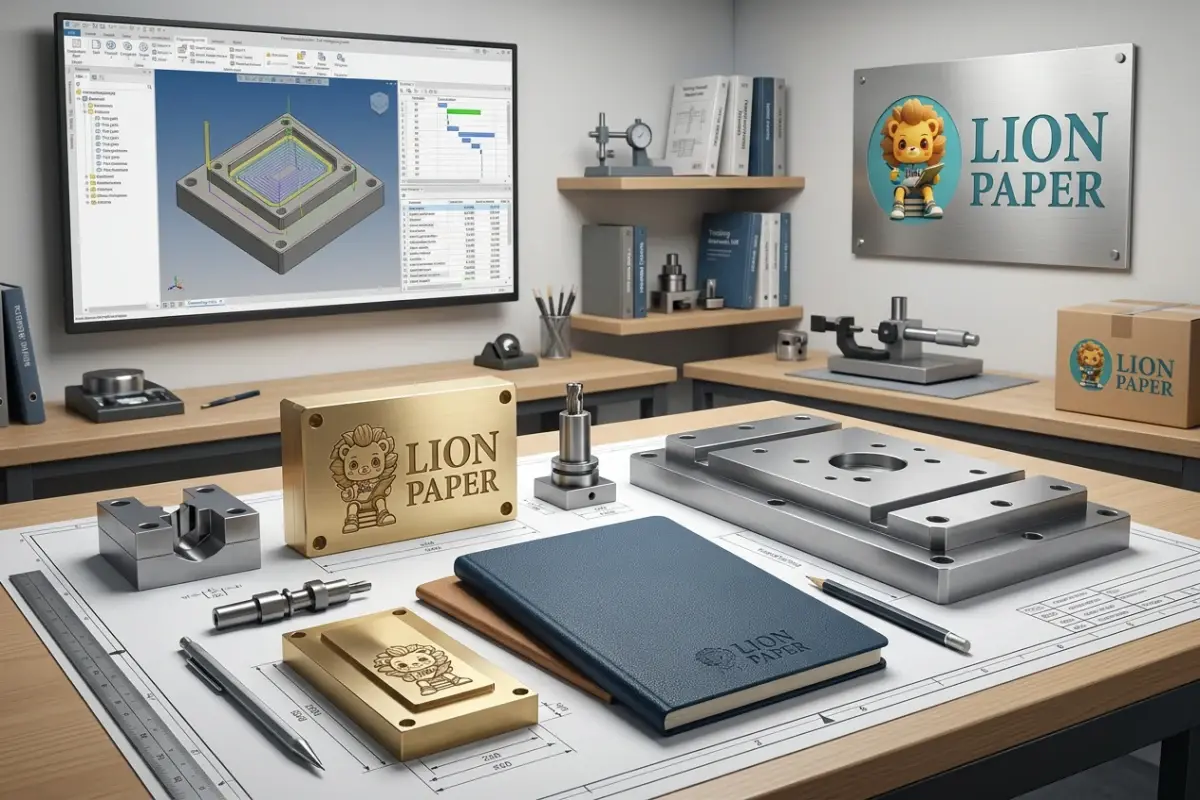
Precision-machined brass dies ensure deep, crisp debossing contours without damaging cover substrates.
When Does a Brand's Custom Notebook Project Justify Tooling Investment?
Investing in dedicated tooling is not required for every stationery product. Off-the-shelf formats with surface-level silkscreen or standard single-location flat foil stamping utilize universal factory tooling. However, committing capital to custom tooling becomes critical under specific operational, structural, and commercial conditions.
1. Proprietary Visual and Tactile Branding
When a brand identity relies on multi-level relief, bevel-edged textures, or textured patterns covering the full perimeter of a cover, custom debossing die tooling made of CNC-milled brass is essential. Standard flat plates cannot achieve smooth multi-tier depth without tearing delicate bookbinding fabrics or synthetic leather grains.
2. Bespoke Geometric Formats and Functional Utility
Projects requiring non-standard page proportions, integrated card slots, accordion rear pockets with distinct gussets, or die-cut thumb notches require dedicated steel-rule dies. The investment ensures clean edge finishes without fiber fraying or manual trimming variance.
3. Scaling Beyond Pilot Run Thresholds
In initial product launches of 300 to 500 units, manual hand-assembly or digital short-run techniques may suffice. Once production volumes surpass 1,500 to 3,000 units, automated machinery using custom-fitted alignment fixtures reduces assembly labor time by up to 60%, lowering the net product cost despite the upfront tooling outlay.
4. Multi-Season and Multi-SKU Product Architectures
If a private label planner line shares identical physical dimensions, page-count profiles, and pocket geometries across seasonal editions, a single set of cutting and binding tooling can serve multiple product cycles over several years, driving rapid capital recovery.
What Is the Difference Between One-Time Tooling Costs and Recurring Unit Costs?
Clear financial planning requires distinguishing Non-Recurring Engineering (NRE) charges—the upfront tooling and mold fees—from recurring bill-of-materials (BOM) and labor expenses. Confusing these two budget lines distorts landed cost modeling and margin projections.
One-Time Tooling Costs (NRE): These are fixed, upfront capital charges paid once prior to mass production. They cover CNC machine programming, metal billet procurement, physical die milling, hardened blade fabrication, tool testing, and sample stamp proofs. Once approved, the physical tooling is cataloged and stored by the manufacturer for subsequent replenishment runs without recurring setup fees.
Recurring Production Expenses: These costs recur with every manufactured unit and scale directly with production volume. They include base raw materials (FSC-certified paper pulp, PU cover substrates, thermal hot-melt glues, elastic bands), machine running time, press operator labor, foil consumables, packaging cartons, and outbound logistics.
Understanding custom notebook mold costs enables product developers to evaluate total cost of ownership (TCO). While tooling increases initial cash outflow before launch, it significantly lowers recurring piece-part unit costs by enabling automated high-speed conversion.

Custom steel-rule cutting dies provide exact dimensional tolerances for interior pockets and custom tabs.
How Do You Calculate Tooling ROI and Amortization Across Production Runs?
Calculating notebook manufacturing tooling ROI involves evaluating the upfront die or mold cost against the labor savings, production yield improvements, and retail margin premiums realized over the lifetime of the product line.
The Amortization Formula
The basic tooling amortization cost per notebook is calculated as:
$$ ext{Amortized Tooling Cost Per Unit} = \frac{ ext{Total Dedicated Tooling Investment (USD)}}{ ext{Total Planned Production Run Volume (Units)}}$$
Unit Economics Across Scaled Order Quantities
Consider an enterprise-grade tooling package totaling $1,200 (comprising a heavy-duty sculpted brass debossing die, custom pocket steel-rule die, and specialized magnetic flap alignment jig):
Order Volume (Units) | Upfront Tooling Cost | Amortized Tooling / Unit | Base Production Unit Cost | Net Landed Unit Cost | Visual Margin Impact |
|---|---|---|---|---|---|
:--- | :--- | :--- | :--- | :--- | :--- |
1,000 | $1,200 | $1.20 | $4.50 | $5.70 | High tactile value; boutique pricing |
3,000 | $1,200 | $0.40 | $3.90 | $4.30 | Balanced commercial retail margin |
5,000 | $1,200 | $0.24 | $3.45 | $3.69 | Standard retail distribution tier |
10,000 | $1,200 | $0.12 | $2.95 | $3.07 | Optimized big-box and omnichannel tier |
25,000 (Multi-Run) | $1,200 | $0.05 | $2.60 | $2.65 | Maximum economies of scale |
As volume scales, the financial burden of tooling drops to fractional pennies per book, while the bespoke physical details—such as distinctive cover contours and crisp micro-embossing—support higher perceived retail price points ($18.00 to $28.00 retail MSRP), widening gross operating margins.
What Critical Questions Should Buyers Review Before Approving Tooling Budgets?
Before signing off on non-recurring engineering charges, procurement teams and creative directors should follow a structured private label notebook tooling guide checklist to avoid unnecessary redesign fees, tooling rebuilds, or operational delays.
Is the Vector Vector Artwork Engineered with Proper Draft Angles and Radii? Intricate typography with sub-0.2mm stroke widths or razor-thin lines may clog during foil stamping or cut through cover substrates under pressure. Artwork must be reviewed for micro-relief feasibility.
What Metal Grade Is Specified for the Debossing Die? Etched magnesium dies are inexpensive but degrade quickly, softening fine lines after several thousand presses. Heavy-duty runs or thick PU covers requiring sustained heat retention necessitate CNC-machined solid brass.
What Are the Tooling Ownership and Retention Terms? Standard manufacturing agreements should stipulate that proprietary tooling paid for by the client remains client intellectual property, safely held in climate-controlled factory storage for future reorders.
Has the Substrate Thickness (Caliper) Been Accounted For? Steel-rule cutting dies calibrated for 250 gsm paperboard cannot be used interchangeably on 400 gsm grayboard without risking uneven score lines and structural spine cracking.
Can Shared Architecture Be Leveraged Across SKUs? By standardizing the outer cover dimensions and interior pocket die across multiple notebook lines, brands can apply different surface foil colors or cover materials using the exact same physical die sets.

Standardized tooling and automated assembly lines maintain consistent quality across high-volume production runs.
How Does Lion Paper Streamlines Prototyping and Tooling Economics for Global Brands?
Lion Paper Products (Jiaxing) Co., Ltd. integrates design engineering with dual-site manufacturing flexibility to eliminate unnecessary tooling expense and accelerate time-to-market. Founded in 2015 with headquarters in Jiaxing, Zhejiang, Lion Paper operates as an integrated supply-chain partner rather than a conventional assembly plant.
Dual-Site Synergy: Jiaxing Prototyping and Cambodia Mass Production
Our supply-chain network balances rapid, high-precision development with scalable production capacity:
Jiaxing Site (3,000 sqm): Dedicated to concept development, structural design, rapid prototyping, and precision tooling calibration. In-house CNC die verification and physical mock-up sampling allow buyers to test debossing depth, closure tension, and pocket fit before committing to full-scale tooling.
Cambodia Site (10,000 sqm): Equipped for automated high-volume production, cost-optimized assembly, and international container shipments. Tooling developed and validated in Jiaxing is deployed directly into Cambodia's automated production lines, ensuring consistent tolerances across large-scale manufacturing.
Engineering and Quality Standards
With an annual notebook output exceeding 5 million units, Lion Paper serves premium brands, retail chains, and e-commerce platforms across North America, Europe, Australia, the Middle East, and Southeast Asia. Our design-to-manufacturing workflow ensures:
Scenario Fit Engineering: Tooling design aligned with client-specific price tiers, usage environments, and retail packaging requirements.
Compliance-Ready Architecture: Material compatibility assessments covering FSC-certified papers, recycled synthetic boards, low-impact inks, and audits including ISO 9001, SMETA, WCA, GSV, FAMA, and CPSIA.
Total-Cost Efficiency: Combining scaled material procurement, automated casing-in, and calibrated tooling maintenance to minimize scrap rates, stabilize unit costs, and protect product consistency from the first prototype to final shipment.
Share your target retail channel, quantity, and customization requirements for a sourcing review with our custom manufacturing specialists to optimize your custom notebook tooling investment and production plan.
FAQ
How much does a typical custom notebook debossing die cost?
A standard magnesium foil stamping or debossing die generally ranges from $80 to $200 depending on surface area, while a heavy-duty, multi-level CNC-milled solid brass die costs between $250 and $600. Brass dies are recommended for high production runs and thick cover materials due to their superior heat transfer and edge durability.
Can custom notebook tooling be reused for future production runs?
Yes. Once paid for, custom debossing dies, steel-rule cutting tools, and specialized hardware molds remain the proprietary asset of the client. They are carefully cleaned, cataloged, and stored in factory tool libraries for subsequent reorders, eliminating tooling charges on repeat production runs.
What is the lead time for producing custom notebook tooling and physical samples?
Developing standard steel-rule dies and CNC debossing plates typically takes 3 to 7 business days. Full physical sample prototyping—including tool mounting, test stamping, and structural assembly—generally requires 7 to 12 business days before mass production sign-off.
How can brands minimize custom tooling costs when launching new notebook collections?
Brands can minimize tooling expenses by standardizing book trim sizes (such as A5, B5, or 7x10 inches) and pocket die dimensions across different product lines. This approach allows multiple SKUs to share the same structural cutting tools while differentiating products through cover materials, foil colors, and custom interior printing.


Comments