


Custom Notebook Tooling Charges: Complete Cost Breakdown & Guide

Custom notebook tooling charges are non-recurring pre-production expenses, including computer-to-plate (CTP) printing plates, hot-stamping and debossing dies, custom cutting dies, and line setup fees required to prepare industrial machinery for custom manufacturing. These upfront costs ensure that custom dimensions, cover embellishments, unique interior layouts, and specialty structural components run accurately across automated production lines.
What Are Custom Notebook Tooling Charges?
Custom notebook tooling charges represent the initial investment in specialized hardware, printing masters, and mechanical calibration required to produce a custom stationery product according to specific brand guidelines. In mass industrial paper manufacturing, offset printing presses, die-cutting equipment, binding lines, and foil-stamping machines cannot operate without physical tools designed specifically for your product's structural artwork and dimensional specifications.
Unlike standard digital print-on-demand setups where files go straight to a digital toner or inkjet system, commercial-scale production relies on dedicated physical tooling to achieve color consistency, sharp structural edges, crisp embossing, and high manufacturing speeds. Understanding these charges helps product development managers, procurement directors, and stationery brand owners accurately evaluate unit economics and manage pre-production cash flow.
Primary Categories of Notebook Tooling
Lithographic/Offset CTP Plates: Aluminum plates carrying digital raster images for CMYK or Pantone (PMS) inks transferred onto cover and text sheets.
Embellishment and Stamping Dies: Precision-machined metal blocks (magnesium, brass, or copper) used for blind debossing, embossing, or hot foil stamping on hardcover bookcloth, PU leather, and paper covers.
Die-Cutting Molds (Steel Rule Dies): Wooden blocks with embedded laser-cut steel blades shaped to stamp out complex cover patterns, rounded corners, inner pockets, tabs, and custom slipcases.
Specialty Machine Setup Tooling: Dedicated mechanical guides, folding jigs, automated ribbon placement brackets, and custom clamping jaws aligned to non-standard trim sizes.

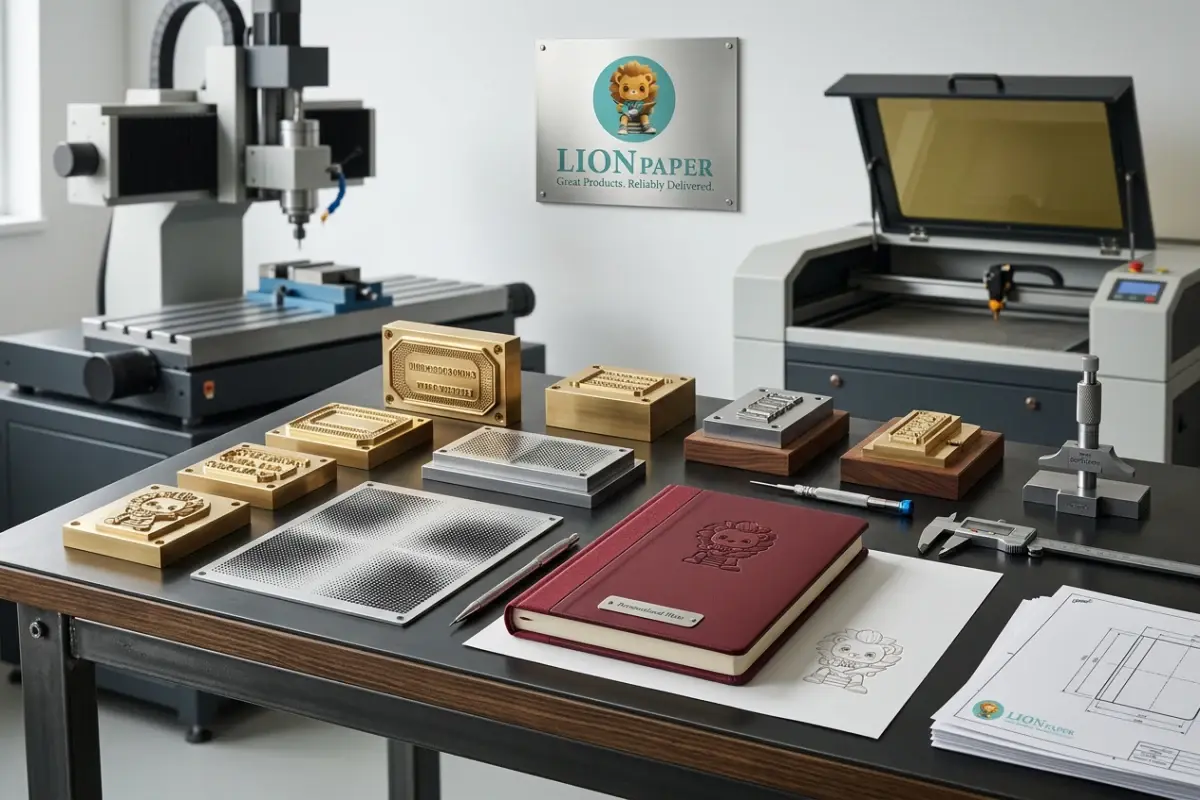
Precision-cut brass and magnesium dies ensure sharp cover debossing, foil stamping, and tactile durability across large production volumes.
Breakdown of Pre-Production Tooling, Plate, and Die Costs
When evaluating a custom journal tooling cost breakdown, costs vary significantly depending on the complexity of the design, base materials, surface finishes, and print runs. Tooling for paper goods generally falls into distinct hardware categories, each with its own material composition, durability rating, and pricing tier.
Tooling / Setup Item | Primary Materials Used | Typical Cost Range (USD) | Reusability Across Runs | Typical Production Life (Impressions) |
|---|---|---|---|---|
:--- | :--- | :--- | :--- | :--- |
Offset CTP Printing Plates | Laser-etched Aluminum | $15 – $35 per plate / color | Low (New set per run/edition) | 50,000 – 100,000 |
Magnesium Debossing / Foil Dies | Chemically Etched Magnesium | $45 – $90 per design | Moderate (Reusable for short runs) | 10,000 – 25,000 |
Brass CNC Debossing / Multi-level Dies | CNC Machined Solid Brass | $120 – $350+ per design | High (Long-term archival use) | 100,000 – 250,000+ |
Steel Rule Cutting Dies (Pockets/Tabs) | Hardwood base, Steel blades | $60 – $180 per mold | High (Reusable for years) | 50,000 – 100,000 |
Custom Rigid Box / Slipcase Tooling | Formed Steel & Positioning Jigs | $100 – $280 per assembly | High (Reusable for same format) | 50,000+ |
1. Notebook Printing Plate Costs
Offset lithography requires separate aluminum plates for every individual color ink channel. For a standard 4-color process (CMYK), a minimum of four distinct plates is required for each press sheet. If your project incorporates metallic accents or dedicated Pantone spot colors, each extra PMS tone requires its own separate plate.
For notebook text blocks with repeating lined or dot grid pages, manufacturers use a signature layout where multiple pages (e.g., 16 or 32 pages) are imposed onto a single large press sheet. If the interior features differentiated content—such as non-repeating daily planners, guided prompts, or multi-tabbed sections—the number of individual printing plates increases substantially, directly multiplying notebook printing plate costs.
2. Custom Debossing Die Charges and Foil Tooling
Applying logos, titles, and patterns to hardcover cases or soft covers requires heat and high mechanical pressure. Custom debossing die charges depend primarily on metal selection and graphic depth:
Magnesium Dies: The most cost-effective choice for flat blind debossing and standard hot foil stamping. Suitable for standard runs under 25,000 copies.
Copper Dies: Offer superior heat distribution and crisper detail on dense bookcloth or abrasive canvas covers.
Brass CNC Dies: Hand-machined or CNC-carved blocks capable of multi-level sculpted embossing, rounded 3D relief, and extreme longevity. Recommended for flagship collections, permanent private label lines, and runs exceeding 50,000 units.
3. Steel Rule Cutting Dies for Pockets, Tabs, and Special Trims
Custom features such as expanding back accordion pockets, index divider tabs, rounded corner radiuses outside standard sizes, or die-cut window covers require custom cutting dies. These tools use high-grade steel rule blades embedded into laser-cut hardwood boards to punch shapes out of paperboard and cover materials in one precise mechanical stroke.

Aluminum CTP plates and steel rule dies determine print alignment accuracy and custom pocket dimensions during automated assembly.
Machine Setup Costs vs. Physical Tooling Expenses
Many buyers confuse physical tooling charges with notebook manufacturing setup fees. While tooling refers to tangible physical hardware created exclusively for your notebook's artwork, setup fees represent the labor, mechanical calibration, and calibration waste involved in preparing massive automated manufacturing lines.
Total Pre-Production Expenses = Physical Tooling Costs + Mechanical Line Setup Fees
Industrial notebook manufacturing incorporates multiple specialized production stages, each requiring machine downtime, operator calibration, and test materials before commercial-grade speed is reached.
Where Setup Fees Originate
Press Calibration and Make-Ready: Adjusting ink keys, registering plates to micro-millimeter precision, and balancing ink-to-water ratios on multi-unit offset printing presses. Printers consume 50 to 150 large sheets of calibration paper during make-ready before colors match the approved hard proof.
Case-Making Line Adjustments: Hardcover manufacturing lines require technicians to adjust board cutters, glue rollers, spine thickness guides, and folding wings to accommodate exact book block dimensions.
Section Sewing and Binding Setup: Automated thread-sewing machines and casing-in production lines must be re-calibrated for exact signature thickness, spine rounding, head and tail band positioning, and ribbon insertion.
Edge Gilding and Color Spraying Adjustments: Clamping book blocks and masking edges for metallic foil application or Pantone edge spraying involves manual batch setup and test cycles.
Because setup labor remains constant whether you manufacture 500 units or 50,000 units, low order volumes carry high per-unit setup burdens. Higher production volumes amortize these fixed setup costs across larger batch sizes, dramatically lowering total unit costs.
Tooling Ownership, Maintenance, and Repeat Order Economics
A critical factor in long-term supply chain planning is understanding who owns the physical tooling, how it is stored, and what charges apply to repeat orders.
Reusability on Repeat Production Runs
On reorders where the structural dimensions, cover artwork, and binding format remain 100% unchanged:
Debossing and Foil Dies: No new die charges apply. Dies are cleaned, cataloged, and archived in temperature-controlled tool libraries for future production.
Cutting Dies: Reused without additional charge as long as the dimensions of internal pockets, tabs, and box structures stay identical.
Printing Plates: Because offset aluminum plates undergo wear, micro-scratches, and oxidation after initial mounting, most commercial manufacturers create fresh CTP plates for repeat production runs. However, since the digital artwork prepress step is already complete, repeat plate fees are minimal or absorbed into standard unit pricing depending on contractual terms.
Dual-Site Tooling Management: Jiaxing and Cambodia
At Lion Paper Products (Jiaxing) Co., Ltd., design verification, prototyping, and rapid pre-production testing originate at the 3,000-square-meter Jiaxing facility. Once pilot samples and tooling geometries are validated, production scales smoothly across either China or the 10,000-square-meter Cambodia facility.
This China–Cambodia dual-site synergy allows brands to prototype and refine dies with high agility in China, then seamlessly transfer structural cutting parameters and master brass dies to Cambodia for high-volume automated production and global logistics, maximizing total-cost efficiency.

Standardized machine setup, line calibration, and SOP controls guarantee batch-to-batch consistency for complex, multi-SKU notebook programs.
Strategies to Optimize Tooling and Setup Costs in Notebook RFQs
Careful engineering during the design-to-manufacturing integration phase can eliminate unnecessary tooling charges without compromising design integrity or aesthetic presentation.
1. Leverage Standard Factory Die Libraries
Established manufacturers maintain extensive inventories of existing tooling for standard A5, B5, A4, and pocket notebook sizes. If your product aligns with standard spine widths, standardized expanding back pocket templates, or standard corner radiuses (e.g., 6mm or 8mm), you can completely avoid custom cutting mold fees.
2. Consolidate Cover Embellishments
Combining hot foil stamping and debossing into a single single-pass brass combination die costs slightly more in initial tooling than a magnesium die, but it saves substantial labor and line setup fees during mass production by executing foil transfer and dimensional debossing in a single machine pass.
3. Standardize Page Layouts in Text Blocks
Designing interior text blocks around standardized 16-page or 32-page signature multiples prevents awkward split signatures that require dedicated small-sheet print setups. Furthermore, repeating standard dot-grid or lined layouts throughout the notebook eliminates the need for dozens of distinct CTP plates.
4. Group Multiple SKUs into Combined Ganged Runs
If you are launching a product line with multiple cover colorways (e.g., navy, charcoal, sage, terracotta) sharing identical cover dimensions, logo placements, and interior blocks, request a single consolidated debossing die and unified text print run. This allows the factory to use one set of tools across your entire multi-SKU collection.
5. Transition from Sampling to Scalable Mass Production
Ensure your development partner operates under strict ISO 9001 and standardized SOP quality frameworks with documented defect criteria and AQL inspection procedures. Validating digital proofs and physical mockups early prevents expensive re-tooling iterations after steel cutting dies and brass stamping blocks have already been cut.
To optimize your project budget and reduce pre-production overhead, contact our engineering and sales team by sharing your desired dimensions, binding style, material preferences, SKU mix, and estimated quantities so we can review quote assumptions and feasible minimums.
Frequently Asked Questions About Notebook Tooling Charges
Why do I have to pay tooling charges for custom debossing if I provide vector artwork?
Vector artwork provides the digital coordinate data, but industrial high-pressure debossing requires a physical, CNC-milled metal block made from magnesium or brass. The machine must press this heated metal die directly into the book cover material with tons of hydraulic force to create a permanent, crisp indentation that cannot be replicated by digital printing alone.
How much do custom notebook tooling charges typically add to unit cost?
On small initial orders (e.g., 500 to 1,000 units), total tooling and machine setup fees ranging from $200 to $600 can add approximately $0.30 to $0.80 to each notebook's base cost. On mass production runs of 5,000 to 20,000+ units, the amortized tooling cost drops to mere pennies per unit ($0.01 to $0.05), making pre-production tooling virtually negligible against total production savings.
Do I have to pay custom tooling charges again when placing a reorder?
No. Physical tools such as brass debossing dies, hot foil stamps, and steel rule cutting dies are preserved for future use. On exact repeat orders, you will not be charged for these physical dies. Depending on the manufacturer's pricing structure, nominal machine make-ready setup fees or fresh aluminum CTP plate costs may still apply for re-calibrating printing lines.
FAQ
Why do I have to pay tooling charges for custom debossing if I provide vector artwork?
Vector artwork provides the digital coordinate data, but industrial high-pressure debossing requires a physical, CNC-milled metal block made from magnesium or brass. The machine must press this heated metal die directly into the book cover material with tons of hydraulic force to create a permanent, crisp indentation that cannot be replicated by digital printing alone.
How much do custom notebook tooling charges typically add to unit cost?
On small initial orders (e.g., 500 to 1,000 units), total tooling and machine setup fees ranging from $200 to $600 can add approximately $0.30 to $0.80 to each notebook's base cost. On mass production runs of 5,000 to 20,000+ units, the amortized tooling cost drops to mere pennies per unit ($0.01 to $0.05), making pre-production tooling virtually negligible against total production savings.
Do I have to pay custom tooling charges again when placing a reorder?
No. Physical tools such as brass debossing dies, hot foil stamps, and steel rule cutting dies are preserved for future use. On exact repeat orders, you will not be charged for these physical dies. Depending on the manufacturer's pricing structure, nominal machine make-ready setup fees or fresh aluminum CTP plate costs may still apply for re-calibrating printing lines.


Comments