


Custom Journal Multiple Paper Types: Engineering Multi-Stock Formats for B2B Production

A custom journal requires multiple paper types when specific sections serve distinct functions, such as combining high-opacity uncoated text stock for daily fountain-pen writing with coated art paper for vibrant color illustrations, heavy cardstock for functional divider tabs, or kraft paper for end sheets and storage pockets. Implementing mixed paper stock notebook manufacturing ensures optimal tactile feel, ink performance, visual pacing, and structural longevity across complex stationery and planner formats.
When Should Brands Use Mixed Paper Stocks in a Single Custom Journal?
Brands incorporate multiple paper types into a single journal when the product serves diverse functional activities across distinct sections. Instead of forcing a single paper specification across the entire publication, combining distinct paper grades enhances user experience and reinforces brand value.
Key applications for combining multiple paper grades include:
Multi-Section Planners and Goal Trackers: Dividing monthly overviews, weekly agenda spreads, and blank reflection sections using heavy cardstock tab dividers (200–300 gsm) alongside standard interior writing pages (80–120 gsm).
Art and Multimedia Keepsake Journals: Incorporating smooth coated art paper (128–157 gsm) for high-definition full-color editorial photography or artwork tips, interleaved with high-bulk, uncoated woodfree paper for fountain pen or pencil sketching.
Interactive Guided Workbooks: Utilizing heavyweight bleed-resistant mixed media paper (140–160 gsm) for drawing exercises, combined with lighter lined stock (100 gsm) for daily journaling.
Hybrid Notebooks with Functional Add-ons: Integrating tear-out perforated memo pads on lightweight offset stock, archival vellum or glassine overlays for artistic tracing, and reinforced kraft board for back-cover expanding pockets.
By leveraging mixed paper stock notebook manufacturing, stationery brands, corporate gift buyers, and private label retailers can differentiate their high-end journal lines while delivering targeted paper utility for each section.
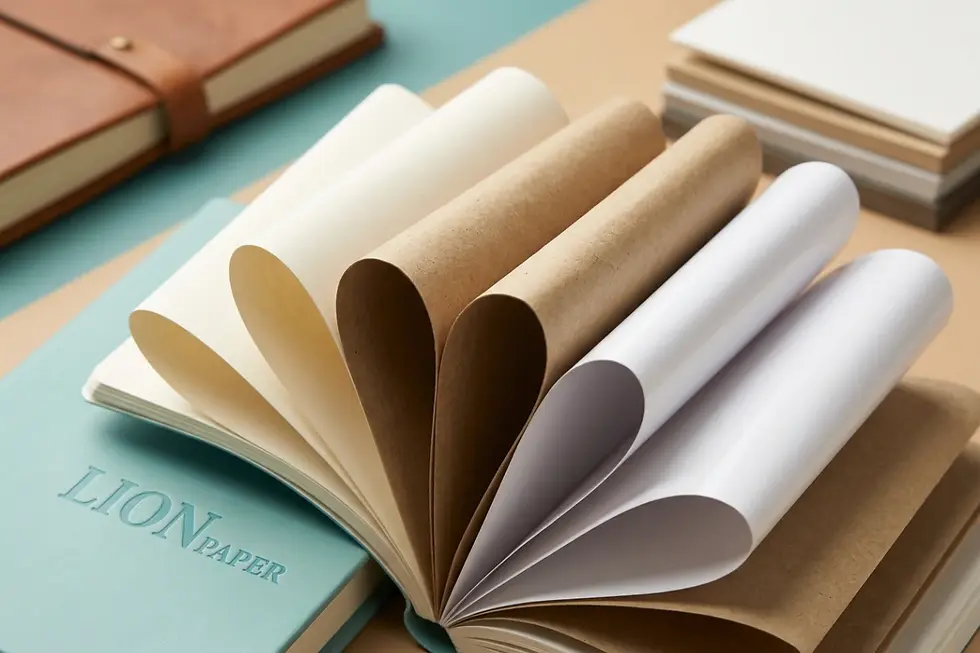
Selecting the right balance of woodfree text, kraft sheets, and coated art stocks ensures both functional writing performance and visual depth.
How Do You Select and Compare Interior Paper Grades for Mixed Formats?
A successful journal interior paper selection guide must balance writing performance, visual opacity, bulk thickness, and tactile finishes. Each substrate within a multi-paper journal serves a distinct mechanical and aesthetic purpose.
The following table outlines standard industrial paper substrates used in OEM notebook paper combination specifications:
Paper Category | Standard Basis Weight (gsm) | Primary Functional Role | Key Performance Attributes |
|---|---|---|---|
:--- | :--- | :--- | :--- |
Uncoated Woodfree (Offset) | 80 – 120 gsm | Primary writing leaves (ruled, grid, dot) | High ink absorbency, minimal feathering, smooth tactile feel |
Acid-Free Archival Paper | 100 – 140 gsm | Premium journaling, fountain pen leaves | Resists yellowing over time, zero show-through, optimal sizing |
Coated Gloss / Matte Art | 128 – 200 gsm | Illustrated inserts, brand intros, photo plates | Superior color reproduction, smooth surface, ink holdout |
Bleached/Unbleached Kraft | 120 – 250 gsm | Section dividers, vintage leaves, pocket folders | High tensile tear strength, rustic tactile grain, structural support |
Bristol / C1S Cardstock | 200 – 350 gsm | Tabbed indexed dividers, fold-out charts | Rigid dimensional stability, die-cut tab durability |
Translucent Vellum / Tracing | 73 – 110 gsm | Protective overlays, decorative interleafing | Visual translucency, smooth non-porous surface |
For multi section custom planner printing, product developers must specify FSC-certified and responsibly sourced virgin or post-consumer recycled pulp to meet international environmental regulations and retail compliance standards.
What Technical and Binding Factors Control Multi-Paper Integrity?
Combining distinct paper weights and surface textures within a single binding block introduces structural complexities during high-speed folding, gathering, and binding. Manufacturing multi-stock formats requires precise engineering to prevent structural failures, uneven spine thicknesses, and loose leaves.
Critical technical considerations include:
Signature Imposition and Folding Mechanics: Thread-sewn (Smyth sewn) casebound books require pages to be grouped into folded sections called signatures (typically 16-page or 32-page signatures). When interleaving different paper types, distinct stocks must either form complete individual signatures or be inserted as tip-ins (single sheets glued along the binding edge). Heavy cardstock cannot be folded tightly into high-page-count signatures without causing spine buckling.
Caliper and Swell Management: Different paper stocks exhibit varying bulk volumes (microns per gsm). A journal combining 200 gsm cardstock dividers with 100 gsm woodfree text leaves will experience differential swelling at the spine. Binding engineers must adjust adhesive formulation and spine backing pressure during case-making to maintain square spines.
Adhesive Compatibility (PUR vs. EVA): Standard EVA hot-melt glues often fail on mixed-stock books because coated art inserts and smooth heavy cardstocks lack the porous fiber penetration required for EVA. Flexible Polyurethane Reactive (PUR) adhesive is mandatory for perfect-bound mixed-stock journals due to its chemical bonding properties, superior pull-test strength, and temperature resilience.
Wire-O and Spiral Tolerance: In mechanical bindings (twin-wire or coil), punching mixed stocks requires sharp, carbide-tipped punch dies to prevent rough edges on fibrous kraft papers while avoiding tearing on heavy tabbed dividers.

Proper signature imposition and flexible PUR adhesive are essential to maintain spine integrity across mixed paper weights.
How Can Brands Balance Production Costs in Multi-Stock Manufacturing?
Manufacturing multi-stock journals involves multiple web or sheetfed printing passes, distinct die-cutting operations, and secondary collating processes, which inherently increase production costs compared to single-stock books. Implementing smart engineering strategies optimizes total landed cost without sacrificing design fidelity.
Key cost-balancing practices include:
Consolidating Print Passes: Group all full-color coated pages into a single 8-page or 16-page signature placed strategically at the front or center of the book block, rather than scattering individual 2-page tip-ins throughout the journal. This eliminates labor-intensive hand tipping.
Standardizing Signature Multiples: Ensure that page counts for each paper type align with standard printing impositions (divisible by 8 or 16 pages). Irregular 2-page or 4-page oddments require specialized slitting and manual collation, driving up unit costs.
Optimizing Sheet Yields: Standardize trim sizes (such as A5, B5, or 7" x 9") that maximize the layout yield on standard commercial master sheets (e.g., 787 × 1092 mm or 889 × 1194 mm), minimizing trim waste across both text stock and specialty divider cardstocks.
Leveraging Dual-Base Synergies: Developing complex journal prototypes and rapid sampling via an agile design center (such as Jiaxing) ensures fast structural validation, while transitioning the scaled, automated mass production to a high-capacity hub (such as Cambodia) delivers significant labor and duty cost efficiencies for volume orders.

Stringent pre-production white dummy mockups and AQL pull-tests prevent defects during mass production of mixed paper stock notebooks.
What Quality Control and Proofing Protocols Prevent Mixed-Stock Defects?
Because multiple paper stocks respond differently to environmental humidity, press fountain solutions, and bindery tension, strict quality management and sampling standards must be enforced from prepress through final palletization.
Unprinted White Dummies (Structural Mockups): Before mass production, an exact blank dummy using the specified paper combination and binding method must be assembled to measure exact spine thickness, book weight, and lay-flat drape.
AQL Standardized Inspection: Enforce strict AQL (Acceptable Quality Limit) sampling plans (typically Level II, Minor 2.5 / Major 1.5) across incoming raw paper moisture content, print registration between coated and uncoated sheets, and spine glue pull-test force (target > 5.0 N/cm).
Environmental Conditioning: Raw paper stocks must acclimate in climate-controlled pressrooms for at least 24 hours prior to printing to prevent paper curl, wavy edges, or static buildup during high-speed collation.
Packaging and Carton Structural Testing: Mixed-stock books are often denser and heavier than standard notebooks. Packaging protocols must specify edge-reinforced double-wall corrugated export cartons, shrink-wrapping, and standardized pallet stacking to prevent carton collapse during sea freight.
Lion Paper provides end-to-end engineering, sampling, and dual-site manufacturing for complex stationery collections. Contact our development team with your journal format, target page count, quantity tier, and budget specifications to review quotation options and structural paper mockups.
Frequently Asked Questions About Custom Journals with Multiple Paper Types
Can fountain pen friendly paper be combined with watercolor or marker paper?
Yes. A custom journal can be engineered with separate signatures of fountain-pen-friendly uncoated text paper (such as 100–120 gsm high-sizing woodfree) and heavier mixed-media or watercolor stock (160–200 gsm). These distinct papers are bound in separate Smyth-sewn signatures to prevent bleed-through while preserving lay-flat performance.
What is the minimum order quantity (MOQ) for mixed paper stock notebooks?
Because mixed paper stocks require separate press setups, dedicated die-cutting for tabbed dividers, and specialized signature collation, OEM production MOQs typically start at 1,000 to 3,000 units per design. Higher volumes allow optimal paper sheet procurement and automated signature collation.
How are tabbed dividers integrated into a hardbound notebook block?
Tabbed cardstock dividers can be integrated either as full signatures with die-cut index tabs extending beyond the text block or as individual sheets tipped into signatures using industrial hot-melt PVA adhesive. The outer cover case dimensions must be widened to protect the extended tabs from edge crushing.
FAQ
Can fountain pen friendly paper be combined with watercolor or marker paper?
Yes. A custom journal can be engineered with separate signatures of fountain-pen-friendly uncoated text paper (such as 100–120 gsm high-sizing woodfree) and heavier mixed-media or watercolor stock (160–200 gsm). These distinct papers are bound in separate Smyth-sewn signatures to prevent bleed-through while preserving lay-flat performance.
What is the minimum order quantity (MOQ) for mixed paper stock notebooks?
Because mixed paper stocks require separate press setups, dedicated die-cutting for tabbed dividers, and specialized signature collation, OEM production MOQs typically start at 1,000 to 3,000 units per design. Higher volumes allow optimal paper sheet procurement and automated signature collation.
How are tabbed dividers integrated into a hardbound notebook block?
Tabbed cardstock dividers can be integrated either as full signatures with die-cut index tabs extending beyond the text block or as individual sheets tipped into signatures using industrial hot-melt PVA adhesive. The outer cover case dimensions must be widened to protect the extended tabs from edge crushing.


Comments