


Engineering Multi-Department Custom Corporate Notebook Personalization at Scale

Managing multi-department custom corporate notebook personalization requires standardizing a shared core specification while utilizing variable data printing, modular tipping pages, and department-level quantity split-packing to streamline approvals and minimize total landed costs. Standardizing structural bindings, dimensions, and inner paper blocks while customizing cover finishes or tip-in sheets allows enterprises to maintain brand consistency, scale volume savings, and fulfill diverse team requirements without multiplying production friction.
What Are the Key Challenges in Multi-Department Custom Corporate Notebook Personalization?
Procuring notebooks for complex organizations with multiple functional divisions—such as sales, engineering, executive leadership, customer success, and human resources—often introduces significant operational friction. Procurement teams and brand managers face competing design priorities, varying quantity demands, and tight regional event schedules across offices.
Fragmented Brand Identity: When different divisions independently source custom branded company notebooks, typography, pantone color matching, and logo debossing depths frequently deviate from global visual identity standards.
Loss of Volume Economies of Scale: Fragmenting a consolidated 5,000-unit enterprise order into separate, smaller 200-to-500-unit purchases from local print shops inflates unit manufacturing costs by 40% to 120% due to redundant tooling and setup charges.
Proofing and Approval Bottlenecks: Coordinating separate design proofs, cover substrate approvals, and copy sign-offs for six or more internal departments creates administrative gridlock and extends procurement timelines by weeks.
Logistical Complexity and Misallocation: Distributing departmental allocations to disparate regional offices, training centers, and remote employee hubs without specialized carton labeling and fulfillment sorting leads to internal shipping errors and delayed onboarding rollouts.
By partnering with an integrated supply-chain specialist like Lion Paper Products—leveraging China-based design and rapid prototyping alongside high-capacity Cambodia manufacturing—enterprises transform fragmented departmental requests into a unified, modular manufacturing workflow.
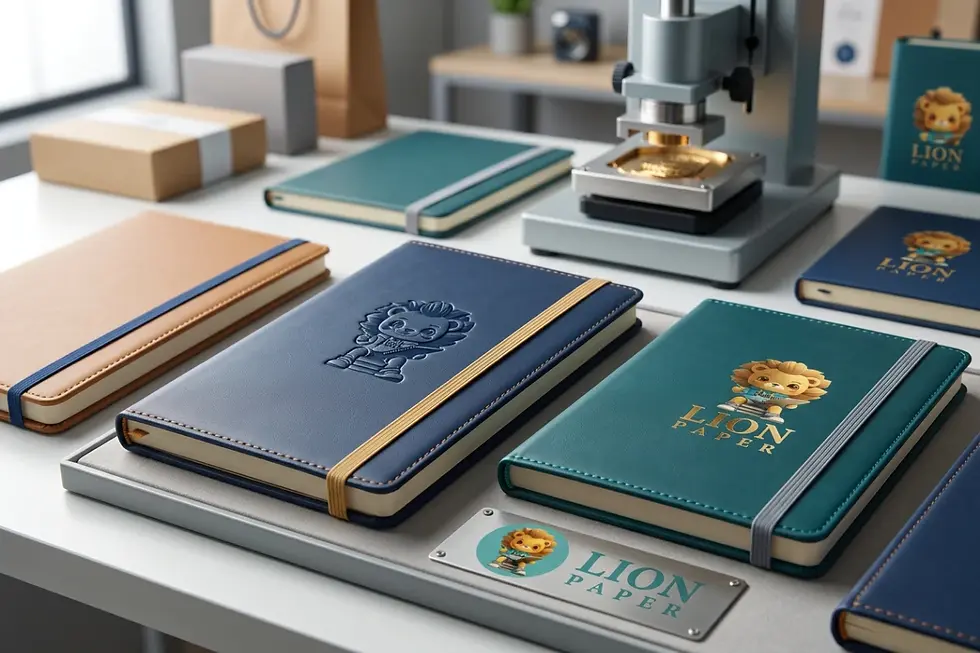
High-precision branding techniques ensure consistent visual identity across multi-department corporate notebooks.
How Do You Balance Standard Core Specifications with Modular Department Elements?
The most cost-effective framework for multi department corporate notebooks is the Modular Core Architecture. In this system, 80% to 90% of the notebook specification remains identical across the enterprise, while the remaining 10% to 20% incorporates localized, variable departmental identifiers.
Specification Component | Standardized Enterprise Core (Fixed) | Departmental Variable Element (Modular) | Production Technique Applied | Landed Cost Impact |
|---|---|---|---|---|
:--- | :--- | :--- | :--- | :--- |
Trim Size & Geometry | Medium (A5: 145 x 210 mm) or Executive (175 x 250 mm) | Identical outer trim across all divisions | Unified die-cutting and block trimming | Zero cost variance; maximizes press efficiency |
Binding Structure | Smyth sewn casebound with round or square spine | Uniform casing construction | Automated hard-cover casing lines | Standardized setup; zero tooling surcharge |
Inner Text Block | 192 pages, 100 gsm FSC-certified acid-free woodfree paper | Standardized dot-grid, lined, or 5 mm grid ruling | High-speed web or sheet-fed offset printing | Captures bulk paper purchasing discounts |
Endpapers (Front/Back) | 140 gsm offset stock in primary corporate brand color | Division-specific core values, mission, or branch maps | 4-color process (CMYK) offset print on endpapers | Low plate surcharge; high visual differentiation |
Modular Tip-In Pages | Optional standard corporate overview (4 pages) | Department-specific handbooks, code references, or calendars (4–8 pages) | Precision automated tipping-in at signature binding | High-impact customization with minimal unit cost increase |
Cover Substrate & Finish | Premium thermo PU leather, book cloth, or recycled RPET | Uniform base color or division-specific colorways | Blind debossing, tone-on-tone foil, or laser engraving | Single tooling block for master logo; modular sub-text |
Functional Trims | Ribbon bookmark, elastic closure band, pen loop | Standardized base ribbon with variable PMS band colors | Coordinated accessory attachment | Minor material cost variance; no tooling fee |
Standardizing the text block paper weight (such as smooth 100 gsm cream woodfree paper) and binding style ensures consistent writing performance across all employee tiers. Meanwhile, incorporating 4-page full-color tipped-in signature sheets at the front of the book delivers dedicated departmental information without requiring unique interior printing plates for every batch.
What Personalization Techniques Work Best for Personalized Business Journals in Bulk?
Selecting the right decoration technique depends on the target aesthetic, durability requirements, and order volume per division. High-volume enterprise runs benefit from durable mechanical and thermal decoration methods that maintain crisp fidelity over years of daily desk use.
Enterprise Master Cover │
Blind Debossing: Heat + pressure creates subtle, high-tactile depth (Best for executive & global branding)
Metallic / Matte Foil Stamping: Pigment transfer for crisp contrast on dark PU leather or book cloth
Variable Digital UV Printing: Full-color CMYK gradients, photo elements, or individual employee naming
Modular Belly Bands: 157 gsm coated art paper wraps providing localized messaging at negligible cost
Blind Debossing: Utilizing CNC-machined brass or magnesium dies, heat and hydraulic pressure permanently depress the corporate insignia into thermo PU leather. Thermo-sensitive PU darkens naturally under heat, creating an elegant, tactile tone-on-tone effect that resists wear and abrasion.
Metallic and Matte Foil Stamping: High-precision stamping foils bond pigment or metallic foil into debossed grooves. Matte silver, champagne gold, or custom gloss PMS foils deliver high visual contrast against dark hardcovers, making it ideal for client-facing teams and corporate milestones.
Screen and Direct UV Digital Printing: For multi-color departmental emblems, safety slogans, or creator-led subsidiary logos, direct UV printing cures ink instantly under ultraviolet lamps. This allows vibrant full-color reproduction on smooth synthetic leather, genuine leather, or heavy paper board covers.
Individual Variable Name Engraving: For VIP client gifts or executive editions, precision laser engraving machines etch individual recipient names or employee serial numbers directly into the cover material, turning bulk production runs into bespoke personal items.
Custom Printed Belly Bands and Slip Sleeves: A 157 gsm or 200 gsm coated art paper band wrapped around the sealed notebook provides an economical canvas for department-specific welcome letters, QR codes linking to digital intranets, and onboarding checklists without altering the reusable notebook exterior.

Modular tipping pages allow cost-effective departmental customization within a standardized notebook block.
How Can Enterprises Streamline Approval Workflows and Data Handling for Multi-Division Programs?
Managing approvals across ten departments can stall a project unless a structured digital workflow and centralized data architecture are established prior to prepress production. Fragmented email chains and uncoordinated file revisions inevitably cause misprints and scheduling delays.
Centralize Artwork Assets into a Locked Master Template: Create a standardized Adobe Illustrator or InDesign template defining non-printable mechanical boundaries, bleed margins (typically 3 mm to 5 mm for casebound edges), deboss safe areas, and spine expansion allowances based on the approved bulk paper caliper.
Deploy a Variable Data Matrix (Spreadsheet Intake): Department heads populate a single standardized spreadsheet containing division names, exact quantities, approved sub-branding text, localized insert copy, and destination shipping codes. This eliminates unstructured email requests and guarantees clean data input for automated prepress batching.
Establish a Tiered Sign-Off Hierarchy: Implement a two-phase approval protocol. Phase 1 requires global brand directors to approve the master physical sample—verifying cover substrate texture, paper opacity, ribbon quality, and master deboss depth. Phase 2 allows department leads to approve localized 1-page digital PDF proofs for variable tipping sheets or belly bands.
Utilize Rapid Physical Prototyping: Lion Paper’s Jiaxing innovation facility produces rapid physical pre-production samples within days, allowing enterprise stakeholders to evaluate exact binding tolerances, closure elasticity, and paper touch before triggering mass production at our Cambodia manufacturing hub.
How Should Packaging, Labeling, and Corporate Notebook Printing Split Delivery Be Managed?
Executing corporate notebook printing split delivery requires robust logistics engineering to ensure each regional facility receives its exact departmental allocation without transit damage or internal redistribution overhead.
Unit-Level Protective Packaging: Every notebook is individually packaged in a flush-fitting, biodegradable polybag, FSC-certified paper sleeve, or custom magnetic-closure gift box. This protects edge-gilded leaves and delicate PU surfaces from scuffing during multi-modal ocean and truck transit.
Color-Coded and Barcoded Inner Bundles: Notebooks are shrink-wrapped in sub-packs of 5, 10, or 25 units, accompanied by scannable SKU barcodes and color-coded labels identifying the target department (e.g., Blue for Engineering, Gold for Executive, Green for Operations).
Heavy-Duty Export Master Cartons: Shipping cartons utilize double-wall corrugated board (5-ply, 200# / 32 ECT minimum) with internal corner edge protectors. Master cartons are capped at 12–15 kg each to ensure safe manual handling and prevent lower carton crushing during container consolidation.
Department-Specific Palletization: Goods are organized onto heat-treated ISPM-15 compliant wooden or heavy-duty recyclable paper pallets. Pallets are organized by destination hub, stretch-wrapped with multiple passes, and strapped with corner boards for maximum stability.
Multi-Node Split Logistics: Leveraging dual-base manufacturing in China and Cambodia, enterprise orders can be consolidated for bulk ocean transit to primary regional distribution hubs (e.g., Los Angeles, Rotterdam, Sydney), where automated warehouse systems break bulk and dispatch direct courier shipments to individual branch offices or remote employee home addresses.

Precision sorting, protective packaging, and split-delivery fulfillment ensure seamless regional office rollouts.
What Is the Recommended Procurement Workflow from Concept to Final Handover?
Executing custom corporate notebooks personalization programs across global operations demands a systematic, milestones-driven manufacturing workflow. Following this structured checklist mitigates supply-chain risks, protects intellectual property, and guarantees timely delivery for annual conferences, employee onboardings, and client gifting initiatives.
Procurement Phase Flowchart │
Requirements Discovery: Consolidate department quantities, functional specs & target delivery dates
Structural Engineering: Finalize trim size, binding type, paper gsm & cover substrate options
Prepress & Rapid Prototyping: Review digital matrices, output physical mockups & finalize brass dies
Mass Production & Inline QC: High-speed offset print, automated casing-in & AQL 1.5/4.0 inspection
Split-Packing & Global Fulfillment: Departmental sorting, carton coding & scheduled drop-ship delivery
Consolidate Requirements (Weeks 1–2): Gather total quantities across all internal divisions, categorize custom options into standard and variable elements, and establish hard delivery deadlines based on internal event calendars.
Select Substrates and Structural Design (Week 2): Choose cover materials, specify inner paper weights (such as 100 gsm woodfree paper for universal fountain pen compatibility), and select accessory details such as expandable back pockets, elastic pen loops, and custom bookmark ribbons.
Approve Digital and Physical Prototypes (Weeks 3–4): Validate digital proofs for all departmental tipping pages and sign off on a physical prototype confirming stamping alignment, binding tightness, and material hand-feel.
Execute High-Yield Mass Manufacturing (Weeks 5–8): High-speed offset printing, precision signature folding, thread sewing, and automated casing-in occur under strict ISO 9001 and FSC-certified production controls with inline AQL inspection standards.
Packout, Sorting, and Split Delivery (Weeks 8–10): Products undergo final quality checks, specialized bundle packing, export palletization, and scheduled multi-address freight dispatch.
To configure an enterprise-wide stationery program tailored to your organization's divisional structure, submit your logo, project requirements, target quantities, and deadline to receive a detailed branding review, physical material swatch set, and modular delivery plan.
FAQ
What is the minimum order quantity (MOQ) for multi-department custom corporate notebooks?
When leveraging a modular core architecture with shared dimensions, paper blocks, and cover dies, standard production MOQs typically start at 500 to 1,000 units for the master order. Within this consolidated run, individual departmental allocations (such as distinct tipped-in insert pages, belly bands, or color-coded closure bands) can be segmented into batches as small as 100 to 250 units per division without incurring excessive setup surcharges.
Can different departments order different cover colors within the same bulk run?
Yes. If the underlying cover substrate (such as thermo PU leather or book cloth) shares the exact same material grade, thickness, and trim dimensions, manufacturers can run multiple cover colorways within a single bulk order. The master tooling die for your corporate logo remains identical, allowing cost savings while providing visual differentiation across departments.
How does split delivery work for companies with multiple regional or international offices?
During the initial order intake, destination addresses and departmental quantities are mapped into a logistics matrix. Following production and quality inspection, the order is packed into color-coded and barcoded cartons labeled by branch location. Finished goods are then routed via consolidated freight to regional fulfillment hubs or dispatched directly to individual corporate offices worldwide via tracked commercial parcel carriers.


Comments