


7 Reasons Craft Retail Is Moving to Project-Based Ranges
- Leo Xia

- 2 days ago
- 10 min read
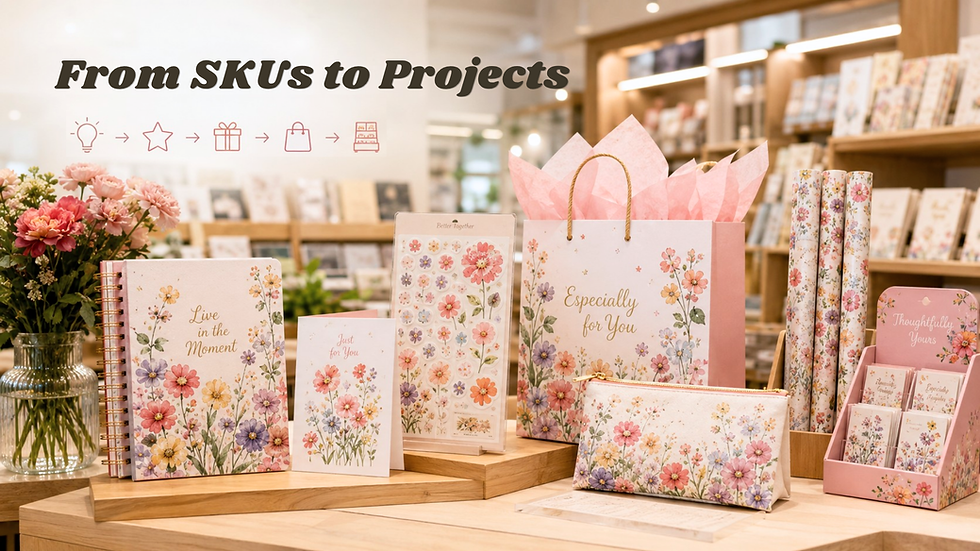
Craft retail is moving from SKU-based selling to project-based ranges because shoppers often enter a store with a mission, not a category list. They want to make a birthday party feel personal, build a memory album, create a handmade gift, decorate a home, or join a craft activity. A project-based range groups the right products, packaging, displays, and services around one clear shopper goal. This approach helps retailers make stores easier to shop, improves basket size, supports seasonal programs, and gives suppliers a stronger role in design, sampling, packaging, and retail execution.
Quick Content Reach:
Why Craft Retail Is Changing Now
For years, craft, party, and stationery retail was built around product categories. Notebooks stayed with notebooks. Stickers stayed with stickers. Gift bags, cards, paper decorations, wrapping paper, pouches, frames, and party supplies each had their own shelf logic.
That structure still helps with inventory, buying, and replenishment. But it does not always match how people shop.
A parent planning a child’s birthday party is not thinking, “I need five product categories.” She is thinking, “I want this party to be fun, easy, and personal.”
A shopper making a memory album is not only looking for paper weight or binding. He may need photo prints, stickers, labels, sleeves, cards, envelopes, gift wrap, and a way to present the final piece.
That is why project-based ranges are becoming more important in craft retail. The range starts with the customer mission. Then it builds a connected set of products around that mission.
This shift also matches wider retail trends. The National Retail Federation forecasts that U.S. retail sales will reach $5.6 trillion in 2026, growing 4.4% over 2025. In a market this large, clearer shopping experiences can help retailers compete on more than price and assortment size.
What Are Project-Based Ranges?
A project-based range is a coordinated product program built around a creative task, event, or shopper need.
It does not start with the question, “Which notebook design should we launch?”
It starts with a better question: “What project is the customer trying to complete?”
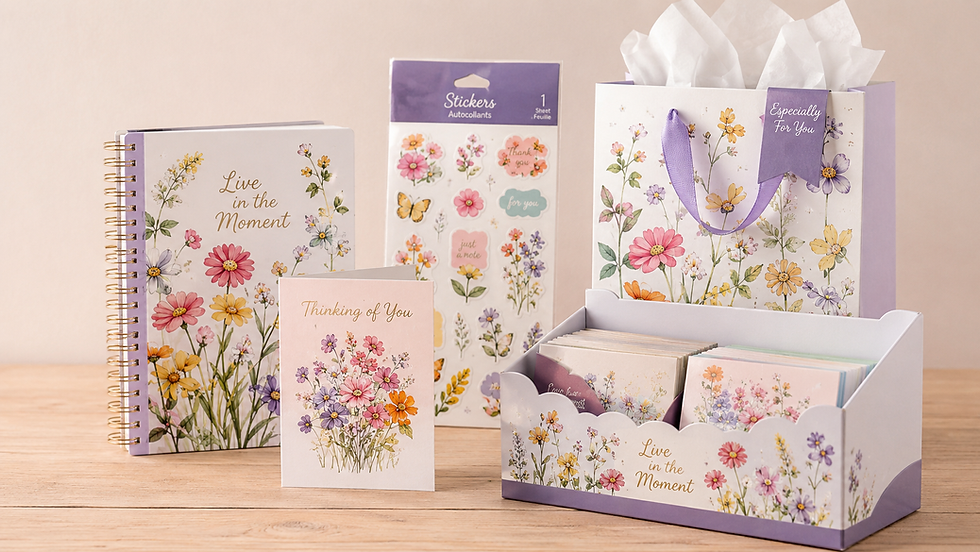
From there, the retailer or supplier can build a range that feels complete. The items may come from different categories, but they work together through theme, color, artwork, packaging, display, and use case.
For example, a “Kids Birthday Craft Party” range could include:
Shopper Mission | Hero Product | Supporting Products | Retail Execution |
Plan a creative birthday party | Craft activity kit | Invitations, stickers, paper decorations, favor bags, thank-you cards | Shelf tray, party table display, bundle signage |
Create a handmade teacher gift | Guided journal or card set | Stickers, gift bag, tissue paper, label tags, wrapping paper | Endcap with finished gift example |
Start a New Year journaling routine | Planner or guided journal | Stickers, bookmarks, storage pouch, pens, greeting cards | Seasonal “reset” display |
In each case, the commercial value does not come from one item alone. It comes from how the items work together.
That is the difference between a product and a program.
The Retail Signal: Inspiration Is Becoming Part of the Product
One clear signal is the move toward more experiential craft stores. Local reporting on Michaels’ Easton location in Columbus, Ohio described a first-of-its-kind experiential format with creative vignettes, customization bars, candle making, flexible classrooms, and an upgraded party and event space.
That kind of store format shows an important change. The store is not only trying to sell supplies. It is trying to help customers move from an idea to a finished project.
Michaels has also expanded same-day printing and framing across North America, describing its stores as full-service creative destinations where customers can upload, print, and frame photos or artwork in one place.
This matters because many craft shoppers need more than choice. They need confidence. They want to know what to buy, how items fit together, and how the final project could look.
A shelf full of items may offer variety. A project-based range offers direction.
Why SKU-Based Selling Is No Longer Enough
SKU-based selling is useful for operations. It gives buyers, planners, and store teams a clean way to manage products. But it can create a problem on the customer side.
Too many separate items can make the shopping journey harder. The customer has to connect everything alone. She must find the right paper, matching stickers, a card, a gift bag, a label, and the right packaging. If one piece is missing or hard to find, the whole project feels less simple.
Project-based ranges reduce that friction.
They answer four customer questions quickly:
Customer Question | Project-Based Range Answer |
What can I make? | Shows a clear finished idea |
What do I need? | Groups the right items together |
Will these products match? | Uses one color palette, artwork style, or theme |
Can I finish this easily? | Adds instructions, packaging, kits, or service support |
This is especially useful in craft, stationery, party, and gift categories because many purchases are emotional. People are not only buying paper. They are making a memory, a gift, a celebration, or a personal ritual.
Michaels’ 2026 Creativity Trend Report also points to strong demand for hands-on projects. The report says searches for analog hobbies such as knitting, crocheting, embroidery, journaling, and painting rose 136% over six months, while craft night searches rose 103% year over year.
That data suggests people are not only shopping for supplies. They are looking for activities, identity, connection, and finished moments.

How Project-Based Ranges Help Retailers
Project-based range planning can improve the retail experience in several practical ways.
First, it makes the store easier to shop. A shopper can understand the idea in seconds. A strong display can say, “Everything you need for a handmade holiday card station” or “Build a cozy winter journaling kit here.”
Second, it can raise basket size. One notebook may become a notebook plus stickers, bookmarks, a pouch, greeting cards, and gift packaging. One balloon service may connect to plates, banners, favor bags, thank-you cards, and craft activities.
Third, it supports seasonal buying. Craft retail depends on moments like birthdays, back-to-school, Halloween, Christmas, Valentine’s Day, graduation, weddings, and New Year planning. These moments are not single-product events. They are project moments.
NRF reported that consumers planned to spend $890.49 per person on holiday gifts, food, decorations, and other seasonal items in 2025, the second-highest amount in the survey’s 23-year history. Seasonal spending creates a strong reason for retailers to plan ranges around complete occasions, not isolated SKUs.
Fourth, it gives stores a stronger reason to exist. McKinsey, working with ICSC, surveyed more than 3,000 U.S. consumers and noted that retailers need to define the mission of each store and meet changing needs around convenience or discovery. Craft stores are well placed to deliver discovery because customers often want ideas they can touch, compare, and try.
A Practical Range-Planning Map
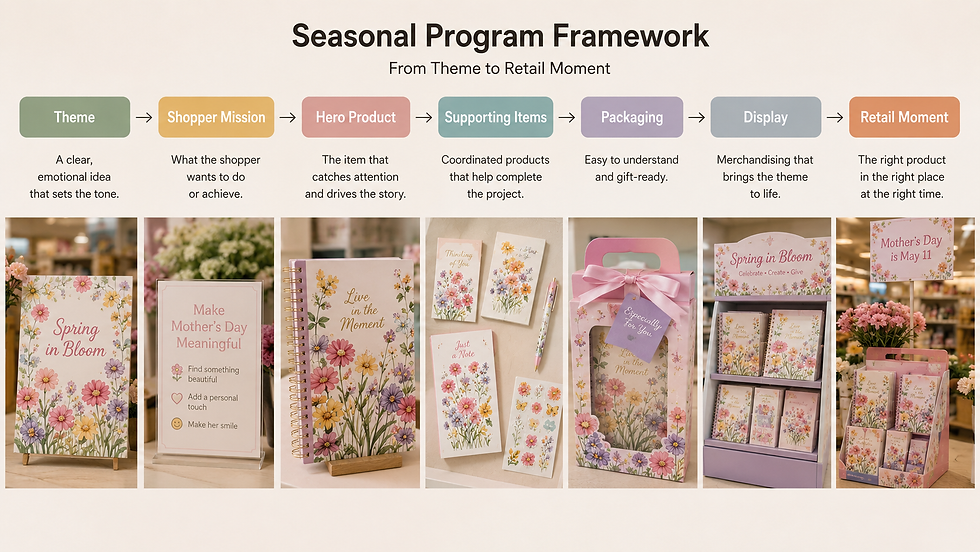
A simple map can help buyers and product teams turn one theme into a retail-ready program:
Theme → Shopper Mission → Hero Product → Supporting Items → Packaging → Display → Retail Moment
Here is how that works in practice.
Planning Step | Example: Cozy Winter Journaling |
Theme | Cozy Winter Journaling |
Shopper Mission | Create a quiet personal routine during cold months |
Hero Product | Guided journal |
Supporting Items | Stickers, bookmarks, greeting cards, pen set, small pouch |
Packaging | Giftable sleeve or belly band with project message |
Display | Countertop carton or seasonal shelf tray |
Retail Moment | Holiday gifting, New Year reset, journaling workshop |
This framework helps teams see the whole commercial picture early. It also helps suppliers avoid developing products in isolation.
When the color palette, artwork, packaging, formats, and display plan are connected from the start, the final range becomes easier to launch and easier to understand.
What This Means for Buyers and Product Teams
For buyers, the sourcing question is changing.
It is no longer enough to ask, “Can you quote this notebook?”
A better question is, “Can you help us turn this theme into a retail-ready paper goods program?”
That question leads to better planning. It also reveals which suppliers can support the full project.
A strong project-based supplier should understand:
Capability | Why It Matters |
Product structure | Different items need different materials, sizes, and finishes |
Artwork adaptation | One theme must work across notebooks, cards, stickers, bags, and displays |
Packaging design | The range must explain itself quickly on shelf |
Sampling speed | Seasonal windows are short and delays can reduce sales opportunity |
Cost control | Each item must fit the target retail price |
Display thinking | The range must work in real store space, not only on a spreadsheet |
This is where suppliers can add more value. They are not only producing units. They are helping create range clarity.
For example, a buyer planning a “Back-to-School Creative Desk” program may need notebooks, labels, folders, pencil pouches, motivational stickers, desk planners, and shelf-ready cartons. If each item comes from a different source with different color standards and timelines, the program becomes harder to execute.
A coordinated supplier can reduce that burden.
Project-Based Ranges Work Best When Services and Products Support Each Other
Craft retail is also adding more services. These may include classes, workshops, personalization, photo printing, framing, party services, maker events, or custom gift stations.
The service creates traffic. But the product range captures the basket.
A journaling workshop should not end with only a notebook sale. It should connect to stickers, pens, bookmarks, pouches, greeting cards, and refill packs.
A birthday party service should connect to invitations, banners, craft activities, favor bags, thank-you cards, and take-home packaging.
A photo printing service should connect to albums, frames, cards, labels, envelopes, gift wrap, and memory boxes.
This is the heart of project-based retail. The product range and the service should help each other. When they do, the customer sees a full solution instead of a group of separate items.
How to Build a Retail-Ready Paper Goods Program
A good project-based range does not need to be huge. In fact, smaller and clearer can be better.
A useful starting point is a 6-part structure:
Range Part | Role in the Program | Example |
Hero product | Main item that anchors the story | Journal, craft kit, planner, memory album |
Add-on items | Small items that lift basket value | Stickers, cards, tags, bookmarks |
Functional extension | Adds practical use | Pouch, organizer, folder, storage sleeve |
Gift packaging | Turns the item into a present | Gift bag, box, tissue, wrap |
Display unit | Makes the story visible in store | Shelf tray, carton, endcap sign |
Activity support | Connects to events or workshops | Instruction card, bundle kit, project guide |
This structure works well because it gives each item a job. The range does not become a random mix. It becomes a story the shopper can understand.
Common Mistakes to Avoid
The first mistake is adding too many products. A project-based range should be clear, not crowded. If the shopper cannot understand the idea in a few seconds, the display is doing too much.
The second mistake is weak packaging. Packaging is not only protection. It is communication. It should explain the project, show the theme, and make the range feel complete.
The third mistake is late sampling. Seasonal craft programs need enough time for design, review, revision, production, shipment, and store setup. A good idea that misses the season is not a good commercial result.
The fourth mistake is treating every item as separate. If the notebook, sticker sheet, card, gift bag, and display carton all feel like they came from different worlds, the customer will not see one clear project.
Where Lion Paper can add value
At Lion Paper, this is exactly the direction we are building toward.
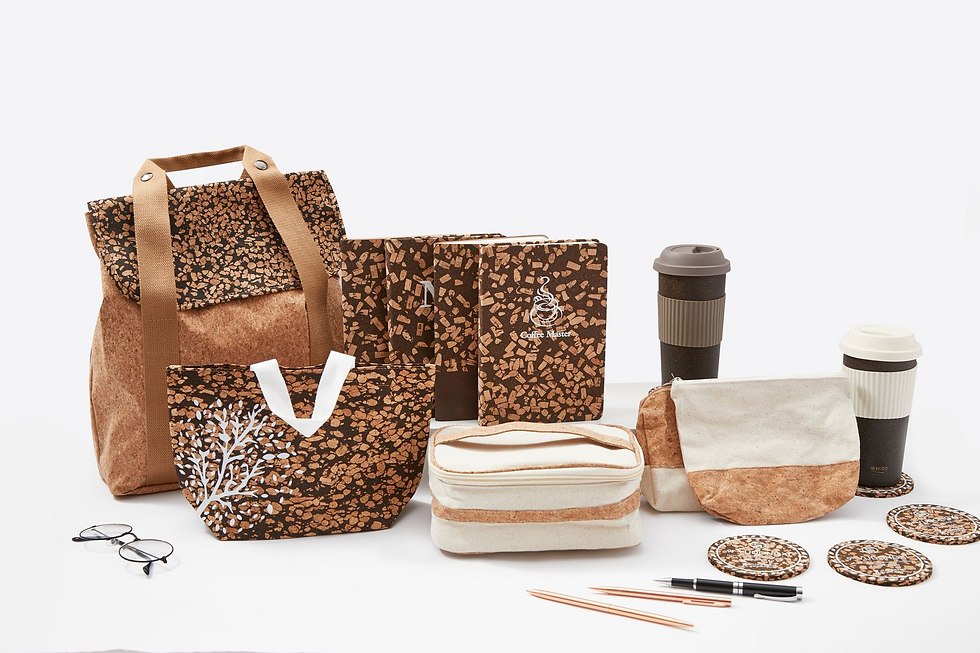
We are not trying to be only a factory that produces one isolated paper item. Our goal is to help customers turn creative ideas into coordinated, retail-ready ranges.
For a buyer or product team, that may mean starting with one theme and developing it into a complete program:
A notebook or journal as the hero product.
Greeting cards and stickers as add-on items.
Pouches or organizers as functional extensions.
Gift bags, wrapping paper, or boxes for gifting moments.
Display cartons or shelf-ready packaging for retail execution.
Workshop kits or bundled sets for event-driven sales.
The value is not that we can make many categories.
The value is that we can help make those categories feel connected.
Because when the color palette, artwork direction, packaging structure, and production plan are managed together, the final range becomes easier for retailers to launch and easier for shoppers to understand.
That is what buyers need more of: not just production capacity, but range clarity.
Looking to build retail-ready project-based ranges for your next seasonal program?
Conclusion: The Future Is Not Just More Products
Craft retail will not be defined only by who has the largest assortment. It will be shaped by who can help customers complete meaningful projects with less friction.
A notebook still matters. A card still matters. A gift bag still matters. But the bigger question is how these products work together.
Project-based ranges help retailers move from selling supplies to solving creative missions. They help buyers plan stronger seasonal programs. They help suppliers become better partners in design, packaging, sampling, display, and delivery.
Most importantly, they help shoppers move from “I have an idea” to “I know how to make it.”
That is where the real opportunity sits.
—Leo Xia, CEO, Lion Paper Products
You design, we deliver.
FAQs:
Q1: What is a project-based range in craft retail?
A project-based range is a group of products planned around one customer mission, such as making a handmade gift, hosting a party, starting a journal, or creating a memory album. The products may come from different categories, but they share one theme, use case, and retail story.
Q2: How is a project-based range different from a SKU-based range?
A SKU-based range starts with individual items. A project-based range starts with what the customer wants to complete. It connects hero products, add-ons, packaging, services, and displays into one easier shopping experience.
Q3: Why are project-based ranges important for craft stores?
They help shoppers understand what to buy and how items work together. This can make shopping easier, support seasonal displays, and encourage customers to buy more than one item for a complete project.
Q4: What should suppliers offer to support project-based ranges?
Suppliers should offer coordinated design, fast sampling, material guidance, packaging support, display solutions, and flexible product development. The goal is to help the buyer launch a connected program, not just buy one item.
Q5: How can retailers measure success?
Retailers can track basket size, sell-through rate, attachment rate, display conversion, repeat purchases, workshop-related sales, and seasonal markdown reduction. These metrics show whether the project story is helping customers buy with more confidence.
Reference
Are you looking for a reliable manufacturer? Reach out to Lion Paper for a free quote and consultation. Let’s collaborate on creating custom writing paper products that will set your brand apart from the competition!
About Lion Paper
Company Name: Lion Paper Products
Office Address: 20th floor, Chuangyedasha Building, No. 135, Jinsui Road, Jiaxing City, Zhejiang Province, China
Factory Address: No.135, Xuri Road, Jiaxing City, Zhejiang, China
Email: Leoxia@lion-paper.com
Audit Certifications: ISO9001:2015/FSC/SEDEX SMETA/Disney FAMA/GSV/SQP


Comments