


Complete Engineering Guide to Corrugated Flute Stationery Cartons

For dense stationery items like hardcover notebooks, daily planners, and desk calendars, B-flute and C-flute single-wall cartons serve well for lightweight case packs under 12 to 15 kg, whereas BC-flute or EB-flute double wall export carton paper goods rated at 44 to 48 ECT are essential for heavier shipments and multi-tier sea freight to prevent carton bulging, bottom-tier crushing, and pallet overhang deformation during long-distance transit.
What Are the Key Corrugated Flute Profiles Used in Stationery Master Cartons?
Corrugated board consists of one or more arched paper flutes glued between flat linerboards. The structural performance of corrugated flute stationery cartons depends directly on the flute geometry, including wave height, pitch density, and paperboard basis weight. Selecting the wrong profile leads to either structural box collapse or excessive dimensional weight fees.
Stationery products present a specific logistical challenge: high bulk density combined with low internal compressibility. Unlike apparel or plush goods that flex under load, packed paper products transmit shock directly to box corners and edges. Understanding how each standard flute profile behaves under compression allows brand buyers and packaging engineers to balance protective cushioning with stacking stiffness.
A-Flute (Approx. 4.8 mm height; 105 flutes/meter): Offers high vertical compression and cushioning, but its large caliper creates rough outer liner surfaces and increases outer box volume. Rarely used alone for stationery export master shippers.
B-Flute (Approx. 2.5 mm to 3.0 mm height; 150 flutes/meter): Features high flute density per linear meter, providing superior crush resistance, puncture resistance, and a smooth printing surface. It is the preferred standard for single-wall inner cartons, shelf-ready retail packaging, and small case packs under 10 kg.
C-Flute (Approx. 3.6 mm to 4.0 mm height; 120 flutes/meter): The industry standard for general-purpose shipping boxes. It balances vertical stacking strength with moderate puncture resistance, making it suitable for moderate-weight paper stationery master cartons.
E-Flute (Approx. 1.2 mm to 1.6 mm height; 290 flutes/meter): A micro-flute that provides a flat, rigid substrate for high-resolution graphics and rigid folding gift boxes. It is rarely used as an outer export master shipper by itself, but frequently serves as a secondary retail sleeve or rigid slipcase.
EB-Flute Combination (Approx. 4.0 mm to 4.5 mm height): A double-wall architecture pairing micro-flute E on the outer layer for puncture resistance and print clarity with B-flute on the inner layer for structural stiffness.
BC-Flute Combination (Approx. 6.5 mm to 7.0 mm height): The premier heavy-duty export standard for global paper goods shipping. It combines the puncture resistance and rigidity of B-flute with the top-to-bottom compression strength of C-flute.

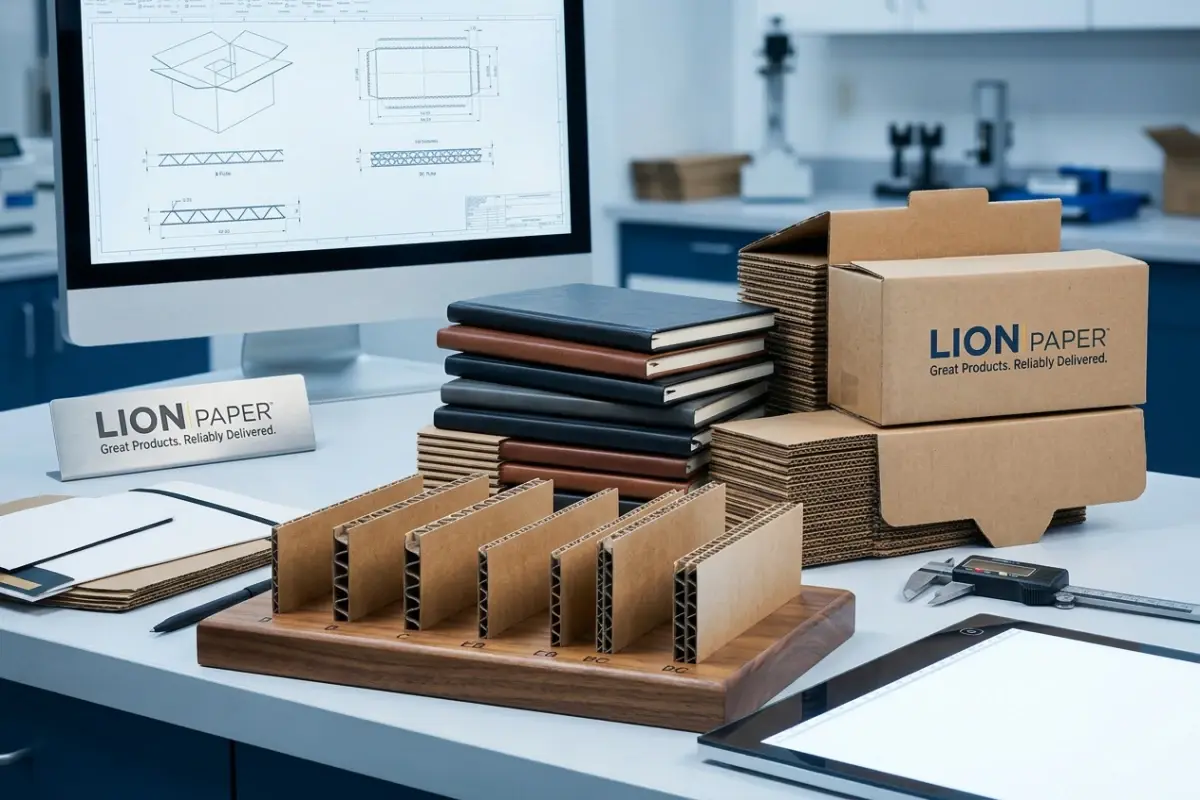
Flute height, wave pitch, and wall structure determine box compression strength and surface puncture resistance.
How Do Product Density and Case Pack Weight Determine Flute Selection?
Selecting the right shipping carton flute selection requires a direct evaluation of stationery product mass, internal void space, and orientation inside the shipper. While bulky lightweight items rely on carton walls to support stacking loads, dense bound books act as solid blocks that carry vertical weight if the shipper fits tightly.
However, when master cartons experience lateral shifting or vertical vibration during ocean freight, books slide against interior walls. If the board caliper lacks adequate stiffness, the carton walls bow outward—a failure mode known as "cube bulging." This bulging destroys pallet interlocking and exposes book edges to crushing.
Stationery Product Category | Typical Case Pack Weight | Recommended Board Structure | Target ECT Rating | Recommended Internal Protection |
|---|---|---|---|---|
:--- | :--- | :--- | :--- | :--- |
Hardcover Journals & Wire-O Planners | 15 kg – 22 kg | BC-Flute Double Wall | 44 – 48 ECT | Corner edge protectors + moisture barrier polybag |
Softcover Notebooks & Exercise Books | 10 kg – 15 kg | B-Flute or C-Flute Single Wall | 32 – 40 ECT | Polybag liner or kraft paper bundle wrap |
Sticky Notes, Memo Pads & Tab Dividers | 8 kg – 12 kg | B-Flute Single Wall | 32 ECT | Corrugated divider grid or shrink wrapping |
Desk Calendars & Wall Planners | 12 kg – 18 kg | EB-Flute or BC-Flute Double Wall | 40 – 44 ECT | Reinforced perimeter buffer or top/bottom pads |
Stationery Accessory Sets & Gift Boxes | 6 kg – 10 kg | B-Flute Single Wall / E-Flute Rigid | 29 – 32 ECT | Custom die-cut corrugated internal trays |
For heavy items like casebound notebooks, packaging engineers must maintain total master carton gross weight between 12 kg and 18 kg. Exceeding 20 kg increases drop-impact damage, accelerates bottom-panel sag, and triggers manual handling surcharges at major distribution centers and e-commerce fulfillment hubs.
What ECT and Mullen Ratings Ensure Structural Master Carton Strength?
Master carton strength stationery specifications historically relied on the Mullen Bursting Test, which measures the hydraulic pressure required to puncture a corrugated sheet in pounds per square inch (e.g., 200# or 275# test). Modern logistics, automated sorting centers, and multi-tier palletization require evaluating the Edge Crush Test (ECT) instead. ECT measures the top-to-bottom compression strength of a short column of corrugated board in pounds per linear inch (or kN/m).
Because stationery cartons are stacked on pallets up to 2.2 meters high inside shipping containers, vertical stacking load is the primary failure risk. The ECT rating directly governs how much load the box walls can carry before buckling.
To establish the proper ECT rating for notebooks packaging, packaging engineers calculate theoretical load using McKee's formula, modified by dynamic safety factors:
Static Top-Load Calculation: Multiply the gross weight of a single carton by the total number of cartons stacked directly above it on the pallet tier.
Ocean Transit Environmental Factor (1.8x to 2.2x): Paper fibers absorb atmospheric moisture under prolonged 80% to 90% relative humidity inside shipping containers, causing up to a 50% loss in structural compression strength.
Dynamic Vibration and Transport Factor (1.3x to 1.5x): Compensates for vessel pitching, rough intermodal rail transport, and road transit shock.
Pallet Pattern Degradation Factor (1.2x to 1.4x): Column-stacked cartons maintain 100% of their theoretical strength, but interlocking pallet patterns reduce vertical stacking strength by 40% to 50% due to corner misalignment.
Required Stacking Strength (BCT) = Single Box Weight × (Stack Height - 1) × Total Safety Factor
For a standard pallet holding 5 tiers of 16 kg notebook master cartons, the bottom box must support 64 kg of static weight. Applying a combined environmental and handling safety factor of 4.5 requires a box compression test (BCT) capacity of at least 288 kg (2,824 N). Meeting this benchmark reliably over long transit periods requires a minimum 44 ECT double-wall board constructed from high-grammage virgin kraft liners (such as 175g/m² outer liner, 120g/m² fluting, and 175g/m² inner liner).

ECT testing verifies that master cartons maintain sufficient compression capacity under high stacking loads.
How Can Brands Prevent Box Bulging and Cut Dimensional Freight Fees?
Overpacking and underpacking both degrade supply chain profitability. Underpacked cartons contain excess void space, allowing dense paper products to shift, collapse carton corners, and crush inward under top loads. Conversely, overpacked cartons force internal contents against the outer walls, causing carton bulging that expands the box's physical footprint.
Dimensional weight (DIM weight) pricing applied by international air freight forwarders, ocean LCL consolidators, and small-parcel carriers (like FedEx, UPS, and DHL) penalizes dimensional growth. A 15 mm lateral bulge along each carton face can increase calculated cubic volume by 8% to 12%, triggering costly dimensional weight surcharges and preventing pallets from fitting side-by-side inside standard ISO shipping containers.
Eliminate Internal Headspace: Dielines must be engineered around exact product dimensions with zero excess vertical tolerance. Dense paper products do not settle like granular goods; any gap between the top notebook and carton flaps encourages flap sagging under stack pressure.
Deploy High-Yield Flute Combinations: Utilizing EB-flute instead of standard BC-flute reduces total board caliper by approximately 35% while preserving superior top-to-bottom compression and exterior puncture resistance. This thin-profile rigidity maximizes inner packing volume while maintaining a flat outer box wall.
Implement Snug Unit Bundling: Shrink-wrapping or paper-banding notebooks in sub-packs of 4, 6, or 10 units prevents individual items from shifting laterally inside the master shipper, eliminating focal pressure points against exterior linerboard.
Apply Kraft Corner Angle Boards: For high-value planner collections and luxury journal sets, inserting 3 mm solid fiber corner posts inside carton corners increases top-load strength by up to 30%, permitting lighter board flutes without risking pallet collapse.
Standardize Master Carton Dimensions: Outer box footprints should align with standard 1200 x 1000 mm (UK/International) or 1200 x 800 mm (Euro) pallet sizes. Ensuring modular stacking without pallet overhang preserves 100% of the box's rated ECT capacity, as even a 15 mm edge overhang reduces carton compression capacity by over 30%.
What Quality Tests Validate Stationery Export Packaging for Moisture and Impact?
Paper is hygroscopic, meaning it continuously exchanges moisture with surrounding air. During transit across tropical ocean routes, relative humidity within a sealed steel container can fluctuate between 60% and 95%, precipitating "container rain." Without strict quality verification, corrugated fiberboard weakens rapidly, causing catastrophic pallet failure before port arrival.
To ensure consistent quality, paper goods packaging must undergo rigorous laboratory testing according to standardized international protocols prior to mass production and shipment release.
Cobb Sizing Test (ISO 535 / TAPPI T441): Measures the water absorptiveness of the outer and inner linerboards over a specified duration (typically 60 or 120 seconds). Export-grade stationery master cartons require a Cobb 60 value below 35 g/m² on outer linerboards to prevent humidity penetration from softening corrugated flutes.
Edge Crush Test (ISO 3037 / TAPPI T811): Verifies the true compressive force of the finished fluted structure. Production lots must undergo routine AQL sampling to confirm that actual ECT values match the approved engineering specification.
Box Compression Test (ASTM D642): Applies dynamic top-down mechanical crushing force to completed, packed cartons until failure, ensuring the total structure meets calculated BCT load thresholds.
ISTA 1A / 2A Transit Simulation: Involves fixed-displacement vibration, rotary vibration, and free-fall drop testing from predetermined heights (typically 760 mm to 900 mm depending on gross package weight). Tests must verify zero seam splitting, internal page denting, or book spine deformation.
Bursting Strength Test (ISO 2759 / TAPPI T810): Measures multidirectional puncture resistance to ensure carton faces do not rupture when handled roughly by stevedores or sorting conveyors.

Properly engineered carton dielines eliminate cube bulging and maximize container cube utilization.
How Does Lion Paper Engineer Optimized Export Packaging for Global Brands?
Lion Paper Products (Jiaxing) Co., Ltd. operates as an integrated supply-chain partner for customized paper goods and creative stationery, combining creative concept development with mass production and packaging engineering. Founded in 2015 with headquarters in Jiaxing, Zhejiang, Lion Paper manages a multi-node manufacturing network comprising a 3,000-square-meter design, prototyping, and customer support center in Jiaxing alongside a 10,000-square-meter large-scale production facility in Cambodia.
Producing over 5 million custom notebooks, planners, journals, and paper stationery items annually for major markets across North America, Europe, Australia, the Middle East, and Southeast Asia, Lion Paper treats transit packaging as an extension of product design. Our dual-site manufacturing synergy allows engineering teams to optimize master packaging during early prototyping in Jiaxing, establishing precise dielines, custom flute combinations, and verified case pack densities before transitioning to mass production in Cambodia.
Scenario-Fit Packaging Engineering: We tailor master carton specifications to specific delivery channels—from reinforced BC-flute double-wall shippers for ocean container freight to frustration-free, drop-tested single-wall e-commerce packaging for DTC and Amazon fulfillment.
Integrated Quality & Compliance SOPs: Our operations adhere to strict international standards supported by ISO 9001, FSC, SMETA, WCA, GSV, FAMA, and CPSIA compliance. Standardized defect catalogs, AQL inspection rules, and automated case-sealing SOPs ensure consistent batch-to-batch protection.
Sustainable & Recyclable Materials: We prioritize FSC-traceable kraft liners, recycled fluting mediums, water-based flexographic inks, and plastic-free paper tape solutions, helping global stationery brands meet corporate ESG targets without sacrificing transit durability.
Total Landed Cost Efficiency: By optimizing pallet patterns, eliminating excess headspace, and selecting the ideal balance between single-wall and double-wall fluting, our packaging engineers maximize container cube utilization and minimize transit damage rates.
Whether developing custom hardcover journals, spiral planners, or retail stationery collections, choosing the correct corrugated flute structure protects brand reputation at the retail shelf. Contact our engineering team and request a master carton packaging density review by sharing your product dimensions, unit weights, case pack counts, and target shipping routes.
Frequently Asked Questions
When should I choose BC-flute double wall instead of single-wall C-flute for stationery?
BC-flute double-wall cartons are recommended whenever total case pack weight exceeds 15 kg, when shipping dense hardcover notebooks or planners via multi-tier ocean freight, or when pallets are stacked two-high in transit warehouses. Single-wall C-flute board is generally sufficient for lightweight, softcover paper goods, memo pads, or small case packs under 12 kg where stacking heights are limited.
How does high ocean humidity affect the ECT rating of corrugated master cartons?
Corrugated fiberboard absorbs moisture rapidly when atmospheric relative humidity exceeds 70%. Prolonged exposure during ocean transit can reduce a carton's effective Edge Crush Test (ECT) and top-load compression capacity by 40% to 55%. To compensate, export packaging should use moisture-resistant virgin kraft liners with low Cobb sizing values (under 35 g/m²) and incorporate higher initial safety factors (typically 4.0x to 5.0x static load).
What is the difference between Mullen Burst strength and ECT for stationery packaging?
Mullen Burst strength measures the hydraulic pressure required to rupture the face of the corrugated board, indicating how well a box resists rough handling, internal puncture, and snagging. Edge Crush Test (ECT) measures the vertical compressive strength of the board edge, indicating how much top load a carton can support when stacked on a pallet. For dense stationery products where crushing and pallet sagging are primary risks, ECT is the more critical engineering metric.
FAQ
When should I choose BC-flute double wall instead of single-wall C-flute for stationery?
BC-flute double-wall cartons are recommended whenever total case pack weight exceeds 15 kg, when shipping dense hardcover notebooks or planners via multi-tier ocean freight, or when pallets are stacked two-high in transit warehouses. Single-wall C-flute board is generally sufficient for lightweight, softcover paper goods, memo pads, or small case packs under 12 kg where stacking heights are limited.
How does high ocean humidity affect the ECT rating of corrugated master cartons?
Corrugated fiberboard absorbs moisture rapidly when atmospheric relative humidity exceeds 70%. Prolonged exposure during ocean transit can reduce a carton's effective Edge Crush Test (ECT) and top-load compression capacity by 40% to 55%. To compensate, export packaging should use moisture-resistant virgin kraft liners with low Cobb sizing values (under 35 g/m²) and incorporate higher initial safety factors (typically 4.0x to 5.0x static load).
What is the difference between Mullen Burst strength and ECT for stationery packaging?
Mullen Burst strength measures the hydraulic pressure required to rupture the face of the corrugated board, indicating how well a box resists rough handling, internal puncture, and snagging. Edge Crush Test (ECT) measures the vertical compressive strength of the board edge, indicating how much top load a carton can support when stacked on a pallet. For dense stationery products where crushing and pallet sagging are primary risks, ECT is the more critical engineering metric.


Comments