


Corporate Planner Artwork Approval: Pre-Press Checklist and Multi-Team Sign-Off Guide

Before approving corporate planner artwork for mass production, print buyers and brand teams must verify dimensional cover mechanics, interior calendar date sequences, localized public holidays, specialty finishes, scannable SKU barcodes, and compliant retail packaging. Establishing a standardized approval workflow prevents expensive press halts, eliminates post-press binding errors, and ensures that multi-department brand assets translate into commercially consistent, high-yield paper goods.
What is the core pre-press checklist for corporate planner artwork approval?
A comprehensive custom planner pre-press checklist audits every mechanical, chromatic, and typographic parameter before files reach the plate-making stage. Custom planners combine dense dateline typography, functional grids, tabs, multi-signature book blocks, and complex outer coverings. An error on a single date, spine calculation, or ribbon placement compounds across high-volume print runs.
When preparing files for corporate planner artwork approval, production engineers and design directors must review six foundational categories:
Spine Width and Cover Mechanics: Calculate the exact spine bulk using the target paper basis weight (GSM) and caliper (bulk thickness in microns) multiplied by total page count, factoring in binder board thickness (typically 1.5mm to 3.0mm) and hinge score allowances (usually 8mm to 12mm).
Calendar Grid and Sequential Date Accuracy: Perform line-by-line checks on leap year configurations, weekday-to-date alignments, week number conventions (ISO 8601 vs. US standard), and micro-typography in monthly overview boxes.
Interior Margin Clearance and Gutter Drift: Maintain a minimum 12mm to 15mm inner safety gutter for perfect bound or casebound sewn books to prevent text disappearing into the spine fold, and 8mm to 10mm hole-punch clearance for wire-o or spiral binding.
Specialty Finishing Layers: Supply foil stamping, debossing, spot UV, and silkscreen layers as dedicated 100% vector spot color separation channels set to "Overprint" with distinct layer labels.
Page Count and Imposition Signatures: Ensure page totals align with printer signature multiples (typically 16-page or 32-page sections for sewn hardcovers, or 4-page multiples for saddle-stitch and wire-o formats).
Tab Divider Indexing and Bleeds: Verify that tab stepped cutouts include 3mm bleeds on all trimmed edges and that tab titles run in logical sequential order from top to bottom.
Inspection Category | Target Specification / Standard | Critical Error Trigger |
|---|---|---|
:--- | :--- | :--- |
Cover Board Wrap Bleed | 18mm to 20mm turn-in allowance on all four sides | Under 15mm turn-in causing board exposure after casing-in |
Interior Margin / Gutter | ≥12mm safe margin from spine fold | Text clipped or obscured in deep sewn or glued gutters |
Total Ink Coverage (TIC) | Maximum 280% to 300% on woodfree/offset text stock | Ink offsetting, slow drying times, paper sheet sticking |
Line Art Resolution | Minimum 800 to 1200 DPI for monochrome line art | Jagged grid lines and blurry micro-print timestamps |
Vector Type Rendering | All text converted to outlines or embedded fonts | Font substitution altering monthly grid alignments |

Verifying interior safe margins, date sequences, and gutter clearances prevents content loss during planner binding.
How should multi-team planner print sign-off workflows handle localized and regional variations?
Managing a multi-team planner print sign-off across global departments, regional retail branches, or diverse corporate subsidiaries requires a structured file architecture. When different brand teams require localized public holidays, specialized corporate milestone dates, custom color accents, or unique departmental inserts, managing disparate design files leads to versioning errors.
A scalable sign-off protocol isolates common master layers from localized variable layers:
Universal Base Master Layer: Contains standardized master grids, structural pagination, edge indexing, line rules, and global corporate brand elements that remain fixed across all production batches.
Variable Localization Layer: Houses regional holiday calendars (such as US Federal, UK Bank Holidays, German statutory dates, or Australian regional holidays), fiscal calendar starting quarters, localized multi-language text, and regional office directory appendices.
Departmental Custom Inserts: Manages tip-in sheets, custom motivational pages, training schedules, or distinct front-matter content specific to sales, executive, or technical branches.
To prevent conflicting approvals, production leaders should mandate a sequential rather than parallel sign-off tree. Under this protocol, the brand governance team signs off on global typography, structural format, and cover materials first. Next, regional compliance and HR managers review localized dates and departmental insert copy. Finally, the pre-press procurement manager executes the technical print verification before issuing final production clearance to the OEM factory.
What technical print specifications govern custom planner pre-press checklists?
High-density daily, weekly, and monthly planners place strict demands on pre-press file preparation. Because planners contain fine rules, miniature calendar numerals, and subtle shaded planning blocks, minor prepress oversights cause visible visual degradation on uncoated offset papers.
Pre-press managers must enforce strict technical file parameters:
Color Space Conversion and Separation: Convert all interior assets to CMYK. Never leave RGB or unmanaged spot colors in interior files unless printing with dedicated Pantone inks. Interior rule grids should use a single black ink plate (e.g., 20% to 40% Tint K) rather than four-color rich black (C40 M30 Y30 K100) to prevent color fringing and misregistration on thin 0.3pt lines.
Stroke Width and Vector Grid Fidelity: Set minimum line stroke weights to 0.25pt for solid 100% vector rules and 0.5pt for tinted or screened lines. Extremely fine hairline rules below 0.15pt break apart during CTP (Computer-to-Plate) rasterization and offset transfer.
Paper Caliper and Ink Absorbency Matching: Uncoated woodfree paper (70 GSM to 120 GSM) absorbs ink aggressively, causing dot gain of 15% to 25%. Apply appropriate ICC profiles (such as ISO Uncoated or GRACoL Uncoated) during artwork export to maintain legible grid contrasts and prevent dot plugging in compact monthly habit trackers.
Bleed Boundaries and Trim Crop Marks: Supply exact 3mm (0.125 inch) bleed allowances outside finished trim dimensions for interior pages, and extend artwork 20mm past the board edge for fully wrapped hardcovers. Keep all essential text and non-bleeding icons at least 5mm inside the primary trim line.
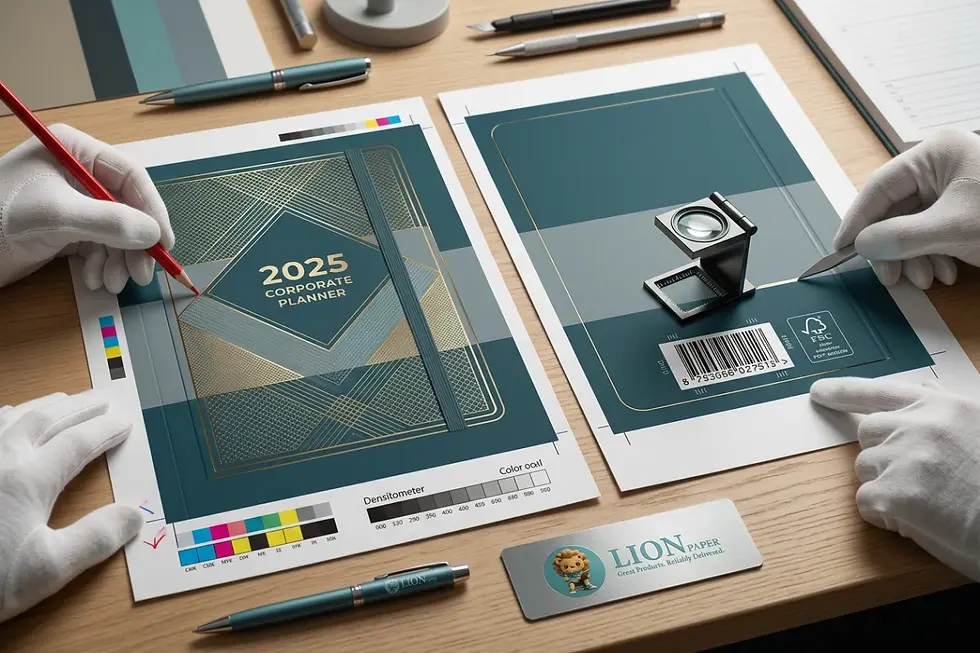
Packaging proofs require exact validation of barcode readability, foil registration, and environmental certification labeling.
What packaging, barcode, and regulatory compliance standards apply to corporate calendar and planner proofing?
A thorough corporate calendar proofing guide must extend beyond the main planner body to encompass secondary retail-ready packaging, point-of-sale branding, and international trade compliance markers. Corporate gift sets and retail-bound planners frequently ship in belly bands, rigid presentation boxes, shrink-wrap sleeves, or protective self-mailer cartons.
During prepress packaging artwork reviews, verify these essential compliance and functional packaging factors:
Barcode Verification and Quiet Zones: Ensure GS1-compliant EAN-13 or UPC-A barcodes appear in 100% Vector K on an opaque white background. Maintain a minimum 2.5mm quiet zone (margin of clear space) to the left and right of the barcode bars to guarantee infrared optical readability at distribution centers and retail point-of-sale checkouts.
FSC® and Environmental Certification Badges: Position certified FSC chain-of-custody logo badges according to the strict trademark guidelines set by the Forest Stewardship Council, incorporating the correct license code, trademark claim (FSC Mix, FSC Recycled, or FSC 100%), and minimum approved clearance boundaries.
Packaging Safety and Suffocation Warnings: Print required safety text in designated multi-lingual variations (e.g., English, French, Spanish) on protective polybags or shrink-wrap materials when opening diameters exceed regulatory thresholds.
Carton Markings and Pallet Manifest Data: Align outer master carton artwork with retail transit standards, incorporating correct stacking height limits, gross weight markers, recycling symbols, and scannable GS1-128 shipping labels on adjacent carton faces.
How does OEM planner production artwork approval bridge design intent with manufacturing reality?
Bridging digital design files with physical manufacturing requires close alignment between the client's creative team and the manufacturing engineering staff. Standard desktop monitors show backlit RGB visuals that differ substantially from ink absorbed into porous uncoated book paper. Standardizing the OEM planner production artwork approval stage eliminates surprises before high-speed printing presses begin mass runs.
Proofing Phase | Media / Format Used | Primary Validation Objective |
|---|---|---|
:--- | :--- | :--- |
1. Digital PDF Soft Proof | Screen-rendered calibrated PDF | Verify layout sequence, page counts, typestyle, and layer integrity |
2. Unprinted White Dummy | Target paper stock, board, and binding | Validate physical weight, spine thickness, hand feel, and binding durability |
3. High-Res Chromatic Proof | G7/FOGRA color-calibrated digital inkjet contract proof | Confirm color saturation, CMYK balance, and brand Pantone match |
4. Wet Proof / Running Sheet | Actual press run on designated production paper stock | Inspect specialty finishes (foil, deboss), ink-to-paper interaction, and registration |
5. Pre-Production Golden Sample | Fully assembled final planner with packaging and accessories | Final sign-off on structural integration, bookmark ribbons, tabs, and belly bands |
Factory engineering teams examine how paper grain direction affects binding stability. For casebound and perfect bound planners, the paper grain direction must run parallel to the book spine. If grain direction runs perpendicular, interior pages resist turning, buckle in changing humidity, and stress binding glue along the spine hinge.

Comparing unprinted structural dummies with final golden samples validates spine mechanics, paper bulk, and finishing aesthetics.
How can organizations build a step-by-step corporate calendar proofing guide for cross-functional sign-off?
To prevent missed milestones and late shipments, enterprise procurement leaders must implement a structured, five-stage proofing pipeline that guides calendar and planner artwork from raw file submission to factory release.
Automated Pre-Flight Check: InDesign or PDF pre-flight scripts automatically flag low-resolution imagery (<300 DPI), non-CMYK color assignments, missing fonts, improper bleed margins, and overset text frames.
Editorial and Legal Verification: Human editors and legal counsel cross-reference all corporate dates, patent statements, corporate contact listings, public holidays, and contractual brand guidelines against an approved master corporate dateline document.
Cross-Departmental Asset Consolidation: Stakeholders from marketing, operations, and product teams review localized variable layers and custom tip-in content, consolidating change requests into a single annotated PDF rather than multiple contradictory email threads.
Contract Color and Finish Proofing: Procurement teams evaluate high-resolution color contract proofs and specialty foil/emboss drawdowns under standard D50 graphic arts viewing booths to certify color accuracy.
Final Multi-Department Authorization: The designated project lead issues a formal, timestamped production sign-off document accompanied by locked, pre-press approved PDF artwork files to authorize plate-making and press runs.
How does Lion Paper streamline design-to-manufacturing pre-flight checks and bulk production?
Founded in 2015 and headquartered in Jiaxing, Zhejiang, Lion Paper Products (Jiaxing) Co., Ltd. serves as an integrated supply-chain partner for customized paper goods and creative stationery collections. Operating a multi-node supply network that combines a 3,000-square-meter design, R&D, and rapid-prototyping center in Jiaxing with a 10,000-square-meter mass manufacturing facility in Cambodia, Lion Paper bridges creative concepts with scalable, cost-optimized manufacturing.
Lion Paper produces over 5 million notebooks and custom planners annually for corporate brands, major retailers, e-commerce sellers, and enterprise gift clients across North America, Europe, Australia, the Middle East, and Southeast Asia. The company's in-house engineering and prepress teams collaborate directly with client design teams to resolve technical file complexities before materials are committed to the press.
Integrated Design-to-Manufacturing Prepress: In-house structural designers and prepress engineers calculate exact spine profiles, adjust for paper bulk variations, review vector lines, and build precise foil stamping and embossing dies.
China–Cambodia Dual-Site Synergy: Clients benefit from rapid sampling and localized technical support out of the Jiaxing facility, paired with tariff-advantaged, large-scale production and stable delivery out of Cambodia.
Total-Cost Efficiency and Agile Prototyping: Automated production lines, standardized SOPs, and scale raw material sourcing optimize landed costs while supporting flexible pilot runs, multi-variant retail collections, and annual high-volume replenishment.
Certified Quality and Compliance Architecture: Supported by ISO 9001, FSC, SMETA, WCA, GSV, FAMA, and CPSIA audit capabilities, every planner run adheres to strict AQL sampling standards, unified defect libraries, and sustainable material options including FSC-traceable papers and low-impact inks.
Ensure your next corporate planner or custom calendar project moves seamlessly from concept to delivery. To evaluate your custom planner project and obtain an expert prepress review, share the format, start month, target quantity, and delivery date with our team today.
FAQ
What is the standard bleed allowance required for hardcover corporate planners?
Hardcover (casebound) planners typically require a 18mm to 20mm outer bleed allowance on all four sides of the outer cover wrap. This extra artwork area wraps around the heavy binder board during the casing-in process. In contrast, interior text pages and divider tabs require a standard 3mm (0.125 inch) bleed outside the trim boundary.
Why should planner interior line grids use a single black ink tint instead of rich black?
Fine interior planning lines (0.25pt to 0.5pt) should be defined using a single plate (such as 20% to 40% Key Black) rather than a 4-color rich black mix (CMYK). Using a single plate eliminates registration issues, prevents color fringing around small dates and numbers, and ensures sharp, clean grid lines across high-speed offset printing presses.
How does paper bulk affect the spine calculation during artwork sign-off?
Spine thickness is determined by multiplying the total sheet count (half the total page count) by the exact single-sheet caliper (thickness in microns), plus allowances for the cover board and binding hinge. Because different paper mills and paper finishes (such as woodfree offset vs. coated art paper) have varying bulk densities at the same GSM, calculating spine width using theoretical basis weight alone leads to misaligned cover wraps or loose hinges.


Comments