


Sourcing a Coordinated Notebook Pencil Case Collection: Design, Materials, and Supply Chain Strategy

A successful coordinated notebook and pencil case collection relies on unified material sourcing, aligned surface decoration methods, and a balanced SKU architecture that maximizes retail visual impact while optimizing production MOQs. Integrating these elements requires deep design-to-manufacturing synergy to ensure texture, color precision, and durability are consistently executed across distinct material substrates like paper, PU leather, and textiles.
How Do You Strategize Assortment Planning and SKU Architecture for Gift and BTS Programs?
Effective back to school stationery assortment planning and seasonal gift program design require a meticulous balance between volume-driving products and high-margin coordinating sets. When planning a coordinated notebook pencil case collection, product development teams must determine the structural hierarchy of the release. A typical high-performing retail assortment includes core paper products (such as hardback journals, spiral notebooks, and notepad sheets) paired with functional storage solutions (like zipper pencil cases, pouch organizers, and desktop accessories). This balanced assortment caters to different price bands and consumer demographics, turning standalone products into a comprehensive retail statement.
For high-volume retail programs, buyers often leverage custom retail ready notebook sets to streamline shelf space and increase average transaction values. In these configurations, SKU architecture must be designed to minimize supply chain complexity. For instance, rather than producing entirely different patterns for every individual product, brands can run a unified design theme across three to four key products. This allows the factory to aggregate raw material orders, such as purchasing a single custom-printed textile roll that is then split between notebook covers and matching pencil cases.
For the stationery gift set wholesale market, packaging serves as the primary bridge. Retail-ready packaging options—including slide-out sleeve boxes, rigid magnetic gift sets, and recycled paper belly bands—must be engineered alongside the products. This ensures that the components fit tightly together without shifting during global shipping. By standardizing the physical footprint of the combined set, retailers can optimize their planograms, maximize shelf utilization, and deliver a clean, premium visual aesthetic that directly engages the end-consumer.
What Are the Key Technical Considerations for Material Matching and Color Consistency?
Creating a flawless pencil case and journal matching collection introduces significant technical challenges in material color matching. Because paper, synthetic leather (PU), cotton canvas, and polyester linings absorb inks and dyes differently, utilizing a single Pantone (PMS) color code across all materials will not automatically yield identical visual results. Paper covers utilize CMYK or spot color offset printing, whereas textiles require pigment printing, sublimation, or reactive dyeing.
To mitigate color divergence, product developers must establish a rigorous lab dip and proofing approval protocol. Standard operating procedures dictate that dye-lots for textiles and print proofs for paper covers are developed concurrently. Samples must be reviewed under standardized lighting cabinets using D65 (daylight) and TL84 (store light) sources to eliminate metamerism—a phenomenon where colors match under one light source but differ under another.
Beyond color, matching the surface finishes and hardware is critical to the collection's overall perceived value. If a notebook cover features metallic rose gold foil stamping, the zipper teeth, metal zipper pulls, snap buttons, and eyelets of the matching pencil case must undergo the same electroplating finish. Furthermore, ancillary materials like elastic closures, ribbon markers, and stitched edge-threads must be matched against the primary color palette. By coordinating these minor details, the custom retail ready notebook sets project a premium, cohesive brand identity on the retail shelf.

How Do You Ensure the Construction and Durability of Coordinated Stationery Sets?
A highly rated coordinated notebook pencil case collection must not only maintain an attractive shelf appearance but also withstand the rigorous demands of daily academic or professional use. For the notebook component, durability is highly dependent on the binding structure and paper weight. Thread-sewn casebound binding represents the gold standard for durability, allowing the notebook to lay completely flat without the spine cracking or pages shedding. The paper itself must be selected based on performance metrics: 80gsm to 100gsm acid-free, wood-free paper prevents ink ghosting and feathering, satisfying users of fountain pens and gel highlighters.
For the coordinating pencil case, construction durability centers around fabric selection, seam reinforcement, and zipper quality. Heavy-duty 12oz cotton canvas, water-resistant 600D polyester, or sustainable RPET (recycled polyethylene) fabrics provide the necessary tensile strength to resist punctures from sharp pens and scissors. The interior seams should be fully bound with piping to prevent fraying, and critical stress points—such as the zipper ends—require bar-tack stitching. Zipper performance is evaluated using high-cycle test standards, specifying nylon coil or molded plastic zippers that slide smoothly without snagging. By matching high-standard notebook construction with robust textile manufacturing, the complete set guarantees a long product lifecycle, protecting the brand's reputation for quality.
How Do Premium and Standard Configurations Compare in Materials and Costs?
When planning a stationery gift set wholesale collection, balancing material costs against the target retail margin is a critical step. Brands must decide whether to position their collections in the standard/mass-market tier or the premium/boutique tier. This decision dictates every manufacturing choice, from cover materials to packaging styles.
The table below outlines the material, binding, and structural differences between premium and standard coordinated sets, allowing product development managers to align their specifications with target retail price points:
Component | Standard Configuration | Premium Configuration | Eco-Forward Configuration |
|---|---|---|---|
:--- | :--- | :--- | :--- |
Notebook Cover | 128gsm artpaper over 1.5mm greyboard, matte lamination | Premium PU leather over 2.0mm greyboard, deep debossing | FSC-certified recycled kraft board, soy-based ink print |
Notebook Binding | Glue bound, perfect binding (non lay-flat) | Thread-sewn casebound, lay-flat design with headband | Thread-sewn, exposed spine with eco-glue |
Pencil Case Outer | 230T polyester fabric with single-color print | 12oz cotton canvas with multi-color screen print | 100% Recycled RPET canvas with low-impact dyes |
Zippers & Pulls | #3 Nylon coil zipper with standard zinc alloy puller | #5 Metal zipper with custom-molded brand logo puller | Recycled plastic zipper with cork or organic cotton puller |
Set Packaging | Polybag with adhesive tape and barcode sticker | Rigid cardboard box with custom EVA foam insert | Recycled paperboard sleeve with die-cut window |
Inner Paper | 70gsm wood-free paper, off-white, double-sided lined | 100gsm premium acid-free paper, ivory, dotted/lined | 80gsm 100% post-consumer recycled paper, soy ink |
Choosing the right configuration depends on the distribution channel. For mass retail back to school stationery assortment planning, standard configurations allow for aggressive pricing and high volume. Conversely, for corporate gifting or boutique retail, premium or eco-forward configurations justify higher price points and build stronger brand equity.
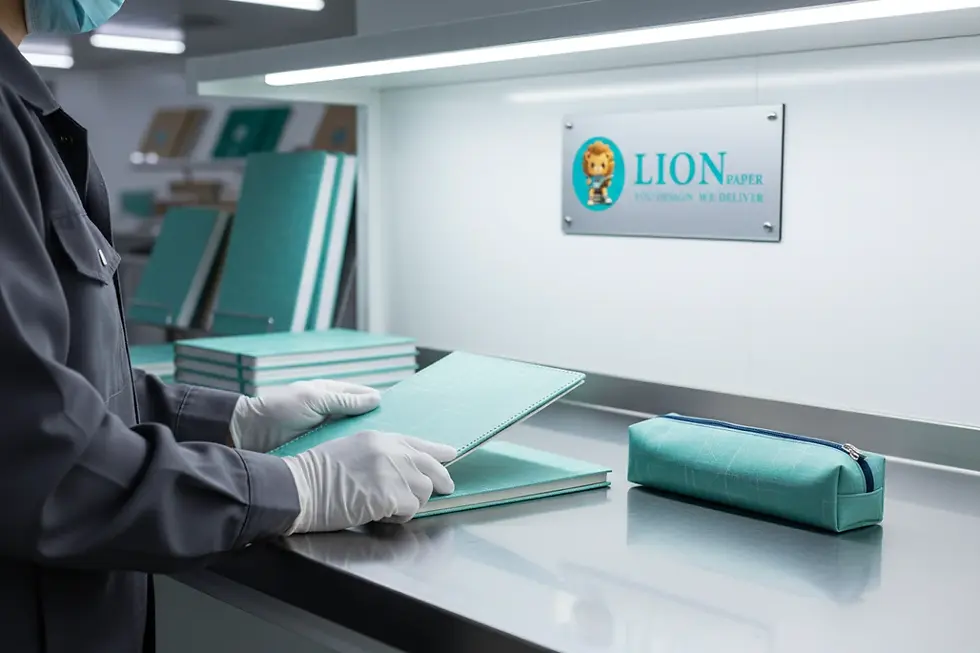
What Quality Control and Testing Standards Apply to Coordinated Sets?
To secure shelf space with major global retailers, a coordinated stationery collection must pass stringent physical and chemical safety tests. These regulations are particularly strict for products targeting school-aged children, where compliance with US CPSIA (Consumer Product Safety Improvement Act) and European REACH regulations is legally mandated.
The quality control protocol for a pencil case and journal matching collection involves several critical test categories:
Chemical Safety Testing: All raw materials—including PU leather, fabrics, metal zipper pulls, paper, and printing inks—must be tested for heavy metals (such as lead and cadmium) and phthalates. Using low-VOC, soy-based inks and certified non-toxic fabric dyes is essential to clear these laboratory screens.
Physical and Mechanical Testing: Notebooks undergo cover adhesion tests, page pull tests (measuring the force required to pull a page out of the spine), and lightfastness testing to ensure covers do not fade under retail lighting. Pencil cases undergo seam strength testing, zipper cycle testing (minimum 5,000 open-close cycles), and colorfastness to rubbing (both wet and dry crocking tests).
AQL Sampling Standards: During mass production, batches are audited using the internationally recognized ANSI/ASQ Z1.4 sampling plan. Major defects (such as broken zippers, page tearing, or severe color deviation) are capped at an Acceptable Quality Limit (AQL) of 1.5, while minor defects (such as slight thread protrusions or minor printing flecks) are capped at AQL 4.0. Meeting these standards ensures that every batch delivered is retail-ready.
How Does China-Cambodia Dual-Site Synergy Optimize Stationery Sourcing?
For global retailers and brands, sourcing a multi-category product like a coordinated notebook pencil case collection requires an agile supply chain. Combining paper manufacturing with textile sewing often forces brands to manage multiple vendors, leading to shipping delays and inconsistent quality. Lion Paper Products solves this bottleneck through a strategic China-Cambodia dual-site production model.
The 3,000-square-meter facility in Jiaxing, Zhejiang, serves as the engineering and design hub. Here, in-house product developers, structural engineers, and material sourcing specialists collaborate on design-to-manufacturing integration. The Jiaxing site is designed for rapid prototyping, turning a brand's creative concepts into high-fidelity material samples in as little as 3 to 7 days. This quick turnaround allows brands to validate their custom retail ready notebook sets before committing to mass production.
Once the design is finalized, mass production is transitioned to our 10,000-square-meter Cambodia facility. Optimized for high-volume manufacturing with an annual notebook capacity exceeding 5 million units, the Cambodia site handles large-scale printing, binding, fabric cutting, and sewing. This dual-site framework offers significant competitive advantages. By producing in Cambodia, global buyers can optimize landed costs through tariff exemptions (such as duty-free access to major markets like the US and Europe) while maintaining strict quality consistency. Both facilities operate under unified SOPs and possess key international compliance certifications, including ISO 9001, FSC, SMETA, WCA, GSV, and FAMA. This seamless coordination ensures that whether you run a small-batch test or a nationwide seasonal rollout, production is cost-effective, compliant, and delivered on schedule.

What is the Ideal RFQ Checklist for Launching a Stationery Collection?
When preparing a request for quotation (RFQ) for a stationery gift set wholesale program, providing precise specifications prevents delays and ensures accurate pricing. A complete RFQ should outline the requirements for both the notebook and the sewing components.
Use the following structural checklist to gather all necessary product specifications before reaching out to your manufacturing partner:
Notebook Specifications:
Cover type (Hardcover, softcover, flexibound, spiral-bound)
Cover material (PU leather, artpaper with lamination, linen fabric, kraft board)
Spine thickness and total page count (typically 120, 160, or 192 pages)
Inner paper weight (80gsm, 100gsm, 120gsm wood-free or recycled paper)
Inner page layout (ruled, grid, dotted, blank, or custom planner layouts)
Decoration details (foil stamping, debossing, spot UV, silk-screen printing)
Pencil Case Specifications:
Dimensions (Length x Width x Gusset depth)
Fabric type (Cotton canvas, polyester, nylon, RPET, PU leather)
Lining material (210D polyester, tc cotton, or unlined with bound seams)
Zipper type and size (Nylon coil, plastic vislon, metal #3 or #5)
Zipper pull customization (Molded zinc alloy puller, woven ribbon puller, PU leather tassel)
Sourcing and Logistics:
Target retail launch date and required shipping terms (FOB, CIF, DDP)
Compliance and auditing certifications required (FSC, SMETA, CPSIA, etc.)
Packing style (individual shrink-wrap, belly band, CDU counter display unit, rigid gift box)
Estimated order quantity per SKU and overall collection volume
Are you ready to design a cohesive, shelf-ready product line for your next seasonal launch? Send your target product, material, decoration and quantity; Lion Paper can propose a retail-ready construction and sampling route.
FAQ
How do you ensure color matching (dye-lot consistency) between paper covers and textile pencil cases?
We establish strict color control by performing lab dips on the selected fabrics and matching them against physical paper print proofs under standardized D65 and TL84 lighting. Rather than relying solely on digital files, our design center coordinates all raw material sourcing in the pre-production phase to adjust ink and dye formulas, ensuring a uniform visual presentation for your pencil case and journal matching collection.
What are the minimum order quantities (MOQs) for custom retail ready notebook sets?
Our minimum order quantities typically range from 1,000 to 3,000 sets per design, depending on the complexity of the materials and decoration methods selected. For standard materials and prints, we can support lower trial run MOQs, whereas highly customized fabrics or specialty metal hardware may require higher production volumes to optimize manufacturing efficiency.
Can we source FSC-certified materials for both the notebook and the packaging in the collection?
Yes. Lion Paper Products holds full FSC (Forest Stewardship Council) chain of custody certification. We can source FSC-traceable papers for the notebook inner pages, cover boards, and outer retail packaging. We also support eco-friendly alternatives for the pencil case, such as GRS-certified recycled polyester (RPET) and organic cotton.


Comments