


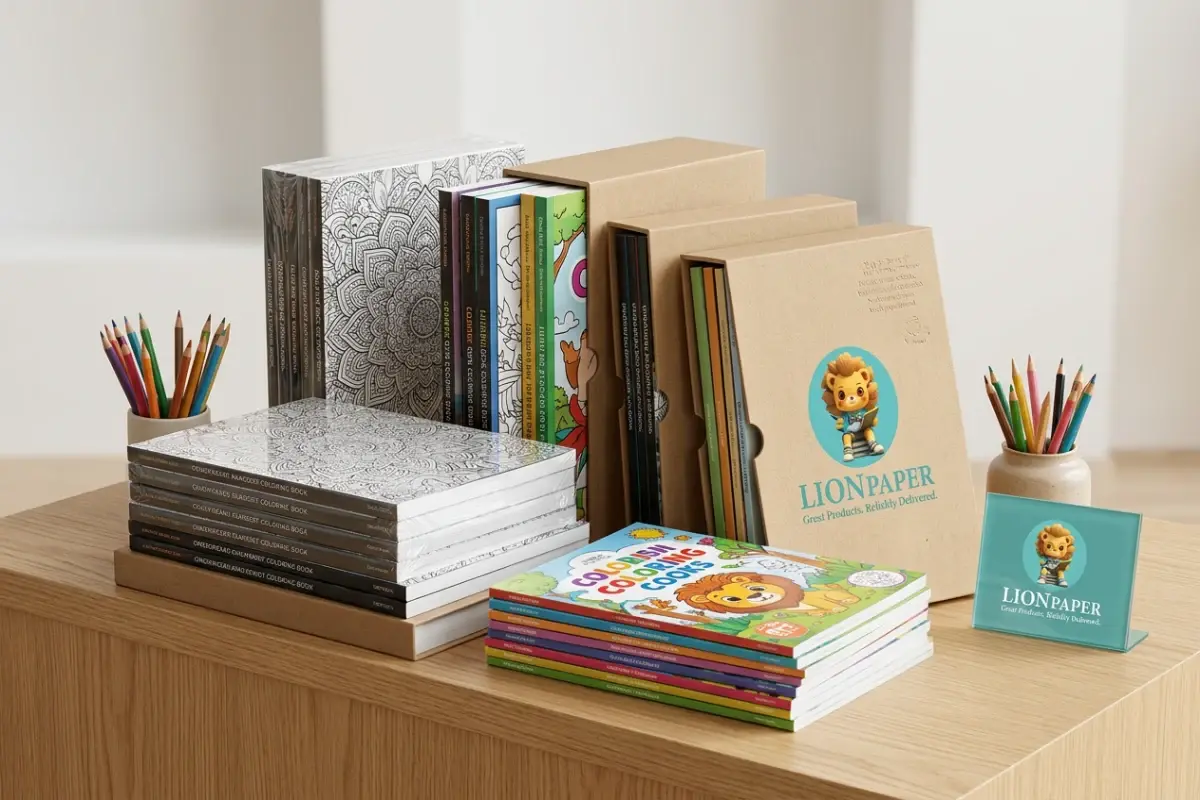
Coloring Book Retail Packaging Protection: Engineering, Formats, and Sourcing Guide

Coloring book retail packaging protection prevents cover scuffing, corner denting, spine damage, moisture ingress, and accessory loss across transit and high-traffic retail display. Effective protection combines primary packaging—such as polyolefin shrink film, self-adhesive cello bags, or cardstock slipcases—with engineered inner master cartons, edge guards, and palletizing standards to keep creative paper products pristine from factory floor to checkout counter.
Why is Retail Packaging Protection Critical for Coloring and Activity Books?
Coloring and activity books face distinct physical challenges in retail environments compared to standard commercial trade books. Because coloring books often feature specialty cover treatments, heavier text paper stock, wire or lay-flat bindings, and bundled components like crayons or sticker sheets, unshielded inventory suffers high damage and return rates.
Cover Surface Scuffing and Foil Abrasion: Soft-touch matte lamination, spot UV varnish, and hot-stamped foil on covers quickly rub off during shelf restocking or customer browsing if not shielded by a protective outer barrier.
Corner Denting and Edge Curling: High-grammage woodfree interior paper (typically 100 gsm to 140 gsm) adds weight to the spine, making unprotected corners vulnerable to impact during case packing and carton handling.
Accessory Separation and Theft: Modern coloring sets frequently include value-added accessories such as gel pens, watercolor trays, metallic markers, or sheets of foiled stickers. Secure retail packaging prevents loose components from falling out or being separated on display.
Atmospheric Moisture and Paper Cockling: Uncoated coloring sheets absorb ambient humidity in overseas sea freight containers and retail stockrooms, leading to paper warping and wavy page edges if barrier packaging is omitted.
Storefront Thumbprint and Soil Marking: Open display allows consumers and children to flip through pages, leaving dirt, grease, and accidental pencil marks that render the item unsellable at full retail price.

Polyolefin (POF) shrink wrap provides crystal-clear surface protection and tamper resistance.
Which Packaging Formats Provide Optimal Protection for Retail-Ready Activity Books?
Choosing the appropriate protective packaging format requires balancing structural integrity, retail display requirements, unit cost, and visual merchandising goals. Retail ready packaging for coloring books must satisfy both automated mass-production constraints and point-of-sale appeal.
Packaging Format | Primary Material | Protection Level | Best Suited For | Key Advantages | Trade-Offs |
|---|---|---|---|---|---|
:--- | :--- | :--- | :--- | :--- | :--- |
Polyolefin (POF) Shrink Wrap | 15–19 micron POF Film | High (Surface & Moisture) | Standalone softcover and hardcover coloring books | Crystal clarity, low cost, tamper evidence, tight fit | Requires heat tunnel calibration to avoid book warping |
Resealable OPP / CPP Bags | 30–40 micron Polypropylene | Medium (Surface & Dust) | Wire-O or spiral-bound notebooks and activity pads | Easy manual packing, adhesive strip closure, hang-hole friendly | Looser fit; corner bag overhang can fold in transit |
Paperboard Slipcases / Sleeves | 300–400 gsm C1S / Kraft Board | High (Corner & Edge) | Premium adult coloring books and multi-book sets | Plastic-free, printable surface, rigid edge protection | Higher unit cost; open edge still exposes page rims |
Rigid Presentation Kit Boxes | 1.5–2.0 mm Greyboard + Art Paper | Superior (Full Enclosure) | Complete coloring activity sets with markers and tools | Maximum retail gift appeal, custom thermoformed or paper trays | Heaviest freight weight, highest structural packaging cost |
Thermoformed Clamshells / Blisters | Recycled PET (rPET) | Superior (Impact & Anti-theft) | Peg-hook retail displays with bulky coloring instruments | Full 360-degree product visibility, puncture resistance | Non-biodegradable, higher tooling mold setup fees |
Polyolefin (POF) Shrink Wrapping
Activity book shrink wrapping using cross-linked polyolefin (POF) film remains the global retail standard for standalone books. Unlike PVC film, POF does not emit corrosive fumes or turn brittle over time. When shrunk in a controlled heat tunnel at 140°C to 160°C, POF creates an airtight, puncture-resistant membrane that conforms tightly to the product profile without curling the cover edges.
Cardstock O-Sleeves and Tuck Slipcases
For plastic-free sustainability mandates, structural paperboard sleeves provide targeted protective packaging for paper stationery. An O-sleeve wraps around the book horizontally or vertically, shielding the front, back, and spine while locking spiral coils in place. Premium adult coloring lines utilize structural slipcases made of rigid greyboard wrapped in FSC-certified art paper, completely defending three vulnerable book edges against shelf drop impacts.
Retail Display Kit Packaging for Multi-Piece Sets
When designing retail shelf packaging for activity sets that bundle coloring books with color pencils, paint pots, or stencils, custom-engineered kit packaging is essential. These packages integrate internal vacuum-formed rPET or molded paper-pulp inserts that cradle each accessory securely. A clear acetate window or a hinged magnetic closure keeps all contents immobile during transit while demonstrating product value directly to shoppers.
How Do You Balance Sustainability, Child Safety Compliance, and Shelf Merchandising?
Retail packaging for coloring books must comply with strict international safety standards while meeting commercial demand for eco-friendly, shelf-attractive stationery.
FSC-Certified Paperboard + Non-Toxic Inks & Adhesives │ ▼ Recyclable Barrier Films / Cardstock Sleeves │ ▼ CPSIA / EN71 Testing: Lead, Phthalates, Small Parts │ ▼ Optimized Shelf Display: Hang Tabs / Tear-Away PDQ Trays
Child Safety and Regulatory Compliance (CPSIA, ASTM F963, and EN 71)
Because children represent a primary audience for coloring and activity sets, packaging materials must adhere to regional consumer product safety directives:
Suffocation Hazard Warnings: Any plastic polybag with an opening of 5 inches or larger must display clear suffocation warning text in multiple languages if distributed in North America or Europe.
Ventilation Holes: Large polybags frequently require micro-perforations or die-cut air release holes to mitigate suffocation risks.
Toxicological Safety: All surface printing inks on outer packaging, varnishes, and laminations must be tested for lead, heavy metals, and restricted phthalates under CPSIA (USA) and EN 71-3 (European Union).
Blunt Edges on Plastic Clamshells: Thermoformed blisters must feature smooth, radiused perimeter cuts rather than sharp flash edges to prevent laceration risks for young end users.
Sustainable Material Integration and Recycling Codes
Brands are increasingly replacing single-use virgin plastics with sustainable alternatives without sacrificing barrier performance. Recyclable POF shrink films can be labeled with SPI Resin Identification Code 4 (LDPE), while paperboard sleeves allow full curbside recycling when paired with water-based dispersion coatings instead of heavy plastic lamination. Sourcing FSC-certified paper for outer boxes guarantees that the packaging supply chain supports responsible forestry management.
Retail Shelf Merchandising and Hanging Mechanisms
For pegboard hanging displays, packaging engineers can integrate reinforced plastic delta-style hang tabs or integrated die-cut headers into the primary cardstock backing. For shelf displays, Point-of-Sale (POS) counter displays and pre-packed display (PDQ) trays made of B-flute or E-flute corrugated board allow retailers to move books directly from the master shipper onto the shelf with zero individual handling, preventing display damage.

Rigorous drop and compression testing ensures outer cartons defend inner books against impact.
What Quality Control Protocols and Drop Tests Prevent Transit and Warehouse Damage?
Even the most attractive consumer packaging will fail if secondary and tertiary transport packaging is under-engineered. Quality assurance protocols must simulate extreme physical stressors encountered across ocean freight, container drayage, and pallet handling.
Primary Packaging Testing Standards
Shrink Tension and Curl Inspection: Automated shrink tunnels must be calibrated to ensure the film creates uniform pressure across the book face without bending lightweight 250 gsm or 300 gsm paperboard covers.
Heat Seal Strength Verification: Pinhole leaks and weak seal seams along the perimeter of polybags and shrink wraps are checked using vacuum dye-leak testing to verify moisture-tight seals.
Rub Resistance (Sutherland Rub Test): Printed packaging surfaces undergo standardized friction testing (up to 400 strokes) to verify that scuff-resistant varnishes withstand box-to-box vibration during shipping.
Master Shipper and Transit Engineering
To safeguard coloring book retail packaging protection, master cartons must be engineered according to standardized International Safe Transit Association (ISTA) protocols:
Corrugated Board Grade Selection: Use double-wall (BC-flute) or high-density single-wall (C-flute) corrugated shippers with an Edge Crush Test (ECT) rating of at least 44 lbs/in or a Bursting Strength of 275 lbs/sq inch.
Moisture Desiccant Packs: In ocean freight shipping, container desiccant poles and food-grade silica gel packets inside inner poly-liners absorb container sweat and condensation.
Corner Angle Boards and Stretch Wrapping: Pallet loads must be fortified with rigid kraft corner posts (minimum 4 mm thickness) and cross-wrapped with multi-layer high-tensile stretch film to eliminate pallet shifting during distribution center sorting.
ISTA 1A / 2A Drop Testing: Packaged master cartons undergo sequential drop tests (1 corner, 3 edges, 6 faces) from heights up to 76 cm, followed by dynamic rotational vibration testing to verify that zero internal books suffer corner crushing or loose accessories.
How Does Dual-Site Manufacturing Optimize Landed Costs for High-Volume Packaging Runs?
Managing coloring book production across multi-node manufacturing networks enables brands to control both upfront development timelines and high-volume landed unit costs.
China Jiaxing Site: 3,000 sqm
Structural Packaging Prototyping
High-Precision Sample Making & Material Testing
Rapid Client Engineering Support │ ▼ Integrated SOPs & Die-Line Transfer Cambodia Mass-Production Site: 10,000 sqm
Automated Printing, Binding & Assembly
High-Speed In-Line Shrink Wrapping & Pack-Out
Scaled Labor for Multi-Component Activity Kits
Prototyping and Fast Sampling in China
At specialized development facilities, structural engineers create precise packaging CAD die-lines, optimize paper nesting, and build digital 3D mockups. Rapid sample cutting tables produce physical, full-scale white samples and color match proofs in 3 to 5 business days. This allows design, purchasing, and marketing teams to evaluate hand-feel, structural clearances for embedded accessories, and pallet cubic efficiency before committing to large-scale tooling investments.
Scaled Production and Assembly in Cambodia
Once packaging specifications and master die-lines are finalized, mass production transfers to high-capacity facilities. High-speed automated binding lines (annual capacities exceeding 5 million notebook and book units) coordinate with in-line shrink-wrapping tunnels and automated carton-packing systems. For multi-piece activity sets requiring hand-assembly of stickers, stencils, and marker trays, scaled regional labor operations keep kitting costs low while adhering to strict AQL Level II inspection guidelines.
Total-Cost Efficiency and Supply Chain Risk Mitigation
By leveraging dual-site manufacturing synergy, global importers navigate shifting tariff landscapes, secure competitive freight access, and balance seasonal production surges. Standardized operating procedures (SOPs), uniform defect libraries, and consistent color management ensure that packaging assembled across different production nodes maintains identical retail shelf quality.

In-line automated packaging ensures tight wrapping tolerances and secure component placement.
What Specifications Must You Include in an RFQ for Retail-Ready Coloring Book Packaging?
To ensure rapid, accurate quotation and manufacturability review from paper packaging suppliers, procurement teams should furnish a comprehensive Request for Quotation (RFQ) detailing product dimensions, material grammages, and pack-out parameters.
Comprehensive RFQ Data Checklist
Book Trim Size & Orientation: Exact width, height, and spine bulk thickness in millimeters (e.g., 210 x 297 mm, 8 mm spine).
Interior Page Count and Substrate: Total page count (e.g., 96 pages / 48 sheets) and paper weight (e.g., 120 gsm woodfree offset paper, FSC Mix).
Cover Material & Finishing: Cover stock grammage (e.g., 350 gsm C1S cardstock), outer lamination (gloss, matte, anti-scuff), and decorative finishes (spot UV, foil stamping, embossing).
Binding Method: Saddle stitch, wire-o / double-spiral (including wire diameter and color), perfect binding, or thread-sewn lay-flat binding.
Bundled Components: Exact dimensions, weights, and counts of included colored pencils, pens, sticker sheets, or stencils.
Primary Packaging Requirement: Specific shrink wrap type (POF thickness in microns), individual OPP bag with adhesive flap, cardboard slipcase, or clear rPET blister box with backing card.
Retail Display Packaging (Secondary): Inner carton pack size (e.g., 6 or 12 units shrink-banded or packed into a perforated tear-away retail PDQ display box).
Tertiary Shipping Specifications: Master carton quantity limit (e.g., maximum 24 units / 12 kg gross weight), pallet height restrictions (e.g., maximum 1200 mm including wood pallet base), and barcode/labeling requirements (UPC, EAN, Amazon FNSKU).
Manufacturing and Costing Review
Partnering with an integrated paper stationery converter streamlines structural optimization, helping your brand reduce shipping volume, eliminate plastic waste, and pass retail drop testing without sacrificing visual presentation.
Send your trim size, page count, coloring medium, binding, artwork and target retail pack to Lion Paper for a manufacturability and costing review by visiting our Custom Stationery Supply Chain Inquiry page.
FAQ
What is the standard thickness for shrink film used on retail coloring books?
The industry standard for retail coloring book shrink wrapping is 15 to 19 micron (60 to 75 gauge) cross-linked Polyolefin (POF) film. This thickness provides optimal tensile strength, tear resistance, and high visual clarity without putting excessive shrink tension on lightweight paper covers.
How can coloring book packaging prevent cover curling after shrink wrapping?
Cover curling is prevented by strictly calibrating the heat tunnel temperature (typically 140°C to 155°C) and conveyor speed, utilizing heavier cover stock (minimum 300 to 350 gsm C1S cardstock), applying balanced lamination on both sides of the cover, and allowing books to cool completely under flat pressure before master carton packing.
What safety markings are legally required on polybagged activity books in North America?
In North America, any plastic bag with an opening of 5 inches or wider must carry a clear suffocation warning statement indicating that the bag is not a toy. If products contain drawing instruments or small parts for children, packaging must also include applicable CPSIA tracking labels, ASTM F963 compliance marks, and age-grading advisories.


Comments