


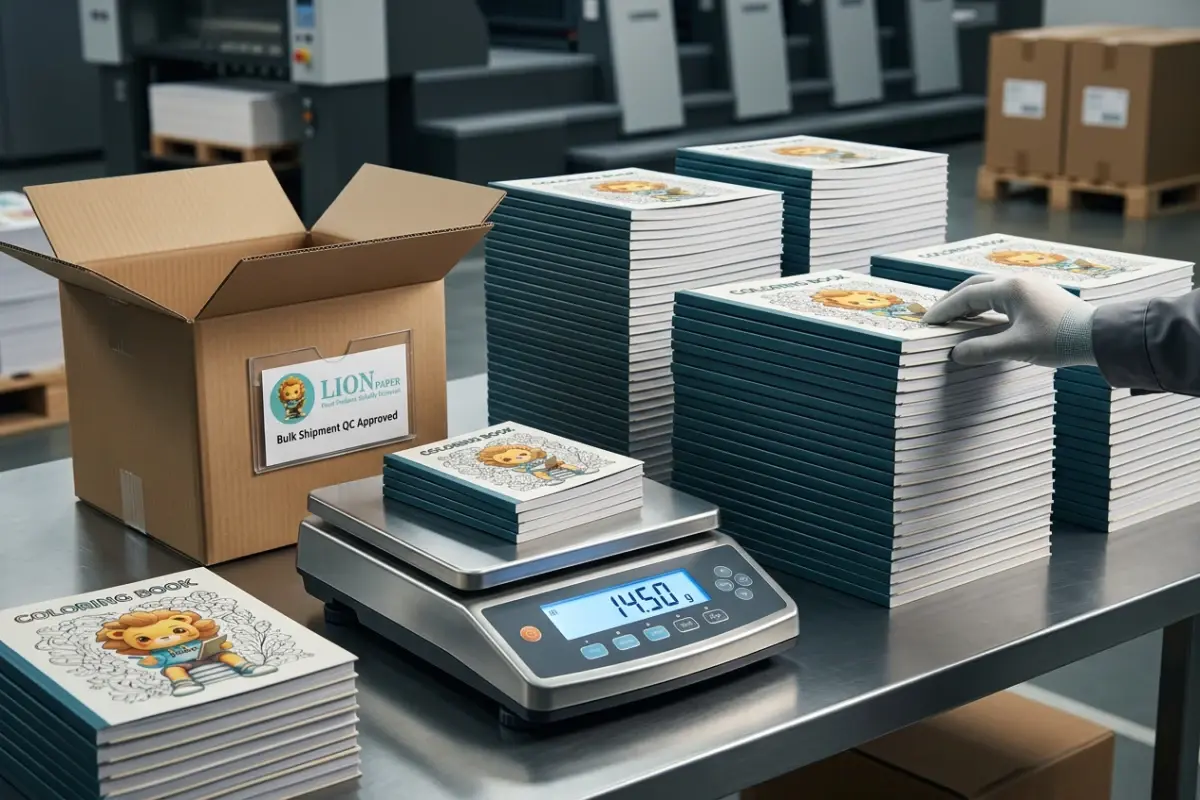
Coloring Book Page Count and Shipping Weight Guide: Calculation, Material Specs, and Freight Optimization

A coloring book's shipping weight is determined by its trim size, total page count, interior paper basis weight (GSM), cover construction, and packaging method. Balancing page count with calibrated paper weights allows publishers and brands to maintain perceived retail volume while avoiding dimensional weight surcharges and high container freight costs.
How Do You Calculate Coloring Book Unit Weight from Page Count and Paper GSM?
Accurate coloring book weight calculation requires separating the physical sheets from the total page count (pagination) and accounting for the cover stock, binding adhesives, and protective packaging materials.
In book manufacturing, page count refers to individual numbered pages (page impressions), meaning one physical sheet of paper equals two pages (front and back). To calculate the net weight of the book interior, you must divide the total page count by two to determine the physical sheet count.
The standard formula for calculating the interior paper weight of a single book is:
Interior Weight (grams) = Trim Width (meters) × Trim Height (meters) × (Interior Page Count / 2) × Interior Paper GSM
To calculate the cover weight, apply the same surface area formula to the flat cover spread (front cover, back cover, plus spine width and wrap-around margins):
Cover Weight (grams) = Cover Width (meters) × Cover Height (meters) × Cover Stock GSM
Total unit weight is the sum of the interior block, cover material, binding consumables (hot-melt EVA/PUR glue, saddle stitch wire, or twin-loop wire), and individual retail packaging such as polybags or shrink wrap.
The table below demonstrates standard unit weights across common trim sizes, page counts, and paper grammages:
Trim Size | Page Count (PP) | Interior Paper GSM | Cover Construction | Estimated Unit Weight (g) | Units per 15 kg Master Carton |
|---|---|---|---|---|---|
:--- | :--- | :--- | :--- | :--- | :--- |
8.5" × 11" (216 × 279 mm) | 64 pp (32 sheets) | 100 gsm Woodfree | 250 gsm C1S Softcover | 222 g | 60 units |
8.5" × 11" (216 × 279 mm) | 96 pp (48 sheets) | 120 gsm Woodfree | 300 gsm C1S Softcover | 382 g | 36 units |
8.5" × 11" (216 × 279 mm) | 128 pp (64 sheets) | 140 gsm Offset | 350 gsm C1S Softcover | 586 g | 24 units |
8.0" × 8.0" (203 × 203 mm) | 80 pp (40 sheets) | 120 gsm Woodfree | 300 gsm C1S Softcover | 224 g | 60 units |
8.5" × 11" (216 × 279 mm) | 112 pp (56 sheets) | 140 gsm Woodfree | 2.0 mm Greyboard Hardcover | 680 g | 20 units |

Selecting high-bulk paper stocks preserves spine thickness while reducing overall shipping mass.
How Do You Balance Page Count and Custom Coloring Book Paper GSM for Retail Perceived Value and Freight?
Balancing perceived shelf thickness against deadweight is critical for managing unit landed costs. When publishers increase custom coloring book paper gsm to prevent ink bleed-through, unit weight climbs rapidly, which compounds freight expenses across ocean container loads and e-commerce courier tiers.
Paper caliper (microns or point thickness) varies depending on the fiber structure and manufacturing finish. High-bulk woodfree offset paper provides greater physical thickness per gram compared to standard coated art papers. Selecting a high-bulk 120 gsm or 140 gsm uncoated woodfree paper delivers the tactile hand-feel and spine thickness of a heavier 160 gsm sheet while eliminating 12% to 25% of the interior paper mass.
Key considerations when balancing page count, sheet grammage, and shipping economics include:
Single-Sided vs. Double-Sided Printing: Single-sided illustrations require twice the physical sheets for the same illustration count. A 50-illustration book printed single-sided requires 100 pages (50 physical sheets), whereas double-sided printing requires only 50 pages (25 physical sheets), halving the interior shipping weight.
Coloring Medium Requirements: Standard wax crayons and colored pencils perform well on 100 gsm to 120 gsm woodfree paper. Alcohol markers, gel pens, and light watercolor washes require 140 gsm to 180 gsm woodfree or high-density offset paper with higher sizing levels to prevent bleed-through and sheet warping.
E-Commerce Shipping Weight Tiers: In postal and direct-to-consumer fulfillment, exceeding specific weight thresholds (such as 0.5 lb, 1.0 lb, or regional postal limits) triggers higher shipping rate brackets. Calibrating sheet count from 112 pages down to 96 pages often keeps an 8.5" × 11" coloring book comfortably below standard 1.0 lb (453.6 g) parcel limits including protective mailers.
How Do Binding Styles and Cover Materials Affect Spine Bulking and Packing Density?
Binding methods dictate how flat books lay in master cartons, directly controlling carton volume, stackability, and pallet space utilization.
Saddle-Stitch Binding: Optimal for thin to mid-thickness books (16 to 64 pages). Wire staples add negligible weight (under 1 gram per book). However, saddle-stitched books flare slightly at the spine edge when stacked, requiring alternating spine-and-edge packing inside cartons to maintain level layering and prevent carton bulge.
Perfect Binding (Milled Spine & PUR/EVA Glue): Ideal for 64 to 192 pages. Square spines create uniform, stackable blocks. Spine thickness must be calculated accurately based on paper bulk factors. Adhesives typically add 2 to 4 grams per unit.
Twin-Loop Wire-O / Spiral Binding: Frequently specified for adult coloring books and premium activity journals to allow flat 360-degree rotation. Metal wire-o coils add 15 to 30 grams per book and increase spine volume by 30% to 50%, reducing the total units that fit into a standard shipping carton.
Softcover vs. Hardcover (Casebound) Construction: A 250 to 350 gsm C1S cardstock softcover adds approximately 35 to 55 grams per 8.5" × 11" book. In contrast, a 2.0 mm to 2.5 mm greyboard casebound cover with endpapers adds 200 to 320 grams per unit, more than doubling the structural tare weight and requiring heavy-duty carton reinforcement.

Engineered export cartons maximize pallet utilization and keep gross weight under 15 kg for safe handling.
How Can Carton Engineering and Pallet Utilization Optimize Bulk Freight Costs?
Achieving activity book freight optimization requires aligning master carton dimensions with standard pallet footprints (ISO/Euro 1200 × 800 mm or North American GMA 48" × 40" / 1219 × 1016 mm) and ocean container load envelopes (20GP, 40GP, 40HQ).
Bulk coloring book carton packaging must protect paper edges from impact crushing while maximizing volume and gross weight limits. Standard international logistics guidelines cap manual handling carton gross weight at 15.0 kg (approx. 33 lbs) to prevent box failure and comply with occupational health regulations.
To engineer export cartons for optimal container packing:
Box Strength Specifications: Use double-wall 5-ply corrugated fiberboard (K=K or K=A grade, minimum 200–275 lbs burst strength / 32–44 ECT) with reinforced edge corners to resist crushing during multi-tier high-cube container stacking.
Elimination of Internal Air Space: Cartons must match the exact dimensions of snugly packed books. Excess headroom causes carton top-sagging under pallet load, compromising stacking integrity.
Moisture Protection: Paper absorbs atmospheric moisture during ocean transit, which increases shipment gross weight and risks fungal or mold growth. Master cartons should be lined with polyethylene barrier bags and silica gel desiccants, followed by full pallet stretch-wrapping.
Below is a freight optimization comparison for shipping 10,000 units of an 8.5" × 11", 96-page softcover coloring book (382 g net unit weight):
Logistics Metric | Non-Optimized Bulk Packaging | Engineered Master Carton Packaging | Optimization Variance |
|---|---|---|---|
:--- | :--- | :--- | :--- |
Units Per Master Carton | 20 units (loose fit) | 36 units (nested snug fit) | +80.0% pack density |
Master Carton Weight | 8.8 kg gross | 14.4 kg gross | Complies with <15 kg safety limit |
Total Master Cartons | 500 cartons | 278 cartons | -44.4% fewer cartons |
Total Shipment Volume | 22.5 CBM | 14.8 CBM | -34.2% CBM savings |
Pallet Footprint (GMA 48"×40") | 14 Pallets | 10 Pallets | -28.5% pallet positions |
40HQ Container Fill Rate | 32% of container capacity | 21% of container capacity | Significant ocean freight reduction |
How Do Paper Safety, Non-Toxic Compliance, and Quality Control Protect Bulk Orders?
Coloring and activity books sold in North America and Europe must satisfy rigorous safety compliance standards, particularly when intended for children or sold in major retail stores.
Chemical Safety & Heavy Metal Screening: Substrates, coatings, and vegetable-based offset inks must comply with CPSIA (Consumer Product Safety Improvement Act), ASTM F963, and European EN 71-3 regulations regarding total lead content, phthalates, and soluble heavy metal migration.
FSC Traceability: Brands targeting sustainable retail environments require FSC-certified (FSC Mix or FSC Recycled) woodfree paper stocks, verified through chain-of-custody documentation.
AQL Quality Inspection & Binding Durability: Mass production requires strict AQL (Acceptable Quality Limit) sampling for page count verification, page pull strength testing (minimum 3.5 N/cm for perfect-bound spines to prevent loose sheets), registration accuracy, and burst resistance.
Lion Paper Products operates dual facilities in Jiaxing, China (3,000 m² focusing on structural development, design, and prototyping) and Cambodia (10,000 m² modern facility handling automated mass production and steady global delivery). With an annual output exceeding 5 million notebook and paper units, both facilities run standardized SOPs, automated binding lines, and defect tracking under ISO 9001, FSC, SMETA, WCA, GSV, FAMA, and CPSIA frameworks.

Pre-production material validation ensures chemical compliance, paper opacity, and accurate freight estimates.
What Technical Specifications Are Needed for a Coloring Book RFQ and Pre-Production Review?
To obtain precise costing, carton packing plans, and freight estimates, publishers and product managers should supply detailed structural parameters during the Request for Quotation (RFQ) stage:
Trim Dimensions: Exact width and height in millimeters or inches (e.g., 216 × 279 mm / 8.5" × 11").
Total Page Count (PP): Interior page impressions including title and copyright pages (e.g., 96 pp interior + 4 pp cover).
Interior Substrate: Paper type, finish, and basis weight (e.g., 120 gsm FSC Uncoated High-Bulk Woodfree Paper).
Cover Construction: Cardstock weight or board core thickness, printing method, and lamination (e.g., 300 gsm C1S Artboard with Matte Soft-Touch Lamination and Spot UV).
Binding Style: Saddle stitch, square spine perfect bound, PUR glue bound, or wire-o spiral.
Finishing & Accessories: Perforated tear-out lines, sticker sheets, metallic foil stamping, or belly bands.
Packaging & Unit Labeling: Individual shrink wrapping, barcode sticker placement, master carton quantity, and pallet stacking height restrictions.
Send your trim size, page count, coloring medium, binding, artwork and target retail pack to Lion Paper for a comprehensive manufacturability, structural packaging, and costing review.
Frequently Asked Questions (FAQ)
How many pages should a standard children's coloring book have to maintain affordable shipping?
Most standard children's coloring books feature 48 to 64 pages (24 to 32 physical sheets) on 100 gsm to 120 gsm woodfree paper with saddle-stitch binding. This keeps the unit weight between 160 g and 230 g, fitting well within economy postal classes and allowing up to 60 units per standard 15 kg export carton.
What is the best paper weight to prevent marker bleed-through without making the coloring book too heavy?
A basis weight of 140 gsm to 160 gsm uncoated woodfree paper is the industry standard for preventing bleed-through from standard water-based markers and gel pens. For alcohol-based markers, bleed-through is inevitable on standard pulp paper; publishers generally recommend single-sided illustration printing on 140 gsm paper with a protective blotter page.
Why does dimensional weight (DIM weight) matter for coloring book shipments?
Dimensional weight reflects carton volume rather than actual mass. Because paper is dense, standard coloring books typically reach physical weight limits before dimensional volume limits. However, wire-o spiral bound books or loosely packed master cartons contain excess air space, causing courier carriers (FedEx, UPS, DHL) to charge based on dimensional volume rather than actual scale weight.
FAQ
How many pages should a standard children's coloring book have to maintain affordable shipping?
Most standard children's coloring books feature 48 to 64 pages (24 to 32 physical sheets) on 100 gsm to 120 gsm woodfree paper with saddle-stitch binding. This keeps the unit weight between 160 g and 230 g, fitting well within economy postal classes and allowing up to 60 units per standard 15 kg export carton.
What is the best paper weight to prevent marker bleed-through without making the coloring book too heavy?
A basis weight of 140 gsm to 160 gsm uncoated woodfree paper is the industry standard for preventing bleed-through from standard water-based markers and gel pens. For alcohol-based markers, bleed-through is inevitable on standard pulp paper; publishers generally recommend single-sided illustration printing on 140 gsm paper with a protective blotter page.
Why does dimensional weight (DIM weight) matter for coloring book shipments?
Dimensional weight reflects carton volume rather than actual mass. Because paper is dense, standard coloring books typically reach physical weight limits before dimensional volume limits. However, wire-o spiral bound books or loosely packed master cartons contain excess air space, causing courier carriers (FedEx, UPS, DHL) to charge based on dimensional volume rather than actual scale weight.


Comments