


Colored Pencil Swatch Accuracy: Quality Control, Pigment Payoff, and Substrate Compatibility Guide

Colored pencil swatch accuracy evaluates how precisely a pencil core's physical pigment deposit matches printed reference swatches, barrel coatings, and digital color standards across standardized substrate textures and production runs. Achieving high fidelity requires rigorous pigment-to-wax binder formulation control, optical spectrophotometry (Delta E < 2.0), pencil pigment payoff and opacity testing, and comprehensive testing on companion paper surfaces to prevent color drift in finished art sets.
What Is Colored Pencil Swatch Accuracy and Why Is It Critical for Art Brands?
Colored pencil swatch accuracy represents the quantitative and visual alignment between the dry pigment laydown on a target substrate and its designated color reference, such as a Pantone target, barrel lacquer, printed packaging swatch, or marketing collateral. In consumer and professional art markets, color discrepancy is one of the leading drivers of product returns, negative e-commerce reviews, and diminished brand equity.
When retail buyers, artists, or hobbyists purchase a colored pencil set—whether a 12-piece student pack or a 120-piece artist-grade tin—they rely on printed swatches, tin artwork, and dipped end-caps to predict color outcomes. If an ultramarine core delivers a muted, desaturated blue or exhibits inconsistent opacity under standard pressure, user trust deteriorates immediately. For stationery brands developing curated kits containing both coloring pencils and companion journals, precise color harmony across media is an absolute prerequisite.
From a technical manufacturing perspective, colored pencil swatch accuracy is determined by four foundational pillars:
Pigment Dispersion and Purity: High-grade organic and inorganic pigments finely milled to under 5 microns guarantee clean chromatic saturation without gritty undertones or unblended speckles.
Binder-to-Filler Ratio: The balance between paraffin or microcrystalline wax, vegetable oils, calcium carbonate, and kaolin clay determines how easily the core transfers pigment to paper fibers under hand pressure.
Optical Consistency (CIELAB Space): Verifying color coordinates (L*, a*, b*) using spectrophotometers ensures that batch variance remains within strict commercial tolerances against signed-off golden masters.
Substrate Calibration: Calibrating swatch charts against the specific grammage, sizing, and tooth of the companion paper bundled within the art kit or sketchbook.
Quality Grade | Delta E (CIELAB) Tolerance | Core Composition Target | Primary Target Audience |
|---|---|---|---|
:--- | :--- | :--- | :--- |
Scholastic / Entry-Level | Delta E <= 3.5 | High filler, wax-dominant | Mass-market school & hobbyist |
Creative / Studio Tier | Delta E <= 2.0 | Balanced oil-wax, mid-filler | Journaling, adult coloring, craft |
Professional / Fine Art | Delta E <= 1.0 | High pigment load, low filler | Fine artists, illustrators, designers |

Standardized draw-down tests evaluate pigment payoff, friction, and opacity against target substrates.
Which Standardized Protocols Govern Pencil Pigment Payoff and Opacity Testing?
To ensure reliable colored pencil swatch accuracy, manufacturers implement standardized pencil pigment payoff and opacity testing across prototyping and mass production. Physical testing removes subjective visual assessment, replacing human visual bias with measurable friction, deposition weight, and light-reflectance values across calibrated testing surfaces.
Industrial laboratories execute four critical testing workflows to qualify core batches prior to mass extrusion and packaging:
1. Mechanical Drawdown and Laydown Friction Testing
Automated mechanical arms apply controlled vertical loads (typically calibrated at 150g for light stroke simulation, 300g for medium shading, and 500g for heavy burnishing) across standardized test sheets at fixed angles (usually 45 degrees or 90 degrees) and speeds (10 mm/s to 25 mm/s). High-precision micro-balances measure the exact weight of pigment deposited per 100 meters of stroke path. This test quantifies core friction, glide smoothness, and the rate of core consumption, ensuring that every color in a 72-piece palette delivers uniform tactile resistance.
2. Contrast Ratio and Opacity Measurement
Opacity is assessed by applying uniform pencil strokes over a standardized black-and-white Leneta opacity contrast card. Using a calibrated spectrophotometer or densitometer, technicians measure the reflectance of the pigmented layer over the black substrate (R0) versus the reflectance over the white substrate (Rwhite):
$$ ext{Opacity (\%)} = \left(\frac{R_0}{R_ ext{white}} ight) imes 100$$
Artist-grade opaque tones (such as titanium white, pastel yellows, or cadmium reds) must achieve high contrast values to facilitate layering and highlighting on dark toned sketch papers, while transparent glaze colors must demonstrate predictable translucency for multi-layer color blending.
3. Spectrophotometric Delta E Assessment
Pencil swatches are evaluated under D65 standard daylight illuminant within a controlled light booth (such as GretagMacbeth or VeriVide systems). Spectrophotometers capture CIELAB coordinates to calculate total color difference:
$$\Delta E_{ab}^* = \sqrt{(\Delta L^)^2 + (\Delta a^)^2 + (\Delta b^*)^2}$$
A tolerance of Delta E < 1.5 is standard for brand-name private label assortments, ensuring that mass-produced cores align indistinguishably with signed-off golden sample cards and printed packaging swatches.
4. Core Break Strength and Hardness Testing
Color payoff is directly linked to core hardness. Technicians evaluate breaking resistance using universal mechanical testing machines that apply perpendicular point loads to sharpened cores until fracture occurs. For standard 3.0mm to 3.8mm cores, minimum break strength is calibrated between 1.8 N and 3.5 N, balancing buttery deposition with point retention during sharpening.
How Does Art Kit Pencil and Paper Compatibility Influence Swatch Fidelity?
A pencil core never functions in isolation; its apparent swatch accuracy depends on art kit pencil and paper compatibility. Even a color-accurate pencil core will underperform or shift hue if applied to an incompatible paper substrate. When manufacturing bundled stationery sets, planners with colored pencil accessories, or all-in-one art sets, technical teams evaluate three key paper characteristics:
Surface Texture and Tooth (Frictional Abrasion Profile)
Smooth / Hot-Press (Roughness < 50 ml/min Bendtsen): Provides crisp, clean line work but limited mechanical grip. Wax-heavy pencils may slide without depositing full pigment depth, resulting in washed-out, undersaturated swatches.
Medium Tooth / Vellum (Roughness 150–300 ml/min Bendtsen): The optimal balance for multi-purpose art kits and guided journals. Paper micro-cavities abrade the pencil core evenly, capturing rich pigment layers while allowing smooth blending and burnishing.
Rough / Cold-Press (Roughness > 400 ml/min Bendtsen): High mechanical tooth extracts maximum pigment, creating deep saturation, but breaks fine points quickly and leaves white flecks in deep valleys if core hardness exceeds 2B equivalents.
Paper Sizing and Internal Fiber Chemistry
Internal sizing (such as alkyl ketene dimer or rosin) and surface starch sizing control liquid absorption and surface fiber rigidity. Under-sized paper can result in fiber lifting during heavy burnishing, causing surface pilling. Over-sized, non-porous paper resists pigment adhesion, requiring excessive user pressure that can cause core fracture and hand fatigue.
Substrate Whiteness and Base Tone (CIE Whiteness vs. ISO Brightness)
Pencil pigments are semi-opaque to translucent. A high-whiteness substrate (CIE Whiteness 150–165, ISO Brightness > 98%) reflects true, vibrant chromaticity. When paired with unbleached kraft, cream sketch paper (ISO Brightness 75–82%), or recycled papers, yellow, pink, and sky-blue swatches exhibit an optical shift toward warmer, desaturated spectra. Swatch reference charts must therefore be printed directly on the companion paper stock to prevent misleading customer expectations.
Paper Substrate Type | Basis Weight | Surface Tooth Characteristic | Optimal Core Pairing | Swatch Payoff Performance |
|---|---|---|---|---|
:--- | :--- | :--- | :--- | :--- |
Smooth Woodfree Paper | 100–120 gsm | Low roughness, hard finish | Medium-soft wax cores (2.8–3.0mm) | Clean single-pass lines, crisp notes |
Sketch Vellum Paper | 140–160 gsm | Balanced micro-tooth | Oil-wax hybrid cores (3.3–3.8mm) | High saturation, 4–6 layering passes |
Mixed Media Art Paper | 180–250 gsm | Medium-rough tooth | Soft pigment-dense cores (3.8mm) | Full opacity, accepts light wash blending |
Recycled Kraft Paper | 120–200 gsm | Fibrous, warm undertone | High-opacity wax cores (3.5mm) | Muted tones; whites pop with high opacity |

Substrate tooth and internal sizing directly affect colored pencil laydown, depth, and swatch fidelity.
What Production Variables Cause Batch to Batch Pencil Color Consistency Failures?
Maintaining batch to batch pencil color consistency across high-volume OEM/ODM manufacturing cycles requires strict process discipline. When variance occurs between production lots, it typically stems from one of four critical manufacturing bottlenecks:
1. Raw Pigment Lot Variability
Commercial pigment syntheses can experience subtle hue shifts and particle size distribution shifts from one raw chemical batch to the next. If suppliers alter chemical sources without optical pre-qualification, secondary undertones (such as green-undertone blues versus red-undertone blues) deviate from approved golden masters. Standardizing pigment purity and dispersion milling to sub-micron thresholds prevents this chromatic drift.
2. Extrusion and Thermal Baking Variance
Pencil leads are formed by mixing pigments, binders, and clays into a homogeneous dough, which is extruded into continuous rods and heat-cured in drying ovens. Temperature fluctuations in drying kilns (even by ±5°C) alter the crystal structure of the wax and clay matrix. Over-curing yields brittle, scratchy cores that deposit less pigment; under-curing leaves excess residual moisture, leading to soft cores that smear and deposit heavy, uneven blotches.
3. Wax Impregnation Imbalance
After extrusion and cutting, clay-based cores undergo a hot wax/fat immersion bath to infuse smooth gliding properties. Inconsistent soak durations or fluctuating wax tank temperatures create uneven wax absorption across core centers compared to their outer perimeters, resulting in changing swatch depth as the pencil is sharpened down by the end user.
4. Wax Bloom and Surface Migration
In wax-dominant formulations, unbonded low-molecular-weight fatty acids can migrate to the surface of the pencil mark or core tip over time, forming a hazy white crystalline film known as wax bloom. This film scatters light and artificially desaturates the swatch appearance until wiped clean with a cloth. Preventing this requires precise antioxidant blending, microcrystalline wax stabilizers, and balanced oil-to-wax ratios.
What Are the Colored Pencil Quality Control Standards Across the Supply Chain?
Industrial colored pencil quality control standards operate through multi-stage gating systems that monitor compliance from raw material compounding to final packaging assembly. A standard factory QA protocol follows an AQL (Acceptable Quality Limit) framework (typically AQL 1.0 critical / 2.5 major for retail stationery brands), incorporating ISO 9001 quality management procedures.
Quality Inspection Gate | Verification Parameters | Testing Methodology | Acceptance Standard |
|---|---|---|---|
:--- | :--- | :--- | :--- |
Gate 1: Raw Materials | Heavy metals, purity, particle size | ICP-MS chemical analysis & laser diffraction | CPSIA, EN71-3, ASTM D-4236, d90 < 5um |
Gate 2: Core Extrusion | Diameter, concentricity, hardness | Digital micrometer & point-load fracture | Diameter +/- 0.05mm, break force > 2.0N |
Gate 3: Casing & Dipping | Wood moisture, lacquer color match | Moisture probe & CIELAB spectrophotometer | Wood moisture 8-11%, Lacquer Delta E < 1.0 |
Gate 4: Final Assembly | Swatch print accuracy, packaging fit | 100% visual sort & AQL sampling audits | AQL 1.0 critical, packaging barcode verified |
Wood Slat Sourcing and Core Concentricity
Quality pencil production utilizes defect-free, FSC-certified basswood or incense cedar slats. Grooving machines mill parallel channels to tight tolerances (±0.02mm). If the core is glued off-center, sharpening blades exert uneven shear torque, fracturing the lead and producing irregular angle contact during swatching.
Chemical and Environmental Safety Compliance
Art products directed to North American, European, and global retail channels must strictly comply with mandatory safety frameworks:
ASTM D-4236 (LHAMA): Toxicological review by board-certified toxicologists verifying that all colorants and binders are non-toxic and properly labeled for chronic health hazards.
CPSIA / Prop 65 (USA): Stringent lead limits (< 90 ppm for surface coatings) and phthalate screening for all outer lacquer dips and components.
EN 71-3 (European Union): Heavy metal migration limits governing 19 elements including antimony, arsenic, barium, cadmium, chromium, lead, and mercury.
FSC Certification: Complete chain-of-custody documentation verifying sustainable forestry practices for wooden casings and companion paper.
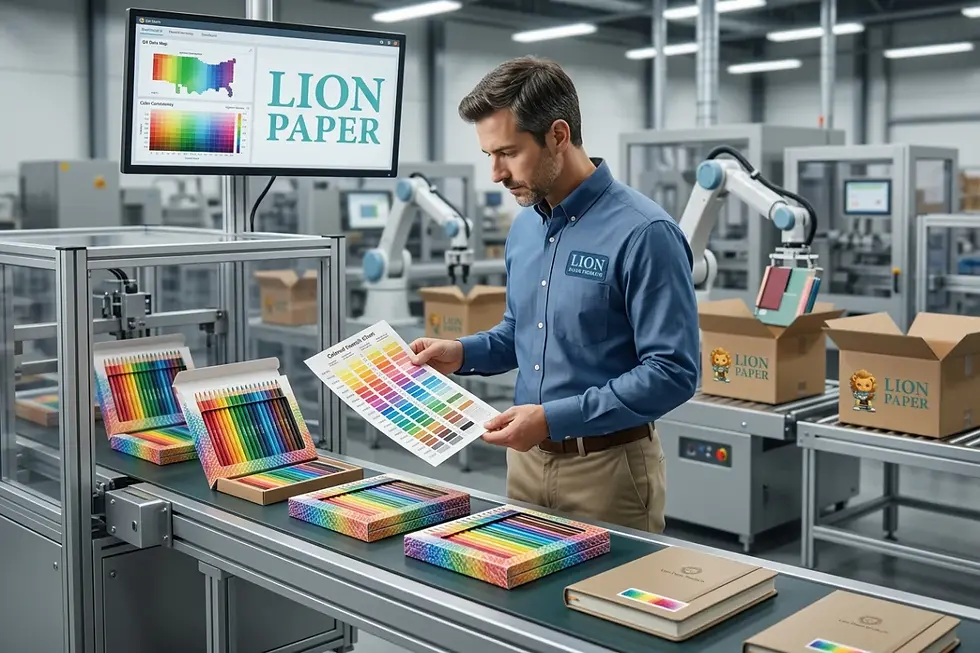
Multi-stage QA inspection protocols safeguard batch-to-batch pencil color consistency and packaging integrity.
How Does China-Cambodia Dual-Site Synergy Streamline Custom Art Kit Manufacturing?
Developing customized art products, journals, and multi-component creative kits requires balancing advanced technical engineering with cost-efficient, scalable manufacturing. Lion Paper Products (Jiaxing) Co., Ltd., established in 2015 in Jiaxing, Zhejiang, utilizes a China-Cambodia dual-site operational model designed to resolve these supply-chain trade-offs for international brand owners and retail buyers.
Jiaxing Base (3,000 m²): Design, Development, and Fast Sampling
The Jiaxing facility serves as the technical engine for R&D, structural design, companion paper pairing, and color-matching validation:
Rapid Prototyping: Physical mockups, custom-dipped pencil samples, and custom printed swatch cards developed in short turnaround windows.
Substrate Calibration: In-house laboratory testing pairs custom notebook papers (from 70 gsm lightweight planners to 300 gsm mixed media sketchbooks) with specific core hardness grades.
Compliance Engineering: Pre-production validation covering FSC materials, ISO 9001 compliance, low-impact printing, and international audit alignment (SMETA, WCA, GSV, FAMA).
Cambodia Base (10,000 m²): Scaled Production, Assembly, and Delivery
Mass production transitions to the Cambodia production facility, delivering volume stability, cost optimization, and supply-chain resilience:
Automated Production Lines: Standardized SOPs govern multi-piece kit packing, tin box assembly, blister packaging, and palletization.
Over 5 Million Annual Notebook Capacity: Seamlessly combines high-volume binding lines with pencil and accessory kit integration across global export routes.
Tariff and Export Optimization: Flexible shipping options to North America, Europe, Australia, the Middle East, and Southeast Asia.
This end-to-end integration ensures that retail stationery brands, creator labels, Amazon DTC businesses, and institutional buyers receive fully vetted, color-accurate creative products from initial sketch to final container delivery.
What Should Product Developers Include in a Colored Pencil and Notebook Specification Checklist?
Before issuing a Request for Quotation (RFQ) or approving tooling for a new art set, brand managers and product developers should complete a comprehensive technical specification matrix:
Core Mechanical & Formulation Targets:
Core diameter (e.g., 2.8mm student, 3.3mm standard, 3.8mm artist).
Binder base (Wax-dominant, Oil-wax hybrid, or Water-soluble / Watercolor).
Target core break strength (minimum 2.2 N).
Color Accuracy & Range Benchmarks:
Assortment size (12, 24, 36, 48, 72, 120 colors).
Reference standard (Pantone Solid Coated / Uncoated or Lab values).
Maximum allowable Delta E tolerance (e.g., Delta E <= 1.5 against master swatch).
Printed insert swatch chart on actual companion paper stock.
Companion Paper & Substrate Specifications:
Basis weight (gsm) and thickness (caliper in microns).
Paper surface roughness (Bendtsen/Sheffield) and sizing level.
Paper color temperature (natural cream vs. high-white) and ISO brightness.
Binding method (spiral, wire-o, case-bound, or pad-bound flat lay).
Packaging, Retail-Ready, & Compliance Formats:
Casing finish (full-dip lacquer, matte rubberized, natural wood with color-matched foil stamp).
Outer container (rigid gift box, printed tin, sliding cardboard drawer, or fabric organizer pouch).
Mandatory regional testing requirements (CPSIA, EN71, ASTM D-4236, FSC chain-of-custody).
To begin tailoring a custom creative collection engineered to exact performance benchmarks, Share target user, color count, performance level, packaging and companion paper; request a colored-pencil test and assortment proposal.
Frequently Asked Questions
What causes wax bloom on colored pencil swatches, and how is it prevented during production?
Wax bloom occurs when low-molecular-weight fatty acids and paraffin wax within a pencil core migrate to the surface after application, reacting with ambient air to form a chalky white haze. During production, manufacturers prevent wax bloom by incorporating microcrystalline waxes, natural plant waxes, and stabilizing fatty acid modifiers that bind the wax matrix securely to the pigment particles.
How does paper sizing influence colored pencil blending and layering capacity?
Paper sizing determines how deeply pigment particles can settle into surface cellulose fibers. Lightly sized paper allows high initial pigment grab but may saturate quickly, preventing multi-layer blending. Heavily sized paper keeps the pigment resting on the extreme surface, allowing multiple color glaze layers and burnishing, though it requires slightly higher application pressure to establish the initial base swatch.
What is the acceptable Delta E tolerance for commercial colored pencil manufacturing?
For mass-market retail and back-to-school stationery, a Delta E <= 3.0 to 3.5 is standard commercial practice. For mid-tier designer sets and premium art collections, brands require a tighter tolerance of Delta E <= 1.5 to 2.0. High-end professional artist-grade pencils operate under Delta E <= 1.0 against master reference swatches to ensure complete visual uniformity across production batches.
FAQ
What causes wax bloom on colored pencil swatches, and how is it prevented during production?
Wax bloom occurs when low-molecular-weight fatty acids and paraffin wax within a pencil core migrate to the surface after application, reacting with ambient air to form a chalky white haze. During production, manufacturers prevent wax bloom by incorporating microcrystalline waxes, natural plant waxes, and stabilizing fatty acid modifiers that bind the wax matrix securely to the pigment particles.
How does paper sizing influence colored pencil blending and layering capacity?
Paper sizing determines how deeply pigment particles can settle into surface cellulose fibers. Lightly sized paper allows high initial pigment grab but may saturate quickly, preventing multi-layer blending. Heavily sized paper keeps the pigment resting on the extreme surface, allowing multiple color glaze layers and burnishing, though it requires slightly higher application pressure to establish the initial base swatch.
What is the acceptable Delta E tolerance for commercial colored pencil manufacturing?
For mass-market retail and back-to-school stationery, a Delta E <= 3.0 to 3.5 is standard commercial practice. For mid-tier designer sets and premium art collections, brands require a tighter tolerance of Delta E <= 1.5 to 2.0. High-end professional artist-grade pencils operate under Delta E <= 1.0 against master reference swatches to ensure complete visual uniformity across production batches.


Comments