


Colored Pencil Layering and Burnishing: Technical Guide & Manufacturing Specs

Colored pencil layering builds translucent tonal depth across toothy paper surfaces by applying sequential light-pressure strokes, while burnishing uses heavy pressure, friction, or colorless blenders to collapse the paper tooth and fuse wax- or oil-based pigments into a smooth, saturated, and reflective finish. Achieving professional results requires matching binder chemistry, pigment load, and paper sizing to prevent binder bloom, fiber tearing, or uneven color saturation.
What Is the Mechanical Difference Between Colored Pencil Layering and Burnishing?
Colored pencil layering and burnishing represent the two foundational mechanical phases in colored pencil artwork. Understanding their structural behavior at the microscopic surface level determines how pigments interact, how light refracts through the binder, and how the underlying paper substrate preserves structural integrity.
Layering is the additive application of pigment particles bound in wax, oil, or hybrid binders over the microscopic peaks and valleys—known as tooth—of a paper surface. During layering, an artist applies minimal to medium mechanical pressure (approximately 1 to 3 on a 5-point pressure scale). This gentle application deposits pigment primarily onto the peaks of the paper texture without flattening the valleys. Because the paper tooth remains open, multiple distinct pigment layers can sit atop one another. Translucent pigment films allow incoming light to pass through sequential color films, reflect off the white cellulose fibers below, and return to the viewer's eye as an optical mixture. For instance, layering transparent cyan over primary yellow produces a vibrant chromatic green that retains luminosity and dimensional depth.
Burnishing is the subtractive or consolidating process that completes the layering sequence. When burnishing, an artist applies high mechanical pressure (4 to 5 on the scale) using a hard colored pencil, a dedicated colorless blender pencil, a paper stump, or an inert solvent. This force shears the pigment particles, forces binder materials deep into the microscopic valleys of the paper tooth, and physically levels the surface texture into a flat, mirror-like plane. Once a surface is fully burnished, the paper tooth is completely exhausted; no additional pencil pigment can adhere mechanically unless an abrasive or solvent intermediate is introduced. Light reflects off a burnished surface specularly rather than diffusely, creating deep color saturation, high contrast, and a smooth sheen similar to oil painting.
Mechanical Property | Layering Phase | Burnishing Phase |
|---|---|---|
:--- | :--- | :--- |
Applied Pressure | Low to moderate (100–300 g/cm²) | High to heavy (600–1200 g/cm²) |
Paper Tooth Status | Preserved and open | Fully flattened and compacted |
Pigment Distribution | Dispersed over surface peaks | Fused continuously into valleys |
Optical Appearance | Translucent, atmospheric, luminous | Dense, glossy, saturated, opaque |
Layer Receptivity | Accepts multiple subsequent passes | Zero mechanical tooth remaining |
Primary Tooling | Soft/medium cores, sharp points | Blender cores, hard leads, solvents |

Layering preserves paper tooth for optical color mixing, whereas burnishing compresses cellulose fibers to create smooth saturation.
How Do Wax vs Oil Colored Pencils Perform During Multi-Layer Blending?
Core formulation dictates how colored pencils behave during prolonged layering sequences and aggressive burnishing. The industry divides fine-art and commercial pencil leads into wax-based, vegetable or mineral oil-based, and proprietary hybrid formulations. Comparing wax vs oil colored pencils reveals distinct functional differences in binder viscosity, blending speed, core shear strength, and post-application stability.
Wax-based colored pencils utilize paraffin, beeswax, microcrystalline wax, or carnauba wax compounds to carry the dry pigment particles. Wax formulations typically feature a softer core hardness (ranging from 2B to 4B equivalent), releasing a rich volume of pigment with minimal hand fatigue. Under the friction heat generated by rapid strokes, wax binders soften quickly, enabling seamless transitions during colored pencil blending techniques. However, wax-based cores deposit thicker binder films. After 4 to 6 heavy layers, wax cores can generate "wax bloom"—a natural oxidation phenomenon where excess wax migrates to the paper surface, leaving a cloudy, whitish film that dulls dark values. Wax bloom requires wiping with a dry microfiber cloth or sealing with a non-yellowing final fixative.
Oil-based colored pencils incorporate drying oils, such as linseed, soy, or synthetic plant oils, blended with hard waxes and binding gums. These cores maintain higher structural hardness (ranging from HB to 2H equivalent) and resist point breakage under heavy downward pressure. Because oil binders do not melt readily from ambient hand warmth, they deposit thinner, crisper, and more controlled pigment films. An artist can apply 15 to 25 micro-layers without clogging the paper grain or triggering bloom. Oil-based leads excel at intricate detail rendering, technical illustration, and razor-sharp linear gradations, though they demand higher manual pressure or solvent assists during final burnishing.
Wax-Based Core Attributes: Rapid blending, high opacity on initial pass, butter-smooth laydown, sensitive to thermal friction, susceptible to wax bloom under heavy saturation.
Oil-Based Core Attributes: High point retention, minimal binder buildup, zero wax bloom, exceptional lightfast pigment suspension, requires progressive layering to build saturation.
Hybrid Binder Systems: Modern OEM formulations combining synthetic ester waxes with modified polymer resins to balance rapid blending with break-resistant point retention.
What Paper Tooth and Substrate Weight Are Required for Colored Pencil Blending Techniques?
Choosing the correct companion paper is critical when executing advanced colored pencil layering and burnishing. Without sufficient paper tooth for colored pencil applications, binder layers slip across the sheet without depositing pigment. Conversely, if the paper substrate lacks internal structural strength or sizing, heavy burnishing pressure will crush the cellulose core, buckle the sheet, or tear surface fibers.
Paper tooth refers to the tactile surface profile created during the papermaking process. Cold press fine art papers, vellum-finish bristol boards, and heavy cartridge sketch papers offer an optimal medium tooth profile (roughly 20 to 40 microns in valley depth). This tooth depth provides sufficient mechanical friction to scrape pigment particles off the pencil core during initial light passes while leaving adequate valley volume to hold subsequent glaze layers. Smooth hot-press papers and plate-finish bristols have minimal tooth; they yield ultra-sharp line fidelity but saturate and slip after only 2 to 3 layers. Extremely rough watercolor papers (rough cold press) hold dozens of layers but require massive pigment volume and intense burnishing effort to eliminate white specks.
Paper basis weight and fiber composition determine how well the substrate withstands continuous mechanical stress:
Lightweight Sketch Paper (80–120 gsm): Suitable only for basic sketches or light single-layer studies. High burnishing pressure causes sheet stretching, fiber delamination, and severe cockling.
Medium Multi-Technique Paper (140–180 gsm): The standard commercial benchmark for private label art notebooks and coloring journals. Supports 5 to 8 pigment layers and moderate burnishing without structural failure.
Heavyweight Fine Art Board (200–300+ gsm): The professional standard. High cotton content (25% to 100%) combined with internal and surface gelatin or synthetic sizing prevents fiber compression, allowing aggressive burnishing, solvent washes, and scraping.

Professional pencil manufacturing requires precise lead centering, optimal core diameter, and stable timber casing.
What Are the Critical Manufacturing Cost Drivers for Custom Art Pencil Kit Manufacturing?
When developing commercial art stationery sets, retail-ready pencil collections, or subscription kits, brands must understand the underlying technical specifications that drive production costs. Sourcing custom art pencil kit manufacturing involves balancing core grade, casing timber, barrel finishing, and exterior packaging systems.
Core Diameter and Pigment Purity
The pencil core (lead) accounts for 40% to 60% of raw material costs. Entry-level student pencils use 2.8 mm to 3.0 mm cores containing high proportions of inert mineral fillers (such as talc, kaolin clay, or calcium carbonate) and basic synthetic dyes. Professional-grade artist pencils utilize 3.8 mm to 4.2 mm thick cores loaded with finely milled, lightfast inorganic pigments (such as quinacridones, iron oxides, and phthalocyanines). Larger core diameters require 40% more raw compound by volume, increasing pigment costs while delivering higher break resistance and faster surface coverage.
Wood Casing Timber Species
The wood casing protects the core, prevents warping under varying relative humidity, and dictates sharpening performance:
Linden / Basswood (Tilia americana / Tilia europaea): Soft, uniform grain, highly cost-effective, easy to sharpen with standard desktop sharpeners. The standard choice for mid-market retail and educational kits.
California Incense Cedar (Calocedrus decurrens): Premium straight-grained timber, pleasant natural aroma, exceptional dimensional stability, zero core deflection under blade torque. Used for luxury artist ranges and high-end private-label collections.
FSC-Certified Plantation Poplar or Pine: Eco-conscious alternative offering traceable forestry compliance for sustainable brand positioning.
Barrel Finishing and Lead Centering
Precision automated manufacturing requires multi-pass dipping or electrostatic spray coating (6 to 10 lacquer coats) to match the barrel color accurately to the core pigment shade. Precise mechanical lead centering during the slat grooving and gluing process is critical; off-center cores lead to uneven casing thickness, causing points to snap repeatedly inside sharpeners during consumer use.
Production Parameter | Mass Retail Tier | Professional Artist Tier |
|---|---|---|
:--- | :--- | :--- |
Core Diameter | 2.8 mm – 3.3 mm | 3.8 mm – 4.2 mm |
Pigment Concentration | 15% – 25% (High filler ratio) | 45% – 60% (High-purity lightfast pigment) |
Casing Material | Standard softened basswood | FSC-certified Incense Cedar |
Barrel Lacquer Passes | 3 – 5 coats | 8 – 12 multi-dip lacquer coats |
Break Strength Standard | > 1.2 kgf point load | > 2.5 kgf point load |
Companion Packaging | Cardboard tuck-box | Tin case, rigid drawer box, or roll-up canvas |
What Quality Control and Safety Testing Standards Apply to OEM Colored Pencil and Journal Kits?
Commercial art kits combining colored pencils with companion sketchbooks or journals must comply with international chemical safety, environmental sustainability, and mechanical durability protocols. Brand owners, retail buyers, and e-commerce sellers face stringent customs and marketplace compliance requirements across North America, Europe, and Asia-Pacific.
Chemical Safety and Heavy Metal Regulations
Pencil cores, barrel coatings, and printed journal covers must undergo strict chemical screening before commercial release:
CPSIA (US) & EN 71-3 (EU): Restricts extractable heavy metals (lead, cadmium, barium, chromium, antimony, mercury, arsenic, selenium) in children's and consumer art supplies.
ASTM D-4236 (LHAMA Act): Requires toxicological evaluation of art materials to ensure proper chronic hazard labeling for consumer products sold in North America.
REACH & RoHS (EU): Regulates SVHC (Substances of Very High Concern), phthalates in synthetic pencil cases, and azo dyes in accessory fabrics.
Pigment Lightfastness and Performance Testing
High-tier colored pencils undergo accelerated weathering tests under xenon arc or carbon arc lamps to evaluate color stability over time. Lightfastness is classified under ASTM D6901 standards or the Blue Wool Scale (Grades 1 to 8). Professional formulations must retain chromatic intensity for over 50 to 100 years under museum lighting conditions without fading or severe hue shifting.
Factory Social Compliance and Forest Stewardship
Global retailers (including supermarkets, department stores, and major e-commerce platforms) require supply-chain audit certifications. Manufacturing facilities must maintain active certifications such as ISO 9001 for quality management systems, SMETA (Sedex) or WCA for labor standards, and GSV/FAMA for security and brand licensing. Additionally, FSC Chain of Custody (FSC-C) certification ensures that all wood casings and paper sketchbook pages originate from responsibly managed, deforestation-free forests.
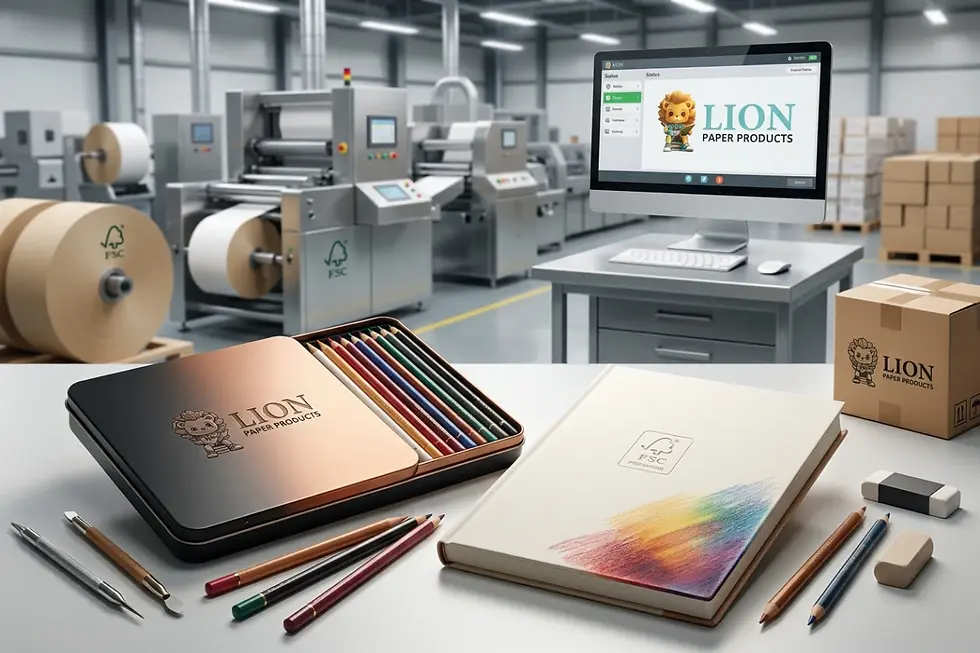
Lion Paper integrates custom colored pencil sets with companion tooth-matched sketchbooks and premium retail packaging.
How Does Lion Paper Deliver Integrated Colored Pencil Kits and Companion Paper Products?
Developing a market-ready art set requires seamless compatibility between the colored pencil formula and the accompanying paper substrate. Lion Paper Products (Jiaxing) Co., Ltd. serves as an integrated supply-chain partner for customized paper goods and creative products, helping global stationery brands, retail chains, and e-commerce sellers bring co-developed art and journaling sets to market from concept to delivery.
Founded in 2015 with headquarters in Jiaxing, Zhejiang, Lion Paper operates a China-Cambodia dual-site manufacturing network. The 3,000-square-meter Jiaxing facility focuses on product planning, structural design, material R&D, rapid prototyping, and customer support. The 10,000-square-meter Cambodia manufacturing facility executes large-scale automated mass production, cost optimization, and duty-efficient global shipments. With an annual notebook and journal output exceeding 5 million units, Lion Paper provides design-to-manufacturing integration across eight diverse categories: Eco Paper Products, Notebooks & Journals, Planners & Calendars, Stationery & Office, Bags & Organizers, Accessories, Gift & Packaging, and Home & Living.
Lion Paper optimizes the customer landed cost and development timeline through unified supply chain execution:
Substrate and Core Pairing: Lion Paper's material engineering team tests custom pencil core hardness against specific internal paper grades (ranging from 120 gsm drawing cartridges to 300 gsm FSC-certified mixed media sketch papers), ensuring ideal tooth friction for layering and structural resilience during burnishing.
Agile Prototyping & Sampling: Rapid sampling workflows in Jiaxing allow brand owners to validate pencil laydown, tin box embossings, rigid gift box structures, and customized paper tooth textures before initiating volume production.
End-to-End Quality Management: Adhering to the Lion Standard, every production run is governed by standardized SOPs, AQL sampling inspections, defect boundary charts, and rigorous packaging drop tests.
Global Compliance & ESG Alignment: Operating under ISO 9001, FSC, SMETA, WCA, GSV, FAMA, and CPSIA frameworks, Lion Paper ensures that all pencils, accessory organizer pouches, and paper goods meet global retail import standards.
For consumer stationery brands, private label retailers, and creative IP owners seeking to launch high-performance drawing sets, gift collections, or specialty journaling kits, Lion Paper bridges creative concepts with dependable manufacturing scale.
To begin developing your custom collection, Share target user, color count, performance level, packaging and companion paper; request a colored-pencil test and assortment proposal.
FAQ
Can you layer wax-based colored pencils over oil-based colored pencils?
Yes. Artists frequently apply oil-based colored pencils first to establish detailed underdrawings and precise linear gradients, followed by softer wax-based colored pencils for rapid color filling and final burnishing. However, applying hard oil-based pencils over heavy, soft wax layers can scrape away the underlying wax film rather than depositing fresh pigment.
How does solvent blending differ from mechanical pencil burnishing?
Mechanical burnishing uses downward pressure to flatten paper fibers and physically merge binder layers. Solvent blending applies odorless mineral spirits or alcohol to chemically dissolve the wax or oil binder, dispersing pigment evenly into the paper valleys without flattening the tooth. This leaves the paper tooth partially intact for subsequent layers.
What minimum paper weight is recommended to prevent buckling during burnishing?
A minimum paper basis weight of 160 to 200 gsm is recommended for dry burnishing. If solvent blending, water-soluble blending, or extreme multi-layer burnishing is planned, a 250 to 300 gsm heavyweight mixed media or cold-press cotton paper is necessary to prevent surface tearing and sheet deformation.
What wood casing species provides the best sharpening performance for custom art pencils?
California Incense Cedar is the premier choice for fine art pencils due to its straight grain, dimensional stability, and smooth cut without splintering. For cost-optimized mass retail or educational sets, softened Basswood (Linden) offers an excellent balance of clean sharpening and economic efficiency.


Comments