


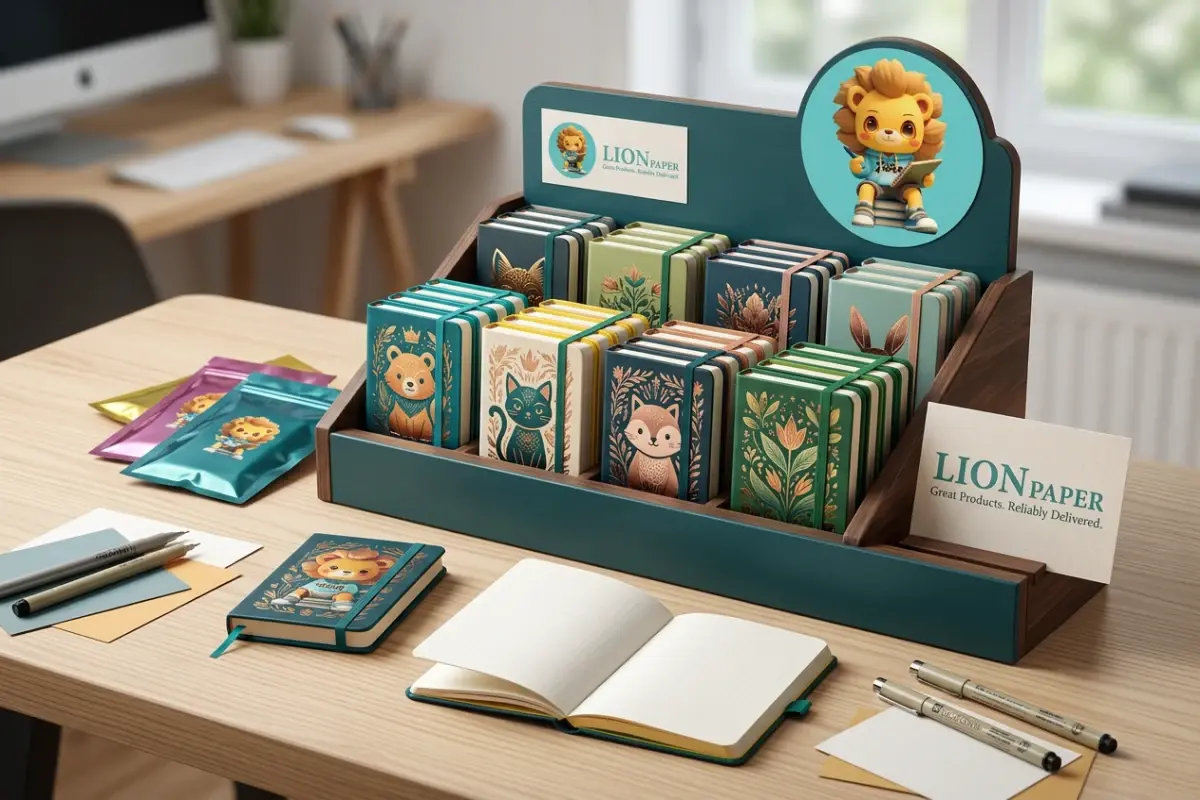
Collectible Mini Notebook Assortments: Sourcing, Design, and Supply Chain Guide

Collectible mini notebook assortments combine structured character systems, multi-tier tactile finishes, and specialized retail packaging formats—such as blind boxes, counter display units (CDUs), and multi-packs—to drive consumer engagement and repeat retail purchases. Executing these programs requires balanced SKU cadence, strict color consistency across production batches, compliant barrier packaging, and agile dual-site manufacturing to optimize landed costs while meeting international retail standards.
What is the strategic architecture of collectible mini notebook assortments?
Collectible mini notebook assortments are curated stationery collections built around cohesive themes, licensed intellectual properties (IP), or functional aesthetic tiers. Unlike standalone pocket journals, collectible assortments are engineered as synchronized product families where individual SKUs encourage cumulative purchasing. Retail buyers and product managers deploy these assortments to maximize revenue per square foot, increase basket size, and generate secondary market trading and social media unboxing engagement.
A commercial assortment architecture relies on three foundational pillars:
Thematic Cohesion and Variant Distribution: A standard assortment typically contains 6 to 12 core designs, accompanied by 1 or 2 rare "chase" variants. Core designs share uniform physical dimensions—such as A7 (74 x 105 mm), B7 (88 x 125 mm), or custom pocket dimensions (85 x 120 mm)—while featuring distinct surface artwork, edge treatments, or interior page configurations.
Modular Manufacturing Alignment: To maintain commercial viability, the internal text blocks use standardized paper stock, page counts (typically 48 to 80 pages), and binding styles (such as saddle stitching or smyth-sewn softcovers). Differentiation is concentrated on exterior cover substrates, stamping foils, and individualized retail packaging.
Multi-Channel Presentation Formats: The physical delivery must cater to specific merchandising environments, ranging from impulse counter display units in retail chain stores to sealed mystery packaging in specialty lifestyle boutiques.
Assortment Parameter | Standard Retail Assortment | Premium IP / Collector Series | High-Volume Promotional Set |
|---|---|---|---|
:--- | :--- | :--- | :--- |
Core SKU Count | 6–8 Variations | 8–12 Variations + 1 Chase | 4–6 Variations |
Trim Size | A7 (74 x 105 mm) | Custom (80 x 125 mm) | Pocket (70 x 100 mm) |
Binding Style | Saddle Stitch / Thread-sewn | Lay-flat Smyth Sewn / Flexi-bound | Saddle Stitch (2-wire) |
Interior Pages | 48–64 pages (80 gsm woodfree) | 64–96 pages (100 gsm FSC woodfree) | 32–48 pages (70 gsm woodfree) |
Packaging Type | Open Counter Display Unit (CDU) | Foil Bag Blind Box with Outer Tray | Shrink-wrapped Multi-pack Band |
Target Channel | Mass Retail, Bookstores | IP Pop-ups, DTC, Specialty Boutiques | Fast-fashion, Gifting, Back-to-School |
How do brands build a character stationery assortment strategy for repeat purchases?
A character stationery assortment strategy translates visual brand assets and character rosters into high-velocity stationery products. Success depends on establishing distinct rarity tiers, aesthetic archetypes, and functional variety within the collection so that consumers have compelling reasons to purchase multiple units rather than a single notebook.
To construct an effective character assortment matrix, brands should organize their character rosters into balanced release waves:
Primary Character Foundations (Anchor SKUs): Feature the most recognizable characters on mainstream, broadly appealing backgrounds with reliable finishes such as soft-touch matte lamination and spot gloss UV.
Secondary and Ensemble Variants (Discovery SKUs): Showcase supporting characters, seasonal motifs, or stylized graphic patterns (such as vintage line art, pastel palettes, or pixel art) that appeal to dedicated fans seeking complete sets.
Rare and Chase Variants (Collector Drivers): Introduce limited-ratio variants (e.g., a 1:24 or 1:48 drop rate in blind boxes) utilizing premium embellishments such as holographic foil stamping, gilded edge gilding, or thermo-sensitive inks.
Interior Content Diversification: Rather than using identical blank or ruled pages across all notebooks, high-performing assortments match interior layouts to character themes. For example, one character notebook may feature grid pages for bullet planning, another incorporates dot-grid layouts with subtle watermark illustrations, and a third offers lined pages with dedicated task-list margins.
Establishing a planned seasonal drop cadence—such as quarterly wave updates with limited carryover SKUs—creates urgency, keeps retail shelves dynamic, and sustains fan engagement throughout the year.

High-precision surface embellishments, rounded corners, and lay-flat binding options tailored for custom pocket notebook collections.
Which packaging formats drive retail success: mini notebook blind box packaging, CDUs, or multipacks?
Packaging serves both as physical protection for custom pocket notebook collections and as the primary marketing vehicle on retail shelves. Selecting between mini notebook blind box packaging, point-of-sale display units, or bundled multi-packs depends on the target price point, retail environment, and customer demographic.
1. Mystery Blind Box Packaging
Mini notebook blind box packaging transforms a functional stationery item into an experiential unboxing event. Each pocket notebook is sealed inside an opaque, moisture-resistant aluminum foil bag or metallized poly pouch to prevent light transmission and physical tampering. The sealed pouch is then housed inside an individually printed folding carton manufactured from 300 to 350 gsm coated white-lined chipboard (FBB or C1S).
Key Technical Challenge: Maintaining uniform weight across all variants is critical. If a chase notebook includes thicker covers or heavier foil, compensating paper adjustments or internal cardboard fillers must be added so consumers cannot identify rare units by weight prior to purchase.
Merchandising Impact: Blind boxes are typically packed in master display boxes of 8, 12, or 24 units that convert into ready-to-sell counter units, maximizing retail impulse purchases.
2. Counter Display Units (CDU) and Gravity Feeders
Open-display CDUs allow consumers to browse and select their preferred notebook design directly. Engineered from sturdy 250 gsm CCNB mounted to E-flute or F-flute corrugated cardboard, CDUs provide structured individual tiered slots that keep pocket notebooks standing upright even as inventory depletes.
Key Technical Challenge: Establishing correct pocket tolerances (adding 3 to 5 mm clearance per slot) to ensure notebooks slide out smoothly without catching cover corners or tearing delicate foil wraps.
Merchandising Impact: CDUs provide prominent retail branding on header cards and side panels, making them suitable for bookstore checkouts, museum shops, and gift boutique counters.
3. Belly-Band Multi-Packs and Acetate Gift Sets
Bundling an entire assortment into a curated multi-pack eliminates collector friction and provides an immediate gift-ready solution. Notebooks are grouped in sets of 3 to 6 units, secured with a printed 157 gsm kraft or art-paper belly band, or enclosed within a transparent, recyclable PET/polypropylene sleeve with direct screen printing.
Key Technical Challenge: Multi-packs require tight wrapping to prevent internal scuffing caused by cover-on-cover friction during international ocean transit.
Merchandising Impact: Raises the average transaction value and appeals directly to corporate gifting, seasonal holiday sets, and back-to-school promotional campaigns.
Packaging Format | Typical Unit Price Range | Primary Retail Advantage | Key Supply Chain Requirement |
|---|---|---|---|
:--- | :--- | :--- | :--- |
Foil Blind Box + Master Tray | $4.00 – $8.00 / unit | Drives gamification, trading, and repeat basket volume | Anti-tamper sealing, weight balancing, exact ratio collating |
Tiered Counter Display (CDU) | $2.50 – $5.00 / unit | Clear visual presentation for self-selection at POS | High-burst corrugated board, drop-tested structural fold |
Belly-Band Multi-Pack (3–5 pk) | $8.00 – $18.00 / set | High average transaction value, gifting appeal | Anti-scuff lamination, precise band tensioning |
Rigid Gift Box with Tray Insert | $15.00 – $30.00 / set | Premium keepsake value, corporate & VIP gifting | Precision-molded paper pulp or EVA tray, magnet closure |
How should materials, paper weights, and cover finishes be structured across collection tiers?
Balancing aesthetic appeal and cost structure across custom pocket notebook collections requires a systematic tiering of substrates, internal papers, and finishing processes. Specifying the correct materials ensures structural durability during daily pocket carry while keeping unit costs within commercial margin targets.
Standard Tier: 300 gsm C1S + Saddle Stitch │ - ► Mid Tier: 1.5 mm Greyboard + Textured Wibalin / PU Softcover │ - ► Collector Tier: Holographic Foil + Edge Gilding + Smyth-Sewn Binding
Cover Substrate Tiering
Standard Retail Tier: 300–350 gsm C1S (Coated One Side) art card or 250–300 gsm unbleached virgin kraft paper. Provides high tear resistance and excellent print fidelity for full-color CMYK character graphics.
Mid-Tier Specialty: Hardcover mini-formats featuring 1.5 mm to 2.0 mm industrial greyboard wrapped in 128 gsm art paper, textured specialty paper, or flexible softcover thermo-PU (polyurethane) with debossed motifs.
Collector Tier: Fabric-wrapped hardcovers using natural cotton bookcloth, metallic shimmer papers, or multi-layered composite covers featuring die-cut reveal windows and embedded metal charms.
Cover Embellishments and Surface Finishes
Surface finishes not only protect the notebook from corner wear and thumb abrasion but also provide the sensory feedback that distinguishes premium stationery:
Lamination Barriers: Soft-touch velvet lamination, anti-scuff matte film, or high-gloss PP lamination provide water resistance and surface protection.
Selective Enhancements: High-build spot UV varnish and 3D textured tactile varnish highlight character outlines and logo branding.
Metallic and Specialty Foils: Precision hot-stamping with gold, rose gold, silver, iridescent, or holographic foils adds perceived value to rare chase variants.
Edge Treatments: High-speed edge printing, metallic foil edge gilding, or corner rounding (standard 4 mm to 8 mm radius) prevents pocket snagging and enhances aesthetic appeal.
Text Block Paper Engineering
The internal paper must prevent ink feathering, show-through, and bleed-through across various writing instruments, including gel pens, fountain pens, and fine-liners:
Paper Stock: 70 to 100 gsm high-opacity, woodfree uncoated offset paper, or FSC-certified acid-free archival cream paper (pH neutral).
Eco-Friendly Substrates: Post-consumer recycled (PCW) paper, bamboo fiber paper, or agricultural residue paper tailored for ESG-focused brands.
Binding Engineering: High-yield 2-wire saddle stitching for slim notebooks (32–48 pages); Smyth-sewn lay-flat book blocks with exposed spine tape or paper spine wrap for thicker notebooks (64–112 pages) ensuring true 180-degree flat opening for ease of writing.

Automated collation and blind bagging ensure precise SKU distribution ratios and secure packaging for collectible stationery lines.
How does dual-site collectible stationery manufacturing balance agility, landed cost, and scalability?
High-volume collectible stationery manufacturing requires an agile production model capable of managing rapid prototyping, multi-SKU collation, and cost-efficient mass manufacturing. Lion Paper Products operates an integrated China–Cambodia dual-site production model to optimize the entire lifecycle of collectible notebook programs.
China Innovation & Rapid Prototyping Hub (Jiaxing)
Lion Paper’s 3,000-square-meter facility in Jiaxing, Zhejiang, serves as the engineering, design development, and rapid sampling core:
Structural Prototyping & Sampling: In-house structural designers and pre-press specialists produce physical mockups, functional CDU prototypes, and digital proof prints within 3 to 5 business days.
Pre-Production Validation: Precision testing of hot-stamping dies, embossing depths, blind box foil pouch dimensions, and weight distribution balances.
Agile Pilot Runs & Specialized Sets: Direct execution of complex, multi-finish collector editions, short-run regional tests, and fast-replenishment programs for domestic and overseas e-commerce brands.
Cambodia Mass Production & Tariff Optimization Facility
For high-volume retail programs exceeding hundreds of thousands of units, production transitions seamlessly to Lion Paper’s 10,000-square-meter facility in Cambodia:
Automated High-Capacity Lines: Equipped with automated high-speed folding, gathering, saddle-stitching, spine-taping, and robotic assembly lines delivering an annual notebook output exceeding 5 million units.
Landed Cost Optimization: Offers significant duty and tariff advantages for North American, European, and Australian retail delivery, shielding buyers from volatile trade policies.
Large-Scale Collation & Blind Packaging: Clean, dust-controlled packaging workshops equipped with multi-station automated packaging lines capable of high-speed collation, blind bagging, sorting ratios, and master CDU assembly with zero cross-contamination.
The "From Sketch to Shipment" Workflow Integration
By uniting design engineering in Jiaxing with scalable manufacturing in Cambodia, brands eliminate communication friction between design agencies and third-party contract packagers. Lion Paper acts as a single-source supply chain partner managing material sourcing, production balancing, quality control, and direct ocean export.
Operational Stage | Jiaxing Center (China) | Cambodia Facility | Buyer Benefit |
|---|---|---|---|
:--- | :--- | :--- | :--- |
Concept & DFM Review | Structural design, substrate selection, foil die testing | Production line feasibility & tooling layout | Prevents unmanufacturable designs early |
Sampling & Prototyping | 3–5 day physical samples, 3D CDU renders | SOP validation samples | Rapid retail buyer approvals |
Volume Scalability | Pilot batches, multi-SKU complex runs | Large-scale continuous production | Scale economics with flexibility |
Tariff & Logistics | Air-freight rapid drops, direct regional hub | Duty-advantageous ocean freight to US/EU | Maximized gross retail margins |
Quality & Packing | Full pre-press AQL inspection | Standardized automated packaging & collation | Strict batch-to-batch consistency |
What quality control and retail compliance standards apply to custom pocket notebook collections?
Collectible stationery products targeted at children, teens, or general retail distribution must satisfy rigorous mechanical safety, chemical compliance, and ethical manufacturing standards before entering major global supply chains.
International Safety and Regulatory Compliance
Lion Paper maintains comprehensive certification and audit readiness across international quality, safety, and ethical benchmarks:
Chemical and Mechanical Safety (CPSIA & EN 71-1/2/3): All printing inks, surface coatings, hot-stamping foils, adhesives, and metal wire staples must undergo heavy metal screening (lead, cadmium, phthalates) to comply with US Consumer Product Safety Improvement Act (CPSIA) standards and European Toy Safety regulations (EN 71).
Sustainable Forestry Sourcing (FSC Certification): Chain of Custody (FSC-C) certification verifies that all paperboards, interior text papers, and corrugated displays are sourced from responsibly managed forests.
Ethical Manufacturing Audits (SMETA & WCA): Regular Sedex Members Ethical Trade Audits (SMETA 4-Pillar) and Workplace Conditions Assessments (WCA) confirm fair labor practices, environmental safety, and factory health standards.
Retailer Authorization Audits (FAMA & GSV): Possession of Disney Facility and Merchandise Authorization (FAMA) and Global Security Verification (GSV) ensures compliance with the most stringent global licensor requirements.
Multi-SKU Factory Quality Assurance Protocols
Managing collectible assortments requires quality controls beyond standard single-book manufacturing:
Delta-E Color Consistency: Spectrophotometer measurements ensure brand-critical character Pantone colors remain within Delta-E < 1.5 across different print sheets, repeat re-orders, and assorted packaging boxes.
Automated Collation Verification: Checkweigher sensors and barcode scanning verify that master cartons and CDUs contain the exact designated ratio of character variants without missing SKUs or duplicate mispacks.
Binding Strength & Durability Tests: Standardized page pull tests (minimum 3.5 N/cm pull strength on glued spines) and staple crimp flatness inspections prevent wire snagging and ensure long service life.
Transit Simulation & Burst Testing: ISTA-1A drop tests and vibration testing on packed CDUs guarantee that display headers, inner dividers, and individual book corners arrive at retail distribution centers in pristine condition.

Rigorous AQL quality control, Delta-E color verification, and mechanical safety testing ensure complete compliance for global retail supply chains.
How can procurement teams optimize the development workflow from first sketch to first shipment?
Executing a multi-SKU collectible stationery launch requires an organized timeline that coordinates graphic design approvals, structural engineering, physical proofing, and ocean freight logistics. Procurement and product management teams can eliminate delays by following a structured stage-gate development workflow:
Stage 1: Design for Manufacturability (DFM) & Blueprint Alignment (Weeks 1–2): Define dimensions, page count, binding method, and packaging format. Provide vector dielines and character color targets. Structural engineers review fold tolerances, spine bulk calculations, and master carton stacking efficiencies.
Stage 2: Rapid Prototyping & Proof Approval (Weeks 3–4): Structural white samples for CDU fitment and full-color digital proof dummies are produced at the Jiaxing facility. Custom foil-stamping dies and blind box packaging materials are verified for opacity and sealing integrity.
Stage 3: Pre-Production Golden Sample Sign-Off (Weeks 5–6): A fully finished pre-production sample—complete with final interior paper, cover embellishments, foil blind bag, and master display box—is submitted for formal buyer approval.
Stage 4: Mass Production & Automated Collation (Weeks 7–10): High-speed offset printing, precision folding, stitching, die-cutting, foil sealing, automated collation, and AQL 2.5/4.0 inline quality inspection are executed at the designated China or Cambodia manufacturing base.
Stage 5: Retail-Ready Packing & Global Logistics (Weeks 11–12): Units are palletized with protective edge guards, moisture-barrier shrink wrap, and drop-tested master cartons ready for direct ocean container loading and international customs clearance.
To begin developing your custom pocket notebook collections, contact our engineering team with your preferred format, character use case, target quantity, and packaging specifications for a comprehensive feasibility and landed-cost review.
FAQ
What is the typical minimum order quantity (MOQ) for collectible mini notebook assortments?
For fully customized multi-SKU assortments featuring custom blind box packaging or dedicated counter display units, production MOQs typically start at 3,000 to 5,000 sets (or 15,000 to 30,000 total individual notebooks depending on the number of character variants). Smaller pilot runs can be evaluated for specialized sampling and market testing through our Jiaxing rapid development center.
How do you guarantee that blind box packaging prevents buyers from identifying contents before purchase?
We utilize high-barrier, opaque metallized foil bags that eliminate light transmission and transparency. For collections with varied cover materials or embellishments, internal cardboard stiffeners or calibrated counterweights are incorporated during automated packaging to ensure uniform weight across all SKUs, preventing detection by hand or pocket scales.
Can Lion Paper manage character licensing audits and compliance documentation for global brands?
Yes. Lion Paper maintains active compliance systems aligned with ISO 9001, FSC, SMETA (4-Pillar), WCA, GSV, FAMA (Disney authorization), and CPSIA testing protocols. We routinely supply full material safety data sheets (MSDS), heavy metal test reports, and factory social audit reports required by global licensors and Tier-1 retail chains.
What binding style is best suited for 64-page to 80-page pocket notebooks?
For 64 to 80 pages, a Smyth-sewn softcover or thread-bound flexi-cover is ideal because it allows true 180-degree lay-flat opening without cracking the spine. For slim 32 to 48-page pocket books, precision 2-wire saddle stitching with rounded corners provides the most cost-efficient and durable solution.


Comments