


Coffee Tasting Journaling Kits: Retail Merchandising, Component Design, and OEM Sourcing Guide

Coffee tasting journaling kits function as high-margin retail merchandising ecosystems by combining structured sensory logbooks with complementary accessories, flavor wheel inserts, and gift packaging to elevate consumer engagement and average order value. They bridge specialty roaster education with consumer lifestyle habits, turning single-bag coffee purchases into premium gift-ready merchandise.
What Defines Modern Coffee Tasting Journaling Kits for Specialty Roasters?
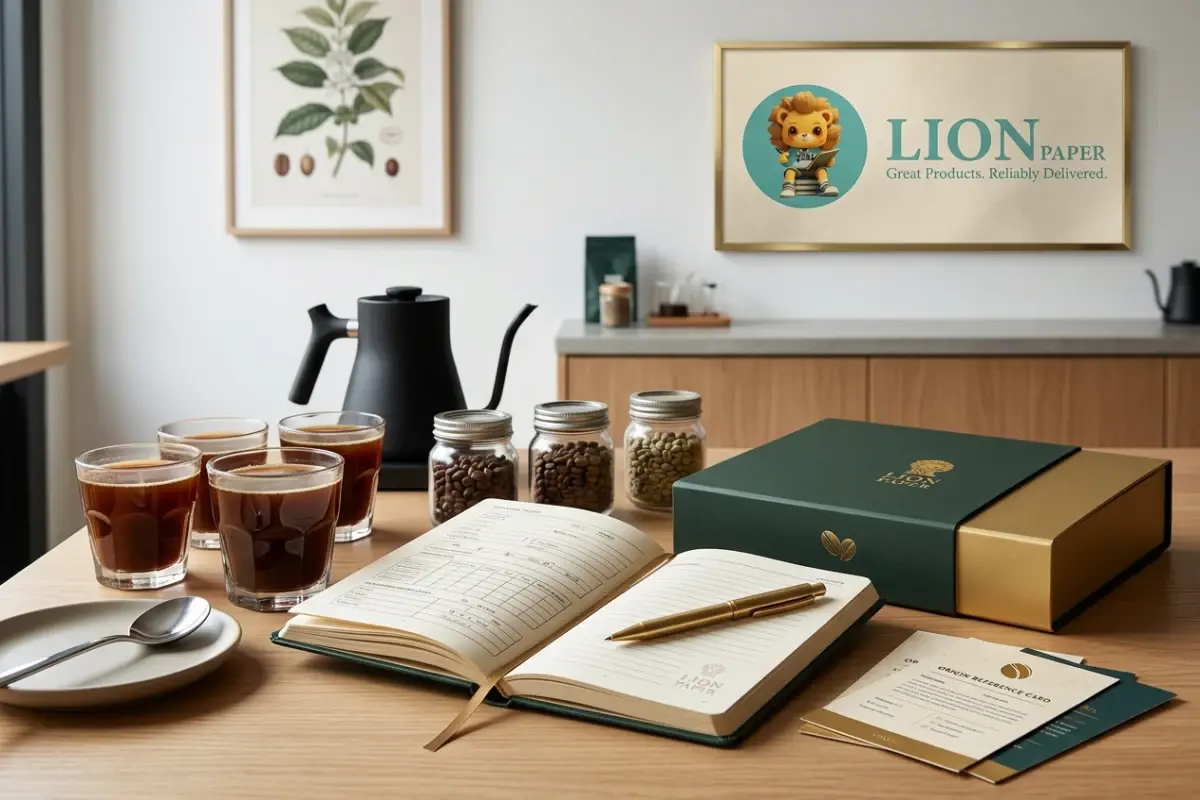
Modern coffee tasting journaling kits serve as both educational frameworks and branded lifestyle products. Rather than offering basic lined stationery, specialty coffee roasters, subscription services, and upscale lifestyle brands curate these multi-piece sets to help consumers systematically capture origin notes, roast profiles, brewing parameters, and sensory evaluations.
A complete retail kit typically integrates multiple functional components designed to guide beginners while satisfying advanced sensory analysts:
Structured Sensory Logbook: Core notebooks featuring industry-aligned cupping scorecards, extraction tracking tables, and flavor descriptor wheels.
Educational Inserts: Quick-reference cards detailing origin characteristics, processing methods (washed, natural, anaerobic), and grind-size calibration charts.
Precision Writing Instruments: Specialized fine-liner pens or brass pencil accessories secured via elastic loops or magnetic pen clips.
Protective and Organizational Elements: Water-resistant covers, bookmark ribbons, storage back pockets for roaster trading cards, and bespoke zippered pouches.
Rigid Gift Packaging: Custom presentation boxes featuring debossed branding, foil stamping, or molded paper pulp trays engineered for retail display and e-commerce fulfillment.
By integrating these items into cohesive specialty coffee stationery kits, roasters transform routine daily brews into interactive tasting rituals, fostering long-term brand loyalty and recurring customer visits.

Structured sensory charts and flavor wheels provide clear guidance for coffee enthusiasts and cupping professionals.
Why Should Brands Develop Curated Coffee Tasting Kits Instead of Standalone Journals?
Developing a bundled tasting kit delivers substantial commercial advantages over offering standalone notebooks. In competitive retail and direct-to-consumer (DTC) channels, kits command higher price ceilings, enhance perceived gift value, and dramatically improve inventory turnover.
Merchandising Dimension | Standalone Tasting Notebook | Curated Coffee Tasting Journaling Kit |
|---|---|---|
:--- | :--- | :--- |
Target Retail Price Point | $12.00 – $18.00 | $35.00 – $65.00 |
Primary Purchase Intent | Self-use by dedicated enthusiasts | Gifting, seasonal holidays, subscription onboarding |
Perceived Value Mechanism | Single-item utility | Curated sensory experience and unboxing ritual |
Gross Margin Potential | 50% – 60% | 65% – 75% |
Brand Storytelling Space | Cover and front introduction pages | Multi-surface packaging, inserts, and accessories |
Cross-Merchandising Fit | Coffee bag add-on at checkout | Standalone gift display, corporate holiday catalog |
From a brand equity perspective, a curated coffee tasting notebook gift set creates a memorable tactile interaction that extends the life of a coffee bag. While roasted beans are consumed within weeks, a premium journal set remains on the kitchen counter or coffee bar for months, serving as a permanent brand touchpoint.
How Should the Interior Architecture of Custom Coffee Cupping Journals Be Structured?
The layout and paper engineering of custom coffee cupping journals dictate how effectively users record their sensory evaluations. To deliver commercial-grade utility, the interior layout must translate Specialty Coffee Association (SCA) tasting protocols into intuitive visual charts.
1. Standardized Sensory Evaluation Spread
A typical tasting log utilizes a structured two-page spread designed for speed and precision:
Header Data: Coffee name, roaster, country of origin, farm/estate, varietal, elevation, processing method, and roast date.
Brew Variable Tracker: Method (V60, Aeropress, Espresso, Cupping), water temperature, grind setting, dose weight, yield, and extraction time.
Visual Flavor Radar: A printed 8-axis or 12-axis flavor wheel matrix allowing users to plot acidity, sweetness, body, clarity, finish, and specific flavor families (floral, fruity, nutty, spicy).
Scoring and Observation Matrix: Numeric rating sliders (1 to 10 scale) paired with dedicated open-ruled lines for personal tasting impressions and pairing notes.
2. Paper Weight and Fluid Resistance
Coffee journaling environments present high exposure to liquid splashes, steam, and heavy ink saturation. Notebook interiors require high-opacity 100 gsm to 120 gsm woodfree paper or FSC-certified mixed pulp. High-density paper sizing prevents ink feathering and bleed-through when using gel pens or fountain pens, while maintaining smooth pen glide across humidity variations.
3. Binding Durability
Flat-opening bindings are non-negotiable for kitchen and cupping lab environments. Smyth-sewn flexi-bound spines, exposed thread lay-flat bindings, or wire-bound double-loop spirals allow the notebook to rest completely flat without hand pressure, freeing both hands for pouring, stirring, and tasting.
Which Complementary Components Maximize the Value of Coffee Brand Retail Merchandise?
To build cohesive coffee brand retail merchandise, brands pair the core cupping notebook with utility-focused accessories. Coordinated material selection and unified color palettes elevate the entire collection into a collectible lifestyle range.
Custom Aroma & Origin Flashcards: Laminated reference cards housed in an interior gusseted envelope provide instant insight into major growing regions (e.g., Yirgacheffe floral profiles vs. Huila citrus acidity).
Integrated Elastic and Metal Pen Loops: Engineered into the spine or back cover board to ensure the writing tool is permanently attached and ready for cupping sessions.
Bean Descriptor Sticker Sheets: Matte-laminated, kiss-cut sticker sheets depicting flavor notes (berries, chocolate, stone fruit, honey) that users can affix directly to their log entries.
Roaster Collector Sleeves: Transparent glassine or kraft pockets inside the back cover to archive roaster bag labels and origin cards.
Matching Storage Pouches: Canvas, Tyvek, or recycled RPET accessory cases designed to organize tasting spoons, refractometer pipettes, timers, and writing tools alongside the journal.

Curated multi-piece stationery kits combine cupping journals, educational flashcards, and branded accessories to maximize retail margins.
What Packaging Engineering Strategies Ensure Shelf Impact and E-Commerce Protection?
Packaging engineering directly influences retail shelf conversion, shipping durability, and the end-user unboxing experience. A successful coffee tasting notebook gift set requires packaging that combines structural integrity with sustainable materials.
Rigid Two-Piece Gift Boxes
Fabricated from 1200 gsm greyboard wrapped in specialty texture paper or kraft board, two-piece lift-off lid boxes convey classic gift value. Precision die-cut internal trays—made from molded biodegradable paper pulp or paperboard folds—securely anchor the journal, pen, and accessories without relying on single-use plastics.
Book-Style Magnetic Closure Boxes
A single-piece folding rigid box with embedded magnetic closures provides a premium opening mechanism. Inner lid printing can be utilized to showcase origin maps, brewing infographics, or founder welcome letters.
Compact Sleeve and Belly-Band Configurations
For roasters with limited retail shelf depth, a compact presentation utilizing a protective tuck-end kraft carton paired with a full-bleed printed paper belly band minimizes footprint while maintaining tactile visibility. Anti-scuff matte lamination and localized spot UV or tactile embossing highlight brand logos and coffee motifs.
Drop-Tested E-Commerce Outer Packaging
For direct-to-consumer and subscription box fulfillments, exterior dimensions should adhere to standard parcel shipping thresholds. Matching corrugated mailer boxes engineered with snug corner buffers prevent transit bruising, ensuring gift-grade presentation upon arrival.
How Do Production Volumes and Material Choices Dictate Unit Costs?
Understanding landed costs across varying manufacturing scales helps product development managers and procurement teams optimize their bill of materials (BOM) to hit target retail margins.
Production Run Scale | Core Production Specifications | Unit Cost Range (USD) | Target Retail Price (USD) | Recommended Application |
|---|---|---|---|---|
:--- | :--- | :--- | :--- | :--- |
Pilot Run (500 – 1,000 units) | Hardcover journal, 1-color interior, belly band, basic tuck box | $6.50 – $9.50 | $28.00 – $38.00 | Single-origin seasonal launch, roaster anniversary limited edition |
Mid-Tier Commercial (2,000 – 5,000 units) | PU leather/linen cover, 2-color interior, debossed logo, custom pen, rigid gift box | $4.20 – $6.20 | $35.00 – $48.00 | Core retail merchandise, holiday gift catalog, DTC subscription tier |
High-Volume Retail (10,000+ units) | Fully custom flexi-cover, 4-color custom flavor wheels, accessory set, molded pulp tray rigid box | $2.80 – $4.10 | $40.00 – $55.00 | Global retail distribution, supermarket specialty aisles, omni-channel campaigns |
Cost efficiency is achieved by standardizing paper sheet trims, consolidating material weights across accessory parts, and leveraging automated assembly lines for rigid box wrapping.

Dual-site OEM manufacturing infrastructure delivers consistent quality control and scalable production for global brand merchandise.
How Does Lion Paper Products Deliver End-to-End Manufacturing for Coffee Stationery Programs?
Founded in 2015 in Jiaxing, Zhejiang, Lion Paper Products (Jiaxing) Co., Ltd. operates as a dedicated customized paper goods and creative product supply-chain solution provider. With an annual notebook capacity exceeding 5 million units, Lion Paper combines concept development, structural engineering, and compliant manufacturing for global brands across North America, Europe, Australia, the Middle East, and Southeast Asia.
1. China–Cambodia Dual-Site Synergy
Lion Paper delivers scalable supply-chain resilience through a synchronized two-base manufacturing network:
Jiaxing Facility (3,000 sqm): Focuses on product design, structural innovation, rapid prototyping, material sourcing, and specialized client technical support.
Cambodia Facility (10,000 sqm): Optimized for high-volume automated manufacturing, competitive labor scaling, tariff efficiency, and stable global delivery.
This infrastructure allows brands to test initial product concepts with rapid prototyping in China before scaling mass-volume retail programs through Cambodia.
2. Design-to-Manufacturing Integration
Lion Paper bridges initial creative concepts with mass-production reality. In-house engineering teams assist buyers with page layout optimization, custom flavor-wheel vectorization, specialty binding selection, and retail-ready packaging structures that balance visual luxury with freight container density.
3. Sustainable and Traceable Materials
Supporting ESG and eco-conscious brand initiatives, Lion Paper supplies FSC-certified traceable papers, recycled pulp boards, soy-based vegetable inks, water-based coatings, and plastic-free packaging architectures.
4. Certified Quality Assurance
Every production batch adheres to standardized SOPs, AQL sampling inspections, and defect-mapping protocols. Lion Paper operates with audit-ready compliance frameworks supporting ISO 9001, FSC, SMETA, WCA, GSV, FAMA, and CPSIA standards.
What Should Procurement Buyers Include in an RFQ for Coffee Tasting Stationery Kits?
To expedite quotation turnaround and secure accurate technical sampling, procurement teams should assemble a comprehensive Request for Quotation (RFQ) checklist covering the following parameters:
Core Journal Dimensions & Page Count: Trim size (e.g., A5, B6, pocket format), page extent (e.g., 96, 128, 160 pages), and binding method (Smyth-sewn, flexi-bound, wire-O).
Material Preferences: Cover substrate (vegan PU, book cloth linen, coated kraft cardstock), text stock (100–120 gsm woodfree or FSC-recycled paper), and decorative embellishments (foil stamping, blind debossing, edge painting).
Interior Print Configuration: Monochrome 1C print vs. multi-color 2C/4C printing for color-coded sensory wheels and origin maps.
Included Accessories: Specifications for writing instruments, custom sticker sheets, envelope pockets, or canvas storage pouches.
Packaging Architecture: Presentation box structure (rigid lid-and-base, magnetic book-box, printed tuck carton) and internal tray material (paper pulp vs. cardstock dividers).
Compliance and Market Logistics: Target delivery markets (North America, EU, UK, Australia), required material certifications, batch volume forecasts, and destination port terms.
Share your target audience, journal theme, interior layout sketch, packaging preferences, and volume forecast with our team to explore a tailored product concept, physical pre-production sample, and full OEM production options via our contact page.
FAQ
What is the typical minimum order quantity (MOQ) for custom coffee cupping journals and boxed kits?
Custom standalone coffee tasting journals generally start at an MOQ of 1,000 units for fully customized covers and custom interior printed pages. Complete multi-component coffee tasting journaling kits housed in custom rigid gift boxes typically require an MOQ of 1,000 to 2,000 sets, depending on accessory complexity and packaging specifications.
How long does the prototyping and mass production process take for OEM coffee merchandise sets?
Rapid structural prototyping and physical sampling typically take 7 to 12 working days once interior and cover artwork files are finalized. Mass production generally requires 25 to 35 working days, with flexible shipment scheduling available via Lion Paper's China and Cambodia production facilities.
Can specialty coffee roasters customize the sensory flavor wheels to match their proprietary scoring systems?
Yes. OEM manufacturing allows 100% custom graphic vectorization for all interior pages. Brands can integrate their proprietary flavor wheels, regional origin maps, specific brewing formulas, SCA scoring scales, or color-coded tasting guides tailored to their product lineup.


Comments