


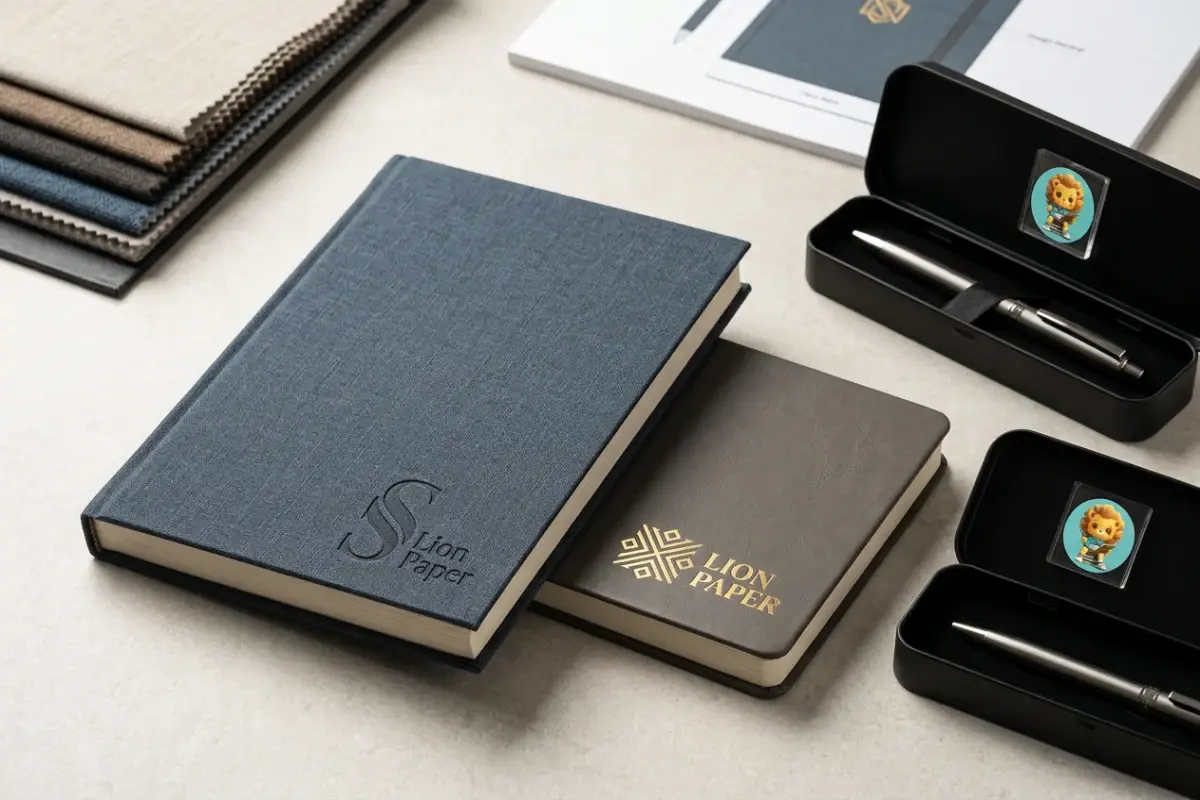
Co-Branded Custom Notebooks: Strategic Sourcing and Manufacturing Guide

Co-branded custom notebooks are dual-identity retail stationery products engineered through structured design approvals, precise logo hierarchy, and shared compliance standards to merge two brand identities into a single retail-ready SKU. Successful collaborative notebook manufacturing requires balancing visual prominence, aligning material quality, and managing end-to-end supply chain logistics to deliver stable commercial value across corporate, licensing, and retail channels.
What Are Co-Branded Custom Notebooks and How Do Collaborative Licensing Workflows Function?
Co-branded custom notebooks are specialized stationery items developed in partnership between two commercial entities—such as a lifestyle brand and an entertainment IP, a corporate sponsor and an educational institution, or an enterprise tech firm and an executive design agency. Unlike standard promotional merchandise, dual brand stationery production demands strict adherence to brand style guides, controlled intellectual property (IP) usage, and balanced visual prominence.
In licensed notebook private label projects, development workflows differ fundamentally from single-brand OEM manufacturing. Every layout, from the front deboss to the inner legal lines, must pass through multi-tiered approval gates. The typical development workflow for collaborative stationery programs follows a systematic five-stage structure:
Intellectual Property and Style Guide Alignment: Both brand owners establish clear guidelines regarding logo clearance zones, primary and secondary color palettes (using standardized Pantone formulas), font families, and mandatory legal disclaimers.
Concept and Structural Prototyping: Industrial designers map out notebook dimensions (e.g., A5, B5, executive formats), binding styles (casebound hardcovers, flexi-covers, Smyth sewn, or wire-o), and functional details such as magnetic closures or custom bookmark ribbons.
Digital Pre-Press Proofing: Digital contract proofs, 3D renders, and color separations are generated for dual sign-off, ensuring that brand colors match across coated cover papers, fabrics, and interior uncoated paper stocks.
Physical Sampling and Golden Master Sign-Off: A physical pre-production sample (PPS) is produced to verify tactile finishes, debossing depth, binding strength, and foil registration before mass production authorization.
Production, Quality Control, and Traceable Packaging: Mass manufacturing commences with batch-level AQL quality control, serial-coded hangtags, tamper-evident seals, and channel-compliant retail packaging.
Establishing this governance upfront mitigates costly production reruns, protects IP assets, and ensures that the final custom branded retail journals meet retail compliance standards across global distribution networks.
How Do You Balance Dual Logo Hierarchy, Visual Harmony, and Cover Finishing Techniques?
Balancing dual logos on custom notebooks requires technical precision. When two brand marks appear on the same surface, designers must avoid visual competition while maintaining equal or intentional secondary brand hierarchy.
Cover material selection establishes the tactile foundation for branding execution. The most common substrates include vegan PU leather (thermo-reactive or standard), bookcloth linen, heavyweight recycled Kraft paperboards, and soft-touch laminated art papers. Each material dictates the optimal logo application method:
Blind Debossing: Ideal for thermo-reactive PU leathers. Heat and pressure darken the debossed mark naturally, creating a sophisticated, subtle, and permanent indentation. Dual logos can be positioned side-by-side (separated by a neutral divider such as a vertical line or subtle ampersand) or distributed between the front cover and the lower back cover.
Hot Foil Stamping: Metallic (gold, silver, rose gold, copper) or matte pigment foils provide crisp contrast on linen bookcloth, buckram, or soft-touch matte lamination. Micro-etched brass stamping dies ensure fine typography down to 0.5-point line widths without filling or bridging.
Screen Printing and UV Flatbed Printing: Used when precise multi-color Pantone reproduction is required for IP characters or vibrant graphic elements. High-build UV varnish can be layered over screen print to add dimensional gloss to key emblems.
Dual Metal Badges and Laser Etching: Premium journals often utilize custom zinc-alloy metal plates mounted onto recessed cover pockets, with laser-etched dual logos for high-durability executive gifts.
The visual layout must maintain consistent visual weight. If Brand A's logo is horizontally oriented and Brand B's is a vertical shield, structural designers balance their visual mass rather than matching bounding box dimensions. A standard industrial guideline is to position the primary brand or IP character in the upper or central focal zone, with the collaborative partner logo anchored in the bottom third or along the spine.

Balanced logo hierarchy and retail-ready packaging components on dual-brand stationery journals.
How Should Brands Structure SKU Planning, Variants, and Packaging for Retail Collaborations?
Managing multiple stock-keeping units (SKUs) in collaborative notebook programs requires meticulous planning around retail presentation, shelf footprint, and e-commerce fulfillment. Retailers and brand partners must coordinate variants across page ruling, colorways, and bundled accessories without escalating tooling costs.
Specification Factor | Retail Edition Options | Corporate / Executive Option | Collector's Boxed Set |
|---|---|---|---|
:--- | :--- | :--- | :--- |
Core Format | Standard A5 (148 x 210 mm) | Medium Executive (175 x 245 mm) | Custom Boxed B5 or A5 Duo |
Page Interior | 80-100 gsm FSC woodfree; dotted / lined | 100-120 gsm premium ivory; ruled / blank | 120 gsm mixed (dot grid + sketch) |
Cover Substrate | Soft-touch printed board / flexi-PU | Thermo-PU / premium linen cloth | Hardcover fabric with foil inlay |
Branding Style | Foil stamp / spot UV combination | Blind deboss + custom ribbon pull | Embossed cover + engraved metal plate |
Retail Outer Wrap | Printed belly band + shrink wrap | Minimal belly band + protective tissue | Rigid presentation box + EVA tray |
Barcode & Labeling | Co-branded belly band with dual UPC | Underside removable barcode label | Outer master carton and retail gift box UPC |
Co-branded packaging serves both protective and storytelling functions. A full-color printed belly band (belly band banderole) wrapped around the notebook is the industry standard for co-branded custom notebooks. It carries partner narrative copy, social media handles, licensing verifications, and retail barcodes (EAN/UPC), leaving the notebook cover uncluttered for long-term consumer use.
For high-tier releases, rigid two-piece gift boxes with precision die-cut EVA or paperboard trays allow the inclusion of matching collaborative accessories, such as custom pens, metal bookmarks, or decorative masking tape. E-commerce-ready packaging requires drop-tested corrugated outer cartons (ISTA 1A/3A compliant) to protect cover corners from edge impact during individual parcel transit.
What Material Sourcing, FSC Traceability, and Safety Compliance Standards Apply to Dual-Brand Stationery?
Collaborative stationery programs involving established retailers or licensed entertainment properties must comply with rigorous international safety, environmental, and social compliance standards. Material integrity and traceable sourcing are non-negotiable foundations of licensed notebook private label manufacturing.
Paper quality forms the core writing experience. Sourcing parameters include:
Paper Weight and Density: Standard writing papers range from 80 gsm to 120 gsm. For dual-brand journals catering to fountain pens, gel ink, and art markers, 100 to 120 gsm woodfree uncoated paper or cream ivory offset stock is specified to prevent feathering and ink bleed-through.
Sustainable Sourcing (FSC Certification): FSC-certified papers (FSC Mix or FSC 100%) verify that pulp originates from responsibly managed forests. Supply chains must maintain Chain of Custody (CoC) certification to allow on-product printing of the official FSC trademark and licensee code.
Recycled and Alternative Fibers: Post-consumer waste (PCW) recycled paper, stone paper, agricultural waste paper (such as sugarcane bagasse), and cotton rag papers support corporate ESG targets while offering distinctive tactile textures.
Beyond paper, all secondary materials must pass chemical and regulatory testing tailored to destination markets:
CPSIA and Prop 65 Compliance: Cover coatings, screen printing inks, edge gilding, and metal components must be tested for total lead, phthalates, and heavy metals according to US Consumer Product Safety Improvement Act regulations and California Proposition 65 requirements.
REACH and RoHS (European Union): Binders, polyurethane covers, adhesives, and elastic closures must comply with EU REACH Annex XVII limits, ensuring absence of restricted azo dyes, organotin compounds, and SVHCs (Substances of Very High Concern).
Factory Audits and Social Responsibility: Manufacturing sites producing co-branded goods must uphold audited ethical and security benchmarks. Key accreditations include ISO 9001 (quality management systems), SMETA (Sedex 4-pillar labor, health, and environmental audits), WCA (Workplace Conditions Assessment), GSV (Global Security Verification), and FAMA (Facility and Merchandise Authorization for Disney-licensed merchandise).

Standardized quality control inspections ensure batch consistency and regulatory compliance across all production runs.
How Does Lion Paper’s Dual-Site Model Bridge Collaborative Notebook Manufacturing from Design to Global Delivery?
Executing complex collaborative stationery projects demands both rapid creative engineering and cost-effective high-volume manufacturing. Lion Paper Products (Jiaxing) Co., Ltd., founded in 2015, addresses this challenge through an agile China–Cambodia dual-site production model that streamlines the journey from the first design sketch to the final global shipment.
| LION PAPER INTEGRATED DUAL-SITE COLLABORATIVE WORKFLOW |
| JIAXING, CHINA HUB (3,000 sqm) | CAMBODIA PRODUCTION (10,000 sqm)| | * Creative Ideation & Styling | * Automated High-Volume Lines | | * Engineering & Structural Dielines | * Scale Raw Material Sourcing | | * Rapid Prototyping (3-5 Days) | * Landed-Cost & Tariff Balancing| | * Pilot Runs & Client Approvals | * Comprehensive AQL Inspections |
+----------------------------------+ | | - +-------------------+ | v GLOBAL RETAIL FULFILLMENT North America | Europe | Australia | Middle East
The dual-site model divides responsibilities across two specialized manufacturing and development centers:
1. Jiaxing, China: Innovation, Prototyping, and Pilot Engineering
The 3,000-square-meter Jiaxing facility serves as the product development and rapid prototyping headquarters. In-house structural designers, print engineers, and materials specialists collaborate directly with brand managers to resolve logo placement, material compatibility, and packaging structural integrity. Key capabilities include:
Digital knife cutting and rapid 3D physical mockups within 3 to 5 business days.
Advanced color-proofing systems calibrated to international press profiles.
Pilot run capability for small-batch testing, creator collaborations, and quick-turn retail pilots.
2. Cambodia Facility: Large-Scale Automated Production and Cost Optimization
The 10,000-square-meter facility in Cambodia is built for scaled mass manufacturing, boasting an annual output exceeding 5 million custom notebooks. This facility features:
High-speed automated casing-in lines, Smyth sewing machines, and robotic book block gluing.
Standardized Operating Procedures (SOPs) aligned across all finishing and inspection stations.
Favorable export tariff structures for shipments entering North American, European, and Australian consumer markets, lowering overall landed costs without compromising build quality.
By leveraging China's specialized accessory supply chain alongside Cambodia's large-scale manufacturing efficiency, Lion Paper provides a balanced solution across product quality, regulatory compliance, speed-to-market, and total cost efficiency.
What Technical Specifications and RFQ Checklist Are Required for Licensed Notebook Production?
To ensure an accurate Request for Quotation (RFQ) and avoid development delays, procurement teams and brand managers should compile detailed technical parameters before initiating sampling. A comprehensive RFQ checklist includes the following engineering variables:
Finished Dimensions: Specify exact closed-cover width, height, and spine thickness (e.g., 148 x 210 mm with a 15 mm spine for A5 hardcovers).
Binding Construction: Detail the binding mechanism (casebound thread-sewn, flexible glued spine, exposed thread binding, hidden wire-o spiral, or saddle-stitched).
Cover Board Specification: Specify core board caliper (e.g., 2.0 mm, 2.5 mm, or 3.0 mm greyboard) and corner style (square corners vs. rounded corners).
Page Count and Inner Printing: Define total page count (standard multiples of 16 for Smyth sewing, e.g., 160, 192, or 240 pages), ink colors (1C/1C micro-dotted grid, 2C/2C lined, or 4C/4C full-color illustrated dividers), and ribbon inserts.
Endpapers and Pocket Specifications: Select endpaper weight (minimum 140 gsm offset to prevent board show-through), full-color bleed printing, and back expander pockets (fabric-gusseted vs. paper-folded).
Hardware and Accessories: Identify elastic band widths (e.g., 10 mm or 12 mm flat woven), pen loop elasticity, metal corner protectors, gilded or sprayed colored page edges, and printed magnetic flap closures.
Palletization and Packaging Standards: State carton drop-test criteria, inner pack counts (shrink-wrapped in master packs of 6 or 12), barcoding locations, and pallet stacking height constraints.

Complete technical planning from cover materials to presentation packaging ensures seamless licensed notebook execution.
How Can Brands Execute a Flawless Collaborative Sourcing Plan?
Executing successful co-branded custom notebooks requires a reliable supply chain partner who understands the balance between design aesthetics, regulatory safety, and high-volume delivery timelines. Whether you are launching an exclusive dual-brand stationery collection for retail shelves or producing premium co-branded journals for executive gifting, aligning your design parameters early simplifies production and safeguards your brand reputation.
Share your brand concept, target channel, quantity and design requirements for a private-label sourcing review with our engineering and production team to receive detailed dielines, material recommendations, and cost-optimized supply chain proposals.
Frequently Asked Questions About Co-Branded Notebook Manufacturing
How are intellectual property and brand guidelines maintained when working with two distinct design systems?
Our technical pre-press team uses official vector assets, master brand books, and standardized Pantone matching formulas provided by both brand partners. Detailed contract digital proofs and physical strike-offs are generated for dual sign-off before mass tooling or plate production begins, ensuring zero distortion of logos, color values, or mandatory copyright disclaimers.
What are the standard minimum order quantities (MOQs) for custom co-branded notebooks?
MOQ structures depend on cover complexity and material selection. Standard customized notebooks using stocked premium PU or FSC paper stocks typically start at 1,000 to 2,000 units per design. Fully bespoke material dyeing, custom metal badge casting, or specialized large-scale retail programs produced at our Cambodia facility generally operate with an MOQ of 3,000 to 5,000 units for optimal landed-cost efficiency.
Can Lion Paper coordinate split shipments to multiple global distribution centers?
Yes. Through our integrated supply chain operations in China and Cambodia, we regularly handle multi-destination logistics, including split ocean freight, air shipments, customs clearance documentation, and direct-to-distribution center pallet deliveries across North America, Europe, Australia, and the Middle East.
FAQ
How are intellectual property and brand guidelines maintained when working with two distinct design systems?
Our technical pre-press team uses official vector assets, master brand books, and standardized Pantone matching formulas provided by both brand partners. Detailed contract digital proofs and physical strike-offs are generated for dual sign-off before mass tooling or plate production begins, ensuring zero distortion of logos, color values, or mandatory copyright disclaimers.
What are the standard minimum order quantities (MOQs) for custom co-branded notebooks?
MOQ structures depend on cover complexity and material selection. Standard customized notebooks using stocked premium PU or FSC paper stocks typically start at 1,000 to 2,000 units per design. Fully bespoke material dyeing, custom metal badge casting, or specialized large-scale retail programs produced at our Cambodia facility generally operate with an MOQ of 3,000 to 5,000 units for optimal landed-cost efficiency.
Can Lion Paper coordinate split shipments to multiple global distribution centers?
Yes. Through our integrated supply chain operations in China and Cambodia, we regularly handle multi-destination logistics, including split ocean freight, air shipments, customs clearance documentation, and direct-to-distribution center pallet deliveries across North America, Europe, Australia, and the Middle East.


Comments