


A Guide to Character-Themed Pencil Case Construction and SKU Engineering

Successful character-themed pencil case construction relies on strategic SKU engineering—using shared base patterns, standardized hardware, and modular artwork layouts to optimize MOQs, balance price tiers, and ensure cross-SKU consistency for high-volume retail assortments. By integrating robust material choices, reinforced sewing techniques, and precise compliance testing, brands can scale novelty stationery from initial prototypes to compliant, mass-market global shipments.
What is the Role of SKU Engineering in Character-Themed Pencil Case Construction?
In the competitive consumer stationery market, licensed character pencil cases must stand out visually while remaining highly cost-efficient to manufacture. This balance is achieved through systematic stationery pouch SKU engineering. IP-licensed product lines often require multiple character variations (SKUs) within a single retail collection. If every character-themed pencil case requires a completely unique structural pattern, custom molds, and non-standardized zippers, the manufacturing setup costs, tooling fees, and minimum order quantities (MOQs) will skyrocket.
By implementing a "shared-architecture" approach, designers and factory engineers collaborate to create a standardized structural envelope. For instance, three different characters in a collection might share the exact same rectangular bag pattern, interior volume, lining fabric, and nylon coil zipper. The distinct character branding is then achieved through modular surface elements, such as customized screen prints, localized embroidery, die-cut applique ears, or unique rubber zipper pulls. This form of custom pencil pouch development allows brands to run diverse product assortments on the same assembly line with minimal downtime, significantly reducing manufacturing waste and lowering the overall unit cost.
Lion Paper Products coordinates this Design-to-Manufacturing Integration through its Jiaxing prototyping center. By engineering the physical structures to share common dies and assembly sequences, the factory reduces development timelines. This layout optimization ensures that complex designs transition smoothly from initial 2D concept sketches into highly scalable, mass-produced physical retail products.
How Do Material Dynamics Impact the Durability of Novelty Pencil Pouches?
The selection of outer fabrics, internal linings, and structural interlinings dictates both the tactile appeal and the functional durability of novelty pencil pouch manufacturing. Character-themed cases often undergo heavy daily use, requiring materials that resist tearing, staining, abrasion, and punctures from sharp writing instruments.
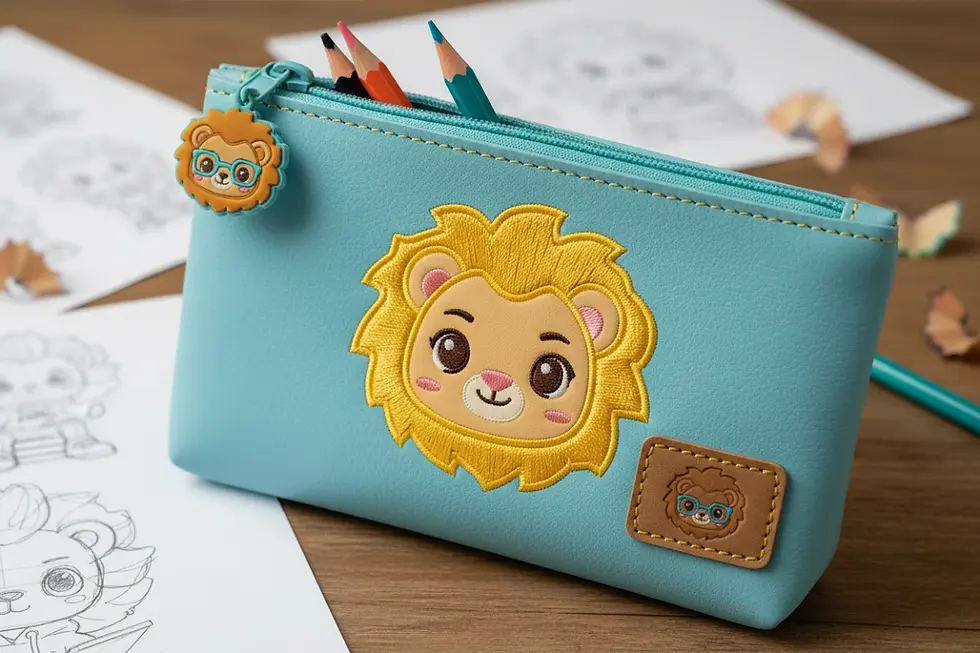
When developing these pouches, engineers must select fabrics that align with the target price point and the complexity of the design:
Canvas & Heavy Cotton Duck (10oz to 16oz): Ideal for classic, eco-friendly, or vintage-style character collections. Canvas offers excellent durability, holds heavy pigment printing well, and is highly compatible with sustainable product lines.
Polyurethane (PU) and Vegan Leather: Preferred for premium or high-definition licensed character pencil cases. PU leather provides a smooth, water-resistant surface that excels at showcasing intricate debossed textures, metallic foil stamping, and vibrant spot UV printing.
Polyester (300D to 900D): The industry standard for high-volume retail. It provides a lightweight, tear-resistant barrier that is highly receptive to dye-sublimation printing, ensuring complex character illustrations remain vivid and fade-resistant over time.
Plush Fabrics and Fleece: Used primarily for 3D novelty pouches where the entire pencil case mimics a soft toy. While highly tactile and engaging, plush materials require strict fiber-shedding controls and heavy-duty inner linings to keep writing tools from piercing the exterior.
To keep the bag upright and maintain its character silhouette on retail shelves, factories laminate these outer fabrics with structural layers like Ethylene-Vinyl Acetate (EVA) foam or non-woven backings. The interior is typically lined with a smooth, easy-to-clean 210D polyester fabric to protect against ink leakage.
How Can Brands Optimize Cost Tiers and MOQs in Custom Pencil Pouch Development?
Managing manufacturing costs in custom pencil pouch development requires a clear understanding of where production expenses accumulate. Labor, material yield, specialized hardware, and decorative printing processes represent the primary cost drivers. Standardizing interior components while varying external artwork is the most effective way to balance product tiers and control minimum order quantities.

By structuring your manufacturing plan around shared components, you can optimize costs across different market segments:
Feature/Component | Budget Tier (Mass Retail/Promo) | Mid-Range Tier (Boutique/Online) | Premium Tier (Licensed Collectibles) |
|---|---|---|---|
:--- | :--- | :--- | :--- |
Primary Fabric | 300D Polyester or lightweight canvas | 600D Polyester, standard PU leather | Premium Vegan Leather, Plush, or TPU |
Artwork Execution | 1-color silk-screen or basic sublimation | Multi-color sublimation, rubber patches | Detailed embroidery, debossing, 3D appliques |
Zipper & Puller | Standard #5 nylon coil with metal slider | Nylon coil with customized molded PVC puller | YKK metal zipper with custom 3D alloy puller |
Internal Structure | Single-compartment, unlined raw seams | Lined interior, raw seams bound with webbing | Multi-layer, mesh pockets, elastic pen loops |
Production Strategy | Cambodia-based mass assembly (Low duty) | China-Cambodia hybrid sourcing | Jiaxing facility for high-complexity runs |
By leveraging Lion Paper’s dual-site synergy, brands can build a flexible supply chain. Initial prototyping, high-complexity decoration, and urgent low-volume batches are executed efficiently at the Jiaxing facility in China. When scaling up to massive, retail-ready orders, production transitions to the Cambodia factory, maximizing cost-effectiveness and securing competitive tariff and duty rates for international shipments.
What Are the Primary Manufacturing Risks in Character-Themed Stationery and How Are They Mitigated?
During character-themed pencil case construction, translating cartoon artwork onto a flexible 3D fabric container introduces several distinct manufacturing challenges. Minor errors in alignment, print distortion, or physical assembly can quickly ruin the visual integrity of a licensed character, resulting in rejected batches and costly delays.
To safeguard product quality, production lines must actively manage these technical risks:
Print-to-Seam Misalignment: When a character's facial features or continuous patterns cross over a zipper or a stitched seam, the slightest shifting during sewing causes misalignment. Factories mitigate this by implementing rigid acrylic positioning templates during the cutting and sewing phases, keeping alignment tolerances under +/- 1.5mm.
Embroidery Distortion: Heavy embroidery on thin or stretchy fabrics can cause the surrounding material to pucker. Production engineers resolve this by applying a stiff stabilizer backing behind the embroidery zone, ensuring the fabric remains perfectly flat and smooth.
Stress-Point Stitch Failure: The attachments of handles, straps, and novelty 3D parts (like plush ears or limbs) are prone to tearing. Factories reinforce these high-stress connections using automated box-stitch or bar-tack patterns, verifying strength through pull-tension tests (typically holding 90N for 10 seconds).
Zipper Binding and Slippage: Character cases with irregular shapes can put uneven tension on zipper tracks, causing them to bind or fail. Utilizing high-grade nylon coil zippers with self-lubricating properties ensures smooth operation, even around tight curves.
Lion Paper applies standard operating procedures (SOPs) and strict Acceptable Quality Limit (AQL) sampling protocols across both its China and Cambodia facilities. By checking materials at incoming, in-process, and pre-shipment stages, potential manufacturing errors are caught and corrected before leaving the factory.
What Compliance and Retail-Ready Standards Apply to Licensed Character Pencil Cases?
Because pencil cases are widely used by school-aged children, licensed character pencil cases must meet stringent international consumer safety standards before entering major retail markets. Non-compliant products can lead to customs seizures, expensive product recalls, and severe damage to a brand's reputation.
Global compliance requires meeting several mandatory regulatory frameworks:
Chemical Safety (CPSIA & REACH): Children's school supplies must undergo strict testing for lead, cadmium, phthalates, and harmful AZO dyes. All plastics, coatings, inks, and metal zipper pulls must be certified non-toxic and skin-safe.
Physical Safety (EN71 & ASTM F963): These tests ensure the pencil case contains no sharp edges, dangerous metal protrusions, or small detachable parts that pose a choking hazard to young children.
IP Compliance and FAMA Audits: Global brands like Disney, Universal, and Sanrio require manufacturing facilities to hold valid Facility and Merchandise Authorization (FAMA) audits, certifying safe working conditions and ethical labor practices.
To support seamless global delivery, Lion Paper maintains key international certifications, including ISO 9001, FSC (Forest Stewardship Council) for traceable packaging, SMETA, WCA, GSV, and FAMA compliance. Working with certified facilities guarantees that your products will comfortably pass through international customs and meet the rigorous compliance checks of major global supermarket chains and specialized gift boutiques.
Additionally, retail-ready solutions require packaging that stands out in high-traffic stores. This includes designing custom PDQ display trays, protective shipping cartons that pass standardized drop tests, and clear, scannable barcode hangtags that streamline shelf replenishment.
How Should You Structure Your RFQ for Novelty Pencil Pouches and Validate Samples?
Launching a successful custom pencil pouch development project requires providing your manufacturing partner with a highly detailed Request for Quote (RFQ). A complete, well-structured RFQ minimizes miscommunication, speeds up the prototyping phase, and prevents unexpected price increases during production.

When preparing your RFQ document, ensure you specify the following key parameters:
Exact Dimensions: Provide length, width, depth, and the diameter of any rounded corners.
Detailed Material Specifications: List the desired outer fabric weight, lining density, and zipper size (e.g., #5 nylon zipper with customized zinc alloy puller).
Branding & Printing Requirements: Specify the printing methods (silk-screen, dye-sublimation, digital, or heat-transfer) along with precise Pantone color codes.
Structural Details: Note any internal mesh pockets, elastic organizer loops, or exterior handles.
Target Price & Expected Volumes: Share your target unit price alongside your annual or seasonal volume projections to help the factory suggest the most cost-efficient material pairings.
Once the quote is approved, the physical sample validation phase begins. Evaluate your pre-production samples against a strict checklist: verify color accuracy under standardized lighting, test zipper durability with multiple rapid pulls, check for flat, pucker-free seams, and verify that the pouch stands or folds exactly as intended in your original design drawings.
Ready to bring your creative product concepts to life? Share your target user, pouch shape, material, hardware, artwork, price tier and merchandising format with Lion Paper for a sample-ready development plan.
FAQ
What is the typical minimum order quantity (MOQ) for custom character-themed pencil cases?
Standard MOQs generally range from 1,000 to 3,000 units per design, depending on the complexity of the materials and custom hardware. However, through smart SKU engineering—such as utilizing shared base fabrics and structural shapes while only varying the printed artwork—the factory can often combine production runs to help you meet minimum fabric requirements more affordably.
How does Lion Paper manage intellectual property (IP) safety for licensed characters?
We take IP security very seriously. All design files, blueprints, and branding assets are managed under strict confidentiality agreements. In compliance with FAMA and SMETA guidelines, custom printing plates and molding tools are stored in highly secure areas, and we never disclose client designs, prototypes, or brand associations to unauthorized third parties.
How long does the prototype-to-shipping lifecycle take for a custom pencil pouch?
The development lifecycle typically takes 10 to 14 days for structural and graphic sampling at our Jiaxing facility. Once the pre-production sample is approved, mass production at our Cambodia factory generally requires 35 to 45 days, depending on order volume, followed by global transport and delivery to your destination.


Comments