


Cardstock Journal Binding Options: Engineering Guide & Comparison

Choosing the right cardstock journal binding options depends on cover caliper, text block page count, lay-flat requirements, and target manufacturing budgets. For professional stationery brands and retail publishers, Smyth sewn with a floating spine, exposed thread sewing, twin-loop wire-o, and PUR perfect binding represent the most reliable industrial solutions. Selecting the appropriate technique ensures structural integrity, prevents spine cracking on heavyweight paperboards, and eliminates page fallout during sustained daily use.
What Are the Core Cardstock Journal Binding Options and Their Technical Mechanics?
Cardstock journals utilize cover paperboards ranging between 250 gsm and 600 gsm (or multi-ply laminated boards reaching 800 gsm). These heavier stocks demand specialized binding mechanics to ensure smooth opening, spine stability, and long-term durability. Commercial publishers and stationery brands generally select from six proven custom journal binding methods:
Smyth Sewn with Floating Cardstock Cover: Interior sheets are grouped into folded signatures (typically 16 or 32 pages per section), sewn through the spine fold with durable cotton-polyester thread, reinforced with spine gauze and adhesive, and then encased within a scored cardstock cover. By detaching or floating the spine hinge from the direct glue layer, the journal opens completely flat across 180 degrees without stressing the exterior cover fold.
Exposed Spine Thread-Sewn Binding (Open Spine / Singer Stitched): In this method, the stitched signatures remain fully visible along the spine edge. Front and back cardstock covers are stitched directly into the outer signatures or applied as separate rigid card boards. This structure offers unrestricted 180-degree to 360-degree flat-opening performance and delivers a modern, tactile aesthetic popular in creative and designer notebooks.
Flexi-Case Binding (Soft Cover Case Bound): A hybrid between traditional hardcover binding and flexible paperbacks, flexi-case binding utilizes a flexible 300 to 450 gsm cardstock cover with turned-in edges wrapped over a lightweight spine stiffener. It delivers the refined perimeter finish of case-bound books while preserving lightweight handling and flexible portability.
Twin-Loop Wire-O Binding (Exposed or Semi-Concealed): Text pages and cardstock covers are pre-punched with precision square or round holes (using standard 3:1 or 2:1 pitch patterns) and bound with double-loop metal wire. To elevate retail aesthetics, semi-concealed (Canadian) or fully enclosed cardstock wraps enclose the wire loop inside a scored cover spine, providing continuous printable area along the exterior backbone.
PUR Perfect Bound (Polyurethane Reactive Adhesive): Gathered individual leaves or micro-notched folded sheets are milled along the spine and bound to a 4-score cardstock cover using flexible polyurethane reactive adhesive. PUR adhesive provides significantly higher flexibility and page-pull resistance than conventional ethylene-vinyl acetate (EVA) hot melt, making it suitable for coated papers and heavy text blocks.
Saddle Stitch Binding (with Scored Cardstock Cover): Folded sheets are nested and wire-stapled along the centerline fold. When pairing with cardstock covers over 250 gsm, precision pre-scoring and front-edge face trimming are required to prevent fiber cracking and booklet creep. This method offers the lowest unit manufacturing cost for slim journals containing under 64 pages.
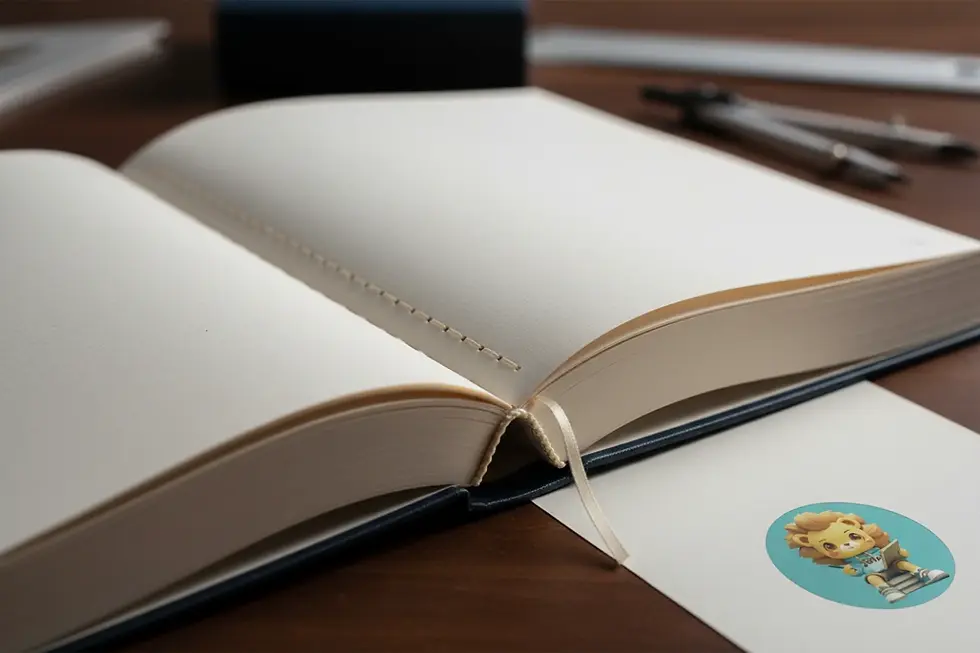
Smyth sewn floating spine construction allows heavyweight cardstock journals to open completely flat at 180 degrees.
How Do Cardstock Notebook Binding Methods Compare Across Performance and Specs?
A thorough cardstock notebook binding comparison helps product developers balance spine flexibility, opening ergonomics, page count limits, and unit manufacturing costs.
Binding Method | Optimal Page Count | Recommended Cover Caliper | Lay-Flat Capability | Spine Stress / Cracking Risk | Target Retail Price Tier |
|---|---|---|---|---|---|
:--- | :--- | :--- | :--- | :--- | :--- |
Smyth Sewn (Floating Spine) | 96 – 320 pages | 250 – 450 gsm (C1S / C2S / Kraft) | 180° Flat (Optimal) | Low (floating spine isolates stress) | Mid to High Tier |
Exposed Spine Sewn | 80 – 240 pages | 300 – 600 gsm (Rigid / Duplex) | 180° – 360° Flat | Negligible (spine is open thread) | Mid to High / Designer |
Flexi-Case Bound | 128 – 384 pages | 300 – 500 gsm (Turned-edge) | 180° Flat | Very Low (cased construction) | Premium / Luxury |
Concealed Wire-O | 80 – 240 pages | 350 – 600 gsm (Scored wrap) | 360° Flat (Optimal) | Low (wire handles rotation) | Mid Tier |
PUR Perfect Bound | 96 – 400 pages | 250 – 400 gsm (4-score spine) | Partial (120°–150° opening) | Moderate (unless PUR layer is 0.35mm) | Low to Mid Tier |
Saddle Stitch | 16 – 64 pages | 200 – 350 gsm (Center-creased) | 180° Flat (for slim formats) | Low (if pre-creased along grain) | Economy / Mass Retail |
Selecting among these custom journal binding methods requires evaluating the intended writing environment. Desktop planners, bullet journals, and art sketchbooks benefit most from thread-sewn floating spines or wire-o mechanisms that lie flat without user intervention. Conversely, mass-market utility notebooks and promotional giveaway journals achieve optimal commercial balance through automated PUR perfect binding or saddle stitching.
What Are the Key Manufacturing Failure Modes in Cardstock Binding and How to Prevent Them?
Heavyweight paperboards behave differently from lightweight text papers under folding, milling, and adhesive application. Industrial defects during cardstock journal production typically stem from four common engineering vulnerabilities:
Spine Cracking and Fiber Breakage Along Hinge Scores: Heavy paperboards (300 gsm and above) and coated artboards tend to crack along exterior spine folds when folded against the grain or creased improperly. Prevention requires ensuring the paper grain direction runs strictly parallel to the journal spine. Manufacturers must also employ matrix channel scoring dies rather than sharp rotary scoring wheels, and apply a ductile thermal BOPP lamination layer (gloss, matte, or soft-touch) to reinforce surface cellulose fibers.
Page Pull Failure in Perfect Bound Blocks: In heavy writing paper (100 to 160 gsm woodfree sheets), standard EVA adhesives crystallize and shear under repetitive stress, causing center pages to detach. To eliminate page loss, manufacturing facilities apply flexible PUR glue at a calibrated wet film thickness of 0.35 mm to 0.40 mm, combined with mechanical spine micro-notching at 0.8 mm depth to maximize adhesive surface contact.
Cover Warping and Asymmetric Board Cupping: Single-sided surface treatments (such as single-sided gloss lamination, heavy foil stamping, or spot varnish) create uneven surface tension, causing cardstock covers to curl when ambient humidity shifts. Preventing warping requires balanced dual-sided barrier coatings, maintaining paper warehouse humidity at 45% to 55% RH, and implementing uniform weight compression during palletized curing.
Hinge Delamination and Signature Creep: In thick saddle-stitched or dense thread-sewn formats, the outermost leaves of nested signatures push outward beyond the cover edge, a phenomenon known as booklet creep. This defect is prevented by programming automated signature creep compensation during prepress imposition, followed by automated three-knife trimming with hardened high-speed steel blades.

Page pull-strength testing ensures adhesive and stitched journal bindings meet commercial retail durability standards.
How Can Brands Achieve a True Lay Flat Cardstock Binding for Heavyweight Paper?
Achieving true lay flat cardstock binding requires deliberate structural engineering that decouples the outer cardstock cover from the internal text block spine. In standard tight-back perfect binding, adhesive forms a rigid bridge between the cover paperboard and the text leaves. When opened, the stiff cardstock creates mechanical leverage resistance, forcing the book to snap closed unless held down by hand.
To achieve an effortless 180-degree flat lay across heavy paper stocks, manufacturing engineers utilize two primary structural mechanisms:
Floating Spine Construction (Hollow Back Sewn): In this configuration, the sewn signature block is reinforced along its spine edge with a flexible woven gauze strip and a flexible primer coat. The outer cardstock cover is creased with a 4-score matrix profile: two spine scores defining the backbone width and two hinge scores set 5 mm to 7 mm offset from the spine edge. The cover is glued exclusively to the outer endpapers along the hinge margin, leaving the spine backbone unglued. When the journal opens, the text block arches upward inside the hollow cavity while the exterior cover rests flat on the desk.
Exposed Spine Thread Sewing: By eliminating the solid cover backbone entirely, the exposed stitched signatures pivot around the thread loops without any physical interference from a paperboard spine. This method allows unrestricted 180-degree to 360-degree rotation, enabling the user to fold the front cover completely behind the back cover for handheld writing.
Both methods accommodate interior paper weights from 80 gsm up to 160 gsm, making them the standard choice for professional bullet journals, executive notebooks, and watercolor sketch pads.
What Physical Testing Protocols Validate Quality in Commercial Journal Manufacturing?
Before authorizing volume production runs, stationery brand buyers and quality engineering teams must evaluate pre-production cardstock journal samples against rigorous physical test standards:
Digital Page Pull-Strength Test (ASTM D6195 / ISO Binding Standards): A pneumatic or digital tensile testing clamp isolates a single interior leaf while the surrounding block is held rigid in a fixture. A uniform vertical pull force is applied until failure occurs. For commercial retail qualification, PUR adhesive and Smyth-sewn bindings must withstand a minimum tensile pull threshold of 4.5 N/cm to 6.5 N/cm without adhesive release or signature perforation tearing.
Automated Flex and Hinge Fatigue Cycling: The pre-production sample is mounted on an automated mechanical flex tester that repeatedly opens and closes the journal from 0 degrees to 180 degrees (or 360 degrees for wire-bound formats) for 500 to 1,000 continuous cycles. Quality inspectors examine the spine fold under magnification to detect micro-cracking, film delamination, or thread loosening.
Caliper and Score Depth Verification: Engineers utilize digital depth micrometers to verify that cover score channel depths reach 40% to 55% of the total cardstock caliper. Insufficient scoring depth causes hinge resistance and cover lift, while excessive scoring depth shears underlying cellulose fibers and weakens the hinge.
Environmental Chamber Conditioning (Thermal and Humidity Stress): Journal samples are conditioned inside an environmental chamber at 40°C (104°F) and 85% relative humidity for 72 hours, followed by a 24-hour dry cycle at 15% RH. The finished binding must show no adhesive crystallization, spine splitting, paper waviness, or cover warping.

Precision matrix creasing and correct grain direction prevent spine cracking on heavy cardstock journal covers.
What Specifications Must Be Included in a Journal Manufacturing RFQ and QC Plan?
To eliminate production ambiguity and receive accurate factory quotations, procurement managers should assemble structured journal manufacturing RFQ specifications. Clear technical callouts prevent sample revisions, tooling delays, and batch inconsistencies.
1. Product Dimensions and Spine Geometry:
Trimmed Journal Size: Specify standard formats (e.g., A5 148 x 210 mm, B5 176 x 250 mm, or Custom 6 x 9 in).
Spine Bulk Caliper: Calculated accurately from interior page count, paper caliper per leaf, and spine glue or gauze allowance.
Corner Finishing: Specify square corners or precision round corners with radius (e.g., 6 mm, 8 mm, or 10 mm).
2. Cover Stock and Creasing Specifications:
Cover Material: Specify exact paperboard grade and caliper (e.g., 350 gsm C1S Ivory Board, 400 gsm FSC Uncoated Kraft, or 600 gsm Duplex Greyboard).
Grain Alignment: Specify paper grain direction strictly parallel to the spine fold.
Scoring Profile: Call out 2-score center creasing or 4-score matrix creasing with designated hinge offset (typically 5 mm to 7 mm).
Surface Finishes: Specify thermal BOPP lamination (matte, glossy, or anti-scratch soft-touch), spot UV varnish, foil stamping, or blind debossing.
3. Interior Text Block Details:
Paper Type & Weight: Specify exact interior stock (e.g., 100 gsm FSC-certified woodfree uncoated, 120 gsm bamboo offset, or 160 gsm mixed media paper).
Total Page Count: Call out exact page counts arranged in manufacturing multiples (multiples of 16 for Smyth sewing; multiples of 4 for saddle stitch or wire-o).
Page Ruling: Specify dot grid, 7 mm lined, blank, or 5 mm graph with PMS ink codes and bleed margins.
4. Binding Structure and Material Callouts:
Binding Construction: Specify exact method (e.g., Smyth Sewn with Floating Cardstock Cover, Exposed Thread Sewn, PUR Perfect Bound, or Concealed Wire-O).
Sewing Thread Specification: Specify thread gauge (#40 or #30 polyester-cotton core) and PMS thread color for exposed spine designs.
Adhesive Specification: Polyurethane Reactive (PUR) glue with 0.35 mm continuous film thickness; non-animal synthetic primer for vegan certified lines.
Endpapers: 140 gsm to 180 gsm woodfree endpapers with reinforced woven fabric hinge tape where applicable.
5. Accessories, Retail Packaging, and Enclosures:
Elastic Band Closure: Specify 10 mm to 15 mm flat woven elastic band with color matching and concealed rear brass eyelets.
Ribbon Bookmark: Specify 5 mm to 7 mm grosgrain or woven satin ribbon (length = book diagonal + 40 mm).
Back Storage Pocket: Expandable gusseted pocket using 200 gsm cardstock with matching paper or fabric gussets.
Packaging: Specify individual biodegradable polybags, belly bands, shrink-wrapping, or protective master carton packing.
6. Compliance and Quality Tolerances:
Minimum Page-Pull Strength: Greater than or equal to 5.0 N/cm.
Factory Certifications: ISO 9001, FSC Chain of Custody, SMETA ethical audit, WCA, GSV, FAMA, and CPSIA compliance.
How Does Lion Paper Support Cardstock Journal Engineering from Prototyping to Mass Production?
Lion Paper Products (Jiaxing) Co., Ltd., established in 2015, is an integrated supply-chain partner for customized paper goods and creative stationery. Operating across a multi-node manufacturing network—including a 3,000-square-meter design, prototyping, and development center in Jiaxing, China, and a 10,000-square-meter mass manufacturing facility in Cambodia—Lion Paper bridges the gap from initial product concepts to reliable, volume retail shipments.
With an annual notebook and journal output exceeding 5 million units, Lion Paper serves consumer brands, retail chains, and direct-to-consumer platforms across North America, Europe, Australia, the Middle East, and Southeast Asia. We provide complete structural engineering across eight core product categories, encompassing Eco Paper Products, Notebooks & Journals, Planners & Calendars, Stationery & Office, Bags & Organizers, Accessories, Gift & Packaging, and Home & Living.
Design-to-Manufacturing Integration: In-house prepress engineers and paper structural specialists analyze paperboard grain directions, calculate spine bulk dynamics, and configure signature layouts to eliminate spine cracking and optimize lay-flat performance before tooling.
Rapid Prototyping and Agile Sampling: The Jiaxing facility delivers precision-cut, fully bound cardstock journal prototypes within 3 to 5 business days, allowing brands to test paper textures, score elasticity, and hinge durability prior to committing to volume production.
China–Cambodia Dual-Site Synergy: Initial product development, short-run multi-SKU testing, and specialized artisanal finishes are engineered at our China hub, while large-scale production orders transition to automated Cambodia manufacturing lines for optimized landed cost efficiency and predictable delivery timelines.
Comprehensive Quality and Compliance Systems: Operations adhere to strict standardized operating procedures (SOPs), AQL sampling standards, digital pull-testing, defect mapping, and pallet compression protocols. Our manufacturing network is supported by ISO 9001, FSC chain-of-custody, SMETA, WCA, GSV, FAMA, and CPSIA audit verifications.
Sustainable Material Architecture: Lion Paper supports corporate ESG goals by sourcing FSC-traceable papers, post-consumer recycled (PCR) cardstocks, low-impact soy inks, and recyclable packaging formats.
Ready to bring your custom notebook collection to market with robust engineering and dependable manufacturing execution? Share your journal size, cardstock, page count, binding, finish, closure and price tier with Lion Paper for a manufacturable sample plan.
FAQ
What is the best cardstock journal binding option for true lay-flat writing?
The most effective binding options for true 180-degree lay-flat writing are Smyth sewn with a floating spine and exposed spine thread-sewn binding. Both constructions isolate the inner signature block from the outer cardstock cover, allowing pages to rest completely flat without snapping shut.
How do you prevent heavyweight cardstock covers from cracking along the spine?
Spine cracking is prevented by aligning the paperboard grain direction parallel to the spine fold, using matrix channel scoring dies rather than standard rotary creasing wheels, and applying a ductile thermal BOPP lamination layer to reinforce outer cardstock surface fibers.
What is the minimum page count required for Smyth sewn cardstock journals?
Smyth sewing generally requires a minimum of 64 to 96 pages, organized into folded signatures of 16 or 32 pages. For notebooks containing fewer than 64 pages, saddle stitching with a pre-scored cardstock cover or Singer center-sewn binding is recommended.
Can cardstock journals with PUR perfect binding lay completely flat?
PUR perfect binding offers improved flexibility compared to traditional EVA adhesive, allowing an opening angle of 120 to 150 degrees. However, because the cardstock cover is bonded directly across the spine, it does not achieve the complete, tension-free 180-degree flat lay of Smyth-sewn floating spine constructions.


Comments