


Mastering Cardstock Grain Direction, Scoring, and Folding: A Complete Production Guide

Aligning cardstock grain direction parallel to the fold line and applying precise mechanical scoring are critical to preventing paper fiber cracking, ensuring clean folds, and maintaining structural integrity in custom notebooks, packaging, and retail-ready paper goods. Proper alignment reduces fiber tension, while scoring compresses paper fibers to facilitate a seamless bend without aesthetic or physical failure.
Understanding Cardstock Grain Direction: Grain Long vs. Grain Short
During the paper manufacturing process on a Fourdrinier machine, cellulose fibers align themselves parallel to the direction of the paper web's travel. This orientation establishes the paper's "grain." Understanding this characteristic is paramount when dealing with heavy cover stocks. "Grain long" means the fibers run parallel to the longer dimension of the sheet, while "grain short" indicates fibers run parallel to the shorter edge.
When executing cardstock grain direction scoring folding, folding parallel to the grain is always preferred. Folding parallel to the grain requires less force because the fold occurs between the fibers rather than breaking through them. Conversely, folding perpendicular (against) the grain forces the fibers to bend and snap, leading to visible surface cracking and structural failure.
To identify paper grain direction on the production floor, technicians use manual diagnostics. The tear test involves tearing a sheet in both directions; the tear parallel to the grain is straight and clean, whereas the tear perpendicular to the grain is jagged. The bend test measures resistance; the direction bending with the least resistance is parallel to the grain.
In high-speed production, failing to establish the correct grain alignment results in high reject rates. For custom notebooks, journals, and planners, custom notebook cover grain alignment must run parallel to the spine. If the grain runs perpendicular to the spine, the cover will resist folding, flare outward when closed, and quickly crack along the hinge, reducing the product's retail value and functional lifespan. Running the fibers parallel to the spine ensures the book opens naturally and lays flat, which is an essential benchmark of the "Lion Standard" for premium retail goods.
The Mechanics of Scoring and Folding Heavy Cardstock
Heavy cardstock (typically classified as paperboard or cover weight exceeding 150 GSM or 10 pt. caliper) cannot be cleanly folded without mechanical preparation. Attempting a direct fold on dense board causes uneven stress distribution on the outer face, resulting in severe paper grain direction folding cracking.
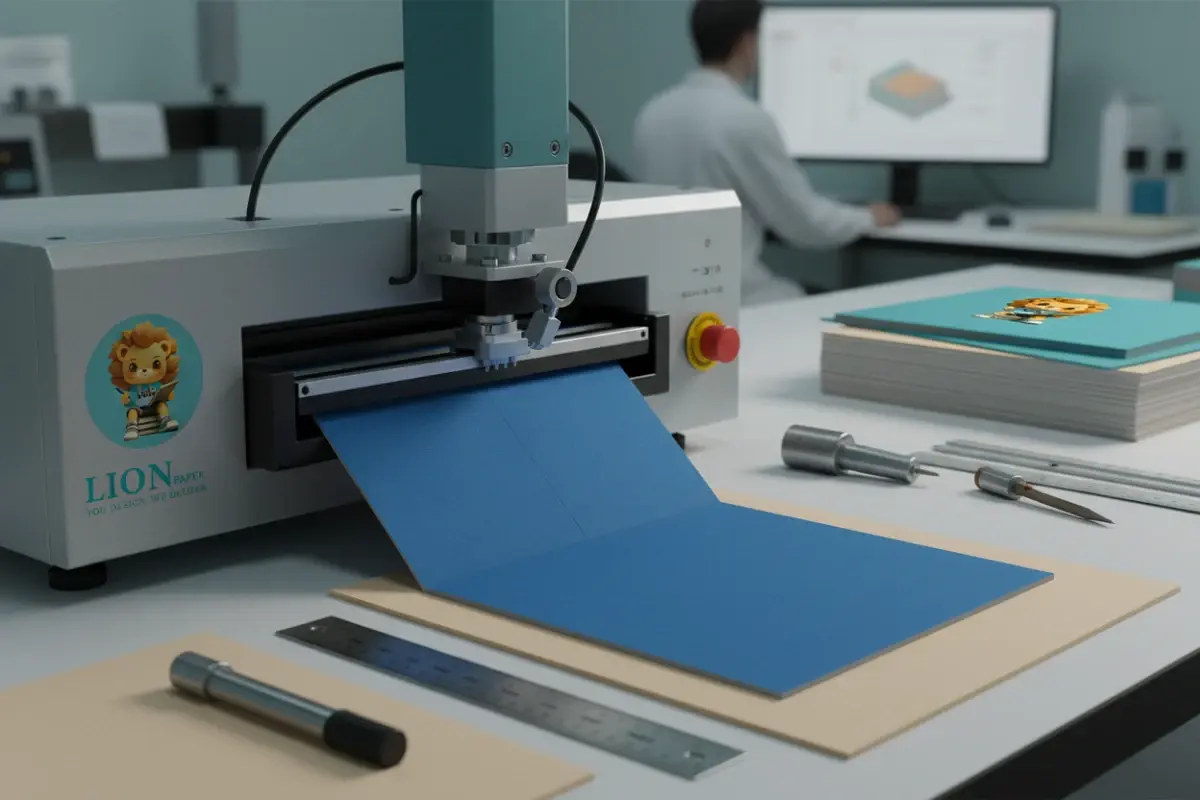
Mechanical scoring solves this issue by creating a pre-defined hinge. The physical process of scoring cardstock before folding involves pushing a steel rule (male die) into the paperboard, forcing the sheet into a grooved channel (female matrix). This process does not cut the paper; instead, it delaminates the internal fiber structure of the cardstock in a controlled zone.
During mechanical scoring, the depth of the crease must be perfectly calibrated. If the male die penetrates too deeply, it cuts the outer paper fibers, causing immediate splitting. If it does not penetrate deeply enough, the internal plies of the board do not delaminate, forcing the cardstock to fold like an unscored sheet—resulting in cracking.
When the scored cardstock is folded, this deliberate internal delamination allows the paper fibers to expand outward and fold inward into a neat bead. The male side of the score must always face outward, and the fold must bend away from the male impression (the ridge goes on the inside of the fold). This geometry accommodates the extra bulk of the folded fibers, ensuring a crisp, professional edge. For heavy-duty applications such as three-dimensional gift packaging or multi-panel folders, double scoring (applying two parallel scores close together) is often utilized to distribute the folding tension across two distinct hinges, dramatically reducing the risk of fiber rupture on outer coated surfaces.

Solving the Paper Cracking Problem: Production Trade-offs and Solutions
While choosing the correct grain direction and utilizing precise scoring methods are fundamental, several variables influence whether cardstock will crack during the folding phase. Heavy ink coverage, thick aqueous coatings, UV varnishes, and film laminations embrittle the paper surface, making it highly susceptible to fracture.
To mitigate these risks, production engineers must balance several critical trade-offs:
Moisture Content: Dry paper fibers lose elasticity. Maintaining a relative humidity (RH) of 50% to 55% in the production facility ensures fibers remain pliable enough to bend without snapping.
Surface Coating Selection: Standard matte or gloss UV coatings are brittle. Specifying "foliating" or "flexible" laminations and soft-touch films provides an elastic layer that holds the paper surface together during folding.
Score Profile Adjustments: Thicker stocks and heavier ink coverage require wider and deeper scoring channels to accommodate the displacement of bulkier material.
Below is a diagnostic matrix outlining common folding issues, their root causes, and production solutions:
Symptom | Primary Root Cause | Mitigation Strategy |
|---|---|---|
:--- | :--- | :--- |
Jagged, irregular cracks along the fold line | Folding against the grain without scoring | Adjust layout for proper grain alignment; introduce mechanical scoring. |
Ink chipping and fine flaking along the fold crease | Brittle UV varnish combined with tight fold radius | Apply a flexible matte/gloss film lamination or use a wider creasing matrix. |
Flared cover edges (refusal to lie flat) | Grain direction running perpendicular to the spine | Re-impose printing plates to ensure grain runs parallel to the fold/spine. |
Delamination and tearing on the inner fold bead | Excessive scoring pressure or narrow matrix channel | Reduce male rule height or increase female matrix groove width. |
Technical Specifications: Cardstock Scoring Matrix by GSM and Caliper
Achieving consistent folding across high-volume production runs requires adherence to strict engineering specifications. When formulating packaging cardstock scoring specifications, production teams must calculate the optimal width of the scoring rule and the corresponding matrix channel based on the paperboard's thickness (caliper) and weight (GSM).
When executing high-speed manufacturing runs, scoring specifications must also account for the speed and mechanical pressure of the folder-gluer machine. Automated folding lines operating at speeds of over 300 meters per minute apply sudden, high-velocity folding forces to the scored lines. If the scoring specifications are slightly off, the sheet will twist, leading to fish-tailing (crooked folding) or structural failure on the glue tab. Our automated lines in our Cambodia mass production facility rely on these exact scoring matrix calculations to maintain consistent high-speed throughput.
The following table outlines standard industrial parameters for scoring and creasing solid bleached sulfate (SBS) and high-density folding boxboard (FBB) used in high-quality packaging and notebook covers:
Cardstock Weight (GSM) | Caliper / Thickness (inches) | Caliper / Thickness (mm) | Male Rule Thickness (Pt.) | Female Matrix Width (mm) | Grain Direction Constraint |
|---|---|---|---|---|---|
:--- | :--- | :--- | :--- | :--- | :--- |
150 – 200 GSM | 0.007" – 0.009" | 0.18mm – 0.23mm | 2 Pt. (0.71mm) | 1.0mm – 1.2mm | Highly recommended parallel to fold |
200 – 250 GSM | 0.009" – 0.012" | 0.23mm – 0.30mm | 2 Pt. (0.71mm) | 1.2mm – 1.4mm | Mandatory parallel to fold for clean edge |
250 – 300 GSM | 0.012" – 0.015" | 0.30mm – 0.38mm | 3 Pt. (1.05mm) | 1.5mm – 1.8mm | Mandatory parallel; requires double score if laminated |
300 – 350 GSM | 0.015" – 0.018" | 0.38mm – 0.46mm | 3 Pt. (1.05mm) | 1.8mm – 2.2mm | Mandatory parallel; matrix depth must match caliper |
350+ GSM | 0.018"+ | 0.46mm+ | 4 Pt. (1.42mm) | 2.2mm+ | Mandatory parallel; custom die-creasing required |

Quality Control: How to Inspect Fold Quality Before Mass Production
At Lion Paper Products (Jiaxing) Co., Ltd., quality control begins in our 3,000-square-meter design and prototyping facility in Zhejiang, China. Before initiating mass manufacturing at our 10,000-square-meter facility in Cambodia, we subject every structural layout to rigorous testing.
To verify that our folding quality meets international standards (including ISO 9001 and AQL benchmarks), we implement a standardized three-step inspection protocol:
The Visual Crack Rating Scale: Technicians inspect the folded edge under 10x magnification. Folds are graded on a scale of 1 to 5 (1 representing zero fiber separation or ink chipping; 5 representing complete surface rupture and fiber exposure). A grade of 2 or higher requires immediate recalibration of the scoring machinery.
Springback and Resistance Testing: Using a digital crease fatigue tester, we measure the resistance force of the folded hinge. High resistance indicates inadequate scoring, which leads to flared notebook covers or improperly sealing packaging boxes.
Adhesion and Rub Testing: For printed and laminated stocks, we perform tape-pull tests directly on the scored hinge to ensure that the tension of folding does not cause the lamination film or ink layers to delaminate from the cardstock base.
We also conduct temperature and humidity environmental simulation tests. Because paper is highly hygroscopic, it absorbs and releases moisture depending on environmental conditions. A custom notebook manufactured in the humid climate of Southeast Asia may experience paper fiber shrinkage or expansion when shipped to a dry winter climate in North America, leading to unexpected cover warping or joint cracking. Our quality control SOPs require that prototype covers are placed in environmental chambers to simulate these regional climatic shifts, ensuring the scored folds retain their stability, flexibility, and neat appearance regardless of their final destination.

Preparing Your RFQ: Essential Cardstock and Die-Line Fields for Lion Paper
When sourcing custom notebooks, planners, or retail-ready packaging, providing precise technical parameters ensures an accurate, fast, and optimized production quote. Our dual-site supply chain integrates the prototyping and engineering strengths of our Jiaxing hub with the cost efficiencies and scaled capacity of our Cambodia production facility, delivering over 5 million notebooks annually.
To streamline the design-to-manufacturing process, please include the following fields in your RFQ:
Cardstock Grade & GSM: Specify the exact material (e.g., FSC-certified SBS, recycled Kraft, FBB) and the desired weight (e.g., 250 GSM or 300 GSM).
Grain Direction Preference: Confirm if the grain must run parallel to the main fold (especially crucial for custom notebook cover grain alignment).
Finishing & Coating Details: List all surface finishes, such as spot UV, foil stamping, soft-touch matte lamination, or aqueous coatings, as these heavily influence the scoring specifications.
Fold and Die-Line Vector Files: Provide complete CAD die-lines with distinct layers indicating cut lines (solid) and crease/score lines (dashed).
Target Market & Compliance Requirements: Specify if your project requires FSC-certified materials, SMETA, FAMA, WCA, or CPSIA compliance so we can source and test accordingly.
By matching material characteristics to your aesthetic goals, we balance quality, cost, and structural performance. Send your cardstock GSM, print coverage, finishing and fold/die-line requirements to Lion Paper for a paper-performance and production-feasibility review.
FAQ
What is the minimum cardstock weight that requires scoring before folding?
Typically, any cardstock with a weight of 150 GSM (or a caliper of 0.007 inches / 7pt) or higher requires mechanical scoring before folding to prevent fiber cracking. Folding paperboard above this threshold without a score line will inevitably result in fractured fibers and jagged edges.
Why does ink crack along the fold even if the cardstock has been scored?
This usually happens when the ink layer or the surface coating (like UV varnish) is too brittle or dry, or if the scoring channel was too narrow to displace the paper bulk. To solve this, you can apply a flexible film lamination (matte or gloss) over the printed sheet or adjust the creasing matrix width to match the paper thickness and ink coverage.
How does Lion Paper handle dual-site quality control for custom notebook covers?
Our Jiaxing design hub (3,000 sqm) creates the technical prototypes and establishes the correct grain alignment, scoring specifications, and material configurations. Once approved, these calibrated specifications are transferred to our Cambodia mass production facility (10,000 sqm) using standardized SOPs, ensuring the final bulk production perfectly matches the validated prototype.


Comments