


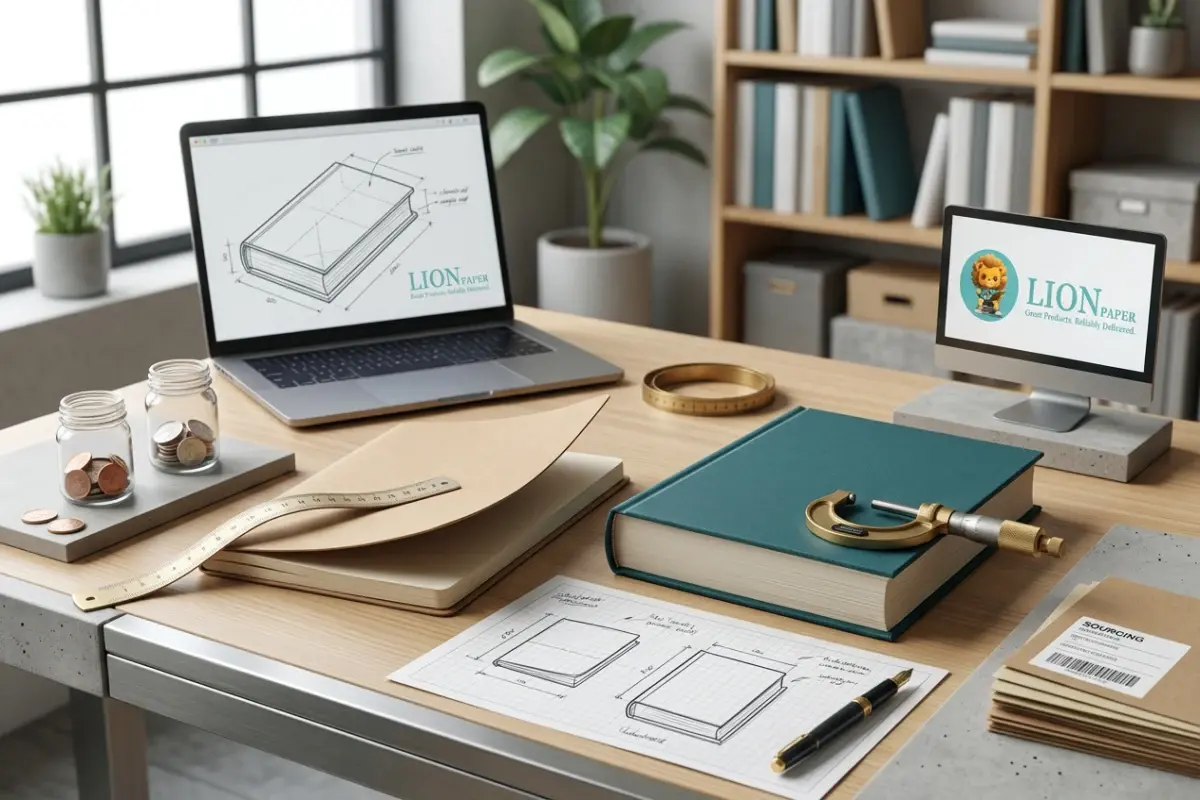
Cardboard Cover vs Wrapped Hardcover Notebook: Engineering, Cost, and Sourcing Guide

Cardboard cover notebooks provide cost efficiency, lightweight portability, and streamlined recyclability ideal for value-driven mass retail, while wrapped hardcover notebooks feature rigid greyboard cores and wrapped outer skins that offer superior corner durability and higher perceived retail value. Choosing between these formats requires balancing target retail price points, logistics volume, surface embellishment requirements, and consumer use cases.
What Are the Core Structural Differences Between Cardboard Covers and Wrapped Hardcovers?
Understanding the fundamental divergence between a single-ply paperboard format and a multi-layer casebound assembly is essential when comparing a cardboard cover vs wrapped hardcover notebook. Each construction method dictates how a notebook handles mechanical stress, accepts bindery adhesive, and behaves during high-speed automated production.
A cardboard cover—often categorized within paperboard or softcover production lines—consists of a single ply of heavy cardstock or duplex board ranging from 250 gsm to 600 gsm (roughly 12 pt to 28 pt caliper). These covers receive print and surface finishes directly onto the raw substrate before being scored and folded around the inner text block. The binding is typically executed via saddle stitching, burst perfect binding, sewn spine binding with a flush paper wrap, or wire-o punching. Because there is no internal core or turning-in process, the edges of the cover remain raw and flush with or slightly extending past the text pages.
In contrast, wrapped hardcover construction—classically known as case binding—is a composite structure. It involves a dense rigid core board (typically greyboard, chipboard, or kappa board ranging from 1.5 mm to 3.0 mm in thickness) wrapped and glued with an outer cover material. This outer skin can be coated art paper (128 gsm to 157 gsm), bookcloth, genuine leather, PU leather, or specialty paper. The outer wrap is glued across the front face, wrapped around the spine and board edges (the "turned-in" turn-in edge), and anchored on the inside by pasted-down endpapers (linings). This builds a resilient shell with distinct structural grooves known as hinges or joints that allow the heavy cover to open freely without pulling away from the text block.
Single-Ply Cardboard: Direct print on one substrate layer, light caliper (0.3 mm–0.7 mm), flush cut edges, flexible spine folding, lower physical mass.
Wrapped Casebound Hardcover: Three-part board core (front, spine, back) wrapped in a laminated skin, heavy caliper (1.8 mm–3.5 mm), turned-in edges, bonded with endpapers, rigid drop-resistant construction.

Structural anatomy: multi-layer casebound assembly versus single-ply paperboard.
How Do Cardboard Covers and Wrapped Hardcovers Compare in Durability, Perceived Value, and Landed Cost?
When evaluating a casebound vs paperboard notebook, product developers and procurement managers must weigh physical lifecycle performance against landed freight and manufacturing costs. The physical structure directly determines whether a product belongs in an impulse-buy value aisle or a premium retail stationery display.
Feature / Metric | Single-Ply Cardboard Notebook | Wrapped Hardcover Notebook (Casebound) |
|---|---|---|
:--- | :--- | :--- |
Core Board Thickness | None (single sheet 250–600 gsm) | 1.5 mm to 3.0 mm Greyboard / Kappa Board |
Corner & Impact Resistance | Moderate; prone to creasing and corner fraying | High; rigid core resists corner dents and drops |
Lay-Flat Functionality | Dependent on binding (good with exposed spine/wire-o) | Excellent with thread-sewn book blocks and square spines |
Unit Manufacturing Cost | Baseline (lowest unit cost) | 1.8x to 3.2x higher than paperboard |
Shipping Weight & Volume | 40%–60% lighter; high pallet packing density | Heavier; adds freight cost on long-haul ocean/air |
Perceived Retail Value | Mass-market, back-to-school, utility ($2.99–$8.99) | Premium, executive, gift-ready ($14.99–$29.99+) |
Typical Binding Methods | Saddle stitch, perfect bound, wire-o | Thread sewn with endpapers, concealed wire-o |
From a cost perspective, custom hardcover notebook manufacturing demands specialized case-making machines, book block casing-in lines, extended drying times for water-based PVA glues, and higher material consumption. The added weight of greyboard also increases international ocean and inland freight costs per unit. However, the resulting tactile weight allows commercial brands to position casebound journals at double or triple the retail price point of paperboard alternatives.
Cardboard covers eliminate multiple manufacturing steps. Since printing, laminating, and die-cutting happen in continuous inline processes, production yields run higher with faster line speeds. For high-volume rollouts, the reduction in cubic volume per carton translates into major container utilization savings.
Which Surface Finishing and Embellishment Techniques Work Best for Each Cover Type?
Surface aesthetics determine visual appeal on store shelves and digital product listings. While both cover types accommodate standard CMYK and Pantone offset printing, their structural stiffness influences how they accept high-pressure decorative finishing.
Cardboard covers perform well with surface-level treatments. Matte or gloss film lamination, soft-touch coatings, all-over aqueous coatings, and spot UV varnishes apply smoothly to paperboard. However, deep debossing and blind multi-level embossing require careful calibration on single-ply stock. Excessive strike pressure on paperboard below 400 gsm can cause visible ghosting, board warping, or internal paper fiber cracking on the reverse side of the cover. Metallic foil stamping functions cleanly on paperboard, provided the die temperature and dwell time do not scorch lightweight coatings.
Wrapped hardcovers offer a stable, rigid backing plate that supports heavy industrial pressure. Because the outer wrap is backed by 2 mm dense greyboard, manufacturers can execute deep blind debossing, crisp multi-level textured embossing, and heavy-gauge foil stamping without telegraphing distortions to the inside pages. Furthermore, wrapped hardcovers accommodate tactile specialty materials that cannot run through standard sheetfed paperboard lines:
Bookcloth and Linen: Woven fabrics laminated with paper backings for a classic heritage texture.
PU and Vegan Leather: Thermo-reactive synthetic leathers that darken naturally when debossed under heat.
Specialty Metallic & Flocked Papers: High-end materials that provide distinctive sensory experiences for premium retail.
Edge Gilding and Spine Treatments: Rigid covers properly protect gilded, sprayed, or stenciled text block page edges from friction during transit.
How Do Material Sourcing, Recyclability, and FSC Compliance Differ Between the Two Structures?
Corporate ESG mandates and changing environmental regulations across North America and Europe make sustainable substrate selection a core product development requirement. Both cardboard and wrapped hardcover notebooks can achieve chain-of-custody compliance, but their end-of-life recyclability profiles differ significantly.
Cardboard notebooks represent an ideal monomaterial or near-monomaterial product. When produced with an unlaminated kraft board, a water-based dispersion coating, or a recyclable paper spine, the entire notebook—cover and interior—can enter municipal paper recycling streams without mechanical separation. Brands utilizing FSC-certified virgin kraft, FSC Mix, or 100% post-consumer waste (PCW) recycled board can print certified on-product environmental claims that appeal directly to eco-conscious consumers.
Wrapped hardcovers are composite items requiring multi-material lamination. While the core greyboard is frequently manufactured from 100% recycled unbleached paper pulp, the assembly requires substantial industrial adhesives (PVA or hot-melt polyurethanes) to bind the outer cover, board, and interior endpapers together. If the exterior wrap features plastic lamination, synthetic PU leather, or metal corner protectors, the consumer cannot easily recycle the unit curbside without stripping the cover from the book block.
To maximize sustainability in custom hardcover notebook manufacturing, brands increasingly specify:
FSC-certified paper wraps coated with water-based varnishes rather than petroleum-based plastic laminates.
High-density 100% recycled greyboard cores compliant with international heavy-metal and chemical safety standards.
Soy-based and vegetable-based inks for all exterior and text block graphics.
Biodegradable animal-free casing adhesives that minimize toxic emissions during manufacturing.

Embellishment capabilities: rigid greyboard cores allow deep debossing and crisp foil stamping.
What Are the Strategic Cardboard Notebook Cover Benefits for Value Retail and High-Volume Distribution?
For volume retail buyers and commercial procurement teams, cardboard notebook cover benefits center on unit economics, logistics efficiency, and rapid inventory turnover. In mass-market retail, educational channels, and corporate promotional campaigns, margin performance depends on minimizing unneeded packaging mass while maintaining adequate utility.
In value retail stationery sourcing, price architecture dictates physical specifications. A retailer targeting an opening price point (OPP) under $5.00 cannot support the labor and material costs inherent in case binding. Single-ply paperboard covers allow commercial stationery brands to provide vibrant full-color printing, clean spine branding, and high page counts while preserving retail gross margins.
Key advantages for large-scale distribution programs include:
Maximized Pallet and Container Density: Being 30% to 50% thinner than equivalent hardcover notebooks, cardboard notebooks allow significantly more units per master carton, per pallet, and per 40-foot high-cube shipping container. This directly lowers per-unit landed freight charges.
Lightweight Portability for Everyday Carry: Students and field professionals often prefer a flexible, lightweight notebook that slips into backpacks or work bags without adding excessive bulk.
Fast Sampling and Rapid Production Runs: With fewer assembly steps and no adhesive curing queues for the cover case, high-speed automated lines can produce tens of thousands of paperboard notebooks daily, facilitating rapid seasonal replenishment.
Flexible Binding Integration: Single-ply covers integrate seamlessly with twin-wire wire-o binding, plastic spiral binding, saddle stitching, and sewn singer spines, providing visual variety across retail product lines.
When Should Brands Choose Custom Hardcover Notebook Manufacturing for Premium Positioning?
While paperboard dominates utility and entry-level retail segments, custom hardcover notebook manufacturing is the gold standard for designer stationery brands, luxury private label programs, executive office supplies, and keepsake gifts. The structural permanence of a casebound book elevates a blank notebook into a refined lifestyle accessory.
Brands should specify wrapped hardcovers under the following strategic conditions:
High Price Tier Positioning: For journals targeting retail price points above $15.00, consumers expect substantial tactile weight, crisp square spines, and rigid protection that withstands a full year of daily desktop use.
Functional Lay-Flat Demands: Heavy-duty case binding utilizing thread-sewn (Smyth sewn) signatures allows the notebook to rest completely flat at 180 degrees on a desk. This is a crucial requirement for artists, bullet journalists, and executive note-takers.
Integrated Accessory Suites: Rigid covers support structural add-ons that would buckle flexible paperboard, such as heavy-gauge elastic closure bands, integrated ribbon markers, expandable inner back-cover gusseted pockets, and built-in pen loops.
Archival Durability: Executive meeting notebooks, religious devotionals, guided gratitude journals, and annual planners require durable structural integrity that ensures pages remain intact for years without curled corners or torn covers.
By leveraging decorative materials such as textured bookcloth, soft-touch coated art paper, or embossed vegan leather, brands establish immediate visual differentiation on crowded retail shelves and in e-commerce product imagery.

Automated binding and casing lines ensure consistent dimensional tolerances across volume runs.
How Does China–Cambodia Dual-Site Synergy Optimize Notebook Production and Landed Costs?
Navigating global supply chain volatility, tariff structures, and lead-time constraints requires a flexible manufacturing model. Modern stationery sourcing benefits substantially from a coordinated multi-node supply chain that combines advanced design engineering with scalable mass production.
Lion Paper Products operates an integrated China–Cambodia dual-site network tailored to balance development agility and volume cost efficiency. Established in 2015 with headquarters in Jiaxing, China, Lion Paper utilizes its 3,000-square-meter Jiaxing facility as a specialized hub for product planning, structural engineering, rapid sampling, and specialized material sourcing. Here, product designers and packaging engineers refine cover structures, run precision pre-production prototypes, and formulate automated production tooling.
For volume production, Lion Paper transfers validated technical packages to its 10,000-square-meter manufacturing facility in Cambodia. This facility is optimized for high-capacity mass production, cost optimization, and tariff-efficient global shipping to major consumer markets, including North America, Europe, Australia, the Middle East, and Southeast Asia. With an annual capacity exceeding 5 million notebooks, the Cambodia plant deploys automated case-making lines, high-speed binding infrastructure, and strict standardized operating procedures (SOPs).
This cross-border coordination delivers clear procurement benefits:
Tariff Mitigation: Production in Cambodia provides preferential duty access and tariff mitigation for North American and global enterprise retailers.
Agile Pre-Production: Rapid prototyping and material testing in Jiaxing minimize sample turnaround times and eliminate structural flaws before mass tooling begins.
Certified Quality Assurance: Both facilities operate under unified quality management systems, incorporating AQL sampling standards, defect mapping, and rigorous in-line inspections.
Comprehensive Audit Compliance: The operations hold and support compliance standards including ISO 9001, FSC, SMETA, WCA, GSV, FAMA, and CPSIA, ensuring smooth compliance approvals for tier-one international retail channels.
What Technical Checklist Should Procurement Teams Follow Before Finalizing Cover Specifications?
Before releasing purchase orders and structural die-lines for notebook manufacturing, sourcing managers and product engineers should verify several core technical parameters to prevent manufacturing delays and field failures.
Substrate Caliper and Grain Direction: Verify that paperboard caliper (e.g., 350 gsm C1S or C2S) or greyboard thickness (e.g., 1.8 mm to 2.5 mm) is clearly specified. Ensure board grain direction runs parallel to the notebook spine to prevent environmental cover warping.
Wrap Material Tension and Turn-in Margins: For wrapped hardcovers, ensure turn-in margins measure at least 15 mm to 20 mm on all four sides. The wrap material must possess sufficient tensile strength to fold around board corners without splitting.
Hinge and Joint Sizing: Specify correct hinge spacing (typically 5 mm to 8 mm between the spine board and cover boards) to ensure clean cover opening without binding the inner text block.
Endpaper Basis Weight: In casebound books, endpapers carry the mechanical load linking the block to the case. Specify heavy offset paper (minimum 140 gsm to 180 gsm) with high tear resistance.
Adhesive Chemistry: Balance water-based PVA adhesives for flexibility with quick-drying hot melts for high-speed assembly. Ensure all glues pass environmental compliance tests.
Packaging and Palletization Tolerances: Define master carton crush resistance ratings (ECT/Burst test) and individual shrink-wrapping or polybagging specifications to protect cover edges against humidity and friction transit damage.
To ensure your next stationery line balances design integrity, durability, and commercial viability, contact our engineering and sales team with your preferred cover material, decorative finish, target price tier, and projected volume for a thorough structural and cost review.
FAQ
What is the primary cost difference between cardboard and wrapped hardcover notebooks?
Wrapped hardcover notebooks typically cost 1.8 to 3.2 times more to manufacture than single-ply cardboard notebooks. Case binding requires multi-piece greyboard cores, laminated wrap skins, endpapers, and multi-step automated assembly, whereas cardboard covers run through streamlined, inline print-score-bind processes.
Can single-ply cardboard covers achieve a lay-flat binding?
Yes. Cardboard covers can achieve lay-flat functionality when paired with exposed thread-sewn bindings, OTA-bind flexible spines, or twin-loop wire-o and spiral binding systems. However, traditional burst perfect-bound paperboard covers will naturally resist lying completely flat.
Which cover type is more environmentally friendly and easier to recycle?
Single-ply cardboard notebooks made with untreated or water-based coated paperboard are generally easier to recycle curbside as monomaterial paper waste. Wrapped hardcovers incorporate composite layers, heavy adhesives, and sometimes synthetic laminates or PU skins, which require mechanical separation before recycling.
How does Lion Paper handle large-volume private label notebook production?
Lion Paper utilizes a dual-site operational model. Prototyping, structural engineering, and fast sampling occur at our 3,000 sqm Jiaxing, China facility, while high-volume mass production, cost optimization, and tariff-efficient export shipping are executed at our 10,000 sqm Cambodia manufacturing facility.


Comments