


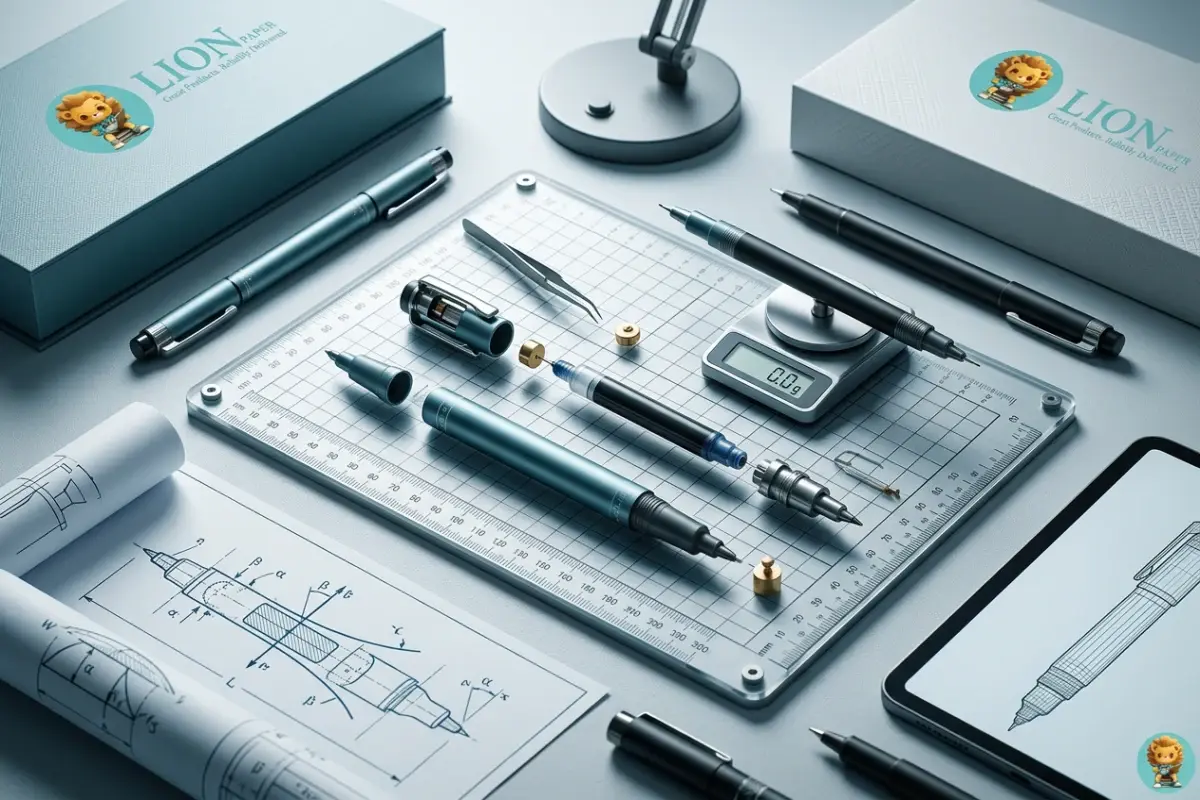
Capped Marker Balance: Engineering Weight Distribution, Ergonomics, and Precision in Writing Instruments

Capped marker balance refers to the calibrated weight distribution and center of gravity across a marker body both uncapped and with the cap posted, ensuring ergonomic control, consistent line stability, and reduced hand fatigue during professional drawing and writing. In commercial stationery manufacturing, optimizing marker balance requires precise engineering of barrel wall thickness, cap clip mass, nib casing integration, and ink reservoir saturation shifts to deliver a natural, fatigue-free grip for artists, planners, and everyday writers.
What is Capped Marker Balance and Why Does Drawing Marker Center of Gravity Matter?
Capped marker balance is the physical equilibrium achieved between the front gripping section, the central barrel body, and the rear cap posting zone of a writing or illustration tool. When a user holds a fineliner or drawing marker, the tool acts as a first-class mechanical lever pivoting between the index finger, the thumb, and the purlicue—the anatomical web space between the base of the thumb and the index finger.
The drawing marker center of gravity directly dictates how much muscular effort is required to maintain the marker at standard writing and sketching angles, which typically range between 45 degrees and 65 degrees relative to the paper surface. When the operational center of gravity is positioned too far toward the rear, the marker creates a continuous negative rotational torque. This backward pull forces the flexor pollicis brevis and dorsal interossei muscles in the hand to exert a sustained pinching force on the grip zone. Over extended drawing, journaling, or technical drafting sessions, this strain leads to hand fatigue, muscle cramping, joint stiffness, and degraded line accuracy.
Conversely, a center of gravity biased excessively toward the writing tip forces the user to drag the marker nib across the paper substrate rather than guiding it smoothly. This excessive downward pressure causes uneven line widths, erratic ink laydown, skipping, and accelerated tip fraying on porous or synthetic felt nibs. An engineered capped marker balance places the operating center of gravity within a strict ergonomic window, usually measuring between 42% and 48% of the marker's total uncapped or posted length measured from the writing tip. This neutral equilibrium creates an effortless downward glide, allowing consistent ink laydown across fine-art paper, journal spreads, and planner pages.
Marker Operational State | Ideal Center of Gravity Location (from Tip) | Primary Ergonomic Impact | Risk of Misalignment |
|---|---|---|---|
:--- | :--- | :--- | :--- |
Uncapped Marker Body | 43% to 47% of total body length | Precise fingertip articulation and agile sketching control | Front-heavy fatigue or tip dragging on paper |
Posted Cap (Rear Fitted) | 45% to 49% of total assembled length | Counterbalanced stability for broad lines and lettering | Rear-heavy lever torque, cramping, and grip slip |
Dual-Tip Architecture | 48% to 50% (Symmetrical midpoint) | Seamless orientation flipping between fine and brush tips | Unbalanced inertia during rapid hand rotation |
How Do Barrel Geometry, Ink Reservoir Density, and Cap Posting Influence Marker Weight Distribution?
Achieving optimal marker weight distribution is an intricate engineering challenge because a marker is not a static solid object. It is a multi-material assembly comprising variable-density polymers, liquid ink formulations, porous fibrous reservoirs, and mechanical closure mechanisms. Every individual component alters the overall mass profile.
First, barrel geometry establishes the baseline balance. Cylindrical, triangular, and flattened oval barrels distribute material mass differently across their cross-sections. While round barrels provide uniform rotational inertia, ergonomic marker design often incorporates subtly tapered profiles or contoured grip sections. Tapering the rear barrel wall thickness from 1.2 mm down to 0.8 mm lightens the tail end, creating room to accommodate cap mass when posted without destabilizing the drawing marker center of gravity.
Second, the internal ink reservoir—composed of bonded polyester fibers, extruded cellulose acetate, or free-ink valve diaphragms—represents a significant portion of the marker's operational mass. A fully saturated reservoir can account for 20% to 35% of the total marker weight. As ink is consumed during the product's lifespan, the internal fluid dynamic shifts. High-precision fineliner product development accounts for this mass depletion by centering the reservoir cavity directly over the primary grip pivot point, ensuring the tool feels equally balanced on its first stroke as it does on its ten-thousandth.
Third, cap posting mechanics represent the most critical variable in user satisfaction. Many consumers post the cap onto the rear barrel while working to prevent loss. If the cap incorporates a heavy spring-loaded metal clip or thick interior sealing liners, posting adds significant rearward mass. Advanced marker engineering utilizes weight-optimized cap architectures:
Segmented Wall Thickness: Caps engineered with thicker plastic near the rim and ultra-thin walls near the crown prevent extreme top-heavy swing weights.
Deep-Set Posting Channels: The rear barrel is stepped or recessed to allow the cap to seat deeply over the barrel, shifting cap mass closer to the hand's purlicue pivot point rather than extending outward.
Friction-Lock Air Vents: Vented safety caps require interior ribbing that must be balanced with structural voids to minimize dead polymer weight.

Precision measurement of the drawing marker center of gravity ensures the balance point remains within the optimal ergonomic window.
What Material Choices and Component Engineering Optimize Ergonomic Marker Design?
Ergonomic marker design relies on precise polymer selection, metal alloy placement, and structural co-molding to maintain tactile comfort, structural rigidity, and balance without unnecessarily increasing unit production costs. Product developers must balance multiple functional materials within tight dimensional envelopes.
Polypropylene (PP) and high-density polyethylene (HDPE) serve as the industry standard for marker barrels and caps due to their superior vapor barrier properties, preventing solvent and water-based ink dry-out over shelf lives spanning 24 to 36 months. However, PP has a low specific gravity (approximately 0.90 to 0.92 g/cm³), which can result in an ultra-light body that feels hollow or unstable in hand. To counteract this without introducing unneeded bulk, engineers integrate co-molded thermoplastic elastomers (TPE) or strategically weighted internal components.
Co-Molded TPE Grips: Applying a 0.5 mm to 1.0 mm soft-touch elastomer over the gripping zone provides anti-slip tactile traction, dampens writing vibrations, and adds calculated front-end mass to anchor the writing tip against the paper.
Metal Ferrules and Nib Sleeves: In precision fineliners, stainless steel or brass guide pipes house the delicate micro-porous or polyacetal nib. This localized metallic mass provides precise tip tracking and subtly draws the center of gravity forward into the optimal grip zone.
Clip Material Calibration: When stainless steel, spring steel, or zinc alloy clips are specified for premium aesthetics, their mechanical profile is skeletonized or tapered to maintain aesthetic appeal while avoiding rearward gravitational drag.
Component | Common Materials | Density Range (g/cm³) | Specific Function in Capped Marker Balance |
|---|---|---|---|
:--- | :--- | :--- | :--- |
Outer Barrel | Polypropylene (PP), ABS, Recycled PCR-PP | 0.91 – 1.08 | Establishes main structural span and lightweight housing |
Grip Sleeve | Thermoplastic Elastomer (TPE), Rubberized Resin | 1.05 – 1.25 | Enhances grip friction and centers mass at the lower third |
Nib Sleeve / Guide | Stainless Steel (SUS304), Brass, Polyacetal (POM) | 1.41 – 8.00 | Protects micro-nibs and shifts balance forward for line accuracy |
Cap Body | Polypropylene (PP), Polycarbonate (PC) | 0.92 – 1.20 | Ensures airtight seal while minimizing cantilever posting weight |
Cap Clip | Sheet Steel, Tempered Aluminum, PP Resin | 0.92 – 7.85 | Secures marker to planners; requires mass optimization |
What are the Key Cost Drivers in Fineliner Product Development and Marker Mass Production?
Balancing fine tolerances, ergonomic balance, and commercial viability requires a detailed understanding of the primary cost drivers involved in fineliner product development. Stationery brands and private-label retailers must balance manufacturing precision with retail price points.
Tooling and mold complexity represent the primary upfront capital investment. Standard single-shot injection molds for basic markers are relatively economical; however, high-precision balanced fineliners frequently require multi-cavity dual-injection (2K) molds to bond TPE grip zones directly to PP substrate barrels. Additionally, core-pin alignment for long, thin fineliner barrels requires tight machining tolerances (within ±0.01 mm) to prevent wall thickness eccentricity, which would skew rotational balance and cause irregular ink flow.
Ink delivery systems and automated assembly represent the secondary cost tier. Dual-tip markers featuring both flexible brush tips and metal-clad fineliner nibs require dual-chamber or synchronized split-reservoir wicks. Assembly machinery must automatically insert wicks, inject precise ink volumes via gravimetric dispensers (within ±0.05 g accuracy), insert nib sub-assemblies, and ultrasonic-weld or snap-fit end plugs without damaging delicate tips.
To balance these cost variables, brands partner with integrated supply chains capable of managing both development agility and high-volume efficiencies. By engineering common internal barrel diameters across broad product lines, stationery brands can utilize standardized internal wicks and automated filling lines while altering external finishes, clip designs, and soft-touch textures to address distinct consumer segments.

Cross-sectional engineering balances the fluid reservoir, barrel wall thickness, and posted cap mass for effortless writing control.
How Do Design Engineers Test, Prototype, and Verify Capped Marker Balance Tolerances?
Prototyping and verifying capped marker balance requires a blend of digital simulation, physical weight testing, and functional ergonomic benchmarking before mass production tooling is commissioned.
During the initial design phase, Computer-Aided Design (CAD) software with volumetric mass-property analysis calculates theoretical centers of gravity across three operational states: completely uncapped, capped for storage, and posted for use. Engineers simulate fluid mass depletion to ensure that as ink transitions from 100% capacity down to 10%, the migration of the balance point does not exceed 1.5 mm along the longitudinal axis.
Once digital verification is complete, rapid physical prototyping begins through a structured verification sequence:
CAD Volumetric Simulation: Calculating exact component volumes, material density mappings, and center of gravity coordinates across all operational states.
Density-Matched 3D Sampling: Using high-resolution Stereolithography (SLA) and PolyJet 3D printing with photopolymers calibrated to match the specific gravity of PP and TPE resins, accompanied by weighted dummy reservoirs.
Knife-Edge Fulcrum Testing: Balancing physical prototypes on precision knife-edge fixtures to measure the actual center of gravity in millimeters from the nib tip, cross-referencing findings against CAD models.
Dynamic Swing Rig Testing: Suspending markers on torsional balance pendulums to calculate dynamic swing weight (moment of inertia) during fast, rhythmic hatching and writing motions.
Ergonomic Pressure and Angle Mapping: Deploying human sensory panels equipped with finger-pressure mapping sensors to execute standard writing protocols on 80–160 gsm papers, capturing grip fatigue, joint strain, and line consistency data.
Tooling and Core-Pin Optimization: Refining injection mold parameters, gate locations, and wall thickness gradients based on empirical test data prior to steel cutting.
These rigorous verification steps ensure that production tooling yields markers that feel intuitive, comfortable, and responsive across varied handwriting and illustration styles.
What Quality Assurance Standards Ensure Batch Consistency Across Capped Marker Retail Programs?
Maintaining strict capped marker balance and structural integrity across millions of units requires standardized manufacturing standard operating procedures (SOPs) and rigorous quality assurance (QA) frameworks.
Dimensional consistency is the foundation of balance. If injection molding cooling cycles vary, plastic barrels can suffer from sink marks, ovality, or uneven wall thicknesses. Automated vision systems on production lines measure outer barrel concentricity and clip alignment at high speeds. Meanwhile, statistical process control (SPC) tracks part weights out of multi-cavity molds, maintaining component mass variances within a tight ±0.08 g threshold.
Standardized AQL (Acceptable Quality Limit) sampling plans, typically inspected to Level II Major 1.5 and Minor 2.5 defect standards, govern mass production batches before export. Key QA testing protocols for balanced writing instruments include:
Cap Snap-Force and Retention Testing: Mechanical load cells measure the force required to cap, uncap, and post the marker cap (typically targeted at 8 N to 15 N). This guarantees that the cap seats securely in the posted position without wobbling, shifting balance, or cracking the barrel rim over repeated cycles.
Centrifuge Ink Retention & Leak Testing: Markers undergo centrifugal spin testing and vacuum chamber depressurization to verify that internal air-expansion baffles prevent leakage under airborne transport conditions.
Drop and Impact Resilience: Capped and uncapped markers are dropped from 1.2 meters onto hardwood and concrete surfaces to confirm that internal reservoirs and nib assemblies remain locked in their calibrated CoG positions without shifting.
Full Regulatory Compliance: Materials, masterbatch colorants, and inks are screened to comply with global safety standards, including CPSIA, ASTM D-4236, EN 71-3, and REACH regulations, ensuring safety for retail distribution.

Lion Paper integrates balanced writing instruments with custom journals and planners for cohesive retail and private-label programs.
How Can Brands Integrate Balanced Markers and Fineliners into Custom Stationery Collections with Lion Paper?
Creating successful retail stationery lines requires more than standalone pen development; it demands seamless integration between writing instruments, specialty notebooks, planners, and lifestyle organizer accessories. Lion Paper Products (Jiaxing) Co., Ltd. serves as an integrated supply-chain partner for customized paper goods and creative products, transforming concepts into scalable retail lines.
Founded in 2015 and headquartered in Jiaxing, Zhejiang, Lion Paper operates a dual-site manufacturing network that combines design, development, scale manufacturing, and global delivery. The 3,000-square-meter Jiaxing facility specializes in product planning, structural engineering, rapid prototyping, and customer support. For volume production, Lion Paper's 10,000-square-meter Cambodia manufacturing base delivers automated manufacturing, competitive landed costs, and stable global delivery.
Through this integrated platform, stationery and lifestyle brands can co-develop cohesive product ecosystems where capped marker balance is tuned to interact smoothly with custom paper substrates. Lion Paper bridges the gap across eight primary product categories, including Eco Paper Products, Notebooks & Journals, Planners & Calendars, Stationery & Office, Bags & Organizers, Accessories, Gift & Packaging, and Home & Living.
When developing a complete journal and marker gift set or retail pack, Lion Paper's design-to-manufacturing integration ensures that the marker's ergonomic weight distribution, clip profile, and ink formulation match the notebook's elastic pen loop, binding structure, and paper thickness (such as 100–160 gsm FSC-certified bleed-resistant papers). Automated lines, standardized SOPs, and comprehensive compliance auditing—supported by ISO 9001, FSC, SMETA, WCA, GSV, FAMA, and CPSIA capabilities—enable Lion Paper to produce over 5 million notebooks annually alongside matched accessories.
From North American and European retail chains to DTC brands and creator-led platforms, Lion Paper delivers end-to-end supply chain execution. By aligning rapid sampling in Jiaxing with high-efficiency Cambodia manufacturing, brands can balance design fidelity, ergonomic precision, compliance standards, and commercial profitability.
FAQ
Why does a marker feel heavier or more fatiguing when the cap is posted on the back?
When a marker cap is posted, its mass is positioned at the extreme end of the barrel, lengthening the lever arm relative to your hand's grip pivot point. If the cap has a heavy clip or thick internal retention plastic, this creates a backward gravitational pull (rotational torque). To counteract this torque, your hand muscles must exert continuous pinch force, leading to muscle strain during long writing sessions.
What is the ideal weight for an everyday ergonomic writing fineliner?
Most high-performance ergonomic fineliners and detail markers weigh between 8.0 grams and 14.0 grams when fully inked. This weight provides enough substance for stable hand tracking and tactile feedback without causing fatigue. Ultra-light pens (under 6 grams) can feel skittish and lack control, while heavy writing markers (over 20 grams) require significant finger grip exertion unless specifically counterbalanced for slow calligraphy.
How does ink depletion affect drawing marker center of gravity over time?
Liquid or wick-based ink accounts for up to a third of a marker's total body weight. As ink is used up, the overall tool becomes lighter. If the reservoir is positioned too far toward the rear or front of the barrel, ink depletion shifts the center of gravity along the body. High-quality fineliner product development centers the ink chamber directly over the grip pivot point so the balance remains stable throughout the product's lifespan.
What is the difference between static balance and dynamic swing weight in markers?
Static balance refers to the stationary center of gravity when the marker is resting horizontally on a fulcrum or in the hand. Dynamic swing weight (moment of inertia) measures the resistance felt when moving the marker back and forth during fast sketching, shading, or handwriting. Dynamic swing weight is influenced heavily by mass located at the extreme ends (the cap crown and nib tip).


Comments