


Brush Pen Taper Geometry: Engineering Specifications, Flex Dynamics, and Manufacturing Standards

Brush pen taper geometry defines the angle, core taper ratio, and tip radius of an elastic nib, directly determining flex recovery, stroke transitions, and capillary ink delivery across lettering and art applications. Precise dimensional engineering balances lateral deflection with longitudinal stiffness, preventing fiber splitting while enabling smooth hairline-to-broad dynamic transitions on varied paper surfaces.
What Is Brush Pen Taper Geometry and How Does It Control Flex Dynamics?
Brush pen taper geometry refers to the progressive reduction in cross-sectional diameter from the nib base (shank) to the microscopic apex (tip radius). This geometric gradient dictates the mathematical moment of inertia along the nib shaft, governing how the structure bends under lateral user pressure and snaps back to its original axis once released.
In flexible marker tip engineering, the dynamic flex response relies on continuous beam mechanics. As a calligrapher applies downward and lateral force during downstrokes, the taper angle determines whether the bending occurs locally at the apex or distributes evenly across the mid-section. A steep taper angle concentrates stress near the tip, producing snappy, responsive hairlines ideal for small-scale modern calligraphy. Conversely, a gradual taper angle distributes deflection across a longer cantilever beam, enabling wide, expressive swell lines suitable for large brush lettering.
Key geometric dimensions include:
Base Shank Diameter (Db): Typically 2.0 mm to 4.5 mm, anchoring the nib inside the feed housing and establishing baseline rigidity.
Active Flex Length (La): The unsupported exposed length (typically 5.0 mm to 12.0 mm) that acts as the working cantilever beam.
Apex Tip Radius (Rt): Precision micro-radii between 0.05 mm and 0.25 mm that dictate minimum line width and paper surface snag resistance.
Core Taper Ratio (Tr): Calculated as (Db - 2Rt) / La, expressing the rate of dimensional reduction per millimeter of nib length.
When taper geometry is miscalculated, nibs suffer from flex fatigue, permanent set (plastic deformation), or tip bifurcations that ruin precision lettering.
What Are the Key Brush Pen Nib Specifications and Core Dimensional Ratios?
Setting rigorous brush pen nib specifications is critical for consistent production quality across multi-cavity injection tooling and sintering lines. Calligraphy markers utilize three primary tip architectures: molded elastomeric tips (thermoplastic polyurethane/polyolefin elastomer), sintered porous plastic tips (polyoxymethylene/POM or high-density polyethylene/HDPE), and individual synthetic fiber bundles (extruded PBT nylon fibers).
Specification Parameter | Small Lettering Tip (Hard Flex) | Medium Lettering Tip (Medium Flex) | Artistic Brush Tip (Full Flex) |
|---|---|---|---|
:--- | :--- | :--- | :--- |
Base Shank Diameter (Db) | 2.20 mm ± 0.05 mm | 3.00 mm ± 0.05 mm | 4.20 mm ± 0.08 mm |
Tip Apex Radius (Rt) | 0.08 mm ± 0.02 mm | 0.12 mm ± 0.02 mm | 0.20 mm ± 0.03 mm |
Active Exposed Length (La) | 5.50 mm ± 0.20 mm | 8.20 mm ± 0.25 mm | 11.50 mm ± 0.30 mm |
Included Taper Angle (θ) | 18° to 22° | 12° to 16° | 8° to 11° |
Material Hardness (Shore D) | 65D – 75D | 50D – 60D | 35D – 45D (or filament bundle) |
Average Void Ratio (Porosity) | 28% – 34% | 35% – 42% | 40% – 50% |
Max Line Width Variation | 0.3 mm to 1.8 mm | 0.5 mm to 3.5 mm | 0.8 mm to 6.0 mm |
Flex Recovery Rate | > 98% within 0.15s | > 95% within 0.25s | > 92% within 0.40s |
For sintered porous materials, internal pore geometry must mirror external taper geometry. As the nib narrows toward the tip, pore size distribution must remain uniform (typically 15 to 30 microns) to prevent capillary starvation during high-speed downstrokes.

Optical comparison highlighting pore distribution and apex radius differences in flexible marker tip engineering.
How Does Brush Lettering Nib Design Interact with Paper Sizing and Ink Rheology?
Brush lettering nib design cannot be evaluated in isolation from the fluid mechanics of ink and the microscopic topology of paper substrates. Capillary flow inside a brush pen relies on a negative pressure gradient: the reservoir holds ink at low capillary tension, the feeder bridge increases capillary pull, and the nib tip creates the highest capillary force to draw ink onto paper fibers.
When the taper geometry narrows, cross-sectional fluid pathways decrease by the square of the radius. To maintain consistent optical density without ink starvation, nib engineers balance fluid viscosity against the capillary radius of the nib pores. Water-based dye inks (viscosity 1.2 to 2.5 mPa·s) flow readily through narrow taper profiles, whereas high-pigment or metallic acrylic formulations (viscosity 3.5 to 7.0 mPa·s) require wider core channels and lower taper angles to prevent particle agglomeration at the apex.
Paper interaction introduces physical shear and chemical absorption variables:
Smooth Coated Surfaces (e.g., 100–120 gsm woodfree paper with surface sizing): Low-friction coatings preserve sharp nib apex geometry, preventing micro-abrasion while allowing clean, crisp snapback on rapid upstrokes.
Uncoated and High-Tooth Papers (e.g., recycled sketch paper, heavy mixed media): High surface roughness creates micro-abrasive wear on elastomeric tips. Sintered POM and composite nylon tips with reinforced taper shoulders resist friction-induced fraying.
Absorbency and Sizing Buffers: Highly absorbent papers pull ink faster than narrow-taper capillary networks can replenish it, causing dry-brush artifacts. Sizing agents applied during papermaking moderate this capillary draw, balancing ink release with nib recovery.
What Tooling and Material Factors Drive Calligraphy Marker Manufacturing?
Precision calligraphy marker manufacturing demands extreme dimensional stability during tool design, injection cycles, and chemical cross-linking. The selection of base polymers and manufacturing processes directly influences unit economics, elastic recovery, and batch-to-batch repeatability.
Manufacturing processes fall into three primary disciplines:
Precision Micro-Injection Molding: Used for elastomeric tips (TPU, TPE, and fluoroelastomers). Tooling cores require mirror-polished electrical discharge machining (EDM) to achieve sub-micron surface finishes. Tool cavity shrinkage must be calculated precisely, as even a 0.5% variance shifts the apex radius out of tolerance, altering flex stiffness.
Sintered Polymer Processing: Spherical or irregularly shaped polymer powders (POM, UHMWPE) are compacted in precision multi-cavity dies and heated below melting temperature. The taper profile in the die must account for heat expansion and directional density gradients, ensuring porosity remains open and uniform down to the apex.
Filament Bundling and Resin Setting: Individual nylon or PBT monofilaments (ranging from 0.05 mm to 0.12 mm in diameter) are gathered, tensioned, thermally set, and ground to a conical profile. Taper geometry in bristle tips is shaped through multi-axis CNC abrasive wheels, creating a natural hair-like stepped taper.
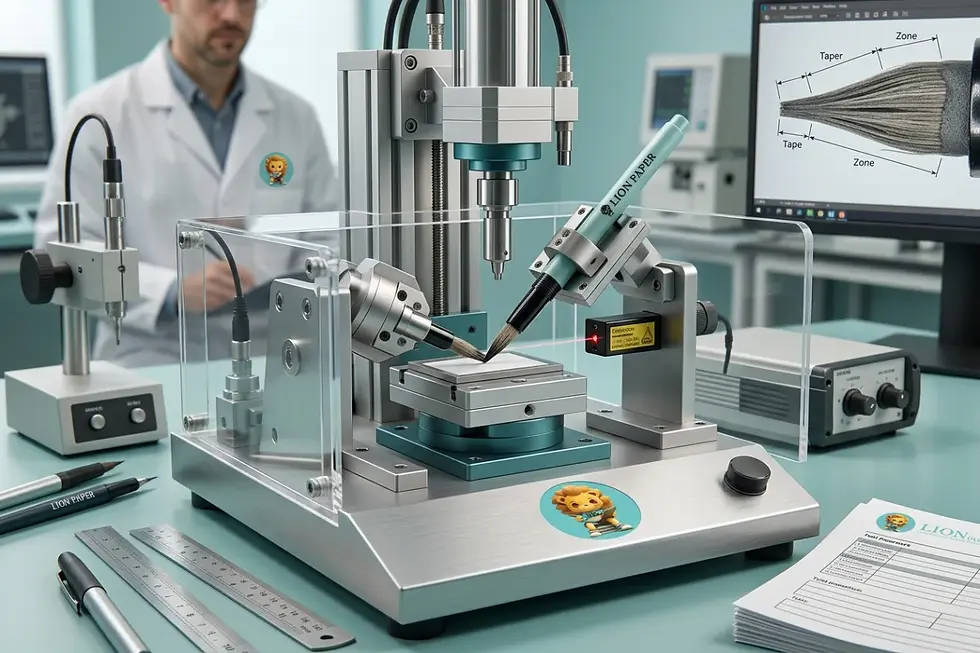
Automated mechanical cycle testing ensures fatigue resistance and elastic recovery across calligraphy marker manufacturing runs.
Tooling wear is a primary cost and quality driver. Sintered abrasives and abrasive pigment colorants gradually erode mold cavities, widening taper angles over production runs. Implementing automated optical inspection (AOI) with telecentric lens profiling allows production teams to monitor dimensional shift across multi-million-unit mass manufacturing runs.
What Quality Control Benchmarks Ensure Fatigue Resistance and Stroke Consistency?
To ensure commercial reliability, pen tips undergo standardized stress and fluid-delivery tests. Brush pen tips endure tens of thousands of dynamic bending cycles during their operational life. Quality assurance programs benchmark three performance criteria: flex fatigue recovery, tip split resistance, and continuous capillary flow rate.
Dynamic Flex Cycling (Hysteresis Test): The pen is mounted in a pneumatic test fixture at a 45-degree angle. It is compressed under 1.5 N to 3.0 N of force at 2.0 Hz for 5,000 to 10,000 cycles. Residual deflection (permanent bend) must not exceed 2.0% of active length, and tip split separation must be zero.
Apex Micro-Wear Inspection (AQL 0.65 Level II): Microscopic projection at 50x magnification checks tip radius roundness and verifies the absence of flash, burrs, or void agglomerations along the taper seam.
Capillary Draw-Down and Flow Rate: Automated writing machines draw continuous spiral tracks at controlled speeds (100 mm/s to 200 mm/s) on standard reference paper to measure optical density, line-width consistency, and the onset of ink starvation.
Cap-Off Drying Resistance: Taper geometry impacts the surface area exposed to ambient air. Quality protocols test cap-off exposure at 23°C and 50% relative humidity, ensuring the pen restarts immediately without hard starts after 30 to 120 minutes uncapped.
Standard operating procedures (SOPs), defect visual catalogues, and statistical process controls (SPC) maintain dimensional consistency across both pilot development batches and high-volume export runs.
How Can Brands Integrate Precision Brush Pens into Journaling and Lettering Sets?
Creating successful brush lettering sets, planner kits, and creative stationery collections requires tight coordination between pen engineering, paper substrate compatibility, and retail packaging design. A mismatch between brush pen tip flex and notebook paper sizing results in feathering, bleeding, or premature tip wear that frustrates end consumers.

Integrated stationery set development aligning calibrated brush pen nib geometry with matching premium paper substrates.
Stationery brands and creative retail product managers optimize custom programs by addressing key integration factors:
Substrate Calibration: Pairing small-taper, hard-flex pens with ultra-smooth 100 gsm to 120 gsm woodfree journal paper for intricate bullet journaling, while pairing medium-to-large flexible brush markers with heavier 160 gsm bamboo or mixed-media art papers.
Coordinated Color Palettes and Multi-Tip Configurations: Bundling dual-tip markers (combining a fine bullet nib with a flexible brush taper) allows creators to switch between structured journaling and decorative lettering using a single ink reservoir.
Packaging and Orientation Stability: Brush pens with fluid ink feeds require horizontal or tip-down retail packaging to prevent air locks in the capillary feed during transport and shelf display.
Lion Paper Products (Jiaxing) Co., Ltd., founded in 2015, acts as an integrated supply chain partner bridging creative concept design with large-scale production. Utilizing its 3,000-square-meter Jiaxing facility for rapid prototyping, design development, and stationery testing, combined with its 10,000-square-meter Cambodia manufacturing base for cost-efficient mass production, Lion Paper supports global brands across North America, Europe, Australia, the Middle East, and Southeast Asia. With certifications including ISO 9001, FSC, SMETA, WCA, GSV, FAMA, and CPSIA compliance capabilities, Lion Paper delivers comprehensive stationery programs—from custom engineered brush lettering kits to integrated notebooks, planners, and gift sets.
FAQ
What is the difference between a sintered POM brush nib and an elastomeric TPU brush nib?
Sintered polyoxymethylene (POM) nibs feature interconnected micro-porous channels that deliver consistent capillary ink flow with high abrasion resistance, making them ideal for fine, crisp lettering on toothy paper. Elastomeric thermoplastic polyurethane (TPU) nibs are solid, rubber-like molded tips that rely on external surface wetting and material elasticity for smooth, dynamic flex, offering superior bounce-back for expressive strokes.
How does nib taper angle affect line variation in brush lettering?
A steep taper angle (18° to 22°) concentrates lateral bending force near the tip apex, creating small, controlled stroke transitions suitable for compact lettering and daily journaling. A gradual taper angle (8° to 12°) distributes deflection along a longer cantilever beam, enabling broad swell lines and dramatic contrast between hairlines and downstrokes.
Why do brush pen tips split or lose their sharp point over time?
Tip splitting or rounding is caused by flex fatigue, abrasive paper friction, or excessive pressure exceeding the polymer's elastic limit. Sintered tips split when internal porous bonds break under shear stress, while elastomeric tips experience plastic deformation or micro-tearing along injection knit lines when dynamic flex limits are surpassed.
What paper specifications work best with fine-taper brush pens?
Fine-taper brush pens perform best on smooth, surface-sized paper with a basis weight between 100 gsm and 160 gsm. Smooth calendered surfaces minimize micro-abrasive wear on delicate nib tips, while balanced surface sizing prevents capillary feathering and preserves razor-sharp hairline definition.


Comments